

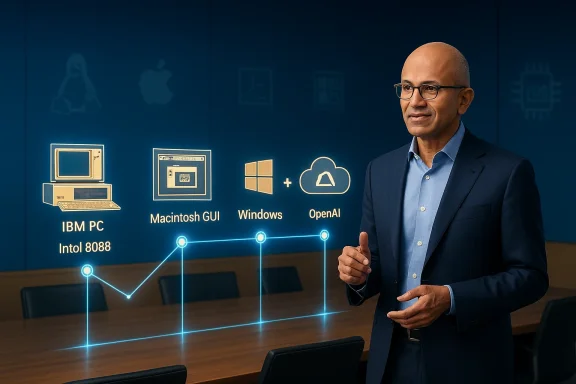
Satya Nadella’s offhand line — “without Intel, I don’t know if Windows would have happened… without Mac, I wonder whether Office would have happened” — landed as more than nostalgia; it was a deliberately economical framing of a new Microsoft posture: openness as strategy, partnership as growth, and history as a justification for a non-zero-sum future. The remark came during a Morgan Stanley investor session and immediately prompted retrospectives on how hardware and UI pioneers helped shape two of Microsoft’s signature franchises: Windows and Office. The historical shorthand is defensible, but the strategic reading is the real story: Nadella used origin myths to explain why Microsoft today pursues broad ecosystems, deep AI bets, and complex partnerships rather than pure vertical control.
Satya Nadella made the comment in a wide-ranging investor conversation at a Morgan Stanley Technology, Media & Telecom forum in early March 2026, where the discussion ranged across Azure capacity, Microsoft 365 and Copilot adoption, compute economics for AI, and the company’s posture toward partnerships such as OpenAI and heterogeneous silicon suppliers. The line about Intel and Apple was part of a larger rhetorical push: to argue Microsoft can expand opportunity by “riding” other companies’ success while still defending the zero-sum battles it deems vital.
That context matters. Nadella’s remark was not a neutral history lesson — it was investor messaging designed to justify capital-intensive cloud investments, a hybrid relationship with OpenAI, and a long-term bet that Microsoft’s value will come from orchestration and integration more than exclusivity. As he framed it: find the “non-zero-sum” where Microsoft can add clear value to customers, and compete vigorously on the remaining zero-sum fronts.
That said, the claim is shorthand — not a claim that Intel alone “created Windows.” Microsoft’s engineering efforts, developer ecosystem, third-party ISVs, OEM relationships, and strategic licensing all mattered. The Intel family provided the common instruction set that made wide compatibility and developer focus rational; Microsoft supplied the software that developers and OEMs targeted. The Wintel label captures that joint ecosystem effect, but each element was necessary.
Again, this is a counterfactual framed as a strategic point: the Mac’s interface innovations nudged Microsoft toward richer GUI apps, and those lessons subsequently diffused to the Windows ecosystem. Nadella used the story as a rhetorical device to show that competitor success can catalyze your own innovation, not just crowd it out.
For Microsoft, this moment is both a warning and an opportunity. If Apple can make a $599 Mac feel like a premium, worry-free experience, marginal Windows buyers — especially first-time purchasers and education buyers — may choose macOS at the margin. Microsoft’s response should not be panic; it should be product-level leadership: better out-of-box experience, clearer device bundles, improved manageability, and optional, privacy-respecting AI features that protect enterprise and consumer trust.
The next few years will tell whether Nadella’s history lesson becomes an operating manual or graceful nostalgia. If Microsoft can convert scale into margin dollars, embed trustworthy intelligence into Office, maintain Windows as the premier productivity environment, and orchestrate heterogeneous silicon effectively, Nadella’s “ride it” doctrine will look prescient. If instead Microsoft becomes a commoditized integrator squeezed between hardware suppliers, open-source models, and regulatory constraints, the rhetoric will have outpaced the reality.
Source: Windows Central Microsoft's CEO Satya Nadella praises Intel and Apple for its huge success
 Background
Satya Nadella made the comment in a wide-ranging investor conversation at a Morgan Stanley Technology, Media & Telecom forum in early March 2026, where the discussion ranged across Azure capacity, Microsoft 365 and Copilot adoption, compute economics for AI, and the company’s posture toward partnerships such as OpenAI and heterogeneous silicon suppliers. The line about Intel and Apple was part of a larger rhetorical push: to argue Microsoft can expand opportunity by “riding” other companies’ success while still defending the zero-sum battles it deems vital.That context matters. Nadella’s remark was not a neutral history lesson — it was investor messaging designed to justify capital-intensive cloud investments, a hybrid relationship with OpenAI, and a long-term bet that Microsoft’s value will come from orchestration and integration more than exclusivity. As he framed it: find the “non-zero-sum” where Microsoft can add clear value to customers, and compete vigorously on the remaining zero-sum fronts.
The historical claim — how accurate is it?
Intel and the Wintel story
The shorthand that Windows succeeded because of Intel has a solid factual anchor: IBM’s original Personal Computer (the IBM PC, August 1981) used Intel’s 8088 microprocessor, and Microsoft supplied the operating system (PC DOS/MS‑DOS) that ran on that hardware. The emergence of x86 hardware in IBM machines and a growing OEM ecosystem of IBM-compatible PCs created a coherent platform where Microsoft’s software could scale. In other words, Intel’s chip families were an important hardware substrate that helped the PC market cohere, which in turn made Microsoft’s software business viable at scale. That is the historical backdrop Nadella invoked.That said, the claim is shorthand — not a claim that Intel alone “created Windows.” Microsoft’s engineering efforts, developer ecosystem, third-party ISVs, OEM relationships, and strategic licensing all mattered. The Intel family provided the common instruction set that made wide compatibility and developer focus rational; Microsoft supplied the software that developers and OEMs targeted. The Wintel label captures that joint ecosystem effect, but each element was necessary.
Apple and the “Mac-first” Office story
Nadella’s second counterfactual — that Office may not have happened without the Macintosh — is more interpretive but historically plausible. Microsoft shipped early GUI versions of its productivity software with a clear Mac-first bias: Excel 1.0 debuted on the Macintosh in 1985, and early mouse-driven, graphical Microsoft Word implementations reached the Mac before Windows achieved GUI parity. The Macintosh’s early GUI and integrated UI paradigms gave developers a fertile platform to build and showcase GUI-focused productivity apps. Microsoft’s GUI-forward experiments on Mac shaped the future Office user experience long before Windows became the dominant GUI environment.Again, this is a counterfactual framed as a strategic point: the Mac’s interface innovations nudged Microsoft toward richer GUI apps, and those lessons subsequently diffused to the Windows ecosystem. Nadella used the story as a rhetorical device to show that competitor success can catalyze your own innovation, not just crowd it out.
Why Nadella used origin stories — beyond nostalgia
Leaders often use origin stories to signal humility, legitimacy, and intent. Nadella did three things with his brief history lesson:- He de-emphasized winner-take-all rhetoric. By saying others’ successes created markets that Microsoft could ride, he positioned Microsoft as a participant in an ecosystem rather than a monopolist clinging to exclusivity.
- He justified strategic openness. The same logic underpins Microsoft’s “Linux-first” push on Azure, its investments in and partnership with OpenAI, and its efforts to make Microsoft tools first-class across platforms. Openness is framed as distribution and leverage rather than capitulation.
- He tied history to capital allocation. The message reassures investors that the company’s heavy spending on datacenter capacity, heterogeneous silicon support, and AI infrastructure is coherent — Microsoft is building orchestration and integration layers that thrive in a multi-vendor world.
What Nadella’s framing implies for Windows, Office, and Azure
Windows — defend the desktop through experience, not lock-in
The long-term play for Windows is less about absolute control of endpoints and more about ensuring the platform remains the best place for deep work, gaming, and professional apps. As alternative OS momentum grows (Mac hardware gains price competitiveness and Linux desktop improvements continue), Windows must lean into distinct experiences — compatibility, management, and the ecosystem of Windows-native tooling — rather than relying purely on install base inertia. Nadella’s non-zero-sum posture suggests Microsoft will avoid heavy-handed exclusivity and instead make Windows an indispensable productivity environment through feature differentiation, AI integrations, and better UX.Office and Microsoft 365 — intelligence and integration win
Office’s future is about embedding trustworthy, secure intelligence into workflows. Copilot and AI services aim to make Microsoft 365 the value layer on top of diverse OSes and devices. Microsoft’s advantage is deep enterprise integration — Active Directory, endpoint management, compliance, and one-click access to enterprise data — and the real battleground is who delivers the most useful, least risky intelligent features for knowledge work. Nadella’s Mac anecdote reminds us that Office’s cross-platform reach is a strength, and Microsoft will continue to monetize that ubiquity while evolving the product with AI.Azure — orchestration across heterogeneous silicon
Perhaps the most consequential practical implication is cloud architecture: Microsoft intends Azure to be the orchestration layer among multiple silicon suppliers, model providers, and application stacks. That requires heavy investment in scheduling, utilization, and system software that optimizes total cost of ownership across different chips and data centers. It’s a defensible strategy — if Microsoft can convert capital expenditure into durable margin dollars and convince customers that its orchestration yields superior price/performance and integration benefits.The strengths of a “ride others’ success” strategy
- Expanded relevance: Supporting Linux, macOS, and other environments keeps Microsoft relevant across enterprise stacks rather than boxed into Windows-only scenarios.
- Risk diversification: Multi-platform presence reduces single-point risk in a rapidly shifting market.
- Leverage of installed base: Microsoft’s control of identity, productivity, and developer tools makes it a valuable integration layer even on competitor hardware.
- Compute scale advantage: Massive datacenter investments and optimized model-serving pipelines can create asymmetries if Microsoft achieves superior TCO and integration benefits.
The risks — real, material, and cross-cutting
Nadella’s non-zero-sum posture is astute, but it comes with concrete risks that demand attention:- Regulatory and antitrust scrutiny: Deep partnerships and privileged access to models or compute resources can look like preferential deals. Microsoft’s hybrid role with OpenAI — investor, partner, infrastructure provider — invites scrutiny and potential regulatory examination.
- Capital intensity and allocation risk: Heavy spending on datacenters, specialized chips, and model-serving infrastructure creates exposure to materials constraints and long lead times. Mistakes in capacity allocation can hurt margins for years.
- Reputational and privacy friction: Aggressive AI integration in Windows and Office (Copilot, telemetry, recall) increases perception risks. Users and regulators react strongly to perceived invasions of privacy; trust is fragile.
- Strategic dilution and commoditization: If Microsoft becomes primarily an integrator across commoditized layers (compute, models, edge), product distinctiveness could erode and margin power evaporate. Competitors or commodity suppliers might undercut TCO advantages.
- Competitive disintermediation: Open-source models and third‑party stacks could erode Microsoft’s role if competitors deliver better cost or performance in model serving or silicon partnerships. Microsoft must convert scale into real customer economic advantages.
The Apple angle: MacBook Neo, Office cameo, and competitive optics
Apple’s recent marketing around the $599 MacBook Neo and the choice to display Microsoft Office in demos is a small but revealing moment in platform competition. Apple’s move to show Office in its Neo promotional material signals pragmatism: Apple recognizes many buyers expect Office to work well on day one, particularly in education and price-sensitive consumer segments. That compatibility reassurance helps ease migration friction and acknowledges Office’s persistence as the productivity standard for many users. Nadella’s Office-as-a-product-of-Mac anecdote reads differently in this light: Apple’s marketing admits Office’s ubiquity even as Cupertino tries to win hearts with hardware and on-device AI.For Microsoft, this moment is both a warning and an opportunity. If Apple can make a $599 Mac feel like a premium, worry-free experience, marginal Windows buyers — especially first-time purchasers and education buyers — may choose macOS at the margin. Microsoft’s response should not be panic; it should be product-level leadership: better out-of-box experience, clearer device bundles, improved manageability, and optional, privacy-respecting AI features that protect enterprise and consumer trust.
Tactical implications — what Microsoft should do now
Microsoft’s current posture requires parallel workstreams: accelerate execution on Azure efficiency, make AI features trustworthy and optional, and sharpen Windows and Office product differentiation. Concretely:- Prioritize transparency and control in AI features. Make Copilot and telemetry configurable, auditable, and clearly bounded by privacy and retention policies. This reduces reputational risk.
- Convert capital into margin dollars. Optimize datacenter utilization, commit to transparent ROIC targets for AI infrastructure, and publish measurable progress on TCO improvements for customers.
- Double down on cross-platform developer tooling. If Microsoft is serious about being the value layer across heterogeneous environments, make it trivially easy to integrate Azure services with Linux, macOS, and mobile stacks.
- Elevate manageability and provisioning for OEMs. Improve out-of-box experiences, reduce preinstalled bloat, and offer better bundles to counter Apple’s perceived quality advantage.
- Protect core differentiators. Preserve and enhance Windows-only experiences where they matter — gaming, pro workflows, and device management — to avoid being relegated to a commodity layer.
Practical recommendations for IT leaders and Windows users
- Reassess vendor risk and portability. Design for interoperability and ensure contracts address data portability, model access, and retention.
- Audit AI dependencies. Catalog where Copilot, Azure OpenAI, or hosted models touch sensitive data and set governance rules.
- Plan for multi-OS scenarios. With macOS and Linux momentum in certain segments, test cross-platform application compatibility and deployment strategies.
- Negotiate cloud capacity terms. Expect lumpy demand and price dynamics for AI workloads; insist on clarity about allocation policies and dynamic pricing triggers.
- Emphasize user education. When rolling out AI features, prepare user training and clear opt-in/opt-out mechanisms to preserve trust.
A balanced verdict — history as strategy, not prophecy
Nadella’s Intel/Mac riff is a neat rhetorical pivot: historical humility used as strategic cover. The facts he referenced are defensible — Intel’s role in the early IBM PC ecosystem and the Macintosh’s influence on GUI productivity apps are both well-documented — and the interpretation that Microsoft can ride other companies’ successes is a persuasive modern strategy. But it is not risk-free. Execution matters: openness without economic intent dilutes value; partnerships without transparency invite regulatory and reputational consequences; heavy capital investment without demonstrable ROIC invites investor concern.The next few years will tell whether Nadella’s history lesson becomes an operating manual or graceful nostalgia. If Microsoft can convert scale into margin dollars, embed trustworthy intelligence into Office, maintain Windows as the premier productivity environment, and orchestrate heterogeneous silicon effectively, Nadella’s “ride it” doctrine will look prescient. If instead Microsoft becomes a commoditized integrator squeezed between hardware suppliers, open-source models, and regulatory constraints, the rhetoric will have outpaced the reality.
Conclusion
Satya Nadella’s casual historical aside — crediting Intel and Apple for shaping Windows and Office — was more than a reflective quip. It was a compact strategic argument: platforms co-evolve; competitor innovation creates opportunity; and Microsoft intends to build the orchestration and integration layers that remain indispensable in a multi-vendor, AI-first world. The logic is sound and grounded in history, but the path from strategic framing to durable advantage depends on rigorous execution across cloud economics, privacy stewardship, product differentiation, and regulatory transparency. For enterprises and Windows users, that means re-evaluating vendor strategies, hardening AI governance, and insisting on options that preserve trust and portability. For Microsoft, the challenge is structural: convert openness into a unique, defensible customer value proposition — and do it while the market watches closely.Source: Windows Central Microsoft's CEO Satya Nadella praises Intel and Apple for its huge success
