

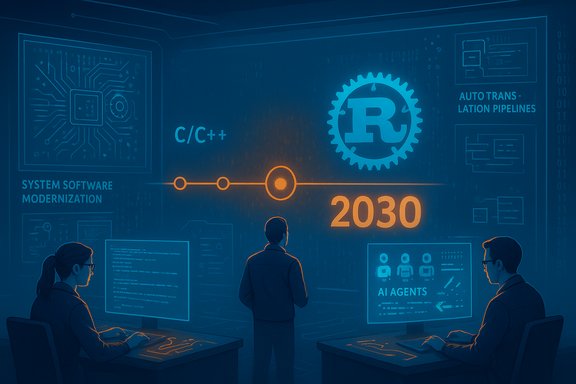
Microsoft’s latest engineering gambit is as audacious as it is literal: replace the company’s legacy C and C++ estate with Rust by 2030, using a blend of algorithmic tooling and AI to mass‑rewrite code at scale — a plan distilled into an evocative (if headline‑hungry) goal sometimes summarized as “one engineer, one month, one million lines.”
Microsoft’s move toward Rust is the outcome of a security‑driven engineering pivot that has been building for several years. The company’s public remarks and internal hiring activity make clear that the objective is not novelty but risk reduction: eliminating an entire class of memory‑safety vulnerabilities that have historically dominated Microsoft’s patch landscape. In a talk cited widely, a Microsoft Security Response Center engineer said that roughly 70 percent of Microsoft’s patches over a 12‑year window addressed memory‑safety issues — a statistic that helps explain the urgency behind the language shift. The Rust story inside big tech is corroborated by broader industry signals. Google funded a Rust–C++ interoperability initiative with a $1 million donation to the Rust Foundation to make mixed‑language migration and co‑existence smoother, acknowledging that wholesale rewrites are rarely practical without improved interop. At the same time, developer surveys show strong growth in Rust usage and commercial adoption: JetBrains’ developer research indicates millions of Rust users globally and substantial year‑over‑year enterprise uptake. Microsoft’s public experiments are already visible in Windows and Azure. Rust components have been introduced into Windows build pipelines and into kernel‑adjacent components in preview builds; that work has been accompanied by public conversations from senior engineers urging the wider industry to favor memory‑safe choices for new systems work.
Either way, the initiative will reshape demands on systems engineers, compilers teams, and security practitioners. Enterprises should watch Microsoft’s progress closely: the company’s timeline, test‑coverage metrics, and published security outcomes will be the clearest indicators of whether a 2030 Rust baseline is attainable — or whether the era of pragmatic, incremental memory‑safety improvements will continue to be the more realistic path.
Microsoft’s ambition to rewrite decades of systems code communicates a clear strategic choice: reduce exploitable memory‑safety surface now, and accept the engineering and ecosystem costs of that choice. The outcome will matter not only for Windows customers, but for the broader tooling, compiler, and security communities that must adapt to the practical realities of moving an entire platform toward memory safety.
Source: Techzine Global Microsoft sets 2030 target to replace C and C++ code with Rust
 Background
Microsoft’s move toward Rust is the outcome of a security‑driven engineering pivot that has been building for several years. The company’s public remarks and internal hiring activity make clear that the objective is not novelty but risk reduction: eliminating an entire class of memory‑safety vulnerabilities that have historically dominated Microsoft’s patch landscape. In a talk cited widely, a Microsoft Security Response Center engineer said that roughly 70 percent of Microsoft’s patches over a 12‑year window addressed memory‑safety issues — a statistic that helps explain the urgency behind the language shift. The Rust story inside big tech is corroborated by broader industry signals. Google funded a Rust–C++ interoperability initiative with a $1 million donation to the Rust Foundation to make mixed‑language migration and co‑existence smoother, acknowledging that wholesale rewrites are rarely practical without improved interop. At the same time, developer surveys show strong growth in Rust usage and commercial adoption: JetBrains’ developer research indicates millions of Rust users globally and substantial year‑over‑year enterprise uptake. Microsoft’s public experiments are already visible in Windows and Azure. Rust components have been introduced into Windows build pipelines and into kernel‑adjacent components in preview builds; that work has been accompanied by public conversations from senior engineers urging the wider industry to favor memory‑safe choices for new systems work. What Microsoft says it will do
The target and the toolkit
The plan being discussed publicly and in job postings combines three bold claims:- A corporate goal to eliminate legacy C/C++ code over a defined multi‑year window, with 2030 cited as a milestone year.
- A technical approach that layers algorithmic, compiler‑style analysis with AI agents to automate large parts of translation, refactoring, and verification at scale.
- A practical productivity motto (often repeated in coverage) framed as one engineer — one month — one million lines to indicate the intended throughput from agent‑assisted refactoring; in practice this is shorthand for heavy automation and re‑use rather than a literal job description.
Why Rust?
The short answer is memory safety without runtime GC: Rust’s ownership, borrowing, and lifetime model eliminates whole classes of buffer overflows, use‑after‑free bugs, and many other memory‑corruption vulnerabilities without imposing a garbage‑collector pause model on low‑latency system code. For OS kernels, device drivers, and other performance‑critical layers, that combination is uniquely appealing. Microsoft’s own public experiments and hiring patterns show a strong belief that Rust can materially reduce vulnerability density while meeting performance constraints.How realistic is a mass migration to Rust?
The technical challenge: translation vs. re‑engineering
There are three plausible technical approaches to move large C/C++ codebases toward memory safety:- Automated source‑to‑source conversion (transpilation) from C/C++ into Rust.
- Incremental interop: keep critical C/C++ components but rewrite or wrap high‑risk modules in Rust and add safe bindings.
- Full re‑engineering: hand‑rewrite and re‑architect subsystems in Rust, using automated tools to assist but relying on human engineers for design and verification.
- C++ semantics — templates, undefined behavior, custom allocators, inline assembly, compiler intrinsics, and platform‑specific ABI assumptions — are not trivially mappable to safe Rust patterns.
- Behavioral equivalence is subtle. A source‑level translation that preserves syntactic structure can still alter observable behavior (timing, memory layout, tail calls, concurrency interleavings) in ways that matter for drivers, kernel code, and binary protocols.
- Tests and harnesses are the limiting factor. Translation can only be considered sound if comprehensive test suites, fuzzing harnesses, and formal checks exercise the translated code to the same depth as the original. Without that, invisible regressions will accumulate.
Real‑world lessons: Rust in kernel space
Practical experience shows both promise and pitfalls. Microsoft’s experiment with early Rust kernel components produced measurable gains — but also produced a notable operational lesson. Fuzzing research that targeted a newly introduced Rust kernel module uncovered a condition where a bounds check in the Rust code caused a kernel panic (BSOD) when fed pathological metafile inputs; Microsoft fixed the issue, but the incident underscored two points:- Rust caught an out‑of‑bounds condition that might have been exploitable in C/C++ as silent memory corruption; that is the safety win.
- But in kernel mode, panic behavior itself is dangerous — a safety check that aborts the kernel can create denial‑of‑service vectors if not hand‑led into graceful error paths. The semantics of panics and error handling need architectural design rather than default language behavior.
Strengths of Microsoft’s plan
- Ambitious, measurable goal — a date‑driven target (2030) focuses internal resources, recruits talent, and creates concrete product goals rather than open‑ended initiatives.
- Tooling first approach — investing in infrastructure to analyze, graph, and refactor code at scale is the right long‑term play: mature tooling can help many organizations, not just Microsoft.
- Security ROI is clear — reducing memory‑safety bugs targets a root cause of many high‑severity exploits, potentially reducing patch volume and attacker surface area. The historical Microsoft data about memory bugs provides a strong business case for this investment.
- Ecosystem alignment — vendors and cloud providers are investing in Rust and interop initiatives (Google’s grant, JetBrains’ survey data), which reduces the risk of isolation.
Risks, unknowns and real costs
- Semantic drift & correctness risk: automated translation risks semantic drift. For kernel and driver code, even tiny changes in ABI, alignment, or memory ordering can result in crashes, data corruption, or security regressions. This is a fundamental risk that tools alone cannot erase.
- Testing debt: the necessary test coverage to validate translated code at production scale is enormous. Where test suites are incomplete — as they are for many legacy components — human review and extended fuzzing will be required.
- Operational risks from panic behavior: using Rust’s strong safety checks in kernel code requires explicit handling of panic semantics; default aborts can turn safety into an availability problem unless the runtime behavior is reworked. The Check Point research and subsequent Microsoft fix are a direct demonstration of this class of risk.
- Dependency and ABI continuity: Windows and many large enterprise products expose stable APIs and ABI surfaces to customers and third‑party drivers. Replacing implementation languages must preserve ABI guarantees or commit to a long, ecosystem‑wide transition plan.
- Toolchain and release risk: Rust toolchains, crates, and build systems have matured quickly but still vary in ecosystem maturity compared to C/C++ toolchains that have decades of vendor investment. Cross‑compilation, reproducible builds, and signed firmware workflows add complexity for embedded and OEM partners.
- Talent and hiring: Rust expertise is growing, but enterprise‑level, systems‑language experience at scale remains a scarce skill. Microsoft’s job ads reflect the need to recruit and train engineers with systems and compiler experience.
What success looks like (practical milestones)
If the 2030 objective is to be more than a slogan, success should be measured with concrete, verifiable milestones:- Inventory & prioritization: map high‑risk C/C++ modules by exploit frequency and business impact.
- Pilot conversions: complete small, well‑scoped rewrites with full verification (tests, fuzzing, formal checks).
- Interop platform: ship robust bindings and ABI shims that let Rust and C++ co‑exist with documented guarantees.
- Tooling rollout: deliver internal agents and transpilers that reduce manual work and produce auditable diffs.
- Security outcomes: publish measurable reductions in memory‑safety CVEs and a decline in exploit‑grade vulnerabilities attributable to migrated components.
- Ecosystem readiness: ensure OEMs, ISVs, and partners can build and verify drivers and firmware against the new stacks.
Guidance for enterprises and IT teams
- Treat the migration as a multi‑year engineering program, not a checkbox. Prioritize by risk and exposure, not by lines of code.
- Expand fuzzing, automated testing, and code‑property testing for high‑risk components now — these are the bedrock of safe translation.
- Establish a language‑interop policy: define where Rust will be allowed, which ABIs are supported, and how to handle mixed‑language debugging.
- Invest in recruitment and training: host internal Rust training tracks focused on unsafe blocks, FFI, and kernel‑level concerns where applicable.
- Prepare vendor and supply‑chain contracts to require reproducible builds, signed artifacts, and transparency on language/ABI changes.
Final analysis: ambition matched to engineering reality
Microsoft’s 2030 Rust target is a meaningful signal to the industry: memory safety matters and code modernization at scale is a solvable engineering problem if attacked with tooling, investment, and operational rigor. The company’s plan combines sensible elements — prioritize memory‑safety, invest in scaleable toolchains, recruit systems talent — with optimistic assumptions about what automation can accomplish. The Check Point kernel case is a concrete reminder that language choice reduces certain classes of bugs but does not eliminate the need for rigorous testing, architecture‑level error handling, and careful rollout policies. If Microsoft delivers against the tooling promise — robust, auditable, verifiable translation and interop at scale — the security and maintainability benefits for customers could be substantial. If, however, the program underestimates the testing and interoperability delta, or if automation is used as a goal rather than an accelerator for careful engineering, the migration will create new classes of operational risk.Either way, the initiative will reshape demands on systems engineers, compilers teams, and security practitioners. Enterprises should watch Microsoft’s progress closely: the company’s timeline, test‑coverage metrics, and published security outcomes will be the clearest indicators of whether a 2030 Rust baseline is attainable — or whether the era of pragmatic, incremental memory‑safety improvements will continue to be the more realistic path.
Microsoft’s ambition to rewrite decades of systems code communicates a clear strategic choice: reduce exploitable memory‑safety surface now, and accept the engineering and ecosystem costs of that choice. The outcome will matter not only for Windows customers, but for the broader tooling, compiler, and security communities that must adapt to the practical realities of moving an entire platform toward memory safety.
Source: Techzine Global Microsoft sets 2030 target to replace C and C++ code with Rust
