

Microsoft’s next living‑room gamble has moved from rumor to a credible engineering plan: the company is preparing a hybrid, Windows‑rooted console that boots into a familiar, TV‑first Xbox shell by default while making the full Windows 11 runtime — and with it, third‑party PC storefronts — available underneath. This design, driven by a multi‑year silicon partnership with AMD and practical testbeds such as Windows‑based Xbox handhelds, could arrive as early as 2027 in a best‑case scenario — but the path to that launch is littered with technical, business, and policy challenges that Microsoft must solve before the vision becomes a polished product.
Microsoft has spent the last decade steadily eroding the traditional wall between consoles and PCs. Initiatives like Play Anywhere, Game Pass on PC, and the Xbox PC app laid cultural and technical groundwork for closer convergence. Recently, Microsoft and OEM partners shipped Windows 11 handhelds that boot into an Xbox Full Screen Experience (FSE) — a controller‑first shell layered on top of Windows that acts as a practical proof‑of‑concept for a console that’s “a Windows PC in console clothes.” Those moves are not cosmetic experiments; they are dprobes intended to validate a layered approach at scale.
At the same time, Microsoft announced a strategic, multi‑year co‑engineering agreement with AMD to design semi‑custom silicon across a portfolio of devices — handhelds, living‑room boxes, and cloud servers. AMD’s leadership publicly stated that the chip work is “progressing well to support a launch in 2027,” a phrasing that signals supplier readiness while leaving the final retail decision to Microsoft. Taken together, the software testbeds and the AMD timeline are the twin pillars undergirding current reporting about a Gen‑10 Xbox that looks more like a purpose‑tuned Win closed console.
ing sensitivity
Delivering PC‑grade memory, NPUs for AI upscaling, and high thermal headroom increases BOM costs compared with previous Xbox launches. That pushes Microsoft toward a premium price bracket for top SKUs, which could limit mass‑market adoption if lower‑cost variants cannot match perceived “next‑gen” expectations. Component and memory price volatility was exrting as a factor shaping the 2027 best‑case timeline.
The 2027 timcause AMD’s silicon work appears to be on a schedule that can support that window, but Microsoft’s public silence and the complexity of software, partnessues make any launch date provisional. In short: the technical scaffolding is in place, the commercial incentives are compelling, and the execution risk is very real. Expect incremental announcements, more FSE rollouts across OEM devices, and negotiations with storefronts and anti‑cheat vendors to dominate industry coverage between now and any formal launch.
Microsoft’s hybrid console ambition is now more than an idea; it’s a structured engineering program with public supplier signals and shipping testbeds to prove the approach. The coming months will determine whether this is a genuine reimagining of the console or an incremental pivot that lands in a premium niche. Either way, the move will shape the next era of platform competition — and the companies, developers, and players who adapt fastest will gain the greatest advantage.
Source: Mix Vale Microsoft prepares hybrid console for 2027 with support for PC stores and open Windows architecture
 Background: why this moment matters
Microsoft has spent the last decade steadily eroding the traditional wall between consoles and PCs. Initiatives like Play Anywhere, Game Pass on PC, and the Xbox PC app laid cultural and technical groundwork for closer convergence. Recently, Microsoft and OEM partners shipped Windows 11 handhelds that boot into an Xbox Full Screen Experience (FSE) — a controller‑first shell layered on top of Windows that acts as a practical proof‑of‑concept for a console that’s “a Windows PC in console clothes.” Those moves are not cosmetic experiments; they are dprobes intended to validate a layered approach at scale.At the same time, Microsoft announced a strategic, multi‑year co‑engineering agreement with AMD to design semi‑custom silicon across a portfolio of devices — handhelds, living‑room boxes, and cloud servers. AMD’s leadership publicly stated that the chip work is “progressing well to support a launch in 2027,” a phrasing that signals supplier readiness while leaving the final retail decision to Microsoft. Taken together, the software testbeds and the AMD timeline are the twin pillars undergirding current reporting about a Gen‑10 Xbox that looks more like a purpose‑tuned Win closed console.
Overview: what the reports and leaks actually say
The core concept: a layered OS model
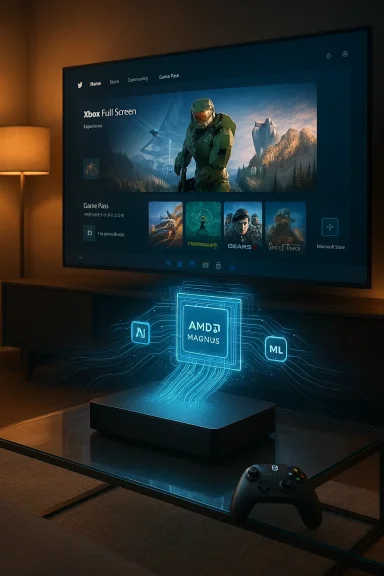
Reported accounts describe a layered architecture rather than a replacement of Xbox with Windows. The device would run full Windows 11 as the base operating system, but by default boot into an Xbox‑branded, TV‑optimized Full Screen Experience that prioritizes controller navigation, fast boot‑to‑game, and a curated discovery surface. Users could then “exit to Windows” to access the full desktop, install desktop apps, or run other PC storefronts such as Steticrosoft to present a console‑grade UX for mainstream players and a full PC for power users.Hardware: bespoke AMD silicon and the “Magnus” rumor
Multiple sources point to a semi‑custom AMD APU (leaked in reporting under internal codenames like “Magnus”) that combines Zen‑line CPU cores, RDNA‑derived GPU logic, and dedicated AI/ML accelerators. AMD’s public comments that their semi‑custom work can support a 2027 launch give credence to the idea that Microsoft seeks bespoke silicon tuned for cross‑device parity and AI features — but precise traounts, memory bandwidth targets, and thermal figures remain unverified.Software and stores: an aggregated library and open storefront support
Microsoft has already moved the Xbox PC app toward an aggregated library that discovers titles installed from multiple PC storefronts and surfaces them in a unified library. Test updates and insider releases have shown the app can display games from the Microsoft Store, Game Pass, Battle.net, and other supported platforms, and Microsoft has said it plans to expand supported stores over time. In practice, this aggregation is a necessary step to making a Windows‑based living‑room device feel like a console while preserving openness to third‑party PC storefronts.Technical anatomy: how Microsoft could build a hybrid console
A minimal shared runtime and device‑specific shells
The most plausible architecture is a small, common runtime — a Windows kernession — with device‑specific shells on top. The TV shell would be optimized for controllers and big‑screen navigation; handheld OEMs would use a fullscreen Xbox shell tailored to small form factors; and power users would be able to enter a full, untrimmed Windows desktop. This layered model reduces duplicated low‑level work and makes cross‑device feature parity more achievable, but it multiplies certification and driver testing complexity.Isolation, containerization, and anti‑cheat
Allowing third‑party storefronts and PC games to run on a device that must also provide console‑grade security and anti‑cheat means Mirely on strong isolation strategies: lightweight containers, hypervisor partitions, or sandboxed runtimes for untrusted clients. Some storefronts and PC titles require kernel‑mode anti‑cheat, which has historically been a friction point for OS-level containerization. Expect hybrid orchestration: direct native launches where anti‑cheat permits, and secure hand‑offs to native clients where kernel‑level access is required.Performance plumbing and memory budgets
A Windows‑grade devi or higher with advanced ray tracing and AI upscaling must allocate generous memory and sustained bandwidth. That pushes BOM costs up — higher DRAM capacity and faster memory types — and makes thermal design and power management tougher, especially if Microsoft intends to ship premium and handheld SKUs in the same family. These hardware economics are central to whether a 2027 timeframe is realistic.What’s already shipping: the ROG Xbox Ally and the FSE proof‑points
ASUS’s ROG Xbox Ally family — Windows 11 handhelds with an Xbox Full Screen Experience layered on top — is the clearest, consumer‑facing testbed for Microsoft’s layered approach. These devices run a full Windows OS beneath a controller‑first shell and already demol problems and advantages of the hybrid model: aggregated libraries, controller‑first overlays, and the ability to run standard Windows apps. The Ally devices show Microsoft and partners can ship hardware with Windows underneath a console skin, but they also expose the fragility of relying on Windows Update and Insider channels for a console‑grade experience.Business strategy: why Microsoft would pursue openness
- Leverage Windows’ massive PC gaming install base to expand Xbox’s reach.
- Reduce dingle Windows runtime compresses PC/console porting costs.
- Make Game Pass and Microsoft services more ubiquitous across device classes.
- Undercut regulatory criticism about closed storefronts by demonstrably supporting third‑party stores.
The credible timeline: why reporters say 2027 (and what that date really means)
The tightest, public timeline anchor is AMD’s statement that semi‑custom SoC work is “progressing well to support a lau a supplier‑side readiness signal, which matters because silicon schedules drive dev‑kit timelines and manufacturing calendars. Multiple outlets interpreted this as a plausible earliest retail window, while cautioning that Microsoft’s product timing depends on OS polish, partner negotiations, supply chain constraints, and first‑party content readiness. In short: 2027 is a realistic best‑case date, not a Microsoft‑confirmed ship day.What would openness look like in practice? A realistic model
- Aggregated discovery: the Xbox PC app displays your Game Pass, Microsoft Store, and supported PC storefront titles together.
- Hybrid launch behavior: when a title can run directly, the shell la‑mode anti‑cheat or DRM requires the original client, the system hands off to Steam/Epic/GOG.
- Certification pathways: Microsoft defines a set of requirements (performance, controller mapping, achievements, Xbox Live integration) that Windows titles must meet to be surfaced seamlessly in the console shell.
- Optional Windows exit: users can opt into full Windows and treat the device like a general‑purpose PC.
Strengths: what Microsoft gains if the plan succeeds
- *** shared toolchains and debug flows reduce porting friction.
- Consumer choice: a single box for console players and PC gamers reduces duplication.
- Market differentiation: a premium, Windows‑native living‑room device stands apart from closed consoles.
- Regulatory positioning: supporting third‑party storefronts weakens arguments of anti‑competitive behavior.
Risks and unresolved challenges
1) Anti‑cheat and DRM fragmentatioat remains the biggest practical blocker for frictionless cross‑store launches. Many triple‑A PC titles rely on anti‑cheat that expects full desktop privileges; integrating those titles into a console‑grade shell without breaking security or player safety will require significant engineering and cooperation from anti‑cheat vendors. Microsoft cannot unilaterally “disable” these restrictions without risking cheating and security problems. Expect hybrid hand‑offs for many titles at launch.
2) Updateability
Windows ships frequent feature and cumulative updates at a cadence very different from the tightly controlled console ecosystem. Early Windows‑based handheld users experienced stability and update issues that disrupted FSE behavior; scaling a Windows core to millions of living‑room devices without compromising console expectations is non‑trivial. Microsoft will need a console‑grade update strategy that guarantees stability while preserving Windows benefits.ing sensitivity
Delivering PC‑grade memory, NPUs for AI upscaling, and high thermal headroom increases BOM costs compared with previous Xbox launches. That pushes Microsoft toward a premium price bracket for top SKUs, which could limit mass‑market adoption if lower‑cost variants cannot match perceived “next‑gen” expectations. Component and memory price volatility was exrting as a factor shaping the 2027 best‑case timeline.
4) UX fragmentation and consumer confusion
If “console mode” and “Windows mode” diverge in behavior — discovery surfaces, controller ergonomics, overlays, and social features — consumers may face inconsistent experiences. Microsoft must design clear, frictionless transitions and default behaviorsare not surprised by hidden Windows complexity.5) Partner and licensing negotiations
Third‑party storefronts and publishers will negotiate cross‑entitlement, DLC portability, and revenue‑share terms. Not every publisher will want to open PC licenses on console hardware without new commercial agreements. Microsoft will have to navigate a complex patchwork of publisher contracts and platform fees.Developer and publisher playbook: preparing for a hybrid platform
- Prioritize controller support and UI layout for full‑screen, TV‑first experiences.
- Adopt Microsoft’s recommended APIs and certification requirements if seamless shell integration is desired.
- Plan dual‑build strategies where necessary: a console‑curated build for FSE and a desktop‑firste.
- Engage with anti‑cheat vendors early to validate kernel‑mode requirements or move to supported user‑mode solutions where feasible.
Consumer playbook: what to expect and how to prepare
- Decide your priority: do you want a plug‑and‑play console simplicity or a flexible, Windows‑enabled machine?
- Watch SKU messaging closely: Microsoft and OEM variants will likely differ by memory, storage, and Windows access level.
- For power users: expect early software updates and driver rollouts after launchive updating will be required.
- For mainstream buyers: default console mode should behave like a modern Xbox; you won’t be forced into Windows unless you choose to “exit” the shell.
Critical read: what to believe and what to treat as provisional
- Verified: AMD publicly indicated semi‑custom SoC work is progressing in a way that could support a 2027 is a concrete, supplier‑level fact.
- Corroborated reporting: multiple trade outlets and insiders describe Microsoft experimenting with a Windows‑first, layered console shell and aggregated store features; these reports are consistent and supported by shipped testbeds like FSE on Windows handhelds.
- Provisional: exact hardware specs, retail SKUs, final pricing, and the degree of third‑party storefront access at launch are not public and should be treated as speculative until Microsoft publishes formal product details. Any story that claims full, frictionless support for every PC storefront at day one should be treated with caution; practical anti‑cheat and licensing obstacles make a phased approach far more likely.
Final assessment: ble only with perfect orchestration
Microsoft’s hybrid‑console thesis is one of the boldest platform strategies in modern gaming: it leverages Windows, Game Pass, and a deeper AMD partnership to reframe the console as an appliance identity rather than a monolithic hardware SKU. If executed well, the model delivers clear benefits — broader libraries, developer efficiency, and consumer choice. If executed poorly, it risks fragmenting the Xbox experience, raising costs, and disappointing mainstream consumers who expect the simplicity that consoles historically provide.The 2027 timcause AMD’s silicon work appears to be on a schedule that can support that window, but Microsoft’s public silence and the complexity of software, partnessues make any launch date provisional. In short: the technical scaffolding is in place, the commercial incentives are compelling, and the execution risk is very real. Expect incremental announcements, more FSE rollouts across OEM devices, and negotiations with storefronts and anti‑cheat vendors to dominate industry coverage between now and any formal launch.
What to watch next (short checklist)
- Mict platform strategy and any official confirmation of a retail launch window.
- AMD earnings call transcripts for additional comments on semi‑custom SoC readiness and tape‑out milestones.
- Xbox PC app updates that expand aggregated library support and the list of supported third‑party storefronts.
- FSE rollouts and stability metrics on Windows Insider builds and across OEM handhelds; these will reveal how polished the layered model is.
- Publisher and anti‑cheat vendor statements about cross‑entitlement and kernel‑mode security cooperation.
Microsoft’s hybrid console ambition is now more than an idea; it’s a structured engineering program with public supplier signals and shipping testbeds to prove the approach. The coming months will determine whether this is a genuine reimagining of the console or an incremental pivot that lands in a premium niche. Either way, the move will shape the next era of platform competition — and the companies, developers, and players who adapt fastest will gain the greatest advantage.
Source: Mix Vale Microsoft prepares hybrid console for 2027 with support for PC stores and open Windows architecture
