

On January 6, 2026, Microsoft and the Midcontinent Independent System Operator (MISO) announced a major collaboration to build a cloud‑native, AI‑driven unified data platform on Microsoft Azure designed to speed transmission planning, improve forecasting, and bring Copilot‑style analytics and visualization directly into grid operations across MISO’s multi‑state footprint.
MISO is one of North America’s largest regional transmission organizations, coordinating wholesale markets, balancing supply and demand, and planning transmission across roughly 15 U.S. states plus parts of Canada—serving on the order of tens of millions of people. The announced partnership pairs that domain knowledge and operational data with Microsoft’s cloud and AI stack—specifically Microsoft Azure, Microsoft Foundry (Azure AI Foundry), Power BI, and Microsoft 365 Copilot—to create a single authoritative data fabric and a managed model lifecycle for forecasting, scenario analysis and operator decision support.
The companies frame this as a modernization move to address three interlocking pressures on regional grids: rising electrification and data‑center demand, a growing share of variable renewable resources, and the increasing operational complexity that comes with integrating distributed resources and extreme‑weather resilience. The public materials emphasize faster analytics, improved situational awareness, and the ability to iterate on planning scenarios much more rapidly than with legacy, batch‑oriented workflows.
However, the transformation is neither automatic nor risk‑free. Realizing the potential requires disciplined pilots, transparent KPIs, independent validation, strong cybersecurity practices, and contractual protections against lock‑in. Regulators, utilities and member stakeholders should treat headline claims as directional until pilot data, audit reports and contractual terms make the benefits and tradeoffs explicit.
If executed with technical rigor, strong governance and human‑centred design, this collaboration could accelerate how the Midwest plans and operates its grid—reducing friction in transmission planning, sharpening forecasting, and providing operators with the situational awareness required for a more resilient and decarbonizing system. If governance lapses, the result will be vendor dependence without commensurate transparency or measurable reliability gains. The coming pilot outcomes and audit artifacts will determine which path this collaboration follows.
Microsoft and MISO have set a clear objective: to modernize one of North America’s most complex electricity markets by bringing Azure AI, Foundry, Power BI and Copilot into the operational fabric. Turning that objective into measurable, verifiable improvements will require proof—published performance metrics, third‑party audits and transparent procurement terms—that confirm whether cloud‑native analytics can safely and reliably accelerate planning and operations at grid scale.
Source: prismedia.ai Microsoft to Bring Azure AI Tools to Modernize Midwest Power Grid
 Background
MISO is one of North America’s largest regional transmission organizations, coordinating wholesale markets, balancing supply and demand, and planning transmission across roughly 15 U.S. states plus parts of Canada—serving on the order of tens of millions of people. The announced partnership pairs that domain knowledge and operational data with Microsoft’s cloud and AI stack—specifically Microsoft Azure, Microsoft Foundry (Azure AI Foundry), Power BI, and Microsoft 365 Copilot—to create a single authoritative data fabric and a managed model lifecycle for forecasting, scenario analysis and operator decision support.The companies frame this as a modernization move to address three interlocking pressures on regional grids: rising electrification and data‑center demand, a growing share of variable renewable resources, and the increasing operational complexity that comes with integrating distributed resources and extreme‑weather resilience. The public materials emphasize faster analytics, improved situational awareness, and the ability to iterate on planning scenarios much more rapidly than with legacy, batch‑oriented workflows.
What was announced — the core components
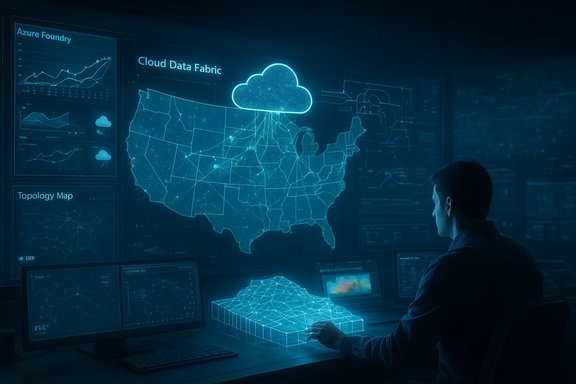
The public summary of the collaboration lays out a practical stack and intended use cases rather than promising to replace control systems overnight. The principal elements include:- A unified data platform on Microsoft Azure to ingest SCADA/EMS telemetry, market data, GIS/topology, asset registers, weather feeds, and third‑party data sources so analytics run from a single authoritative dataset.
- Microsoft Foundry (Azure AI Foundry) for model hosting, agent orchestration, observability, routing and governance of ML models and multi‑agent workflows.
- Operator and stakeholder-facing productivity and visualization built with Power BI and Microsoft 365 Copilot to surface insights, recommended actions, and collaborative decision trails.
- Integration pathways for industry partners, DER aggregators, weather providers and other third‑party systems to broaden analytics and accelerate feature rollout.
Why this matters: the operational and strategic case
Modernizing bulk‑power planning and operations is both a data problem and a coordination problem. Legacy workflows often stitch together siloed datasets, run sequential model sweeps on fixed on‑prem compute, and require lengthy manual validation. The MISO–Microsoft approach targets that fragmentation by:- Compressing analytics cycle time through cloud elasticity and parallelized scenario sweeps, enabling large probabilistic studies and thousands of sensitivity runs that once took weeks to complete.
- Improving short‑term and weather‑aware forecasting by combining higher‑fidelity meteorological feeds with machine learning models trained on large operational histories. This matters for congestion forecasting, outage risk estimation and day‑ahead/hour‑ahead operations.
- Delivering operator decision support with Copilot‑style assistants, advanced visualization, and auditable model outputs to reduce cognitive load and speed incident triage.
Technical architecture: what the platform likely looks like
The public overview is intentionally high level, but the announced building blocks permit a clear, plausible architecture:Data fabric and ingestion
- A cloud‑hosted ingestion layer pulls telemetry (SCADA/EMS), market settlements, asset registers, meter/AMI data, GIS/topology, and external feeds (weather, DER telemetry). Role‑based access and identity are anchored in Microsoft Entra/Azure AD.
Model lifecycle and governance
- Microsoft Foundry (Azure AI Foundry) provides model registry, observability, experiment tracking, multi‑agent orchestration and routing. Model governance—including versioning, lineage, retraining cadences and access control—becomes a first‑class capability in regulated environments.
Compute and simulation layer
- Elastic Azure compute (VMs, scale sets, containerized inference clusters) enables parallelized contingency sweeps, Monte Carlo resource‑adequacy studies and fast retraining/inference loops for short‑term forecasting. This is the lever that converts "weeks" of compute time into "minutes" for well‑scoped workloads.
Operator UX and productivity layer
- Power BI dashboards for visualization and Microsoft 365 Copilot integration for textual summarization and guided workflows deliver synthesized insights into control‑room and planner environments. Audit trails and human‑in‑the‑loop overrides are emphasized in public messaging.
Integration and extensibility
- Open connectors and partner integrations (weather providers, DER aggregators, market participants) allow iterative extension of analytic scope and operational use cases. The platform is designed to act as a hub for partner innovation while retaining a single authoritative model of the grid.
Claimed benefits and realistic expectations
The partners make several performance claims; some are specific and actionable, others are directional. Key claims and the assessment of each:- Claim: Shrink planning and analytics cycle times “from weeks to minutes.”
Assessment: This is plausible for discrete workloads—specifically ETL automation, certain model runs, and parallelized scenario sweeps—when moved to elastic cloud compute. However, end‑to‑end validation, physics‑based powerflow studies, and multi‑stakeholder regulatory reviews still impose wall‑clock and process limits. The partners acknowledge these are projections and they have not been independently verified. - Claim: Improve forecasting for weather, load and congestion.
Assessment: Integrating richer meteorological inputs and ML models typically improves probabilistic forecasts, but gains depend heavily on data quality, granularity, retraining cadence and the fidelity of topology/model reconciliation. Early pilot metrics (MAE, RMSE) published during validation will be the best objective measure. - Claim: Embed Copilot‑style decision support into control rooms.
Assessment: Copilot integrations can surface hypotheses and recommended next steps, reducing operator cognitive load; safe adoption requires conservative human‑in‑the‑loop constraints and rigorous UI design to avoid over‑automation.
Strengths: why this collaboration is credible
- Domain + scale pairing. MISO supplies the operational datasets and domain processes; Microsoft supplies cloud scale, model lifecycle tooling and enterprise security primitives. That pairing addresses a common gap where utilities have domain expertise but lack cloud‑native MLOps at scale.
- Governance and observability. Foundry’s focus on model cataloging, routing and observability gives a path toward auditable AI deployments—critical in regulated, safety‑sensitive infrastructure.
- Incremental, modular rollout. The architecture as described allows advisory and decision‑support features to be operationalized first, with any closed‑loop automation gated by conservative validation. This staged approach reduces operational risk compared with “big‑bang” replacements.
- Cloud economics for simulation. Parallelized simulations and elastic compute make probabilistic planning affordable and practical, enabling sensitivity sweeps that were previously cost‑prohibitive. This can shorten interconnection studies and reduce planning friction.
Risks and open questions
Modernizing grid operations with hyperscaler AI platforms raises several important technical, governance and strategic risks that must be addressed explicitly:1) Verification, validation and explainability
AI and ML outputs must be auditable and explainable to satisfy regulators and operators. Model drift, edge cases, and unexpected failure modes remain real hazards. Independent validation and published KPIs for forecast accuracy, ETR performance and congestion predictions will be essential.2) Cybersecurity and supply‑chain exposure
Moving operational analytics to the cloud increases the attack surface and introduces third‑party dependencies. While Azure supplies mature security tools (Defender for IoT, Sentinel, Entra), the joint environment requires hardened SOC integration, red‑team validation, and clear incident‑response SLAs.3) Vendor lock‑in and data portability
Large portions of model artefacts, optimized pipelines, and telemetry transforms can become tightly coupled to a cloud vendor. Contracts must specify portability artifacts, exportable models, retraining scripts and raw‑data egress to avoid prohibitive lock‑in.4) Regulatory and market governance
RTOs operate under complex jurisdictional rules. Analytics that inform market actions, redispatch or settlement mechanics will require transparency, auditability, and regulator engagement to ensure non‑discriminatory outcomes. The announcement does not disclose precise governance or timelines for regulatory approvals.5) Human factors and workforce readiness
Realizing benefits demands reskilling planners, operators and engineers. Without investment in human‑centred design and change management, new tools risk low adoption or the creation of shadow processes that bypass official audits.Practical use cases and early pilots to watch
Based on the technical scope and analogous industry deployments, the most actionable near‑term use cases include:- Weather‑aware outage and risk forecasting to pre‑position crews and reduce restoration times.
- Short‑term congestion prediction and advisory workflows to enable pre‑emptive redispatch or market operations.
- Accelerated interconnection and transmission planning through cloud‑scale scenario sweeps and probabilistic resource‑adequacy runs.
- Operator decision support with Copilot‑style assistants and Power BI dashboards that summarize root‑cause hypotheses and recommend next steps with auditable trails.
Governance and procurement checklist: what member utilities and regulators should demand
To convert promising technology into trustworthy operations, procurement and governance documents must include concrete artefacts and milestones:- Require a scoped internal pilot with advisory outputs only for a minimum period (e.g., 6 months) before any automation affects live switching or settlements.
- Insist on published, independently audited KPIs for operational forecasts and ETRs, and require model‑cards documenting training data, bias analyses, retrain cadence, and expected failure modes.
- Specify cybersecurity requirements: joint red‑team reports, SOC integration playbooks, incident SLAs, and third‑party penetration testing results.
- Negotiate portability and exit clauses that include exported models, retraining scripts, raw data extracts and a practical egress pricing schedule.
- Tie compensation or milestone payments to measurable operational outcomes (forecast accuracy, reduced planning cycle times, validated restoration accuracy).
Broader market implications: hyperscalers and grid operations
The MISO–Microsoft collaboration is emblematic of a broader industry trend: hyperscalers are moving beyond simple power procurement to offer software and cloud services that become integral to grid planning and operations. This creates both opportunities and structural questions:- Opportunity: Cloud providers can supply managed AI, model lifecycle services and the compute scale needed for modern probabilistic planning—capabilities many grid operators lack in house.
- Structural question: How should regulated entities balance operational dependence on commercial cloud platforms while preserving market fairness, data sovereignty and competitive neutrality? Clear governance, transparent KPIs and regulatory engagement are essential.
What to watch next — milestones and verification signals
The next 6–18 months will be decisive. Useful public signals of progress include:- Published pilot results with statistical performance metrics for forecasting, congestion detection and ETR accuracy.
- Independent technical audits of model governance and cybersecurity posture.
- Formal regulatory consultations or filings that describe how analytics will be used in market or operational decisions.
- Commercial terms (cost model, data portability, SLAs) disclosed or summarized to members so budget and lock‑in risks are visible.
Final assessment: promise tempered by requirement for rigor
The MISO–Microsoft partnership brings together the right ingredients—domain data, cloud scale, managed AI tooling and operator‑facing productivity—to make meaningful progress on grid modernization, cloud‑native analytics, and AI for utilities. The architecture described is sensible: keep mission‑critical control loops intact on premises while moving heavy simulations, model training and analytics to a governed Azure stack and using Foundry for model lifecycle control.However, the transformation is neither automatic nor risk‑free. Realizing the potential requires disciplined pilots, transparent KPIs, independent validation, strong cybersecurity practices, and contractual protections against lock‑in. Regulators, utilities and member stakeholders should treat headline claims as directional until pilot data, audit reports and contractual terms make the benefits and tradeoffs explicit.
If executed with technical rigor, strong governance and human‑centred design, this collaboration could accelerate how the Midwest plans and operates its grid—reducing friction in transmission planning, sharpening forecasting, and providing operators with the situational awareness required for a more resilient and decarbonizing system. If governance lapses, the result will be vendor dependence without commensurate transparency or measurable reliability gains. The coming pilot outcomes and audit artifacts will determine which path this collaboration follows.
Microsoft and MISO have set a clear objective: to modernize one of North America’s most complex electricity markets by bringing Azure AI, Foundry, Power BI and Copilot into the operational fabric. Turning that objective into measurable, verifiable improvements will require proof—published performance metrics, third‑party audits and transparent procurement terms—that confirm whether cloud‑native analytics can safely and reliably accelerate planning and operations at grid scale.
Source: prismedia.ai Microsoft to Bring Azure AI Tools to Modernize Midwest Power Grid
