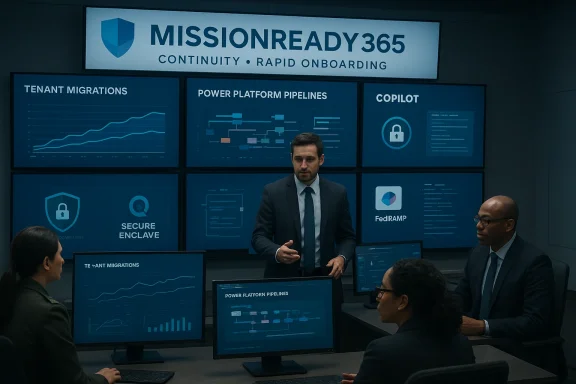
MissionReady365: Fast, Secure Microsoft 365 Staffing for Government

  • Thread Author
ESW’s new MissionReady365™ promises to remove one of the thorniest bottlenecks in government IT modernization: getting experienced Microsoft 365 professionals into mission-critical programs quickly and with the right operational and security posture. The announcement, published via GlobeNewswire and carried by StreetInsider on February 12, 2026, frames MissionReady365™ as a staffed, continuity-focused alternative to conventional staff augmentation—delivering vetted, full‑time Microsoft 365 consultants who plug directly into government and contractor teams for migrations, Copilot rollouts, Power Platform projects, eDiscovery, and 24/7 operations. (streetinsider.com)

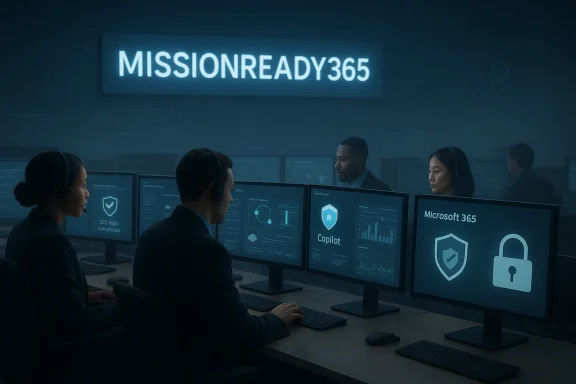
Security operations center monitoring Microsoft 365 protection at MissionReady365.Background / Overview​

ESW (eSoftware Associates) has steadily expanded a portfolio aimed at the public‑sector Microsoft 365 market: secure collaboration and Intune work for regulated environments, Copilot training and automation services, and a GovCon‑focused deployment framework that targets GCC High and other compliance regimes. Recent ESW announcements include the GovCon Accelerator™ for compliant GCC High deployments and Copilot Ascend™ for role‑based Copilot enablement—both of which underscore the company’s positioning as a Microsoft‑centric partner for regulated customers. These prior offerings provide important context for MissionReady365™ and help explain the emphasis on continuity, security, and domain experience.
MissionReady365™, as described in the press release, is designed to:
  • Supply experienced, full‑time Microsoft 365 professionals quickly for federal, state, and local agency projects and for contractors supporting public‑sector work. (streetinsider.com)
  • Support a broad set of government use cases: tenant migrations and consolidations, secure collaboration for multi‑agency teams, Power Platform solutions for citizen services, eDiscovery and records management, Microsoft Copilot implementations with security controls, and 24/7 operational support. (streetinsider.com)
  • Prioritize continuity—keeping consistent staff on an engagement rather than rotating short‑term contractors—and to operate in environments where security and compliance are non‑negotiable. (streetinsider.com)
That combination—domain expertise plus operational continuity—is the central promise. But the promise must be measured against federal procurement realities, workforce constraints, and compliance obligations. Below I unpack what the program means in practice, the likely benefits, the operational risks, procurement pitfalls to watch for, and a practical due‑diligence playbook for agency CIOs, contracting officers, and prime contractors.

Why MissionReady365™ matters now​

The public‑sector talent gap is real and systemic​

Federal and state agencies have been grappling with persistent IT staffing shortfalls for years. Multiple Government Accountability Office reports and federal IT workforce studies document chronic recruitment and retention problems, lengthy hiring cycles, and capacity gaps—especially for cybersecurity and cloud‑migration skill sets. These shortages directly affect government programs’ ability to meet schedules and contract deliverables. MissionReady365™ is essentially a vendor response to that market reality: a packaged way to access experienced Microsoft 365 skills without the full burden of hiring or long civil‑service hiring cycles.

Microsoft 365 modernization requires specialized, cross‑disciplinary skill sets​

Delivering secure Microsoft 365 services in government settings usually requires not only SharePoint, Teams, and Intune know‑how, but also familiarity with compliance regimes (FedRAMP, CMMC, ITAR/DFARS), tenant architecture, Purview/DLP, Entra identity and conditional access, and Power Platform governance. ESW’s recent GovCon Accelerator and operational case studies show that the company has been packaging those cross‑disciplinary patterns for repeat use—an experience set that makes MissionReady365™’s promise plausible on paper.

What MissionReady365™ actually offers (as announced)​

The press release lists the main service areas and design priorities. Key points to call out, verified against the release:
  • Immediate access to vetted, full‑time M365 consultants who integrate into government and contractor teams. The release positions this as different from transient staff augmentation by maintaining consistent resources throughout an engagement. (streetinsider.com)
  • Coverage across migration, secure collaboration, Power Platform projects, records/eDiscovery, Copilot implementation with security controls, and 24/7 operational support. (streetinsider.com)
  • Availability “immediately” to federal, state, and local agencies and to prime contractors supporting public‑sector programs. The release names the company founder and CEO, Russell Kommer, and includes a short quote reiterating the staffing risk narrative. (streetinsider.com)
These claims are stated in vendor terms and therefore represent ESW’s positioning and capability set as of the announcement date. The rest of this article treats those claims as vendor assertions that procurement and technical teams must validate in practice.

Strengths and likely operational positives​

1) Faster time to capability​

By supplying experienced practitioners who already know government constraints and Microsoft’s enterprise stack, MissionReady365™ can plausibly reduce ramp time. Where agencies face weeks‑to‑months to hire or onboard staff, a pre‑vetted consultant who knows GCC High nuances or tenant consolidation patterns can begin contributing sooner—assuming the contracting and background check gating items are handled rapidly. (streetinsider.com)

2) Continuity and knowledge retention​

ESW emphasizes full‑time engagements and continuity rather than rotating short‑term contractors. Continuity reduces the repeated onboarding cost and the knowledge loss that often accompanies contract churn. For sustained modernization efforts—tenant consolidations, long Power Platform rollouts, or Copilot program management—this matters a lot. (streetinsider.com)

3) Built for regulated environments​

ESW’s public collateral shows an emphasis on GCC High, FedRAMP, and defense work patterns (GovCon Accelerator, detailed case studies). That background suggests the company understands the compliance artifacts, segmentation strategies, and technical constraints agencies require—an important differentiator for some missions.

4) End‑to‑end capability mix​

Pairing staffing with enablement and operational offerings (e.g., Copilot Ascend™, Copilot Systems, and managed automation services) allows ESW to supply not just bodies, but packaged project outcomes: training, governance artifacts, runbooks, and automation patterns that speed the path from staff to measurable outputs. This can reduce vendor sprawl and integration overhead.

Risks, caveats, and what the announcement does not prove​

The announcement is a credible market response, but several operational and procurement risks remain. Treat the following as due caution items.

1) Security clearance and background vetting​

The press release promises suitability for government programs, but it does not specify the security clearance levels ESW’s consultants will hold. Many mission‑critical programs require personnel with specific clearance levels or adjudication processes that can take months. Agencies and prime contractors must verify clearance and insider‑threat screening procedures before relying on “immediate” staffing claims. This is a procurement gating item, not a marketing one. (streetinsider.com)

2) Contracting rules and procurement timelines​

“Immediate availability” in a marketing release does not overcome public procurement rules: GSA schedules, FAR regulations, state procurement windows, and the time needed to negotiate SOC/ATO artifacts and SOW acceptance can still stretch timelines. Where agencies expect plug‑and‑play contractors, they must confirm the acquisition vehicle (e.g., IDIQ task orders, GSA schedule, existing BPA) and the timeline to onboard a vendor under existing contract vehicles. Federal acquisition complexity remains a material constraint. GAO and CIO guidance documents emphasize the importance of workforce planning and acquisition readiness in avoiding schedule slippage—issues MissionReady365™ cannot eliminate by itself.

3) Depth vs breadth of skill coverage​

The release lists many supported areas—from eDiscovery to Copilot implementation—but it’s rare for any single partner to be deeply expert across every niche at a scale suitable for simultaneous multi‑program delivery. Buyers should probe depth: how many senior M365 architects, how many Power Platform experts, how many eDiscovery leads does ESW have on payroll and immediately available? Vendor assertions should be matched to concrete resource rosters and CVs in the procurement pack. (streetinsider.com)

4) Vendor lock‑in and knowledge transfer​

Full‑time contractor continuity can be an advantage, but it can also create operational lock‑in if knowledge transfer and exit strategies aren’t contractually enforced. Agencies should require documented runbooks, tested data‑export/exit plans, and knowledge transfer milestones so projects don’t stall when a contractor departs. This is standard acquisition hygiene but is especially important when continuity is the selling point. (streetinsider.com)

5) Pricing transparency and value measurement​

The press release does not provide pricing, billing models, or metrics for expected outcomes. Agencies must insist on concrete acceptance criteria, KPIs, and price ceilings or not‑to‑exceed amounts in task orders. It’s common for “staffing acceleration” offerings to be priced at a premium; procurement teams should quantify the premium and validate that the total cost of engagement yields measurable acceleration or risk reduction. (streetinsider.com)

Practical due‑diligence checklist (for CIOs, CORs, and primes)​

When evaluating MissionReady365™ or similar proposals, use this checklist as an operational playbook. Items are ordered roughly by sequencing during procurement and onboarding.
  • Validate legal and procurement vehicles
  • Confirm whether ESW will be engaged via GSA schedule, existing IDIQ, a subcontract to a prime, or a new contract vehicle. Ensure FAR compliance and obtain relevant contract numbers.
  • Confirm security posture and personnel vetting
  • Request SOC 2 / FedRAMP artifacts (if applicable), background check processes, and the exact security clearances held by proposed staff. Require CVs and dates of clearance adjudication.
  • Define measurable acceptance criteria up front
  • Baseline metrics (e.g., tenant migration throughput metrics, Copilot adoption KPIs, Power Platform deployment counts, mean time to remediation) and agreed pilot success criteria.
  • Require knowledge transfer and exit artifacts
  • Deliverables should include runbooks, admin playbooks, documented Purview/DLP mappings, Power Platform solution packages, and an executable data‑export/exit plan.
  • Contractual continuity and replacement SLAs
  • If the selling point is continuity, require contractual clauses on resource replacement timelines, shadowing periods, and penalties or remediation when continuity is broken.
  • Test with a time‑boxed pilot
  • Run a 4–8 week pilot with defined KPIs. Use the pilot to validate technical fit, cultural fit, and onboarding throughput before scale procurement.
  • Review cost models against value
  • Compare ESW’s staffing rates and value proposition against market rates for cleared Microsoft 365 architects, Power Platform leads, and Copilot specialists. Validate the math: is the acceleration worth the premium?
  • Confirm compliance integration
  • For GCC High or FedRAMP environments, demand documented evidence the proposed architectures and processes have been tested and can operate inside the chosen cloud enclave.
  • Establish reporting and governance cadence
  • Define weekly leadership reports, security posture checks, and a monthly governance board for escalations and budget reviews.
  • Plan for lifecycle and handover
  • Establish a roadmap for phasing down MissionReady365™ staff into a permanent model—whether an internal team, an MSP, or a managed service contract.
These steps help transform a vendor marketing claim into a structured program with measurable outcomes and controlled risk.

How MissionReady365™ fits ESW’s broader product stack​

The new staffing offer should be seen as part of an ecosystem ESW has been building: operational accelerators for GovCon customers, Copilot enablement, and managed automation services. That breadth gives buyers an opportunity to bundle training, architecture, and staffing in a single partner relationship—reducing integration friction if the partner is proven. On the other hand, buyers should be wary of packaging that mixes professional services and managed delivery without clear separation of responsibilities and SLAs. ESW’s other announcements (GovCon Accelerator™, Copilot Ascend™, Copilot Orbit™) indicate a deliberate strategy to cover discovery, enablement, automation, and now staffing—making MissionReady365™ the staffing arm of a larger Microsoft 365 product family.

Procurement scenarios where MissionReady365™ makes most sense​

  • Large tenant consolidations with aggressive timelines where hiring a dozen cleared hires would be impractical. Continuity reduces the risk of repeated contractor churn. (streetinsider.com)
  • Copilot and automation pilots that need both technical architects and adoption coaching—bundled staffing plus training can shorten the pilot→scale window.
  • Prime contractors who must quickly scale capability for a DoD or civilian agency win and lack immediate bench strength. MissionReady365™ can be part of a rapid staffing response while the prime builds long‑term capacity. (streetinsider.com)

Where MissionReady365™ will face the hardest tests​

  • Programs requiring high‑level clearances (TS/SCI) and rigorous personnel adjudication. Marketing claims of immediacy falter where clearances are required. (streetinsider.com)
  • Long, multi‑year modernization programs where in‑house capacity building is a statutory or strategic goal. Agencies should weigh short‑term acceleration against long‑term workforce development obligations (and GAO recommendations to strengthen workforce planning).
  • Highly specialized eDiscovery or legal hold operations with bespoke tool chains and legal process requirements. Vendor staff must demonstrate proven case law and legal operations experience, not just M365 technical chops. (streetinsider.com)

Red flags to watch for in any staffing acceleration proposal​

  • Vague claims about clearance levels, on‑site availability, or immediacy without corroborating personnel rosters and adjudication proof. (streetinsider.com)
  • Absence of an exit plan or transfer‑of‑knowledge clauses in the SOW. Continuity must not become an excuse to retain monopoly control over institutional knowledge. (streetinsider.com)
  • No pilot or deliverable‑based milestones—contracts that pay purely for time are riskier when the stated value is acceleration and outcomes. (streetinsider.com)

Recommended contract language starters (boilerplate items to include)​

  • Resource credentials: delivery of CVs and clearance documentation within X business days of award.
  • Continuity clause: any replacement resource must have a handover overlap of at least Y weeks and meet the same skill and clearance profile.
  • Knowledge artifacts: delivery of runbooks, admin playbooks, and tested export/exit scripts by milestone M.
  • Acceptance KPIs: defined performance metrics tied to milestone payment (e.g., migration throughput, Copilot adoption rates, resolution SLAs).
  • Security attestations: SOC 2 Type 2 or FedRAMP controls mapping, plus log review, breach notification timelines, and encryption responsibilities.
These items convert marketing statements into verifiable contractual obligations.

Bottom line: pragmatic optimism with contractual rigor​

MissionReady365™ is a credible and timely answer to a documented government problem—accelerating access to experienced Microsoft 365 talent in regulated environments. ESW’s broader product portfolio (GovCon Accelerator™, Copilot Ascend™, Copilot Orbit™) and portfolio case studies support the claim that the company knows how to deliver M365 solutions for government customers. That background makes MissionReady365™ a potentially useful procurement option for agencies and primes that need rapid capability and continuity.
However, the program’s value will be realized only when buyers convert vendor assertions into binding contract terms: concrete clearance evidence, pilot‑based acceptance criteria, knowledge‑transfer plans, and tested ATO/compliance artifacts. Agencies should also temper expectations about pure “plug‑and‑play” speed—procurement rules, clearance timelines, and technical integration work remain real constraints that no staffing solution can fully eliminate. The sensible path is a time‑boxed pilot with explicit KPIs, followed by a performance‑based scale‑up if the pilot proves the supplier’s claims. (streetinsider.com)

Quick reference — what to ask ESW before you sign​

  • Provide names, CVs, and current clearance status for proposed staff.
  • Demonstrate two prior contracts in regulated environments where the team delivered the listed scope (migrations, Copilot, Power Platform) and show referenceable outcomes. (streetinsider.com)
  • Share security artifacts (SOC 2, FedRAMP mapping, or equivalent) and an ATO readiness plan.
  • Present a pilot SOW that includes acceptance metrics, knowledge transfer, and exit deliverables. (streetinsider.com)

MissionReady365™ is a sensible productized response to an enduring problem: government projects repeatedly stall because the right Microsoft 365 talent is not available at the right moment. ESW’s announcement is consistent with the company’s broader public‑sector positioning and adds an explicit continuity angle that many agencies will find attractive. But procurement teams should treat the press release as the beginning of a verification process, not its end—insist on clear evidence of clearance, concrete deliverables, and binding SLAs before trading calendar days for staff acceleration. With the right contractual guardrails and a pilot‑driven rollout, MissionReady365™ can shorten timelines and lower program risk; without those guardrails, it risks becoming another vendor‑friendly staffing story that underdelivers against public‑sector expectations. (streetinsider.com)

Source: StreetInsider ESW Launches MissionReady365™ to Accelerate Microsoft 365 Staffing for Government Projects
 

ESW’s MissionReady365™ arrived on February 12, 2026 as a purpose-built staffing offering that promises to shorten the time it takes federal, state, and local agencies — and their prime contractors — to field experienced Microsoft 365 talent for mission-critical programs.

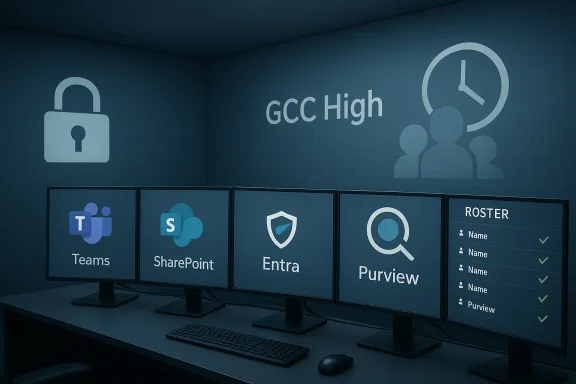
GCC High security desk with four monitors displaying Teams, SharePoint, Entra and Purview.Background / Overview​

Government IT modernization projects routinely stall on one problem above most others: people. Recruiting, vetting, and onboarding Microsoft 365 architects, Intune engineers, Power Platform leads, and security/compliance specialists can take months — far longer than many funding windows and program timelines allow. MissionReady365™ is ESW’s packaged answer to that problem: a service that supplies vetted, full‑time Microsoft 365 consultants who are intended to embed into government and contractor teams quickly, with an emphasis on continuity (keeping the same faces on an engagement rather than recycling short‑term contractors). The company announced the service on February 12, 2026.
ESW frames MissionReady365™ as suitable for a broad set of government use cases, including tenant migrations and consolidations, secure multi‑agency collaboration, Power Platform solutions, eDiscovery and records management, Microsoft Copilot implementations with security controls, and 24/7 operations for mission‑critical systems. Those scope areas mirror ESW’s existing portfolio and prior launches — for example the company’s GovCon Accelerator™ and its Microsoft 365 short‑term staffing pages that emphasize GCC High and regulated‑environment experience.

What ESW announced (the facts)​

  • Announcement date: February 12, 2026.
  • Product name: MissionReady365™ (a specialized Microsoft 365 staffing/service package).
  • Claimed availability: Immediately for federal, state, and local agencies and primes supporting public‑sector programs.
  • Promised capabilities: vetted, full‑time M365 consultants; continuity of staffing; coverage for migrations, collaboration, Power Platform, eDiscovery/records, Copilot implementations, and 24/7 operations.
  • Company positioning: ESW bills MissionReady365™ as part of a broader, GovCon‑focused Microsoft 365 product family that also includes GovCon Accelerator™, Copilot enablement services and short‑term staffing.
These are the vendor’s public claims. The remainder of this article evaluates what those claims mean in practice for government buyers and prime contractors, highlights the operational strengths, and outlines procurement and security caveats that agencies must resolve before relying on “immediate” staffing.

Why this matters now: the staffing and compliance context​

The talent gap is systemic​

Multiple federal workforce studies and Government Accountability Office reviews have documented that recruiting and retaining digital and cloud talent in government is hard, slow, and expensive. The consequence: modernization timelines lengthen, contractors scramble for cleared bench strength, and program momentum slips. A productized staffing offering aimed specifically at Microsoft 365 makes immediate market sense because M365 modernization requires cross‑disciplinary capabilities — from SharePoint and Teams to Entra identity, Purview/DLP, Intune, and Power Platform governance. MissionReady365™ is positioned to bridge that skills and timing gap.

Regulated clouds and operational nuance​

Delivering Microsoft 365 in regulated contexts (GCC High, Azure Government, FedRAMP Moderate/High) is not identical to commercial M365 work. Feature sets differ, connectors behave differently, and identity/segmentation patterns require thoughtful design. ESW has made this a stated part of its practice (GovCon Accelerator™, case studies showing GCC High migrations), which increases the plausibility of MissionReady365™’s value proposition — but it does not eliminate the need to validate personnel and artifacts for your specific compliance regime.

Strengths: where MissionReady365™ could help programs win​

1) Faster time to capability​

  • Bringing experienced Microsoft 365 professionals to a program reduces ramp time compared with civil‑service hires or ad hoc contractor searches. For program managers facing a funding window or a hard cutover date, the ability to staff quickly is a measurable advantage. ESW’s staffing pages describe quick onboarding cycles for short‑term engagements, which aligns with the product framing.

2) Continuity reduces turnover costs​

  • The pledge to maintain consistent full‑time resources — not rotating bodies — tackles a real pain point: churned contractors cause repeated onboarding overhead and knowledge loss. Continuity can pay dividends when projects require long, iterative migrations, ongoing Copilot enablement, or sustained Power Platform governance.

3) Built for regulated environments​

  • ESW’s prior product work (GovCon Accelerator™, documented GCC High projects) signals familiarity with compliance artifacts and enclave constraints. For agencies operating inside FedRAMP, DFAdaries, that domain experience is necessary and not easily replaced.

4) Bundled capability — staffing plus enablement​

  • Because ESW also sells enablement services (Copilot training, automation, runbooks), MissionReady365™ can be offerto‑end program: staffing to build and operate; training to upskill users; runbooks and governance to hand back to the customer. That reduces vendor sprawl and integration friction where a single partner can deliver consistent artifacts and operating models.

Risks, caveats, and procurement realities​

Despite the promise, buyers must approach MissionReady365™ with disciBelow are the most important operational and contractual risks.

1) “Immediate availability” vs. clearance realities​

  • The press release does not state what security clearances, if any, the proposed staff hold. Many mission‑critical programs require personnel with adjudicated clearances (e.g., TS/SCI, or at minimum Suitability/Federal Background Investigation) and insider‑threat screening. Clearance timelines can take m any vendor’s marketing calendar; a claim of “immediate” staffing must be validated against concrete, time‑stamped clearance evidence and adjudication records. Treat any immediacy claim as conditional pending personnel vetting.

2) Procurement vehicle and FAR/GSA constraints​

  • Marketing cannot bypass federal acquisition rules. Agencies must confirm the acquisition route (GSA schedule, IDIQ task order, existing BPA, or subcontract to a prime) and understand onboarding timelines under that vehicle. Even with a vendor that keeps a cleared bench, task order award and administrative compliance still add days or weeks. Don’t conflate “service ready” with “contract signed.”

3) Depth vs. breadth of coverage​

  • The release lists many capability areas , eDiscovery, Power Platform, 24/7 ops. Buyers should probe depth: how many senior M365 architects, how many Power Platform experts, how many eDiscovery/legal operations leads are actually on ESW’s roster and immediately availis useful, but depth matters when multiple concurrent programs demand senior architects. Ask for concrete resource rosters and CVs.

4) Potential vendor lock‑in without knowledge transfeselling point — but continuity without enforced knowledge-transfer clauses can create operational lock‑in. Contracts must require runbooks, tested export/exit plans, administrative playbooks, and handover overlthe agency retains institutional knowledge when the engagement ends.​

5) Pricing transparency and measure of acceleration​

  • The press release contains no pricing details. Staffing acceleration frequently carries a preminsist on priced pilots, measurable KPIs (e.g., migration throughput, Copilot adoption rates), and capped costs or not‑to‑exceed clauses to align spend with realized acchether the premium paid buys demonstrable calendar‑day savings.

Due‑diligence checklist for buyers (practical, sequential)​

  • Validate the acquAR/GSA path. Determine whether engagement will be via direct award, GSA schedule, IDIQ, or as a subcontract; obtain contract numbers and time estimates for onboarding.
  • Demand, dates of clearance adjudication, background‑check processes, and references for each named resource. Require evidence of current clearances where a program requires them.
  • Request security and compliance artifacts: SOC 2 Type II reports, FedRAMP mapping or an ATO readiness plan, vulnerability scanning cadence, and breach-notification timelines.
  • Insist on a time‑boxed pilot (4–8 weeks) with explicit acceptance criteria and KPIs: migration throughput, backlog closure, Copilot adoption targets, mean time to remediate incidents. Pay on milestones tied to outcomes, not only time.
  • Contractual continuity clauses: replacement SLAs, shadowing overlap (minimum X weeks), and penalties for failure to maintain continuity. Require delivery of runbooks and tested export/exit scripts by an early milestone.
  • Require an exit and handover plan: deliverable list (runbooks, Purview/DLP mapping, Power Platform solution packages), knowledge transfer schedule, and a documented rollback/exit test.
  • Price and value validation: model the cost against market rates for cleared M365 architects and Power Platform leads. Confirm the acceleration premium is justified by schedule savings and risk reduction.

Contract language starters (boilerplate suggestions)​

  • Resource Credentials: "Vendor shall deliver CVs and copies of clearance adjudication letters for each proposed staff member within X business days of award."
  • Continuity & Replacement: "Any replacement resource must shadow the incumbent for at least Y weeks and meet or exceed the incumbent’s skill and clearance profile."
  • Knowledge Artifacts: "Vendor shall deliver runbooks, admin playbooks, Purview/DLP mapping documents, and an exportable data package by milestone M."
  • Acceptance KPIs: "Payments tied to defined performance metrics (migration throughput, Copilot adoption, incident SLA resolution) validated by an independent acceptance test."
  • Security Attestations: "Vendor shall provide SOC 2 Type II or equivalent audit evidence and a FedRAMP‑controls mapping within 15 business days of award when operating in cloud enclaves."

Technical and operational considerations for common MissionReady365™ use cases​

Tenant migrations and consolidations​

  • Key technical checks: tenant architecture plan, mailbox/OneDrive/SharePoint migration throughput (GB/day), identity cutover window, and rollback procedures. Assess the vendor’s migration toolchain, throttling mitigation, and post‑migration validation processes. Continuity of staff is especially valuable here because migrations require deep institutional knowledge of mapping rules and permission preservation.

Secure collaboration across agencies​

  • Cross‑agency collaboration requires careful data segmentation, conditional access policies, and consent models. For GCC High and DoD enclaves, confirm feature parity limitations and safe connector lists. ESW’s prior GovCon work indicates experience with those constraints but demand example architectures and audit evidence.

Power Platform and citizen services​

  • Low‑code solutce delivery but introduce governance risk if Power Apps and Automate flows are unchecked. Insist on ALM pipelines, solution packaging, connector governance, and Dataverse security models. Verify the proposed staffing includes BOTH Power Platform developers and governance leads.

eDiscoverent​

  • eDiscovery in Microsoft 365 is not just a tool configuration exercise; it touches legal process, chain of custody, and defensible deletion/retention. Confirm vendor experience in legal holds, Purview labeling, and defensible export procedures with references to prior judicial or investigative use cases where available.

Microsoft Copilot implementations​

  • Copilot adoption spans licensing, prompt engineering, privacy, and guardrails. In regulated environments, Copilot must be coupled with clear policies about data retention, private inference, and sensitivity labels. ESW positions Copilot implementation as part of MissionReady365™’s scope, but agencies should require privacy impact assessments and role‑based Copilot enablement plans before implementation.

How MissionReady365™ fits in ESW’s broader ecosystem​

MissionReady365™ is not a standalone pivot — it sits alongside ESW’s GovCon Accelerator™, Copilot enablement programs, and short‑term staffing services. That packaged ecosystem makes sense for buyers who prefer fewer vendors and a consistent operating model; it also raises the usual vendor‑management tradeoffs. If an agency wants a single partner to own migration, Copilot enablement, and operations, MissionReady365™ can serve as the staffing arm of that arrangement. But agencies must separate responsibilities and SLAs clearly to avoid blended accountability where neither professional services nor managed services teams accept end‑to‑end ownership.

Independent verification and evidence you should collect​

Before awarding any task order that leans on MissionReady365™’s immediacy, require the vendor to demonstrate:
  • Names, CVs, and dated clearance adjudications for proposed staff.
  • Two prior reference engagements in regulated environments covering the same scope (migrations, Copilot, Power Platform, or eDiscovery) with verifiable outcomes.
  • Security attestations (SOC 2ping, ATO readiness artifacts).
  • A time‑boxed pilot SOW with acceptance KPIs and priced milestones.
If the vendor cannot provide that evidence quickly, treat “immediate availability” as aspirational rather than guaranteed.

Practical procurement scenarios where MissionReady365™ makes the most sense​

  • Large tenant consolidations with aggressive schedules where hiring multiple cleared staff is impractical. Continuity and embedded consultancy reduce the risk of repeated onboarding churn.
  • Prime contractors who need immediate bench strength to meet a DoD or civilian award while they build internal capacity. MissionReady365™ can function as a surge model for primes.
  • Copilot or automation pilots that need both technical architects and adoption coaches to move from proof‑of‑concept to scaled deployment within a fiscal quarter. Bundled staffing plus enablement shortens pilot→scale timelines.

Where the offering will face the hardest tests​

  • Programs that require high‑level clearances (TS/SCI) and adjudicated personnel — marketing claims of immediacy will be tested against clearance backlogs and adjudication timelines.
  • Multi‑year workforce development mandates where agencies are required to build in‑house capacity rather than depend indefinitely on external staff. Short‑term acceleration must be balanced against long‑term workforce goals.
  • Highly specialized eDiscovery or legal operations work that requires demonstrable legal process experience and precedent; technical M365 chops alone are not sufficient.

Conclusion — pragmatic optimism with contractual rigor​

MissionReady365™ is a credible, timely productized response to a stubborn government problem: access to qualified Microsoft 365 talent on compressed timelines. ESW’s track record with GovCon Accelerator™ and documented GCC High work makes the pitch plausible on its face. When combined with ESW’s short‑term staffing and Copilot enablement services, MissionReady365™ becomes a logical component of a broader modernization playbook.
That said, the real value will only appear when buyers translate vendor marketing into binding contractual guarantees: verified clearances, accepted pilots with measurable KPIs, knowledge‑transfer and exit artifacts, and explicit security attestations. Treat the press release as the start of a procurement conversation — not the procurement itself — and insist on concrete evidence before relying on “immediate” staffing to meet mission deadlines.
If agencies and prime contractors follow a disciplined checklist — validate vehicles, demand CVs and clearance evidence, run a time‑boxed pilot, and attach price to outcomes — MissionReady365™ can be a useful tool to shorten timelines and lower program risk. Without those guardrails, it risks becoming another vendor‑friendly staffing narrative that underdelivers against the strict operational and compliance demands of the public sector.


Source: GlobeNewswire ESW Launches MissionReady365™ to Accelerate Microsoft 365 Staffing for Government Projects
 

ESW’s new MissionReady365™ promises to tackle a perennial bottleneck in government IT modernization by offering pre‑vetted, full‑time Microsoft 365 professionals who can be embedded into agency and prime‑contractor teams on compressed timelines, a package the company announced on February 12, 2026.

Team in a high-tech control room monitors MissionREADY365 dashboards.Background​

Government programs repeatedly stumble on one simple operational reality: people. Recruiting cleared, cross‑discipline Microsoft 365 talent — from Entra identity architects to Power Platform governance leads and Purview specialists — often takes months, while funding windows and migration cutovers operate on tight schedules. MissionReady365™ is ESW’s productized response to that market failure: a staffing offering that emphasizes continuity, compliance posture, and rapid integration into mission programs.
Public‑sector agencies face a structurally constrained labor market for cloud and collaboration skills. Multiple government reviews and workforce studies have traced long hiring cycles, high churn, and capacity shortfalls that lengthen modernization timelines and increase program risk. A vendor that can credibly deliver immediately available, properly cleared M365 specialists would therefore fill a real operational need — if the claims survive routine procurement and security validation.

What MissionReady365™ Claims to Deliver​

ESW frames MissionReady365™ as a continuity‑focused alternative to standard staff augmentation, emphasizing full‑time embeds rather than rotating contractors. The press materials and related briefings list the following scoped capabilities as central to the offering:
  • Tenant migrations and consolidations, including mailbox/OneDrive/SharePoint moves and identity cutovers.
  • Secure collaboration platforms for multi‑agency teams, with segmentation and conditional access controls appropriate to regulated enclaves.
  • Power Platform architecture, ALM pipelines, and governance for citizen services and case management.
  • eDiscovery and records management for investigations and legal compliance, including defensible export procedures.
  • Microsoft Copilot implementations with security controls, prompt governance, and privacy assessments.
  • 24/7 operations and on‑call support for mission‑critical systems.
The vendor positions MissionReady365™ as immediately available to federal, state, and local agencies and their prime contractors, and underscores continuity — the same consultants stay on each engagement rather than being cycled out. ESW’s CEO, Russell Kommer, framed staffing delays as one of the greatest program risks and presented MissionReady365™ as a direct mitigation.

Why This Offer Matters — Operationally​

Bringing experienced practitioners who already understand regulated Microsoft 365 deployments can materially shorten ramp‑up time for a program. That matters where a tenant consolidation or Copilot pilot must finish inside a fiscal quarter or where a prime needs immediate bench strength to staff a new award. Continuity of personnel also reduces repeated onboarding costs and knowledge loss — a real and measurable drag on complex migrations and long Power Platform rollouts.
ESW’s prior productization — GovCon Accelerator™, short‑term staffing pages, and Copilot enablement materials — lends plausibility to MissionReady365™’s claims by demonstrating domain experience with GCC High and other enclave contexts. That history suggests ESW understands the architectural and compliance nuances regulators expect. But plausible on paper is not the same as proven in contract, so agency buyers must translate marketing into verifiable contractual deliverables.

Strengths — Where MissionReady365™ Could Move the Needle​

  • Faster time to capability: Experienced embeds reduce discovery and initial configuration time compared with civil‑service hiring or ad‑hoc contractor searches. This matters when a funding window or cutover date is immovable.
  • Continuity and institutional memory: ESW’s continuity promise directly addresses the churn problem that inflates cost and risk during multi‑stage migrations or prolonged Copilot adoption programs.
  • Regulated‑environment expertise: ESW has marketed prior work for GovCon customers and GCC High scenarios; that prior experience is a practical differentiator for agencies operating inside FedRAMP or DoD enclaves.
  • Bundled outcomes: Because ESW pairs staffing with enablement offerings (training, runbooks, governance artifacts), buyers have the option to receive integrated deliverables rather than isolated bodies. This can reduce vendor sprawl if responsibilities are clearly compartmentalized.
These strengths make MissionReady365™ a useful procurement tool for rapid surge scenarios, pilot acceleration, and prime contractor surge staffing — provided buyers apply standard acquisition rigor.

Risks, Caveats, and the Procurement Reality​

The press release is explicit about ambition, but it is short on the details that govern reality. The following risks deserve careful attention before any award based on “immediate availability.”
  • Security clearances and adjudication: The announcement does not specify clearance levels for proposed staff. Many mission‑critical programs require adjudicated clearances (e.g., Suitability, TS/SCI) and insider‑threat screening — gates that can add weeks or months. Treat immediate claims as conditional until ESW supplies dated adjudication evidence for named personnel.
  • Acquisition vehicle and administrative timelines: Marketing cannot bypass FAR, GSA, and IDIQ realities. Even with a cleared bench, onboarding a new vendor under the appropriate vehicle takes administrative effort. Agencies must confirm procurement path and award timelines.
  • Depth versus breadth: The offering lists many domains — Copilot, eDiscovery, Power Platform, migrations, 24/7 ops — but buyers must verify that ESW has sufficient senior architects and specialists in each area and not just a shallow bench across many topics. Ask for rosters and CVs with dates of adjudication.
  • Vendor lock‑in and knowledge transfer: Continuity is a selling point, but it also risks creating a single point of institutional knowledge. Contracts must require runbooks, exportable data packages, and validated exit artifacts to avoid extended lock‑in.
  • Pricing transparency and measurable value: The press materials omit pricing. Staffing acceleration often carries a premium; buyers need not‑to‑exceed clauses, milestone ties to deliverables, and a priced pilot to validate the economic case.

Due‑Diligence Playbook: What Agencies and Primes Should Require​

To convert a marketing claim into a low‑risk program, contract teams should insist on the following items before award and at acceptance milestones. This checklist is ordered roughly by procurement and onboarding sequence.
  • Validate procurement vehicle
  • Confirm whether ESW will be engaged via GSA schedule, an existing IDIQ/BPA, or as a subcontract to a prime.
  • Require contract references and FAR compliance artifacts.
  • Security posture and personnel vetting
  • Require SOC 2 Type II, FedRAMP controls mapping (if operating in cloud enclaves), and documented background‑check processes.
  • Obtain CVs and dated clearance adjudication letters for each proposed resource.
  • Time‑boxed pilot with explicit KPIs
  • Run a 4–8 week pilot with measurable acceptance criteria: migration throughput (GB/day), Copilot adoption KPIs, Power Platform deployment counts, and mean time to remediation for incidents.
  • Use the pilot to validate onboarding throughput and cultural fit.
  • Knowledge transfer and exit artifacts
  • Deliver runbooks, admin playbooks, Purview/DLP mapping documents, and an executable exit plan as early milestones.
  • Continuity and replacement SLAs
  • Require replacement SLAs: any replacement resource must have shadowing overlap and meet the incumbent’s credentials.
  • Include penalties or remediation for broken continuity claims.
  • Pricing and value validation
  • Model ESW’s rates against market rates for cleared Microsoft 365 architects and Power Platform leads to confirm the premium buys calendar‑day acceleration.
  • ATO and enclave readiness
  • If the program targets GCC High or Azure Government, obtain documented evidence that proposed architectures and processes have been validated inside that enclave.
  • Reference checks
  • Require at least two prior regulated engagements with verifiable outcomes for the named team members.

Technical Considerations by Use Case​

Tenant migrations and consolidations​

Tenant consolidation demands careful architecture, migration throughput planning, identity cutover strategies, and rollback plans. Ask for concrete toolchains, throttling mitigation strategies, and post‑migration validation procedures. Continuity of staff is especially valuable here because mappings and permission preservation rely on institutional knowledge.

Secure multi‑agency collaboration​

Cross‑agency collaboration requires segmented information architecture, selective sharing models, and conditional access policies that respect differing trust levels across organizations. For GCC High and DoD enclaves, confirm feature parity limitations and safe connector lists.

Power Platform and citizen services​

Low‑code delivery scales quickly but introduces governance risk. Require ALM pipelines, solution packaging standards, Dataverse security models, and both developers and governance leads in the staffing roster. Insist on documented ALM and CI/CD processes before mass rollout.

eDiscovery and records management​

eDiscovery work crosses legal, technical, and procedural domains. Verify vendor experience with legal holds, Purview labeling, and defensible export procedures — and demand references tied to judicial or investigative outcomes when possible.

Microsoft Copilot implementations​

Copilot adoption is not purely technical; it requires licensing alignment, prompt engineering, privacy risk assessments, and guardrails for sensitive data. In regulated contexts, demand privacy impact assessments and role‑based Copilot enablement plans before deployment.

Contract Language Starters (Boilerplate to Protect Agencies)​

  • Resource credentials: “Vendor shall deliver CVs and copies of clearance adjudication letters for each proposed staff member within X business days of award.”
  • Continuity & replacement: “Any replacement resource must shadow the incumbent for at least Y weeks and meet or exceed the incumbent’s skill and clearance profile.”
  • Knowledge artifacts: “Vendor shall deliver runbooks, admin playbooks, Purview/DLP mapping documents, and an exportable data package by milestone M.”
  • Acceptance KPIs: “Payments tied to defined performance metrics (migration throughput, Copilot adoption, incident SLA resolution) validated by an independent acceptance test.”
  • Security attestations: “Vendor shall provide SOC 2 Type II or equivalent audit evidence and a FedRAMP‑controls mapping within 15 business days of award when operating in cloud enclaves.”
These template clauses convert vendor marketing into enforceable contract obligations and reduce the risk that a “continuity” promise becomes a long‑term knowledge monopoly.

Practical Procurement Scenarios Where MissionReady365™ Makes Sense​

  • Large tenant consolidations with aggressive timelines where hiring multiple cleared specialists is impractical. Continuity reduces the risk of repeated onboarding churn.
  • Copilot and automation pilots requiring both technical architects and adoption coaching — bundling staffing and enablement can shorten pilot→scale windows.
  • Prime contractors who must surge capability after an award and lack immediate bench strength; MissionReady365™ can provide interim capacity while the prime builds internal teams.
These scenarios align with common program pressures in federal and state IT modernization work — but each requires the validation steps above to turn vendor claims into durable outcomes.

Red Flags That Should Trigger a Pause​

  • Vague statements about security clearances or “immediate availability” without dated adjudication evidence.
  • No pilot or deliverable‑based milestones — paying purely for time is riskier when the declared value is schedule acceleration.
  • Absence of an exit plan or transfer‑of‑knowledge clauses — continuity without enforced handover can create lock‑in.
  • Lack of transparent pricing or not‑to‑exceed limits for scaled engagements.
If any of these conditions exist, procurement teams should either renegotiate terms or consider a phased, milestone‑driven pilot instead of an immediate long‑term award.

Strategic Recommendations for Agencies and Primes​

  • Treat MissionReady365™ as a procurement tool, not a turnkey cure. Use it for surge and pilot work but bake in contract structures that force knowledge transfer.
  • Insist on named resource CVs and dated clearance proof. Without this, immediacy claims are aspirational.
  • Run a priced, time‑boxed pilot with acceptance KPIs. Use independent verification for migration throughput and Copilot adoption metrics.
  • Separate responsibilities and SLAs clearly if the vendor also sells managed services and enablement packages. Avoid blended accountability where no party accepts end‑to‑end ownership.
  • Model the cost of acceleration against the calendar‑day value of meeting your deadline. If the premium does not materially shorten program timelines, favor internal hiring or competitive procurement.

Conclusion​

MissionReady365™ is a credible, well‑timed vendor response to a longstanding public‑sector problem: getting the right Microsoft 365 talent into mission programs fast enough to keep schedules and funding windows intact. ESW’s package — staff continuity, regulated‑environment experience, and a bundled enablement stack — is a practical model that many agencies and primes will find attractive on first read.
That said, marketing cannot replace acquisition discipline. The program’s true value will emerge only when agencies convert vendor assertions into binding contract terms: dated clearance evidence, pilot‑based acceptance criteria, enforceable knowledge transfer, and ATO or FedRAMP readiness artifacts where applicable. Absent those controls, “immediate” staffing risks becoming an expensive placeholder rather than a schedule‑saving force multiplier.
For CIOs, contracting officers, and CORs evaluating MissionReady365™, the sensible path is pragmatic optimism: run a short, KPI‑driven pilot; demand clear evidence of clearances and prior regulated engagements; tie payments to measurable outcomes; and require tested exit plans that protect institutional knowledge. When those boxes are checked, MissionReady365™ can be a powerful tool to accelerate Microsoft 365 modernization without surrendering governance or security.

Source: The Manila Times ESW Launches MissionReady365™ to Accelerate Microsoft 365 Staffing for Government Projects
 

Back
Top