

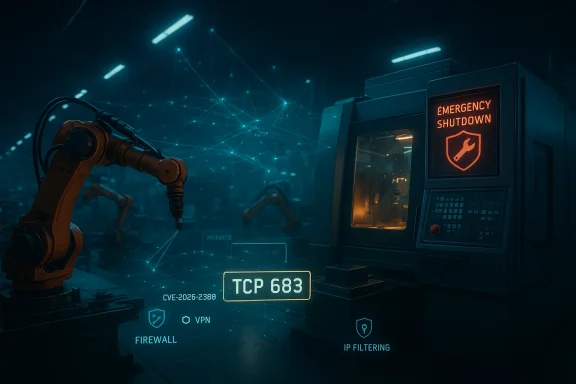
A newly disclosed denial-of-service flaw in Mitsubishi Electric’s CNC software stack is a reminder that industrial systems often fail in the least glamorous place: basic input validation. The issue, tracked as CVE-2025-2399, can let a remote attacker trigger an out-of-bounds read by sending specially crafted packets to TCP port 683, potentially forcing affected controllers into emergency shutdown and requiring a reset to recover. Mitsubishi Electric published its advisory on March 10, 2026, and CISA has since echoed the finding in its industrial control systems advisory stream. (mitsubishielectric.com)
Industrial CNC environments sit at the intersection of precision manufacturing and networked computing, which makes them especially sensitive to weaknesses that might seem modest in a typical IT context. A denial-of-service bug on a machine controller can stop a production line, interrupt time-sensitive machining jobs, and create cascading operational delays far beyond the immediate device. Mitsubishi Electric’s advisory makes clear that this is not a theoretical code-quality issue; the vulnerable behavior can push affected products into emergency shutdown conditions. (mitsubishielectric.com)
The latest issue is part of a broader pattern around Mitsubishi Electric CNC disclosures over the last several years. CISA’s advisory history shows prior CNC-series problems involving remotely exploitable conditions and software-side weaknesses, including a July 2025 advisory on a DLL hijacking issue in CNC software tools and an earlier March 2025 CNC denial-of-service bulletin. In other words, this ecosystem has already been under sustained security scrutiny, and the new finding reinforces how industrial software supply chains tend to accumulate risk over time.
What is notable here is the specificity of the attack surface. This flaw is tied to packets delivered to TCP port 683, which suggests a service or protocol path that may be reachable in more environments than operators expect. That detail matters because many shops assume that “industrial” automatically means “isolated,” when in practice remote support, remote monitoring, flat network design, and third-party integrations often punch holes through that assumption. (mitsubishielectric.com)
Mitsubishi Electric’s own remediation guidance also reflects the realities of OT deployment. Some product families have a fixed version available, while others rely on mitigations and workarounds such as VPNs, firewalls, LAN-only use, IP filtering, physical access restrictions, and anti-virus protections on connected PCs. That combination tells a familiar story: patching is the clean answer, but not always the fastest or most practical one in a factory setting. (mitsubishielectric.com)
The risk profile is therefore more about availability than confidentiality or integrity. Mitsubishi Electric assigns CVSS 3.1 base score 5.9, with network attack vector, no privileges required, and no user interaction required, but high attack complexity and an availability impact rated high. That combination is a classic industrial concern: the flaw is reachable remotely, but it may still require a degree of packet crafting and protocol familiarity. (mitsubishielectric.com)
The advisory says the product may enter emergency shutdown and require a system reset for recovery. That detail is important because it changes the operational burden from “apply a restart during maintenance” to “interrupt machine availability and verify recovery,” which is far more disruptive in high-value manufacturing settings. Even a limited denial-of-service bug can become expensive when it affects a machine tool producing critical parts. (mitsubishielectric.com)
The advisory also lists broader product families such as C80, M700V/M70V/E70, and software tools like NC Trainer2 and NC Trainer2 plus as affected, with their own version conditions. That breadth matters because CNC security advisories frequently span both runtime controllers and engineering tools, and the latter can be just as sensitive if they are used to prepare, load, or administer machine configurations. (mitsubishielectric.com)
This is a small but meaningful operational detail. Industrial fleets are rarely uniform, so version awareness is often the difference between a clean remediation and a missed asset. In practice, that means plant engineers need a repeatable inventory process, not just a patch bulletin sitting in an inbox. (mitsubishielectric.com)
What makes this especially important is that the vulnerability is unauthenticated and remote. That means no stolen credentials are needed, and a network attacker only needs reachability plus the right packet structure. For operators, that shifts the question from “Is the controller internet-facing?” to the broader and more realistic “Can anything untrusted reach the service path?” (mitsubishielectric.com)
The advisory’s recommendation to use a firewall, VPN, LAN-only deployment, and IP filters reflects the fact that many installations cannot be patched instantly. That advice is also a quiet admission that OT remediation often happens in stages, with compensating controls buying time until maintenance windows, validation cycles, and vendor coordination line up. That is not ideal, but it is realistic. (mitsubishielectric.com)
For M800V/M80V Series products, the fixed branch is BC or later. For M800/M80/E80 Series, the fixed branch is FN or later. The company does not describe a one-click automatic remediation path in the advisory, which suggests that operators should expect validation, scheduling, and possibly firmware-management coordination before deploying any changes. (mitsubishielectric.com)
A sensible response sequence would be:
The recommendation to use IP filters is especially practical for supported product families. Mitsubishi Electric notes that the function is available for M800V/M80V Series and M800/M80/E80 Series, with references to the relevant instruction manual appendices. That tells defenders there is a device-native control available on at least part of the fleet, which can be easier to operationalize than relying solely on edge firewall policy. (mitsubishielectric.com)
Physical access restrictions may sound old-fashioned, yet they remain relevant in factories where engineering laptops, service ports, and temporary test equipment can be a hidden route into control networks. Mitsubishi Electric’s inclusion of this mitigation is a reminder that cyber risk in industrial systems still has a strong physical dimension. (mitsubishielectric.com)
The availability focus also makes the vulnerability more than an IT-style nuisance. Industrial operators often build around assumptions of deterministic behavior, and a remote-triggered fault breaks that assumption in a way that can ripple across shifts and even entire production runs. In that sense, the CVSS score understates the business impact if the affected machine is on a constrained or high-mix production line. (mitsubishielectric.com)
This advisory also reinforces a broader market trend: industrial buyers increasingly need security lifecycle management, not just machine capability. Vendors that can provide clear versioning, clear mitigation paths, and clear recovery guidance will be better positioned as customers demand less ambiguity around supportable remediation. That is a competitive advantage as much as a security one. (mitsubishielectric.com)
The July 2025 CNC advisory on uncontrolled search path behavior was especially notable because it affected multiple engineering and monitoring tools, not just runtime devices. By contrast, the new March 2026 issue focuses on the numerical control systems themselves. Together, the pair suggests that attackers and defenders alike should look beyond a single product to the broader CNC ecosystem.
It also suggests that defenders should monitor not only the controller firmware but also remote-monitoring tools, engineer workstations, and update paths. Every one of those layers can become part of the attack surface or the remediation path, and mature adversaries know that a soft administrative tool can be easier to compromise than a hardened real-time controller.
If the answer is yes, then the organization needs a temporary architecture that constrains the route tightly. That may mean a segmented jump host, a narrow VPN policy, device-level IP filters, or a maintenance-only access window. In OT, the right answer is often controlled inconvenience, because uncontrolled convenience is where many incidents begin. (mitsubishielectric.com)
This vulnerability also creates an opportunity for industrial operators to improve their broader CNC security posture. If a company uses this incident to clean up network segmentation, tighten remote access, and refresh its asset inventory, the long-term value can exceed the immediate patch outcome. Good security programs often improve most when responding to a painful but bounded issue. (mitsubishielectric.com)
Another concern is exposure creep. Even when a controller is not directly internet-facing, temporary vendor access, shared infrastructure, and weak segmentation can make it reachable in ways that are easy to overlook. The advisory’s emphasis on VPNs, firewalls, LAN use, and IP filtering is really an indication that operators should assume network reachability can exist unless it is proven otherwise. (mitsubishielectric.com)
Longer term, this advisory is another sign that industrial vendors and customers need to treat network-exposed CNC controllers as continuously managed assets, not static appliances. The more a factory depends on remote support, connected diagnostics, and machine data flows, the more important it becomes to maintain tight control over access paths and protocol surfaces. The era of “air-gapped by assumption” is over. (mitsubishielectric.com)
Source: CISA Mitsubishi Electric CNC Series | CISA
 Background
Industrial CNC environments sit at the intersection of precision manufacturing and networked computing, which makes them especially sensitive to weaknesses that might seem modest in a typical IT context. A denial-of-service bug on a machine controller can stop a production line, interrupt time-sensitive machining jobs, and create cascading operational delays far beyond the immediate device. Mitsubishi Electric’s advisory makes clear that this is not a theoretical code-quality issue; the vulnerable behavior can push affected products into emergency shutdown conditions. (mitsubishielectric.com)The latest issue is part of a broader pattern around Mitsubishi Electric CNC disclosures over the last several years. CISA’s advisory history shows prior CNC-series problems involving remotely exploitable conditions and software-side weaknesses, including a July 2025 advisory on a DLL hijacking issue in CNC software tools and an earlier March 2025 CNC denial-of-service bulletin. In other words, this ecosystem has already been under sustained security scrutiny, and the new finding reinforces how industrial software supply chains tend to accumulate risk over time.
What is notable here is the specificity of the attack surface. This flaw is tied to packets delivered to TCP port 683, which suggests a service or protocol path that may be reachable in more environments than operators expect. That detail matters because many shops assume that “industrial” automatically means “isolated,” when in practice remote support, remote monitoring, flat network design, and third-party integrations often punch holes through that assumption. (mitsubishielectric.com)
Mitsubishi Electric’s own remediation guidance also reflects the realities of OT deployment. Some product families have a fixed version available, while others rely on mitigations and workarounds such as VPNs, firewalls, LAN-only use, IP filtering, physical access restrictions, and anti-virus protections on connected PCs. That combination tells a familiar story: patching is the clean answer, but not always the fastest or most practical one in a factory setting. (mitsubishielectric.com)
What the Vulnerability Is
At the technical core, Mitsubishi Electric describes the bug as an Improper Validation of Specified Index, Position, or Offset in Input issue, classified as CWE-1285. That wording can sound abstract, but the practical effect is straightforward: malformed data can make the software read outside the bounds of expected memory. In this case, the outcome is an out-of-bounds read that destabilizes the controller rather than directly exposing data or enabling code execution. (mitsubishielectric.com)The risk profile is therefore more about availability than confidentiality or integrity. Mitsubishi Electric assigns CVSS 3.1 base score 5.9, with network attack vector, no privileges required, and no user interaction required, but high attack complexity and an availability impact rated high. That combination is a classic industrial concern: the flaw is reachable remotely, but it may still require a degree of packet crafting and protocol familiarity. (mitsubishielectric.com)
Why an out-of-bounds read can still be disruptive
An out-of-bounds read is often less dramatic than an overwrite, but in embedded or controller software it can be just as disruptive. If the read touches invalid or sensitive memory regions, the process may crash, enter a fault state, or trigger a protective shutdown path designed to keep the machine safe. In an OT environment, safe failure is still failure, and the production consequences can be immediate. (mitsubishielectric.com)The advisory says the product may enter emergency shutdown and require a system reset for recovery. That detail is important because it changes the operational burden from “apply a restart during maintenance” to “interrupt machine availability and verify recovery,” which is far more disruptive in high-value manufacturing settings. Even a limited denial-of-service bug can become expensive when it affects a machine tool producing critical parts. (mitsubishielectric.com)
Affected Products and Versioning
Mitsubishi Electric lists two main product groupings for the fixed versions: M800V/M80V Series and M800/M80/E80 Series. For the first group, affected devices include M800VW, M800VS, M80V, and M80VW, with fixes available in BC or later. For the second group, affected devices include M800W, M800S, M80, M80W, and E80, with fixes available in FN or later. (mitsubishielectric.com)The advisory also lists broader product families such as C80, M700V/M70V/E70, and software tools like NC Trainer2 and NC Trainer2 plus as affected, with their own version conditions. That breadth matters because CNC security advisories frequently span both runtime controllers and engineering tools, and the latter can be just as sensitive if they are used to prepare, load, or administer machine configurations. (mitsubishielectric.com)
How operators identify exposure
Mitsubishi Electric provides explicit steps for checking system numbers on the affected controller families. For the CNC hardware series, operators are instructed to open the Diagnostics screen, select Config, and then verify the System Number shown in NCMAIN1 on the Software Configuration screen. For NC Trainer2 products, the company instructs users to check Version Information from the Help menu and confirm the system number beginning with BND. (mitsubishielectric.com)This is a small but meaningful operational detail. Industrial fleets are rarely uniform, so version awareness is often the difference between a clean remediation and a missed asset. In practice, that means plant engineers need a repeatable inventory process, not just a patch bulletin sitting in an inbox. (mitsubishielectric.com)
- Affected families span both controllers and software tools.
- Version thresholds differ by product line.
- System numbers are the key inventory anchor for many models.
- The fix is not a universal firmware drop-in.
- Some customers will need mitigations instead of a patch.
How the Attack Works
The attack path is, on its face, mercifully narrow: send specially crafted packets to TCP port 683. Yet narrow does not mean harmless. In industrial environments, a single exposed service can become a reliable entry point if it is reachable from a routed network segment, a vendor VPN, or a poorly segmented maintenance network. (mitsubishielectric.com)What makes this especially important is that the vulnerability is unauthenticated and remote. That means no stolen credentials are needed, and a network attacker only needs reachability plus the right packet structure. For operators, that shifts the question from “Is the controller internet-facing?” to the broader and more realistic “Can anything untrusted reach the service path?” (mitsubishielectric.com)
The practical reality in plants
In real facilities, engineers frequently rely on remote monitoring tools, temporary vendor access, and shared OT/IT infrastructure that can blur trust boundaries. A device that is not directly exposed to the public internet may still be reachable from adjacent systems that are compromised or misconfigured. That is why CISA and Mitsubishi Electric both emphasize layered network controls rather than a single perimeter assumption. (mitsubishielectric.com)The advisory’s recommendation to use a firewall, VPN, LAN-only deployment, and IP filters reflects the fact that many installations cannot be patched instantly. That advice is also a quiet admission that OT remediation often happens in stages, with compensating controls buying time until maintenance windows, validation cycles, and vendor coordination line up. That is not ideal, but it is realistic. (mitsubishielectric.com)
Remediation and Vendor Fixes
Mitsubishi Electric says customers with eligible products should apply the fixed version and consult a Mitsubishi Electric representative for instructions. The remediation split is simple on paper but operationally complex: some systems can move to the corrected branch, while others require temporary mitigations because no fixed version is available yet. (mitsubishielectric.com)For M800V/M80V Series products, the fixed branch is BC or later. For M800/M80/E80 Series, the fixed branch is FN or later. The company does not describe a one-click automatic remediation path in the advisory, which suggests that operators should expect validation, scheduling, and possibly firmware-management coordination before deploying any changes. (mitsubishielectric.com)
What good remediation looks like in OT
The right response is more than “patch and move on.” It is inventory, exposure review, maintenance planning, backup verification, and post-change functional testing. A CNC controller sits inside a production process, not a desktop environment, so the blast radius of a failed update can exceed the blast radius of the vulnerability itself if changes are rushed. (mitsubishielectric.com)A sensible response sequence would be:
- Identify every exposed CNC asset and confirm its exact system number.
- Determine whether a fixed version exists for that branch.
- Review network reachability to TCP port 683.
- Apply segmentation or filtering where patching cannot happen immediately.
- Schedule patching in a controlled maintenance window.
- Validate machine behavior after the update.
Mitigations When Patching Is Not Immediate
Mitsubishi Electric’s mitigation list is unusually explicit, which is useful because many OT advisories stop at vague advice like “restrict access.” Here, the company recommends firewalls or VPNs when internet access is required, LAN-only use with untrusted access blocked, IP filters on supported product lines, physical access restrictions, and anti-virus software on connected PCs. (mitsubishielectric.com)The recommendation to use IP filters is especially practical for supported product families. Mitsubishi Electric notes that the function is available for M800V/M80V Series and M800/M80/E80 Series, with references to the relevant instruction manual appendices. That tells defenders there is a device-native control available on at least part of the fleet, which can be easier to operationalize than relying solely on edge firewall policy. (mitsubishielectric.com)
Defense-in-depth matters more than any single control
A firewall can reduce exposure, but it does not substitute for network design that keeps critical controllers off untrusted paths. Likewise, a VPN can improve access control, but only if it is tightly managed and not used as a broad bridge into a flat plant network. The most important lesson here is that compensating controls only work when they are layered. (mitsubishielectric.com)Physical access restrictions may sound old-fashioned, yet they remain relevant in factories where engineering laptops, service ports, and temporary test equipment can be a hidden route into control networks. Mitsubishi Electric’s inclusion of this mitigation is a reminder that cyber risk in industrial systems still has a strong physical dimension. (mitsubishielectric.com)
- Firewall or VPN controls should be treated as temporary shields, not permanent substitutes for patching.
- LAN-only deployment is preferable when remote access is unnecessary.
- IP filtering can reduce exposure on supported device families.
- Physical security still matters in OT environments.
- Endpoint protection on connected PCs remains part of the overall risk picture.
Why This Matters for Manufacturers
For manufacturers, the biggest issue is not simply whether the controller crashes. It is what that crash does to throughput, scheduling, and customer commitments. A stopped CNC machine can interrupt a job at a bad moment, affect downstream operations, and force requalification or rework if the process is highly controlled. (mitsubishielectric.com)The availability focus also makes the vulnerability more than an IT-style nuisance. Industrial operators often build around assumptions of deterministic behavior, and a remote-triggered fault breaks that assumption in a way that can ripple across shifts and even entire production runs. In that sense, the CVSS score understates the business impact if the affected machine is on a constrained or high-mix production line. (mitsubishielectric.com)
Enterprise versus plant-floor impact
At the enterprise level, this is a security management issue: asset inventory, patch governance, supplier coordination, and exposure reduction. At the plant-floor level, it is a production continuity issue that may force operators to choose between risk acceptance and downtime. The best organizations connect those two layers, while weaker ones treat them as separate silos until an incident forces convergence. (mitsubishielectric.com)This advisory also reinforces a broader market trend: industrial buyers increasingly need security lifecycle management, not just machine capability. Vendors that can provide clear versioning, clear mitigation paths, and clear recovery guidance will be better positioned as customers demand less ambiguity around supportable remediation. That is a competitive advantage as much as a security one. (mitsubishielectric.com)
Comparison With Earlier Mitsubishi Electric CNC Advisories
The March 2026 bulletin does not exist in isolation. Mitsubishi Electric’s CNC series has previously been the subject of CISA advisories dealing with both remote denial-of-service conditions and malicious code execution paths, which indicates a recurring need to harden both the controller software and the companion tools around it. That history matters because it shows the current issue is part of a maturity curve, not a one-off anomaly.The July 2025 CNC advisory on uncontrolled search path behavior was especially notable because it affected multiple engineering and monitoring tools, not just runtime devices. By contrast, the new March 2026 issue focuses on the numerical control systems themselves. Together, the pair suggests that attackers and defenders alike should look beyond a single product to the broader CNC ecosystem.
What the trend suggests
The pattern is not unusual in industrial automation. Complex product families often mix legacy code, protocol compatibility requirements, and long lifecycle commitments, all of which can create a backlog of security debt. A vendor can be highly competent and still find that the realities of embedded support windows make vulnerabilities linger longer than anyone would like. Industrial longevity is a blessing and a burden. (mitsubishielectric.com)It also suggests that defenders should monitor not only the controller firmware but also remote-monitoring tools, engineer workstations, and update paths. Every one of those layers can become part of the attack surface or the remediation path, and mature adversaries know that a soft administrative tool can be easier to compromise than a hardened real-time controller.
Operational Priorities for Security Teams
Security and engineering teams should treat this as a network exposure problem first and a firmware issue second. The first step is identifying whether any systems can reach TCP port 683 from untrusted networks, then determining whether those paths are truly required. If the answer is no, then closure should be immediate. (mitsubishielectric.com)If the answer is yes, then the organization needs a temporary architecture that constrains the route tightly. That may mean a segmented jump host, a narrow VPN policy, device-level IP filters, or a maintenance-only access window. In OT, the right answer is often controlled inconvenience, because uncontrolled convenience is where many incidents begin. (mitsubishielectric.com)
Priorities in plain language
- Confirm whether the controller is in the affected version range.
- Inventory every device and engineering workstation with access.
- Block unnecessary access to TCP port 683.
- Use the strongest available compensating controls.
- Plan patching during a verified maintenance window.
- Recheck emergency shutdown behavior after remediation.
Strengths and Opportunities
The good news is that Mitsubishi Electric has provided a relatively clear advisory with specific affected models, explicit fixed branches, and concrete mitigations. That gives operators a workable remediation map, which is more than many industrial advisories provide. It also gives security teams something they can turn into action rather than speculation. (mitsubishielectric.com)This vulnerability also creates an opportunity for industrial operators to improve their broader CNC security posture. If a company uses this incident to clean up network segmentation, tighten remote access, and refresh its asset inventory, the long-term value can exceed the immediate patch outcome. Good security programs often improve most when responding to a painful but bounded issue. (mitsubishielectric.com)
- Clear product/version guidance helps accelerate remediation.
- Availability-focused risk is easier to explain to plant leadership.
- Device-native IP filtering can reduce exposure quickly.
- The issue is a good trigger for asset inventory cleanup.
- Network segmentation improvements will pay dividends beyond this CVE.
- Vendor support paths appear to be well defined.
- The advisory helps align IT security and OT operations around a shared task.
Risks and Concerns
The main concern is that availability bugs in industrial controllers are often underestimated because they do not sound as severe as code execution flaws. That mindset can delay patching until a production incident forces the issue, and by then the organization is already reacting under pressure. The fact that this bug can trigger emergency shutdown makes the operational risk concrete, not academic. (mitsubishielectric.com)Another concern is exposure creep. Even when a controller is not directly internet-facing, temporary vendor access, shared infrastructure, and weak segmentation can make it reachable in ways that are easy to overlook. The advisory’s emphasis on VPNs, firewalls, LAN use, and IP filtering is really an indication that operators should assume network reachability can exist unless it is proven otherwise. (mitsubishielectric.com)
- Downtime risk may be larger than the CVSS score suggests.
- Flat networks can make “remote” attacks possible from inside the plant.
- Some product lines may lack immediate fixed versions.
- Patching may require vendor assistance and planned downtime.
- Recovery requires a system reset, which can delay resumption.
- Connected PCs broaden the practical attack surface.
- Legacy lifecycle constraints may slow remediation in older deployments.
Looking Ahead
The next phase is likely to be routine but important: asset owners will need to determine where the affected system numbers exist, whether those devices are reachable from untrusted networks, and how quickly the fixed branches can be installed. For many plants, the real work will be in scheduling and validation rather than the software update itself. That is typical for OT, where the human process around remediation often matters more than the binary patch. (mitsubishielectric.com)Longer term, this advisory is another sign that industrial vendors and customers need to treat network-exposed CNC controllers as continuously managed assets, not static appliances. The more a factory depends on remote support, connected diagnostics, and machine data flows, the more important it becomes to maintain tight control over access paths and protocol surfaces. The era of “air-gapped by assumption” is over. (mitsubishielectric.com)
What to watch next
- Whether Mitsubishi Electric issues further updates or clarifications.
- How quickly customers adopt the fixed branches.
- Whether affected sites rely more heavily on IP filtering and VPNs.
- Whether additional CNC-series advisories emerge this year.
- Whether operators revise remote-access policies after reviewing port 683 exposure.
Source: CISA Mitsubishi Electric CNC Series | CISA
