

The challenge to Modbury’s neighbourhood housing plan turns on a deceptively small planning phrase, but the implications are much larger. At issue is whether the Modbury Neighbourhood Plan has enough housing-policy content to satisfy the legal test in paragraph 14(b) of the National Planning Policy Framework. The developer’s KC says no; an AI review says the opposite, arguing that the plan’s settlement boundary, JLP-backed allocations and development-management policies are enough to count. That clash matters because neighbourhood plans are supposed to give communities some certainty, yet they only carry special weight if they meet the housing-allocation rules properly. hbourhood planning was designed to give towns and parishes a direct say in where development should go, but it has never been a blank cheque. Under the framework used in planning law, neighbourhood plans gain protection only when they do more than express preferences; they have to meet an identified housing requirement through policies and allocations. GOV.UK’s guidance is explicit that the relevant policies and allocations must satisfy that housing requirement in full, and that a policy on windfalls alone is not enough.
That is where the legal argument in Modbury starts to matter. The reporting says the developer’s KC argued the plan fails because it does not contain allocations sufficient to meet the housing requirement, which would defeat the protection sought under paragraph 14(b). The AI-generated counterview, by contrast, treats the plan’s existing settlement boundary and governance of Joint Local Plan allocations as functionally adequate. In other words, one side sees a missing allocation exercise; the other sees a plan that works because the housing task was a level.
The distinction between a strategic plan and a neighbourhood plan is central here. The Joint Local Plan for South Hams, Plymouth and West Devon already allocated sites across the wider area, including the category of “smaller towns,” and historical reporting shows those allocations were intended to guide where growth would go in places like Modbury. That creates a real tension: if the strategic plan has already carried the housing burden, how much is left for the neighbourhood plan to do? The answer depends on the legal construction of paragraph 14(b), not on common-sense assumptions about local growth.
There is also a broader policy backdrop. Government guidance on neighbourhood planning says the plan must have policies and allocations that meet the identified housing requirement, but it also acknowledges that the requirement may come from strategic policies or an indicative figure supplied by the local authority. That means a neighbourhood plan can be protected even when it is not inventing a new housing target from scratch, provided it actually covers the requirement in its own policies and allocations. This is the fine legal seam the Modbury dispute is testing.
The dispute is not really about whether Modbury needs housing policy. It is about whether the neighbourhood plan’s existing content is legally sufficient to trigger the protection in paragraph 14(b). The developer’s KC says the answer is no becau kind of explicit allocations the framework contemplates. The AI review says yes because the JLP already allocated sites and the neighbourhood plan’s own policies still govern delivery.
That matters because a neighbourhood plan cannot simply point to strategic allocations elsewhere and claim the benefit of paragraph 14(b) by association. GOV.UK guidance says policies and allocations contained in other development plan documents, such as a local plan, will not count for the criterion. So the central legal problem is whether Modbury’s own plan contains enough of its own policy machinery to satisfy the rule, not whether the wider JLP once identified growth in the area.
The AI review appears to interpret settlement boundaries and delivery policies as sufficient “policies and allocations.” That is a more elastic reading, ive to a plan-maker because it preserves the neighbourhood plan’s role without requiring a fresh site-allocation exercise. But elastic does not necessarily mean lawful. Planning disputes often turn on whether a court or inspector accepts a flexible reading or insists on a more literal one.
At the same time, the framework also respects the hierarchy of planning documents. Strategic policies are supposed to set the broad pattern and scale of development, while neighbourhood plans translate that into local shape and character. If the JLP already allocated Modbury’s contribution, the question becomes whether the neighbourhood plan is being unfairly asked to repeat work already completed at strategic level. That tension is what makes the case interesting.
That said, a boundary is not the same thing as an allocation. A settlement boundary restricts and channels growth, but it does not always amount to identifying specific land to meet a quantified housing need. The difference is subtle, yet legally important. A plan can manage devssarily satisfying the specific paragraph 14(b) test that Government guidance describes.
The AI review’s value is therefore analytical, not determinative. It highlights a plausible way a decision-maker might see the document as a complete policy package. But whether that package meets the letter of national policyon. Plausible in planning is not the same as defensible.
But again, the legal question is whether operational policies alone satisfy the housing-requirement test. GOV.UK’s guidance says the policies and allocations should meet the housing requirement in full, and gives the example of sites plus windfall allowance. That suggests a mix of positive delivery mechanisms may work, but only if the housing nut within the plan itself.
The AI review seems to rely on a functionalist reading: if the strategic plan already allocated land and the neighbourhood plan now controls how those allocations are delivered, then the system is doing its job. That is a respectable planning argument. It is not, however, the only one available, and it may struggle if the framework is interpreted strictly. That is the real vulnerability.
This is why the AI review’s framing matters. If Modbury has already been assigned housing through the JLP, then the neighbourhood plan may be more about refining than reallocating. That would fit the ordinary division of labour between strategic and neighbourhood planning, especially where the neighbourhood plan is trying to preserve local character while avoiding a second round of site selection.
The problem is that national policy for neighbourhood plans has become increasingly explicit about site allocation as the route to protection. Government consultations and responses over recent years have repeatedly emphasised that a neighbourhood plan must allocate a housing site to benefit from the paragraph 14 protection. That trend makes the local plan hierarchy less helpful if the neighbourhood plan itself is thin on allocations.
But hierarchy can also work against Modbury. If the JLP allocations are the strategic source of the housing requirement, then the neighbourhood plan still has to show its own policies and allocations for the protection to apply. That is where the government guidance is hard-edged: it says other development plan documents do not satisfy criterion 14(b) for the neighbourhood plan.
The planning field is particularly vulnerable to this problem because it blends statute, policy, guidance, local evidence and case-specific judgment. An AI model can often summarise the framework well, but it may overstate certainty where the real issue is interpretation. That is why the Modbury example is revealing: the AI review sounds confident, but the legal question remains one of formal compliance, not rhetorical persuasion. Confidence is not authority.
There is also a practical benefit to AI in this context. It can help residents, councillors and journalists see how arguments are being framed, especially where planning language becomes opaque. But any AI-assisted analysis still needs to be checked against the actual policy wording and the legal status of the documents involved. GOV.Uthe anchor, not the model’s paraphrase of it.
The risk for the developer is that a too-literal approach may ignore the plan’s structural role within the JLP system. If the neighbourhood plan is only one part of a larger housing framework, decision-makers may be reluctant to invalidate it for not repeating allocations already made elsewhere. That is especially true if the local evidence shows the community has already accepted strategic growth.
Still, the developer’s position benefits from the official guidance, which repeatedly insists on housing requirements being met by the neighbourhood plan’s own policies and allocations. That is why the dispute is so tight: the broader planning logic may favour the AI review, while the black-letter guidance may favour the developer. Those are not the same thing.
A second strength is procedural. If the JLP allocations are indeed strategic rather than neighbourhood-specific, then relying on them for paragraph 14(b) may be legally insufficient. The government’s guidance warns against exactly that kind of substitution. On that reading, the developer does not need to disprove the plan’s general usefulness; it only needs to show the legal test has not been met.
What makes the issue harder is that the legal answer may not line up neatly with the planning story communities tell themselves. A town can accept growth through the JLP and still believe its neighbourhood plan should count as protective. But if national guidance insists on allocations within the neighbourhood plan itself, the procedural label will matter as much as the practical outcome. That is a lesson Modbury may now be forced to confront.
Source: Dartmouth Chronicle AI disputes Modbury housing plan's legal basis
That is where the legal argument in Modbury starts to matter. The reporting says the developer’s KC argued the plan fails because it does not contain allocations sufficient to meet the housing requirement, which would defeat the protection sought under paragraph 14(b). The AI-generated counterview, by contrast, treats the plan’s existing settlement boundary and governance of Joint Local Plan allocations as functionally adequate. In other words, one side sees a missing allocation exercise; the other sees a plan that works because the housing task was a level.
The distinction between a strategic plan and a neighbourhood plan is central here. The Joint Local Plan for South Hams, Plymouth and West Devon already allocated sites across the wider area, including the category of “smaller towns,” and historical reporting shows those allocations were intended to guide where growth would go in places like Modbury. That creates a real tension: if the strategic plan has already carried the housing burden, how much is left for the neighbourhood plan to do? The answer depends on the legal construction of paragraph 14(b), not on common-sense assumptions about local growth.
There is also a broader policy backdrop. Government guidance on neighbourhood planning says the plan must have policies and allocations that meet the identified housing requirement, but it also acknowledges that the requirement may come from strategic policies or an indicative figure supplied by the local authority. That means a neighbourhood plan can be protected even when it is not inventing a new housing target from scratch, provided it actually covers the requirement in its own policies and allocations. This is the fine legal seam the Modbury dispute is testing.
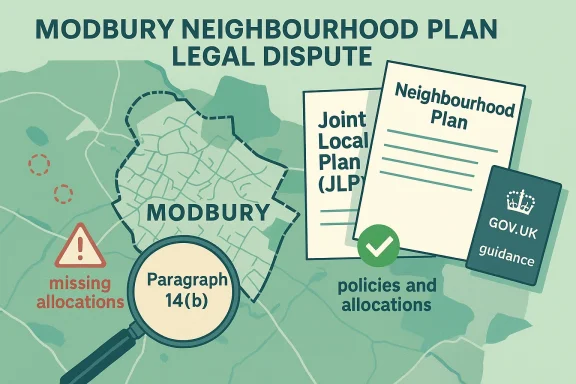 The Core Legal Question
The dispute is not really about whether Modbury needs housing policy. It is about whether the neighbourhood plan’s existing content is legally sufficient to trigger the protection in paragraph 14(b). The developer’s KC says the answer is no becau kind of explicit allocations the framework contemplates. The AI review says yes because the JLP already allocated sites and the neighbourhood plan’s own policies still govern delivery.What Paragraph 14(b) Actually Requires
The current government guidance is unusually direct on this point. It explains that the policies and allocations in a neighbourhood plan should meet the identified housing requirement in full, whether that requirement comes from strategic policy, an indicative local authority figure, or a figure set exceptionally by the neighbourhood body itself. It even gives a practical example of how multiple sites plus windfall allowance can satisfy the test.That matters because a neighbourhood plan cannot simply point to strategic allocations elsewhere and claim the benefit of paragraph 14(b) by association. GOV.UK guidance says policies and allocations contained in other development plan documents, such as a local plan, will not count for the criterion. So the central legal problem is whether Modbury’s own plan contains enough of its own policy machinery to satisfy the rule, not whether the wider JLP once identified growth in the area.
The AI review appears to interpret settlement boundaries and delivery policies as sufficient “policies and allocations.” That is a more elastic reading, ive to a plan-maker because it preserves the neighbourhood plan’s role without requiring a fresh site-allocation exercise. But elastic does not necessarily mean lawful. Planning disputes often turn on whether a court or inspector accepts a flexible reading or insists on a more literal one.
Why the Allocation Issue Is So Sensitive
The allocation requirement exists for a reason. If neighbourhood plans could receive special protection while avoiding real housing choices, the framework would be too easy to game. The policy is meant to reward communities that shape growth constructively, not just communities that erect procedural barriers. That is why the wording around “policies and allocations” is more than bureaucratic detail; it is the legal gatekeeper to a powerful planning presumption.At the same time, the framework also respects the hierarchy of planning documents. Strategic policies are supposed to set the broad pattern and scale of development, while neighbourhood plans translate that into local shape and character. If the JLP already allocated Modbury’s contribution, the question becomes whether the neighbourhood plan is being unfairly asked to repeat work already completed at strategic level. That tension is what makes the case interesting.
- The developer’s argument is that Modbury lacks sufficient site allocations.
- The AI response is that existing JLP allocations and local plan controls are enough.
- The legal hinge is whether paragraph 14(b) demands fresh allocations inside the neighbourhood plan itself.
- GOV.UK guidance suggests that other plan documents do not satisfy the criterion on their own.
Whhes Back
The AI review’s most interesting contribution is not that it disagrees with the KC, but how it reframes the document hierarchy. It says Modbury is a Smaller Town in the JLP hierarchy and that the JLP already allocated sites for it, so the neighbourhood plan did not need to add more land allocations. That is a smart planning-policy argument because it shifts the focus from standalone complompliance across the plan system.Settlement Boundaries as a Legal Hook
The AI review also points to settlement boundaries. In planning practice, those boundaries are often treated as a strong control on where development should occur and where it should not. If the neighbourhood plan contains settlement boundaries, the argument goes, then it is not merely passive or descriptive; it is actively shaping where housing can happen.That said, a boundary is not the same thing as an allocation. A settlement boundary restricts and channels growth, but it does not always amount to identifying specific land to meet a quantified housing need. The difference is subtle, yet legally important. A plan can manage devssarily satisfying the specific paragraph 14(b) test that Government guidance describes.
The AI review’s value is therefore analytical, not determinative. It highlights a plausible way a decision-maker might see the document as a complete policy package. But whether that package meets the letter of national policyon. Plausible in planning is not the same as defensible.
Delivery Policies and Development Management Criteria
The review also cites “policies governing delivery of the JLP allocations” and “development management criteria.” That matters because a neighbourhood plan need not only allocate new sites; it can also establish the rules under which allocated sites should come forward. In that sense, the plan can be operational without being expansive.But again, the legal question is whether operational policies alone satisfy the housing-requirement test. GOV.UK’s guidance says the policies and allocations should meet the housing requirement in full, and gives the example of sites plus windfall allowance. That suggests a mix of positive delivery mechanisms may work, but only if the housing nut within the plan itself.
The AI review seems to rely on a functionalist reading: if the strategic plan already allocated land and the neighbourhood plan now controls how those allocations are delivered, then the system is doing its job. That is a respectable planning argument. It is not, however, the only one available, and it may struggle if the framework is interpreted strictly. That is the real vulnerability.
The Joint Local Plan Context
The JLP background is essential because Modbury did not exist in a policy vacuum. Historical reporting shows the Joint Local Plan was built to allocate substantial numbers of homes across the area, including a separate bucket for smaller towns and key villages. In other words, the region’s housing task was apportioned at strategic level long before the current dispute.What the JLP Was Trying to Do
The JLP was designed to shape where development takes place across the three-authority area, and that means local places like Modbury were never meant to shoulder the whole planning burden independently. The plan was widely described as allocating sites for different forms of development, with f the overall housing target assigned to smaller settlements. That makes Modbury’s designation as a smaller town more than a label; it is part of the planning hierarchy that determines who plans for what.This is why the AI review’s framing matters. If Modbury has already been assigned housing through the JLP, then the neighbourhood plan may be more about refining than reallocating. That would fit the ordinary division of labour between strategic and neighbourhood planning, especially where the neighbourhood plan is trying to preserve local character while avoiding a second round of site selection.
The problem is that national policy for neighbourhood plans has become increasingly explicit about site allocation as the route to protection. Government consultations and responses over recent years have repeatedly emphasised that a neighbourhood plan must allocate a housing site to benefit from the paragraph 14 protection. That trend makes the local plan hierarchy less helpful if the neighbourhood plan itself is thin on allocations.
Why Hierarchy Cuts Both Ways
There is a legitimate argument that the JLP already did the heavy lifting, and the neighbourhood plan should not be punished for respecting that structure. Planning systems are supposed to avoid duplication, and duplicate allocation exercises can create confusion. If the strategic plan settled the amount and broad location of growth, a neighbourhood plan that concentrates on delivery rules may still be faithful to the wider architecture.But hierarchy can also work against Modbury. If the JLP allocations are the strategic source of the housing requirement, then the neighbourhood plan still has to show its own policies and allocations for the protection to apply. That is where the government guidance is hard-edged: it says other development plan documents do not satisfy criterion 14(b) for the neighbourhood plan.
- The JLP gives Modbury a broader strategic context.
- The JLP may support the AI review’s view that Modbury already has a housing role.
- Yet national guidance still requires the contain its own sufficient policies and allocations.
- The legal fight is therefore about whether Modbury’s plan is enough on its own terms.
Why This Matters Beyond Modbury
This is not just a parochial planning spat. The controversy highlights a wider problem for neighbourhood planning in England: communities want influence, but the national policy framework increasingly tively accommodate housing, not just manage its edges. If that direction continues, more neighbourhood plans will face pressure to include explicit allocations or risk losing protection.The AI Angle Is the New Wildcard
What makes this episode unusual is that an AI system is being used to contest a legal opinion. That does not make the AI right, but it does show how generative tools are being pulled into planning disputes, where they can act as second-readers, argument generators, or document critics. In practice, that can be uit can also be dangerous if users mistake fluent analysis for verified law.The planning field is particularly vulnerable to this problem because it blends statute, policy, guidance, local evidence and case-specific judgment. An AI model can often summarise the framework well, but it may overstate certainty where the real issue is interpretation. That is why the Modbury example is revealing: the AI review sounds confident, but the legal question remains one of formal compliance, not rhetorical persuasion. Confidence is not authority.
There is also a practical benefit to AI in this context. It can help residents, councillors and journalists see how arguments are being framed, especially where planning language becomes opaque. But any AI-assisted analysis still needs to be checked against the actual policy wording and the legal status of the documents involved. GOV.Uthe anchor, not the model’s paraphrase of it.
The Developer’s Legal Pressure
The developer’s KC has the simpler case on paper: no allocations, no protection. That is attractive because it tracks the straightforward reading of paragraph 14(b), and it avoids asking the decision-maker to stretch the wording too far. In planning law, clear tests are often easier to defend than nuanced system-wide arguments.Simplicity Can Be Powerful
A concise argument has real force when the policy text is explicit. If the neighbourhood plan does not itself contain allocations sufficient to meet the housing requirement, then the developer can argue the paragraph 14 exemption does not apply, leaving the presumption in favour of sustainable development to bite. That is a potent position because it turns question into a decision rule.The risk for the developer is that a too-literal approach may ignore the plan’s structural role within the JLP system. If the neighbourhood plan is only one part of a larger housing framework, decision-makers may be reluctant to invalidate it for not repeating allocations already made elsewhere. That is especially true if the local evidence shows the community has already accepted strategic growth.
Still, the developer’s position benefits from the official guidance, which repeatedly insists on housing requirements being met by the neighbourhood plan’s own policies and allocations. That is why the dispute is so tight: the broader planning logic may favour the AI review, while the black-letter guidance may favour the developer. Those are not the same thing.
What Would Strengthen the Developer’s Case
The most persuasive evidence for the developer would be a close reading of the plan text showing that the relevant allocations are absent, indirect or already exhausted by the JLP. If the neighbourhood plan only contains generic boundary policies and development-management criteria, then the claim that it “meets” the housing requirement becomes harder to sustain. That would bring the case closer to a classic criterion-failure analysis.A second strength is procedural. If the JLP allocations are indeed strategic rather than neighbourhood-specific, then relying on them for paragraph 14(b) may be legally insufficient. The government’s guidance warns against exactly that kind of substitution. On that reading, the developer does not need to disprove the plan’s general usefulness; it only needs to show the legal test has not been met.
- A simple non-compliance argument is often the strongest planning argument.
- The developer benefits from the guidance’s plain wording.
- The key weakness for the defence is over-reliance on strategic allocations.
- If the plan lacks its own site allocations, the legal protection may fail.
Strengths and Opportunities
This case, oddly enough, highlights several strengths in how local being handled, and it also points to opportunities for better public understanding. The AI review shows how residents can interrogate legal claims quickly, while the JLP background demonstrates that planning is genuinely hierarchical rather than isolated. Done properly, this kind of scrutiny can improve transparency around what a neighbourhood plan is supposed to do.- AI tools can help stress-test planning arguments before they harden into public claims.
- Clearer summaries of the JLP hierarchy can improve local planning literacy.
- Neighbourhood plans that integrate allocations well can reduce future dispute risk.
- Strategic plans and neighbourhood plans can be better aligned if drafters understand the paragraph 14(b) test early.
- Public debate can force councils to explain the difference between policy control and site allocation.
- The Modbury case may become a useful precedent for other smaller towns wrestling with the same issue.
- Better drafting could turn AI from a novelty into a genuine civic review tool.
Risks and Concerns
The biggest risk is that people will read an AI-produced analysis as if it were a legal ruling. That would be a mistake in any field, but it is especially risky in planning, where small wording differences can change the outcome. If the plan is challenged on appeal or at examination, the decisive question will be what the policy texts actually say, not what a model thinks they mean.- AI can sound authoritative even when it is only offering an interpretive guess.
- Planning law depends on exact wording, not just broad policy themes.
- A neighbourhood plan may be vulnerable if it relies too heavily on strategic allocations.
- Residents may assume the JLP already “covers” Modbury when the legal test may require more.
- Overconfidence from either side could escalate a dispute that might otherwise be resolved by careful drafting.
- If guidance changes, older arguments may become outdated quickly.
- A poor understanding of the hierarchy between JLP and neighbourhood plan could lead to avoidable litigation.
Looking Ahead
The next step will almost certainly be technical rather than political. Someone will have to decide whether Modbury’s neighbourhood plan, in its current form, contains enough actual policy and allocation content to satisfy the paragraph 14(b) protection. If it does not, the plan may still be useful locally, but it may lose the special planning shelter it is trying to claim.What makes the issue harder is that the legal answer may not line up neatly with the planning story communities tell themselves. A town can accept growth through the JLP and still believe its neighbourhood plan should count as protective. But if national guidance insists on allocations within the neighbourhood plan itself, the procedural label will matter as much as the practical outcome. That is a lesson Modbury may now be forced to confront.
- Watch whether the plan is revised to include clearer housing allocations.
- Watch how inspectors interpret the relationship between JLP allocations and neighbourhood-level protection.
- Watch whether other South Hams neighbourhood plans are affected by the same legal reading.
- Watch whether AI-assisted planning commentary becomes more common in local disputes.
- Watch for any clarification from guidance or appeal decisions on what counts as sufficient policies and allocations.
Source: Dartmouth Chronicle AI disputes Modbury housing plan's legal basis
