

On the morning after the Big Game, McDonald’s literally rotated its ads — and the industry noticed. This week’s roundup of standout creative, led by ADWEEK’s “Ads of the Week” selection, surfaces a clear set of themes: timing and context as creative levers, Valentine’s messaging that leans into messy modern love, and the increasing presence of AI as both subject and tool in advertising. From Wieden+Kennedy New York’s cheeky “Horizontal Breakfast” to DoorDash’s panic‑of‑gifting spot, the work underlines how brands are competing not just for attention but for immediate cultural relevance. Below, an in‑depth look at the campaigns that caught our eye, the strategic play behind each, and what marketers should steal — and avoid — from their playbooks.
Advertising has always been a race to meet attention where it lives. But two developments have tightened the window for impact in the last 24 months: 1) cultural events (Super Bowl, award shows, holidays) create micro‑moments of predictable behavior, and 2) modern media channels let brands respond quickly with cross‑platform treatments. The result is a growing appetite for “moment first” creative: ideas that work because they align with a specific emotion or posture consumers are actually in at a moment in time.
This week’s highlights all play that game:
The campaign showed in digital spots and high‑visibility OOH (including major screens), and social channels mirrored the same sideways art direction. The play was simple, immediately legible, and hard to ignore: if you’re horizontal, McDonald’s breakfast will get you vertical.
Ads that dramatize last‑minute panics have long been high‑conversion: they map a clear problem to an immediate product solution (fast delivery, curated options, guaranteed arrival windows). DoorDash’s execution relies on rapid comedic beats and an immediate CTA to drive conversions through the app.
This tonal pivot reflects a broader trend: audiences (particularly younger cohorts) are less persuaded by aspirational perfection and more by authenticity — the honest, sometimes funny moments that feel like people not characters.
EDO’s involvement matters: their measurement framework evaluates not just creative craft but commercial effectiveness (recall, persuasion, purchase intent, or other KPIs). When EDO flags an AI‑forward ad as “Most Effective,” it signals the message resonated with audiences and moved measurable needles.
For marketers, the prescription is simple: identify the exact moment you want to own, design creative that matches the audience’s posture and emotion at that moment, and make sure your product and operations can deliver on the promise. Do that, and even a sideways billboard can move behavior.
Source: ADWEEK Ads of the Week: 6 Campaigns That Caught Our Eye, From McDonald's to DoorDash
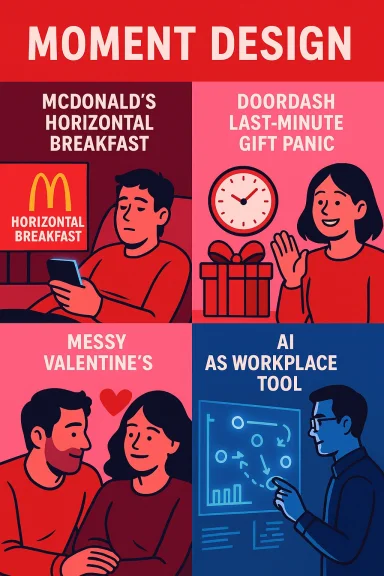 Background / Overview
Advertising has always been a race to meet attention where it lives. But two developments have tightened the window for impact in the last 24 months: 1) cultural events (Super Bowl, award shows, holidays) create micro‑moments of predictable behavior, and 2) modern media channels let brands respond quickly with cross‑platform treatments. The result is a growing appetite for “moment first” creative: ideas that work because they align with a specific emotion or posture consumers are actually in at a moment in time.This week’s highlights all play that game:
- McDonald’s used physical orientation (the literal angle of the creative) to reflect post‑game lethargy.
- Several Valentine’s Day ads leaned into awkward, authentic, or last‑minute emotional beats rather than glossy romance.
- A data/measurement partner (EDO) surfaced a Most Effective Ad that uses AI as a narrative device to show practical, workplace applications — a sign that brands are comfortable positioning AI as a productivity tool, not just a buzzword.
McDonald’s — “Horizontal Breakfast” (Wieden+Kennedy New York)
What the creative actually did
McDonald’s launched a compact campaign intended to capture the cultural hangover the morning after the Super Bowl. The idea, called Horizontal Breakfast, flips creative assets 90 degrees so that video spots, social posts, and out‑of‑home billboards are oriented sideways — deliberately matching the posture of viewers sprawled on couches and scrolling horizontally on their phones. The 15‑second spot centers on a viewer too tired to sit up; the camera language and creative orientation emphasize the horizontal posture while an app ordering CTA does the heavy lifting.The campaign showed in digital spots and high‑visibility OOH (including major screens), and social channels mirrored the same sideways art direction. The play was simple, immediately legible, and hard to ignore: if you’re horizontal, McDonald’s breakfast will get you vertical.
Why it works: timing, empathy, craft
The campaign succeeds on three levels.- Cultural timing. The day‑after is a known behavioral moment: millions of viewers are in a post‑game, low‑energy state. By launching on that specific Monday morning, McDonald’s turned a calendar insight into an activation that felt custom‑made for the audience’s exact condition.
- Empathy and humor. The sideways execution is not only a visual stunt — it reads as a wink to people who are too tired to pretend otherwise. That kind of light, topical humor tends to be high‑reward: it earns a smile without asking for deep brand allegiance.
- Craft and coherence. The strategy tied app ordering, menu items (hot honey sausage + egg biscuit, hash browns, a Coke), and OOH copy into a consistent narrative — one that points directly to conversion. The ad didn’t try to be more than it was; it solved a narrow job: get people to order breakfast when they couldn’t be bothered to stand up.
Potential risks and caveats
No campaign is risk‑free. McDonald’s play introduces a few potential downsides:- Readability and legibility. Rotating OOH creative can backfire if viewers can’t quickly process copy or logos. A sideways billboard will work for attention, but if the message is dense, drivers and passersby might miss it entirely.
- Tone sensitivity. Joking about post‑party hangovers is low‑stakes for most, but any humor referencing substance use or sickness carries a tiny reputational risk if executed clumsily.
- Short shelf life. The cleverness is highly tethered to the Super Bowl moment; as a creative formula it doesn’t scale across other contexts without losing its punch.
Commercial implications
This sort of “moment design” is cheap to produce relative to a full broadcast spot and can be amplified across channels quickly. It’s an efficient way to capture cultural relevance without large, long‑lead media buys — provided the brand measures uplift in app installs, breakfast orders, and same‑store sales in the campaign window.DoorDash — “You Shouldn’t Have” (GUT LA / campaign theme)
The creative idea
DoorDash’s Valentine work this week leaned into gift panic — the universal moment of gifting gone wrong. The creative distills the moment many people dread: realizing your present is inadequate, late, or missing entirely. Rather than precious romance, the spot sells relief — DoorDash as the last‑mile emotional safety net when gifting goes sideways.Ads that dramatize last‑minute panics have long been high‑conversion: they map a clear problem to an immediate product solution (fast delivery, curated options, guaranteed arrival windows). DoorDash’s execution relies on rapid comedic beats and an immediate CTA to drive conversions through the app.
Why this direction is smart
- Behavioral truth. Valentine's Day historically produces predictable anxiety: forgetfulness, mismatched expectations, and last‑minute shopping. Ads that dramatize those tensions feel relevant instead of aspirational.
- Utility as emotional currency. Brands that sell function (speed, reliability, curation) can win by promising a straightforward solution to a universal problem. Emotional payoff in this format is immediate: relief + gratitude.
- Social shareability. Panic narratives translate well into short social clips and meme culture, increasing earned reach for a comparatively modest media spend.
Risks and friction points
- Empathy vs. mockery. The line between playful and mean is thin: if the ad’s tone punches down — mocking the forgetful partner instead of empathizing with the anxious gift‑giver — social backlash is possible.
- Expectations vs. reality. Ads that promise same‑day salvation put a spotlight on operational reliability. If DoorDash’s product experience fails (late drivers, unavailable inventory), the ad can amplify negative sentiment the moment consumers try to transact.
- Saturation. The last‑minute gift trope is a crowded genre; creativity needs a distinctive visual or narrative hook to cut through.
Tactical takeaways
For delivery and quick‑commerce brands, the ad’s playbook is straightforward:- Own a distinct emotional job (relief, not romance).
- Build campaign assets optimized for snackable, shareable formats.
- Prepare operations and customer care to absorb any spike driven by the creative.
JCPenney & Yahoo — Valentine’s that celebrate “messy” love
A tonal shift away from glossy romance
Multiple brands this week opted out of the surface‑perfect Valentine’s playbook. Instead of choreographed serenades or cinematic romance, JCPenney and Yahoo ran creative that acknowledges the messiness of modern relationships — the misfires, the practical jokes, the friendly exes, and the awkward but real small moments people actually remember.This tonal pivot reflects a broader trend: audiences (particularly younger cohorts) are less persuaded by aspirational perfection and more by authenticity — the honest, sometimes funny moments that feel like people not characters.
Strengths of the approach
- Relatability. Ads that show small, imperfect human moments create immediate empathy and social virality.
- Lower cognitive resistance. Audiences distrust overly polished romance in the era of social transparency; “messy” narratives feel honest and therefore persuasive.
- Versatility. This tone scales across categories: retailers (JCPenney), media brands (Yahoo), consumer packaged goods, and services can adapt the voice to their product benefits.
Risks and executional pitfalls
- Authenticity fatigue. “Relatable” has become shorthand in briefs. When every brand claims vulnerability, the effect blunts quickly.
- Inclusivity and nuance. “Messy” must be inclusive and avoid stereotyping to prevent alienating audiences.
- Measurement complexity. Emotional resonance doesn’t always map neatly to conversions; tie campaigns to measurable business metrics (basket size, sign‑ups, watch time) to justify spend.
Most Effective Ad of the Week — AI helping NFL coaches evaluate players (EDO partnership)
What “Most Effective” signaled this week
ADWEEK’s Most Effective Ad of the Week — measured in partnership with EDO — highlighted a spot that framed AI as a practical aid for NFL coaches evaluating players. This is a noteworthy direction: rather than positioning AI as a futuristic novelty, the ad presents it as a grounded tool that augments human decisions in a high‑stakes workplace.EDO’s involvement matters: their measurement framework evaluates not just creative craft but commercial effectiveness (recall, persuasion, purchase intent, or other KPIs). When EDO flags an AI‑forward ad as “Most Effective,” it signals the message resonated with audiences and moved measurable needles.
Why this is important for marketers
- Normalizing AI. Positioning AI as a practical assistant (scouting analysis, faster film breakdowns, pattern detection) helps reduce fear and create adoption pathways for enterprise and consumer audiences.
- Story as proof. Ads that show concrete use cases (not vague “AI helps”) are more persuasive. Viewers can imagine exactly how the technology applies.
- Measurement alignment. Pairing creative with independent effectiveness measurement (EDO) adds credibility and accountability to what otherwise could be a hype play.
Risks and ethical considerations
- Overclaiming capability. Ads can unintentionally exaggerate what AI does. Marketers should be careful to avoid implying fully automated decision‑making where human judgment still dominates.
- Data and bias. Sports analytics systems trained on historical data can inherit biases — e.g., undervaluing certain play styles or positions. Ads that present AI outcomes as definitive risk misleading stakeholders.
- Privacy and consent. Any campaign that references player data should be transparent about data sources and consent mechanisms.
Practical checklist before you run an AI claims ad
- Verify the underlying model’s limitations and have subject‑matter experts review claims.
- Include clear consumer/enterprise disclaimers where appropriate.
- Pair the launch with a measurement plan that can be independently validated.
What these campaigns teach us — strategic lessons for 2026
1. Moment design beats generic spectacle
McDonald’s pivot proves that design which aligns with how people are physically and emotionally situated will cut through. Marketers should map creative orientation and channel format to actual user posture and intent (e.g., people on couches, commuters on trains, in‑store shoppers).2. Utility is an emotional play
DoorDash shows that utility (speed, availability, reliability) is a defensible emotional proposition. Utility sells when paired with empathy: the ad’s emotional arc should end in relief, not shame.3. Authenticity must be earned, not claimed
JCPenney and Yahoo’s “messy love” work reminds us that authenticity is a craft, not a tone you paste onto copy. The story must feel genuine to the brand and be backed by consistent experience.4. AI storytelling must be concrete
Audiences reward AI stories that show practical benefits. Ads that are vague or purely speculative produce curiosity but not necessarily behavior change. When you position AI as a tool, demonstrate the specific task it augments.5. Prepare operations for the creative lift
An ad that drives conversions can be a double‑edged sword if the brand’s product or logistics can’t deliver. Realistic campaign forecasts, inventory checks, and customer‑care readiness are as important as the creative itself.Creative risks & reputational red flags to watch
- Stunts that require comprehension: novelty can backfire if viewers don’t immediately grasp the joke. Rotated creative is bold, but clarity must be preserved.
- Humor that marginalizes: Valentine’s and Super Bowl creatives that mock particular groups risk backlash in the era of fast‑moving social critique.
- AI exaggeration: regulators and consumers are increasingly scrutinizing tech claims. Overpromising can invite both regulatory attention and distrust.
- Operational mismatch: ads that promise immediate delivery or availability require robust logistics. If execution lags, earned coverage will skew negative.
Tactical playbook for marketers inspired by this week’s work
- Start with the micro‑moment. Map the precise emotional posture your audience will be in at the time of ad exposure (e.g., horizontal after the Super Bowl; anxious on Valentine’s Eve).
- Design for posture and format. If viewers are on their phones in bed, optimize for short, horizontal cuts and large, legible text. If OOH is part of the plan, test legibility at size and angle first.
- Lead with utility when applicable. For categories where function matters (delivery, quick commerce, financial tools), dramatize the problem and show how your product fixes it now.
- Be concrete about AI. Show the task the AI performs, how humans remain in the loop, and what the measurable benefit is.
- Measure in partnership. If possible, use independent measurement partners (like EDO) to surface effectiveness metrics you can credibly share with stakeholders.
Final analysis — standouts and the week’s biggest bets
- Best use of cultural timing: McDonald’s — Horizontal Breakfast. It’s a simple, high‑context stunt rooted in an observable behavior. The cost‑to‑impact ratio is attractive: a short spot, rotated OOH, and social amplification achieved a coherent narrative with direct commercial intent.
- Best utility narrative: DoorDash’s Valentine pivot. When brands sell relief they give consumers a reason to act now. That emotional arc — panic → solution → gratitude — is a reliable conversion funnel when matched to product capability.
- Biggest strategic move: AI framed as workplace augmentation. The Most Effective Ad this week (per EDO) reflects a growing maturity in AI messaging, moving away from sci‑fi wonder into tangible, day‑to‑day value. That’s a brand story that can scale across categories — from sports to finance to logistics — if executed with honesty.
- Top risk to monitor: Operational credibility. Advertising that promises immediate convenience or high‑stakes capability (AI‑driven decisions) must be matched by product truth. The industry’s appetite for clever creative must be balanced by operational reliability and transparent claims.
Conclusion
This week’s creative highlights show the advantage of being small, precise, and cultural rather than large, vague, and generic. McDonald’s turned a visual trick into a direct conversion play; DoorDash leaned into the human stress point of gifting and offered itself as a rescue; brand writers and agencies are increasingly willing to trade glossy fantasy for real life resonance. Meanwhile, AI is evolving from headline fodder into an asset class for storytelling — when advertisers pair it with measurable claims and guarded transparency.For marketers, the prescription is simple: identify the exact moment you want to own, design creative that matches the audience’s posture and emotion at that moment, and make sure your product and operations can deliver on the promise. Do that, and even a sideways billboard can move behavior.
Source: ADWEEK Ads of the Week: 6 Campaigns That Caught Our Eye, From McDonald's to DoorDash
