

Morningstar has embedded its investment research and proprietary data directly into Microsoft’s AI stack, enabling licensed users to call Morningstar insights from Azure AI Foundry, Microsoft Copilot Studio and — soon — Microsoft 365 Copilot, a move that promises to shift how advisors, asset managers and institutional investors access licensed research inside the tools they already use.
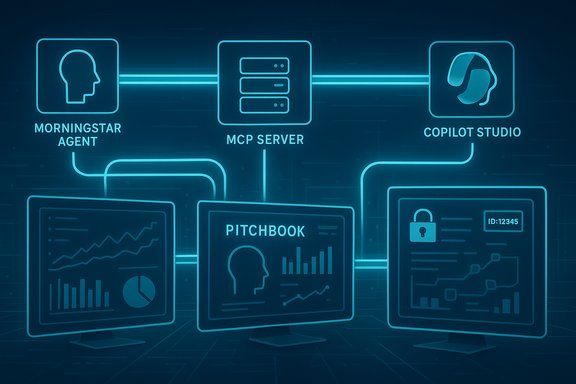
Morningstar’s announcement positions the company as a content provider adapting to an agent-first enterprise world. The rollout centers on two technical building blocks Morningstar named publicly: the Morningstar Agent and a Morningstar Model Context Protocol (MCP) Server, which present entitlement-aware, API-style access to Morningstar’s research, portfolio analytics, proprietary methodologies and licensed PitchBook content. Microsoft’s agent platform strategy — built from Azure AI Foundry, Copilot Studio and Microsoft 365 Copilot — explicitly supports the Model Context Protocol as a way to connect agents to third-party knowledge servers and tools. That platform plumbing is what makes Morningstar’s approach technically feasible: Foundry and Copilot agents can treat the Morningstar MCP server as a discoverable, authenticated tool that returns structured, provenance-rich responses for downstream generative workflows. Morningstar’s scale matters in two ways: it brings editorial depth to agent workflows and it brings business scale. Morningstar reported approximately $369 billion in assets under management and advisement (AUMA) as of Sept. 30, 2025, which underscores the company’s footprint across advisory and retirement channels and contextualizes why financial firms would prioritize connectors to Morningstar content.
Industry momentum toward MCP and agent registries — supported by Microsoft’s Foundry and Copilot investments — also makes these connectors practical at scale. Microsoft’s platform moves over 2025 prioritized MCP and agent governance primitives explicitly to enable third-party knowledge servers to be treated as first-class tools. That ecosystem effect is a large part of why content providers are racing to make their information agent-ready.
However, the benefits are not automatic. Real value requires careful governance: verified license scope (especially for PitchBook/private content), provenance-first RAG patterns, robust DLP and retention, and operational playbooks for AgentOps. Firms that pilot thoughtfully — with tight human-in-the-loop controls, contractual clarity and measurable KPIs — stand to gain meaningful productivity and advisory scale. Firms that rush to enable broad agent access without these controls risk compliance headaches, uncontrolled costs and potential data leakage.
Conclusion
The Morningstar–Microsoft integration transforms premium investment research from a static payload into an interactive, agent-driven service inside enterprise AI workflows. For financial firms the upside is clear: faster insights, more personalized client experiences and automation of repetitive reporting tasks. The caveat is just as clear: firms must pair the new capabilities with rigorous governance, explicit licensing clarity and conservative rollout plans to protect clients, preserve auditability and control costs. When those elements are in place, agent-native access to Morningstar’s research could materially reshape advisor productivity and institutional investment operations.
Source: The Globe and Mail Morningstar Unleashes AI-Ready Investing Insights in Microsoft AI Tools
 Background
Morningstar’s announcement positions the company as a content provider adapting to an agent-first enterprise world. The rollout centers on two technical building blocks Morningstar named publicly: the Morningstar Agent and a Morningstar Model Context Protocol (MCP) Server, which present entitlement-aware, API-style access to Morningstar’s research, portfolio analytics, proprietary methodologies and licensed PitchBook content. Microsoft’s agent platform strategy — built from Azure AI Foundry, Copilot Studio and Microsoft 365 Copilot — explicitly supports the Model Context Protocol as a way to connect agents to third-party knowledge servers and tools. That platform plumbing is what makes Morningstar’s approach technically feasible: Foundry and Copilot agents can treat the Morningstar MCP server as a discoverable, authenticated tool that returns structured, provenance-rich responses for downstream generative workflows. Morningstar’s scale matters in two ways: it brings editorial depth to agent workflows and it brings business scale. Morningstar reported approximately $369 billion in assets under management and advisement (AUMA) as of Sept. 30, 2025, which underscores the company’s footprint across advisory and retirement channels and contextualizes why financial firms would prioritize connectors to Morningstar content. What Morningstar announced — the essentials
- Platforms supported now: Microsoft Foundry for enterprise-scale AI applications and Copilot Studio for building custom agents. Microsoft 365 Copilot connectivity is advertised as coming soon, enabling Morningstar insights inside productivity surfaces like Teams and Outlook.
- Data and content scope: Global coverage of open-end funds, ETFs, equities, portfolio analytics, Morningstar ratings and methodologies, performance data, and licensed PitchBook intelligence are all part of the content set Morningstar says it will make AI-ready for enterprise integrations.
- Commercial and technical access: Morningstar describes entitlement-based access (who can see what) delivered via Morningstar Agent + MCP Server, plus flexible commercial models designed to scale across tenants and agent workloads. That architecture aims to preserve licensing controls while enabling agent-native retrieval and synthesis.
- Value proposition: Morningstar frames the move as removing friction — letting financial professionals surface trusted, human-curated research and metrics without switching tools, and enabling personalized client narratives, faster portfolio research and automated compliance workflows.
How the integration appears to work (technical anatomy)
Morningstar Agent + MCP Server: the connective tissue
The Morningstar Agent functions as a broker or tool provider: it exposes data endpoints and research artifacts in formats agents expect, while the MCP Server implements the Model Context Protocol to publish tool metadata, input/output schemas, and authentication requirements. This lets an agent (for example, a Copilot Studio agent or Foundry-hosted model) discover available Morningstar “tools,” request specific research items or metrics, and receive structured results that include provenance and data IDs.Azure AI Foundry and Copilot Studio: where agents run
- Azure AI Foundry provides the enterprise runtime and orchestration for production-scale agents and model routing. Foundry’s MCP client capability enables it to import and route calls to external MCP servers with enterprise governance and identity controls.
- Copilot Studio is the authoring and deployment surface for agents that non-developers and pro developers can publish. Copilot Studio agents can call external MCP servers as tools, be published into Microsoft 365 Copilot channels and be combined with Power Platform flows for deterministic automation. Microsoft documentation confirms Copilot Studio’s ability to publish agents into M365 Copilot environments and to wire external tools into agent logic.
Provenance, entitlements and audit trails
A central promise of the integration is provenance: every material claim or data point should be traceable to a Morningstar data ID or analyst note. That traceability is essential for compliance-heavy workflows: audit logs, immutable retrieval records and agent-run transcripts become the evidentiary chain auditors and regulators will demand. Morningstar’s MCP-based design and Microsoft’s identity/gov tooling (Azure AD / Entra) are intended to support those controls, but practical governance depends on tenant implementation.Who stands to benefit — practical use cases
Morningstar and Microsoft highlight several target audiences and workflows:- Asset & wealth managers: accelerate research, portfolio analysis, scenario modeling and client reporting by embedding Morningstar analytics behind programmatic agent flows.
- Financial advisors: generate personalized proposals, client talking points and compliance-ready narratives at scale using Copilot Studio agents that ground answers in Morningstar ratings and methodology.
- Institutional investors and compliance teams: operationalize compliance screening, risk monitoring and strategy workflows by connecting Morningstar intelligence into custom Foundry-hosted AI applications.
Why this matters now — the strategic context
The financial services sector is in the early stages of moving from siloed research libraries and PDF reports to agent-native knowledge services where model-driven assistants act as the UI for expert content. Embedding high-quality, licensed, human-curated datasets into that fabric gives vendors like Morningstar a strategic moat: agents that are deeply grounded in premium editorial content tend to be stickier and more defensible in regulated workflows. That shift changes licensing dynamics — firms may buy not just data feeds but the right to use data interactively inside agent workflows.Industry momentum toward MCP and agent registries — supported by Microsoft’s Foundry and Copilot investments — also makes these connectors practical at scale. Microsoft’s platform moves over 2025 prioritized MCP and agent governance primitives explicitly to enable third-party knowledge servers to be treated as first-class tools. That ecosystem effect is a large part of why content providers are racing to make their information agent-ready.
Strengths: what Morningstar + Microsoft do well here
- Editorial depth combined with platform reach. Morningstar’s analyst research plus PitchBook data plugged into Microsoft agent runtimes reduces the friction of discovery and synthesis for advisors and portfolio teams.
- Standards-first integration. Using MCP fits the emerging industry pattern for tool discovery and structured tool invocations, making the Morningstar connector easier to maintain and secure inside enterprise agent registries.
- Entitlement-aware design. Morningstar’s emphasis on entitlement enforcement — who can retrieve which licensed dataset — addresses commercial and compliance realities that simple API feeds do not. When implemented correctly, entitlement controls reduce the risk of unauthorized distribution of premium content.
- Operational leverage for advisors. Automating routine report generation and proposal drafting with grounded research can materially reduce advisor time-to-delivery and scale personalization for client relationships.
Risks and trade-offs — what firms must watch
- Licensing ambiguity and contractual scope
- Morningstar references PitchBook intelligence in the product messaging, but access to non-public private-market datasets is frequently governed by separate contracts. Firms must validate which datasets are included under their existing agreements and how agent-level access is metered. Treat “non-public PitchBook intelligence” claims as contract-dependent until verified.
- Model risk and hallucination
- Retrieval grounding reduces hallucination risk but doesn’t eliminate it. Agents that synthesize across multiple data sources still require RAG (retrieval-augmented generation) patterns that force the agent to return the supporting Morningstar snippet or data ID with any substantive claim. Human sign-off should be mandatory for client-facing outputs.
- Data-exfiltration and downstream leakage
- Once agent outputs mix licensed Morningstar content with client data, firms must ensure that outputs are not subsequently routed to unauthorized clouds or used to train third-party models. Data Loss Prevention (DLP), tenant-level restrictions and contract language prohibiting downstream model training are essential controls.
- Auditability and recordkeeping
- Regulatory regimes will want immutable logs and retention of retrievals and final outputs. Firms must plan for storage and tamper-evident archives that match recordkeeping schedules. Microsoft provides platform tools for observability, but mapping those primitives to regulatory obligations is a tenant responsibility.
- Cost and meterability
- Agent-driven usage introduces new consumption models (Copilot Credits, tool invocations, retrieval counts) that can complicate chargeback. Firms should model consumption scenarios and adjust pilot size and throttle policies accordingly.
- Vendor lock-in and portability
- Deep integration of Morningstar content across agent logic can raise migration costs. Firms should design for portability: detachable RAG stores, exportable logs, and contractual exit clauses to avoid being locked into a specific vendor-agent combination.
Practical implementation checklist (for IT, data, legal and compliance)
- Contract and entitlements audit
- Confirm which Morningstar datasets and PitchBook content are in-scope.
- Define per-agent, per-user or per-tenant entitlements and pricing implications.
- Identity and agent registration
- Use Microsoft Entra / Azure AD for least-privilege identities.
- Register agents in a controlled MCP registry; restrict which agents can call the Morningstar MCP server.
- Provenance-first RAG design
- Implement RAG patterns that force the agent to return data IDs or analyst-note links with every material claim. Preserve raw retrievals for audits.
- Logging and immutable retention
- Route retrievals and agent outputs to tamper-evident storage with retention schedules mapped to regulatory obligations.
- DLP and exfiltration controls
- Block agent outputs from being copied to public notebooks or non-entitled services. Contractually prohibit use of licensed data for third-party model training without explicit permission.
- Pilot, validate, and scale
- Start with narrow pilots: one business line, predetermined KPI targets, human-in-the-loop sign-offs and a rollback plan. Evolve governance artifacts before scaling.
- Security and incident playbooks
- Maintain AgentOps runbooks: incident isolation, entitlement revocation, forensic retrieval of agent logs and SLAs for vendor responses.
Competitive and market implications
Morningstar’s move is part of a broader trend: major data and research vendors are shifting from static feeds to agent-aware, API-first distribution. Competing vendor ecosystems — from BlackRock’s Aladdin Wealth to Anthropic and other specialized players embedding data into their agents — are racing to offer similar grounded content to financial professionals. The practical effect is a market where premium editorial content plugged into trusted agent runtimes becomes a high-value differentiator for enterprise buyers seeking auditable, high-fidelity outputs. For Microsoft, having premium connectors like Morningstar strengthens Copilot Studio and Foundry’s catalog of enterprise knowledge servers and accelerates adoption in regulated industries where provenance and licensing controls matter. For Morningstar, the integration increases distribution in environments where professionals already spend their time: Teams, Copilot workflows and Foundry-hosted apps.Verification of key claims
- The company announced official integrations with Microsoft Foundry and Microsoft Copilot Studio, with Microsoft 365 Copilot connectivity planned, in a BusinessWire press release and Morningstar newsroom messaging.
- Morningstar confirmed the architecture centers on a Morningstar Agent and a Morningstar MCP Server to deliver entitlement-based access into Microsoft agent runtimes, as outlined in Morningstar’s product materials and press coverage.
- Morningstar reported ~$369 billion AUMA as of Sept. 30, 2025 in its Q3 2025 financial release, validating the scale figure cited alongside the product announcement.
- Microsoft’s Azure AI Foundry and Copilot Studio both publicly document MCP support and agent publishing patterns — the same platform primitives Morningstar is leveraging to expose its MCP server to enterprise agents.
Governance, compliance and regulatory posture — a closer look
Embedding third-party research into agent outputs raises immediate questions for regulated financial services firms:- Recordkeeping: agent interactions that contribute to client advice will likely be subject to the same retention and supervision rules that apply to human advice. Firms must ensure logs, retrieval evidence and final outputs are retained and auditable.
- Supervision and suitability: automated outputs that inform suitability determinations require human oversight. Firms should define approval gates for any agent-generated client recommendation.
- Vendor management: when a third party (Morningstar) provides licensed research inside a tenant’s agents, that relationship must be part of vendor risk assessments, SLAs and data handling agreements — including prohibitions on downstream model training and requirements for breach notification.
- Data minimization and segregation: client PII and sensitive account data should never be combined with non-entitled content flows in ways that risk cross-tenant leakage. Entra-backed short-lived credentials and MCP registries help, but operational discipline is essential.
Final assessment
Morningstar’s integration with Microsoft’s agent platforms is a pragmatic and strategically timed product move that converts high-value editorial research into agent-native services. The technical stack — Morningstar Agent + MCP Server combined with Microsoft Foundry and Copilot Studio — maps to current enterprise best practices for secure, discoverable tool integration and gives advisors and portfolio teams faster access to grounded insights where they already work.However, the benefits are not automatic. Real value requires careful governance: verified license scope (especially for PitchBook/private content), provenance-first RAG patterns, robust DLP and retention, and operational playbooks for AgentOps. Firms that pilot thoughtfully — with tight human-in-the-loop controls, contractual clarity and measurable KPIs — stand to gain meaningful productivity and advisory scale. Firms that rush to enable broad agent access without these controls risk compliance headaches, uncontrolled costs and potential data leakage.
Practical next steps for firms evaluating the Morningstar connectors
- Convene a quick cross-functional task force: legal, compliance, IT, data, and business owners.
- Request a data map from Morningstar: list of datasets included, entitlements, API call metering and PitchBook scope.
- Run a narrow pilot: one advisory team, controlled data, mandatory human sign-off and defined KPIs (time saved, proposal throughput, error rate).
- Measure costs and model consumption under Copilot Credits / tool invocation scenarios.
- Document AgentOps runbooks and retention policies before scaling agent access beyond the pilot.
Conclusion
The Morningstar–Microsoft integration transforms premium investment research from a static payload into an interactive, agent-driven service inside enterprise AI workflows. For financial firms the upside is clear: faster insights, more personalized client experiences and automation of repetitive reporting tasks. The caveat is just as clear: firms must pair the new capabilities with rigorous governance, explicit licensing clarity and conservative rollout plans to protect clients, preserve auditability and control costs. When those elements are in place, agent-native access to Morningstar’s research could materially reshape advisor productivity and institutional investment operations.
Source: The Globe and Mail Morningstar Unleashes AI-Ready Investing Insights in Microsoft AI Tools
