

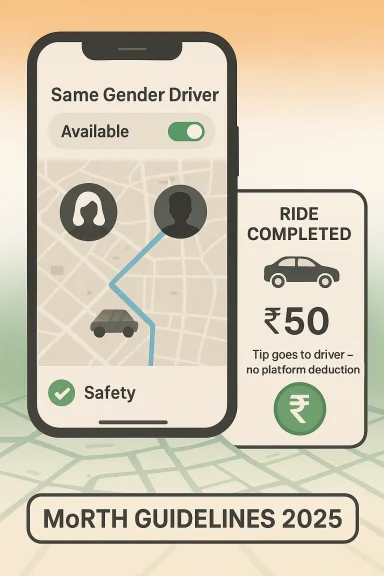
The government’s late-December amendment to the Motor Vehicles Aggregators Guidelines, 2025 introduces two headline changes for ride-hailing platforms: a mandatory in-app option for passengers to select a same-gender driver where available, and a ban on “advance tipping” that restricts voluntary tips to after trip completion and requires platforms to pass the full tip to drivers without any deduction.
The Ministry of Road Transport and Highways (MoRTH) has updated the Motor Vehicles Aggregators Guidelines, 2025 with new subsections that amend the compliance requirements for aggregator apps’ websites, booking flows and technology. The amendments add a voluntary tipping clause and a gender-selection feature to sections of the guidelines that govern app behaviour and passenger safety. Media coverage cites Subsections 14.15 and 14.16 (under Section 14) and a new Clause 15.6 (under Section 15) as the loci of the change. The official rationale framed in media reports is twofold: increase passenger safety — particularly the comfort and perceived safety of women riders — and curb perceived unfair trade practices linked to “advance tipping” mechanics that were being used by some platforms to surface drivers or influence allocation. The government’s move is positioned as both a consumer-protection step (tipping visibility / Consumer Protection Act 2019 constraints) and a passenger-safety measure (same-gender selection). Note: at the time of writing there is wide, corroborating press coverage of these amendments in mainstream Indian outlets but an easily downloadable official PDF of the updated MoRTH circular could not be located on central government portals in the public domain. Readers should treat the statutory references cited in press reports as accurate summaries of the change unless and until the formal notification appears on MoRTH’s official releases. This article flags those areas explicitly where independent confirmation from the Ministry’s own notice was not found.
The road ahead for ride-hailing in India is now explicitly demandside-focused: regulators have put passenger choice and consumer-protection mechanics into the booking stack. What matters next is whether the platforms, states and civil-society partners move quickly to convert rules into practical, operational changes and measurable improvements for riders and drivers alike.
Source: ET Now Govt revises cab aggregator rules: Gender choice and tipping introduced
 Background / Overview
The Ministry of Road Transport and Highways (MoRTH) has updated the Motor Vehicles Aggregators Guidelines, 2025 with new subsections that amend the compliance requirements for aggregator apps’ websites, booking flows and technology. The amendments add a voluntary tipping clause and a gender-selection feature to sections of the guidelines that govern app behaviour and passenger safety. Media coverage cites Subsections 14.15 and 14.16 (under Section 14) and a new Clause 15.6 (under Section 15) as the loci of the change. The official rationale framed in media reports is twofold: increase passenger safety — particularly the comfort and perceived safety of women riders — and curb perceived unfair trade practices linked to “advance tipping” mechanics that were being used by some platforms to surface drivers or influence allocation. The government’s move is positioned as both a consumer-protection step (tipping visibility / Consumer Protection Act 2019 constraints) and a passenger-safety measure (same-gender selection). Note: at the time of writing there is wide, corroborating press coverage of these amendments in mainstream Indian outlets but an easily downloadable official PDF of the updated MoRTH circular could not be located on central government portals in the public domain. Readers should treat the statutory references cited in press reports as accurate summaries of the change unless and until the formal notification appears on MoRTH’s official releases. This article flags those areas explicitly where independent confirmation from the Ministry’s own notice was not found. What changed — the rules in plain language
Voluntary tipping: timing and economics
- Aggregator apps may offer a voluntary tipping feature, but it must be visible only after trip completion — not at booking, not before the trip begins, and not while searching for a ride.
- Any tip collected via the app must be credited fully to the driver; platforms are specifically directed not to deduct any commission or service fee from tips.
- The tipping mechanism must not be misleading or manipulative, and must comply with the Consumer Protection Act, 2019 and allied rules.
Same-gender driver selection: the feature requirement
- Aggregator apps must include a feature allowing a passenger to select a driver of their own gender, where available. The press descriptions emphasize the option for female passengers to choose female drivers.
- The language in the amendment — as reported — conditions the option by availability: passengers can select same-gender drivers only if such drivers are logged on and available to accept trips in the market at that time.
Why the government did this — stated aims and policy context
- Passenger safety: Female riders and other passengers expressed sustained concerns about harassment and safety. A same-gender option is presented as a low-friction, demand-side safety enhancement positioned to give riders control over the gender of the person they share a ride with.
- Consumer protection: The Central Consumer Protection Authority (CCPA) and consumer-rights advocates flagged pre-trip tipping mechanisms as potentially unfair trade practices that distort allocation and can pressure riders into inflating offers just to get a ride. The new rule aligns tipping visibility with standard post-service gratuity norms.
- Market governance: These changes sit alongside other 2025 aggregator rules — such as caps on surge pricing and explicit prohibitions against charging for “dead mileage” — reflecting a broader regulator push to normalise aggregator behaviour and reduce perceived operational asymmetries.
Cross-check: What multiple reporters confirm and what remains uncertain
Confirmed by multiple outlets:- The new features were added as amendments to the Motor Vehicles Aggregators Guidelines, 2025 and reported in major Indian business and tech outlets.
- Tipping must be visible only after trip completion and the full tip goes to drivers without deduction.
- Apps must include an option for same-gender driver selection where such drivers are available on the platform.
- Percentage of women drivers: media quotes vary — some stories say “less than 5%” of aggregators’ drivers are women, others report “less than 1%” or cite public-transport employment statistics that are not directly comparable. There is no single, up-to-date, platform-verified industry statistic in the public domain we could locate to reconcile these claims. Readers should treat the precise share as uncertain and indicative of very low female representation rather than a precise metric.
- Official ministry circular or Gazette notification: several reports reference a circular (some say dated December 15); however, the formal MoRTH PDF / gazette notice was not located on government websites at the time of reporting. Press reports appear consistent, but until the ministry posts the final notification publicly, precise clause numbering and legal language should be treated as accurate summaries rather than verbatim law text.
Practical implications — how platforms will need to change
UX, matching and backend changes
Implementing a same-gender selection filter is not a simple toggle; it has front-end and back-end implications:- UI/UX updates:
- Add a clear, accessible selector in the booking flow (e.g., “Prefer same-gender driver”).
- Provide explicit messaging about availability (e.g., “Female drivers may not be available in your area right now”).
- Preserve accessibility and localisation for multilingual markets.
- Matching logic and dispatch:
- Matching algorithms must include gender as a filter when a passenger opts in, which will influence dispatch scoring and ETA calculations.
- Systems must handle fallback logic: when no same-gender driver is available, the app should offer an immediate alternate or ask the rider whether they want to expand matching criteria to the full pool.
- Driver onboarding and data:
- Platforms will need accurate driver-profile gender fields and must make it optional and privacy-protective to ensure compliance with nondiscrimination and data-protection rules.
- Identity verification pipelines may need minor adjustments to ensure gender fields are accurate and mutable in response to driver updates.
- Performance and SLAs:
- ETA calculations must account for thinner same-gender supply in many markets to avoid misleading arrival-time promises.
- Cancellation and no-show metrics could change if same-gender constraints make matching harder — platforms must redesign incentives or notifications to avoid increased cancellations.
Operational and contractual items for drivers
- Tip accounting must be separated in the ledger so that post-trip voluntary tips flow directly and fully to driver wallets (or the bank accounts/drivers’ payment methods) without any platform commission or administrative deductions.
- Platforms will need audit trails and reporting showing tip flows to avoid disputes and to satisfy consumer-protection scrutiny.
Safety benefits — what could improve
- Psychological comfort: For many riders, particularly women travelling alone at night, the ability to select a same-gender driver may increase perceived safety and reduce anxiety.
- Empowerment: The option gives riders more control and reduces the perceived exposure from being matched without choice.
- Signalling and recruitment: Platforms may use the requirement as a driver-acquisition lever to hire and retain more women drivers by marketing gender-friendly onboarding programs, flexible work windows, and targeted incentives.
Risks, trade-offs and unintended consequences
- Increased wait times: With a very low base of women drivers in many markets, enforcing or prioritising same-gender matching will plausibly increase ETAs and cancellation rates, especially at night or in suburban/rural markets. This is the principal operational objection raised by industry insiders.
- Reduced availability and equity concerns: If same-gender selection is treated as mandatory rather than an opt-in preference, it could reduce platform liquidity and harm users with urgent needs. The amendment language — based on press reports — ties the feature to availability, but perceptions and semantics will matter in UX design.
- Safety vs discrimination tension: Requiring gender selection could have the perverse effect of segmenting supply and incentivising drivers to prefer or avoid certain segments. There is also the potential for gender-based hiring discrimination by partners who, to avoid matching constraints, may prefer male applicants in some markets if the policy is poorly enforced.
- Privacy and data risk: Storing gender as a driver attribute requires careful handling under privacy and employment laws. Platforms must ensure fields are optional, editable by drivers, and protected against misuse.
- Gaming the system: If tipping can no longer be used pre-ride to attract drivers, platforms or third-party actors might develop workarounds (e.g., in-person cash offers, off-platform incentives) that reintroduce distorted allocation. Regulators should be attentive to substitution effects.
Legal and consumer-protection considerations
- Consumer Protection Act, 2019: The new tipping guidance references the Consumer Protection Act’s prohibition on misleading or manipulative practices. Regulators appear intent on treating pre-trip tipping nudges — which can influence allocation and pricing — as potential unfair trade practices. Platforms must audit their flows for dark patterns and disclose tip mechanics transparently.
- Enforcement and penalties: Earlier 2025 aggregator rules enabled state-level enforcement and license suspension for breaches such as unjustified dynamic fares. The new clauses likely sit within that enforcement framework; states and union territories have been directed to implement the changes, per press reports. This implies on-the-ground enforcement will be local, and platforms must work with state authorities to implement compliance playbooks.
How platforms are likely to respond (short-term vs long-term)
Short-term (weeks to months)- Hide all pre-ride tipping prompts and move tip options entirely to post-trip screens.
- Add a same-gender preference toggle with explicit “availability” messaging.
- Add compliance code paths and audits to ensure tip flows are passed to drivers untampered.
- Targeted driver recruitment & incentive programs to increase the pool of women drivers (sign-up bonuses, safe-hire programs, localised training, flexible roster slots).
- Algorithm and UX redesign to provide better fallback messaging when same-gender drivers are unavailable and to surface approximate wait-time impacts before confirmation.
- Legal and payment-system updates to isolate tip flows from commission accounting and to produce auditable proof for regulators.
- Structural changes in driver-sourcing and scheduling to create more balanced supply (e.g., female-driver cohorts for late-night shifts with dedicated support).
- Partnerships with state authorities, NGOs and local women’s groups to reduce barriers to female participation (safety networks, childcare solutions, insurance and legal aid packages).
- Potential product diversification: women-only ride pools, women-only driver fleets in specific cities, or dedicated shift-based pools to guarantee female-driver availability in high-demand corridors.
Recommendations — what aggregators and regulators should do next
For aggregators- Treat the change as a compliance baseline, not a one-off toggle. Invest in clear messaging about availability and expected wait-time trade-offs.
- Ensure tip flows are auditable and pass-through: maintain immutable ledgers showing tip credit to drivers and publish driver reconciliation summaries on request.
- Launch targeted, safe, privacy-respecting programs to onboard and retain more women drivers (training, background checks, mentorship, microcredit for vehicle access).
- Audit UX flows for dark patterns and update to meet Consumer Protection Act standards.
- Publish the official circular and an implementation playbook clarifying enforcement timelines, acceptable fallbacks, and non-compliance penalties.
- Support supply-side measures — pilot schemes to recruit women drivers, subsidies for daytime-first shifts, or transit support for driver safety.
- Require transparent reporting from large platforms on metrics that matter: share of women drivers, average wait time impact from gender preference, and aggregate tip flows.
- Monitor whether the policy reduces safety incidents and whether it creates access gaps for riders.
- Advocate for data transparency: periodically publish anonymised metrics showing effects on wait times, cancellations and tip distributions.
Comparative perspective — how other markets have handled gender choices and tipping
- Several countries and cities have experimented with women-only options (e.g., women-only taxis or women-driver initiatives) with mixed operational results: they can increase comfort but often require sustained supply-building to be practical.
- Internationally, tipping policy varies: in many mature markets platforms allow post-trip tipping and pass most tips to drivers, but administrative fees and processing costs sometimes result in micro-deductions. The Indian rule requiring zero deduction is stronger than many global norms and will require domestic payment-routing changes.
What to watch next — timeline and metrics
- Publication of the formal MoRTH circular on an official government portal (this will settle legal text and clause numbering).
- Platform updates to app flows (look for removal of pre-ride tip prompts and the appearance of a same-gender selector).
- Early metrics (first 3 months): availability notices, average wait-time delta for same-gender requests, and post-implementation tip-ledger transparency.
- Recruitment outcomes (6–12 months): change in share of women drivers, attrition and retention rates for drivers recruited under any incentive programs.
Final assessment — balance of benefits and risks
The amendments target legitimate problems: perceived safety gaps for women riders and the consumer-protection concerns created by pre-ride tipping nudges. In principle, both moves are straightforward policy levers that nudge platforms toward safer, more transparent behaviour. The tipping rule is the simpler, higher-confidence fix: move tips post-trip and prevent platforms from skimming gratuities — a clear win for driver earnings and consumer fairness. The same-gender selection requirement is policy-forward but operationally challenging. Without simultaneous supply-side interventions, users in many markets will face longer waits or disappointed searches for same-gender drivers, and platforms will experience matching friction. The rule’s effectiveness ultimately depends on active measures by aggregators, regulators and civil society to increase women’s participation in driving — a structural change that will take months, if not years. Claims about exact shares of women drivers should be treated cautiously: the available press figures point to very low representation, but they vary and are not reconciled by a single, platform-provided dataset. These reforms are therefore a starting point — not a complete fix. They can improve safety and fairness if implemented together with transparency measures, supply-building incentives, and robust oversight that monitors both intended benefits and unintended harms.The road ahead for ride-hailing in India is now explicitly demandside-focused: regulators have put passenger choice and consumer-protection mechanics into the booking stack. What matters next is whether the platforms, states and civil-society partners move quickly to convert rules into practical, operational changes and measurable improvements for riders and drivers alike.
Source: ET Now Govt revises cab aggregator rules: Gender choice and tipping introduced
