

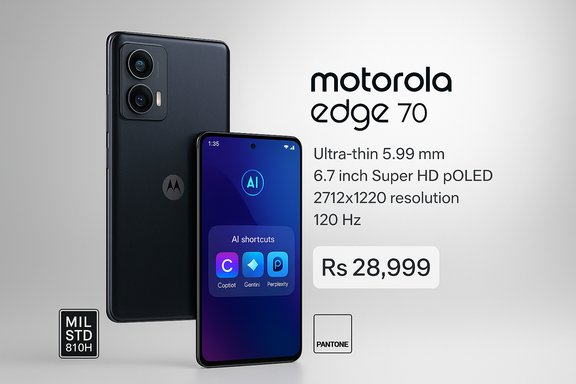
Motorola’s new edge 70 arrives in India as a slim, boldly marketed mid‑range contender that promises flagship touches — triple 50MP AI cameras, a dedicated AI key and multi‑platform AI hooks, a super‑bright 6.7‑inch Super HD AMOLED, military‑grade durability and an ultra‑thin 5.99 mm profile — all at an aggressive effective launch price of Rs. 28,999 (with launch bank offer).
Background
The motorola edge 70 is Motorola’s latest attempt to blur the line between premium design and mid‑range pricing by packing features normally reserved for higher tiers into an ultra‑thin chassis. The company positions the phone as “no‑compromise” — emphasizing thinness (5.99 mm), light weight (159 g), pro‑grade cameras, long battery life and military‑grade durability while adding an emphasis on AI with a dedicated hardware key and multiple assistant integrations. Early launch material and Indian retailer listings confirm availability from 23 December 2025 through Flipkart, the Motorola online store and retail partners, with an introductory price headline of Rs. 29,999 and an effective price of Rs. 28,999 after a Rs. 1,000 bank discount.What Motorola actually ships: a quick spec snapshot
- Display: 6.67" Super HD pOLED, 1.5K (2712 × 1220), up to 120 Hz, HDR10+, peak brightness up to 4,500 nits, Pantone and SkinTone validation.
- SoC: Qualcomm Snapdragon 7 Gen 4 (4 nm class mid‑to‑upper midrange chipset), with on‑device AI acceleration and a dedicated AI key to launch Moto AI 2.0 and third‑party assistants.
- Cameras: Three 50MP cameras — 50MP main with OIS (2.0µm Ultra Pixel claim on some marketing), 50MP ultra‑wide that also supports macro focus, and a 50MP front camera; maker claims 4K @ 60 fps video on all cameras. Backed by Moto AI processing and Google Photos AI tools integration.
- Battery / Charging: Marketing states a 5,000 mAh silicon‑carbon battery with 68W TurboPower wired charging, 15W wireless charging and reverse wireless charging; Motorola support pages show a closely related silicon‑carbon pack sometimes listed as 4,800 mAh for some global variants — regional SKU details vary.
- Build and protection: 5.99 mm thin, 159 g weight, aircraft‑grade aluminium frame with textured finish, IP68 + IP69 ingress protection, MIL‑STD‑810H certification and Corning Gorilla Glass 7i front.
- Software and updates: Ships with Hello UI on Android 16, promises of 3 OS upgrades and 4 years of security updates in launch messaging; Moto Secure and ThinkShield enterprise features included.
Design and ergonomics: ultra‑thin is back (but at what cost?
Slim profile, bold trade‑offs
Motorola advertises the edge 70 at 5.99 mm thick and 159 g — figures that place it among the slimmest and lightest phones in its price bracket. That level of thinness is an immediate headline and one of the phone’s strongest identity signals: it competes on elegance and pocketability as much as on raw specification. The aluminium frame and textile‑inspired rear finish aim to mask the camera island while delivering a premium hand feel. Thinness at this scale, however, forces engineering trade‑offs. Manufacturers typically balance battery capacity, thermal mass and camera stack thickness when chasing a sub‑6 mm profile. Motorola’s design suggests careful material choices (aircraft‑grade aluminium) and packaging efficiencies, but buyers should be aware that ultra‑thin devices can feel less grippy in the hand, and camera islands can produce wobble on flat surfaces unless a case is fitted. Industry coverage of similarly thin phones in 2025 shows the same ergonomic trade‑offs: pleasing aesthetics versus practical handling and thermal headroom.Durability claims: rugged on paper
The edge 70’s combination of MIL‑STD‑810H testing and IP68 + IP69 ingress ratings is rare for ultra‑thin designs and would be a meaningful advantage if it holds up in real‑world use. Motorola also cites Corning Gorilla Glass 7i on the front. These certifications are useful signals, but MIL‑STD testing regimes and IP performance depend heavily on factory seals and long‑term wear; buyers should still treat liquid‑damage coverage and warranty fine print carefully.Display: a bright, color‑correct canvas
Motorola has leaned into the display story hard: a 6.7‑inch Super HD pOLED panel with 1.5K resolution, 10‑bit color, 100% DCI‑P3 coverage and Pantone + Pantone SkinTone validation for improved skin‑tone reproduction. The standout figure is 4,500 nits peak brightness — an exceptional number that promises legible outdoor visibility and HDR pop. The panel also supports a 120 Hz refresh rate and a 300 Hz touch sampling rate. Independent testing of manufacturer peak‑nit claims is always prudent: sustained high brightness has a severe battery cost and is often an “HBM/peak only” figure reserved for brief HDR highlights. Still, for photographers, streamers and outdoor users, the validated Pantone/ SkinTone work and Dolby Atmos stereo sound positioning make the edge 70 attractive on paper for media consumption and social‑first creators.Performance and on‑device AI: Snapdragon 7 Gen 4 plus a dedicated AI key
The edge 70 uses the Snapdragon 7 Gen 4 platform, a mid‑to‑upper midrange SoC designed for a balance of performance and efficiency, and it benefits from an on‑device NPU that accelerates local AI tasks. Motorola promotes a dedicated AI key that acts as a hardware shortcut to Moto AI 2.0 and integrates third‑party assistants — Microsoft Copilot, Google Gemini and Perplexity — offering users a choice of AI ecosystems. Apple‑style integration of multiple assistant backends is appealing on paper because it gives users freedom to pick tools that match their workflows. The practical value, though, will depend on:- How tightly Motorola integrates local NPU processing versus cloud fallbacks; and
- Whether the phone’s NPU TOPS and software hooks can support the latency‑sensitive features that make Copilot/Gemini feel local.
Cameras: three 50MP sensors and ambitious video promises
Motorola’s photography headline is simple: three 50MP cameras (main + ultra‑wide/macro + front), with the main camera featuring OIS and 2.0µm Ultra‑Pixel technology in marketing copy. Motorola claims 4K/60 fps video recording across all cameras, paired with Moto AI features — AI Video Enhancement, AI Action Shot, AI Adaptive Stabilisation and AI Group Shot — and Google Photos AI tools (Magic Eraser, Photo Unblur, Magic Editor). Taken together, this represents a serious effort to bring studio‑style imaging tools into a thin midrange device. Practical considerations and risks:- High megapixel counts on auxiliary lenses help with cropping and detail recovery but are not a substitute for an optical telephoto when it comes to portrait micro‑detail. Expect Motorola to rely heavily on computational cropping and software zoom rather than optical reach.
- 4K/60 on ultrawide and selfie modules is impressive on paper, but real‑world performance often varies by firmware, ISP tuning and heat. Reviewers frequently report higher noise and less stable stabilization on ultrawide video compared with the main lens. Buyers who plan serious mult‑lens 4K workflows should wait for third‑party video samples and reviews.
Battery: impressive numbers — and a notable discrepancy
Motorola promotes the edge 70 as housing a 5,000 mAh silicon‑carbon battery delivering “up to 40 hours” in mixed‑use messaging and supporting 68W TurboPower wired charging plus 15W wireless charging and reverse charging capabilities. That combination (high capacity + wireless + thinness) is a strong ownership proposition if realized. However, an important verification note: Motorola’s official global support/spec page lists a 4,800 mAh silicon‑carbon battery for some documented variants, not 5,000 mAh. This mismatch suggests that regional SKUs or marketing roundings differ between markets. Readers should treat the “5,000 mAh” and “up to 40 hours” claims as manufacturer estimates that need independent validation under representative use. Expect real‑world battery life to depend heavily on screen brightness (especially with a 4,500‑nit peak panel), AI processing load and network conditions.Software, updates and ownership experience
Motorola ships the edge 70 with Hello UI over Android 16, and the launch messaging promises 3 OS upgrades and 4 years of security updates alongside features such as Moto Secure with ThinkShield, Family Spaces, Moto Unplugged and Smart Connect. Motorola is also promoting Moto Premium Care for 24×7 WhatsApp support, free pickup/drop, and a standby device during repairs in some markets. Why this matters: long‑term software support materially affects device longevity and resale value. The headline “3 OS upgrades” is competitive for a mid‑range phone, but buyers should confirm the exact terms in India (what counts as a major version upgrade, and whether security patch cadence is regional). Past OEM practice shows that update promises can vary by SKU and region, so buyers should validate the local policy before purchase.Pricing and availability: aggressive launch pricing in India
The motorola edge 70 goes on sale in India from 23 December 2025, available via Flipkart, Motorola.in and retail outlets. The standard launch SKU in India is listed as 8 GB + 256 GB with an MRP/launch price shown at Rs. 29,999 and an effective bank‑offer price of Rs. 28,999 for a limited time. Operator and bank offers (including Reliance Jio benefits in some bundles) are part of the introductory marketing push. These pricing points position the phone very competitively within the sub‑₹30,000 segment.Competitive positioning: where the edge 70 fits
Motorola’s pitch is a triad: design, cameras, and AI. At the stated price, the edge 70 will compete directly with upper‑midrange models from Realme, iQOO, Samsung’s A‑series and others who are also pushing high‑brightness OLEDs, large batteries and AI features. The differentiators for Motorola are:- An unusual combination of ultra‑thin design with military‑grade durability and a high peak‑nit OLED;
- Triple 50MP cameras with 4K/60 video promises and Google Photos AI integration;
- A marketing emphasis on multi‑platform AI freedom (Moto AI 2.0 plus Copilot, Gemini and Perplexity), surfaced via a hardware AI key.
Strengths: what Motorola gets right
- Design and portability: real head‑turner thinness and low weight for a modern phone at this price.
- Display ambition: 1.5K pOLED with Pantone validation and a very high peak brightness number — excellent for HDR content and outdoors.
- Camera versatility: a pragmatic three‑50MP configuration gives useful detail for social and editorial uses, with wide support for AI editing tools.
- AI flexibility: allowing users to choose between Moto AI, Copilot, Gemini and Perplexity is a consumer‑friendly move that reduces lock‑in.
- Price/perf for India: aggressive introductory pricing combined with bank and operator offers makes the edge 70 compelling among value‑conscious buyers.
Risks and open questions
- Battery capacity discrepancy — Motorola’s global support site lists 4,800 mAh for some variants while Indian marketing emphasizes 5,000 mAh; buyers should verify the India‑market battery spec and independent run‑time tests.
- Real‑world camera video — 4K/60 across all modules is ambitious; ultrawide/selfie video historically show more noise and less stabilization than the main lens. Wait for sample footage and third‑party reviews.
- AI feature delivery and privacy — multi‑assistant support is promising, but many advanced capabilities depend on cloud services, model access and regional licensing; expect variance in features and performance over time.
- Software update clarity — “3 OS upgrades + 4 years security” is competitive, but the exact definition and regional enforcement should be validated in the India warranty and policy documents.
- Durability at scale — IP and MIL‑STD claims are positive, but long‑term ingress protection relies on seal integrity; insist on warranty terms for liquid damage before high‑risk use.
Buying checklist: what to confirm before you buy
- Confirm the exact India SKU (8GB/256GB vs global 12GB/512GB) on the retailer product page.
- Verify the battery capacity printed on the box or listed on the official India product page (4,800 mAh vs 5,000 mAh ambiguity).
- Look for independent camera and battery reviews that show real‑world 4K/60 performance and endurance before relying on marketing numbers.
- Check covered service/repair terms for water/accidental damage and confirm availability of Moto Premium Care offerings in your city.
- If on‑device AI matters, check whether the features you want run locally (NPU) or fall back to cloud services; confirm any recurring subscription or network requirements.
Final analysis: is the motorola edge 70 worth it?
Motorola has created an attractive, tightly packaged proposition with the edge 70: a standout display, an uncommon triple‑50MP camera array for the segment, thin and light industrial design, and broad AI positioning that caters to current buyer appetites for on‑device intelligence. At an effective launch price just under ₹29,000, the phone is compelling on paper and will draw buyers who value look, display quality and camera versatility. Caveats matter. The battery capacity discrepancy between regional spec pages and marketing, real‑world validation of 4K/60 across ultrawide and selfie cameras, and the practical limits of on‑device AI (what runs locally versus in the cloud) are all important ownership considerations. For buyers who prize raw benchmark leadership, optical telephoto capability or the absolute longest software support windows, there are other options; for users seeking a stylish, feature‑rich, AI‑friendly phone that leans into display and camera utility, the edge 70 is a serious contender — provided independent reviews confirm Motorola’s claims in lab and field testing.Conclusion
The motorola edge 70 is a bold, design‑forward offering that pushes the sometimes conservative mid‑range price band toward flagship territory on display, camera and AI capabilities. Motorola’s strategy is smart: offer recognizably premium touches (Pantone validation, high peak brightness, military‑grade claims) alongside modern AI flexibility and aggressive pricing. The decisive moment for many buyers will come down to independent verification — battery endurance, real‑world video and camera stabilization, and whether the multi‑assistant AI experience truly delivers seamless, low‑latency value without excessive cloud dependence. If Motorola’s engineering and software teams have delivered on the marketing promises, the edge 70 will stand out as one of 2025’s most interesting ultra‑thin mid‑range phones.Source: AD HOC NEWS motorola edge 70 - No-Compromise Ultra-Slim Smartphone^ with Triple 50MP AI cameras, Snapdragon 7 Ge
