

Motorola’s surprise announcement at Mobile World Congress that it will partner with GrapheneOS to bring the privacy-minded Android fork to future Motorola flagships represents a potentially seismic shift in the Android ecosystem — one that could move “secure-by-design” mobile software beyond Google’s Pixel family and into mainstream OEM hardware, but only if a long list of technical and trust conditions are met.
GrapheneOS started as an uncompromising, open-source hardening of AOSP with a mission to push the state of the art on Android privacy and exploit mitigation. For years it has been tightly coupled with Google Pixel hardware because Pixel phones offer a combination of firmware transparency, verified boot and chip-level security primitives (including Google’s Titan-class secure elements and early MTE exposure on Tensor chips) that made high-assurance builds feasible. The project’s official build and releases pages list Pixel devices — Pixel 6 through Pixel 10 families among them — as fully supported, production-ready targets receiving monthly security updates. That narrow hardware support was deliberate: GrapheneOS has insisted on a clean, auditable firmware stack and access to device-specific driver/firmware code necessary for the project’s security features to function properly.
For privacy-conscious users, GrapheneOS has been the de facto reference for a hardened Android: sandboxing improvements, a stricter permission model, exploit mitigations and a stance against telemetry and opaque vendor binaries. But that exclusivity also limited adoption: only Pixel owners could realistically run a fully patched and supported GrapheneOS device. The Motorola announcement signals an attempt to move beyond that constraint.
What both parties made clear was equally important: this is not an immediate shipping product. GrapheneOS repeatedly cites hardware prerequisites — especially hardware memory tagging and other low-level features — and Motorola acknowledged it is actively developing next‑generation devices to meet those constraints. In short: a collaborative roadmap exists, but the productization step is pending hardware and software alignment.
But the implication also raises numerous technical, operational and trust-related questions. GrapheneOS’ decisions are not only technical; they are policy choices about how firmware, drivers and update infrastructure must be handled for the OS to remain verifiably secure. Translating that model to an OEM with different supply chains, SoC partners and business imperatives is non-trivial.
The practical takeaway: GrapheneOS can only support non‑Pixel hardware at scale if the chosen SoC and vendor firmware expose the necessary hooks and if Qualcomm/MediaTek and other involved parties provide kernel sources, firmware updates, and functional MTE support across the device’s variants — a long, coordination-heavy process. Public reporting suggests MTE posture varies by SoC generation and vendor; some platforms (notably Pixel’s Tensor G3 and certain MediaTek Dimensity parts) have been early implementations of MTE, while Qualcomm’s coverage across flagship lines has been historically mixed. That nuance explains why GrapheneOS expects 2027 as the earliest realistic timeline for fully compatible Motorola hardware.
GrapheneOS has historically marketed itself to users who care deeply about supply-chain integrity and firmware transparency. Any collaboration that increases the number of parties with privileged firmware access — or that concerns hardware components produced in jurisdictions of geopolitical interest — will be scrutinized by privacy advocates and researchers. Motorola and GrapheneOS both need to be explicit about what “compatibility” and “support” mean for firmware provenance, update control and the ability for independent auditors to verify security properties.
GrapheneOS’ careful insistence on hardware primitives like memory tagging, verified boot and accessible device support is exactly what makes it both compelling and hard to port. Motorola’s public commitment to tailor future flagships to those requirements is an important step, but it is the follow-through — published sources, confirmed SKUs, demonstrable MTE support, and a robust update story — that will determine whether this partnership is transformative or merely a headline.
For now, the announcement is cause for guarded optimism. If Motorola and GrapheneOS can bridge the remaining technical divides and make the engineering trade-offs visible and auditable, ordinary users may finally get access to a secure-by-design Android phone at scale. Until then, privacy advocates and enterprise buyers should continue to demand transparent evidence and resist marketing claims that aren’t backed by concrete technical deliverables.
Conclusion
This collaboration is one of the most consequential stories in mobile security in recent years: it tests whether a community-driven, security-first OS can escape hardware constraints and influence mainstream device design. The announcement at MWC is the start of a long, technically demanding journey; success will require sustained cooperation between GrapheneOS, Motorola, SoC vendors and the wider Android ecosystem. Observers should expect a multi-stage rollout, rigorous technical scrutiny, and plenty of debate about trade-offs — all healthy signs that the community and industry are taking secure, privacy-aware mobile computing seriously.
Source: theregister.com Motorola partners with GrapheneOS for future phones
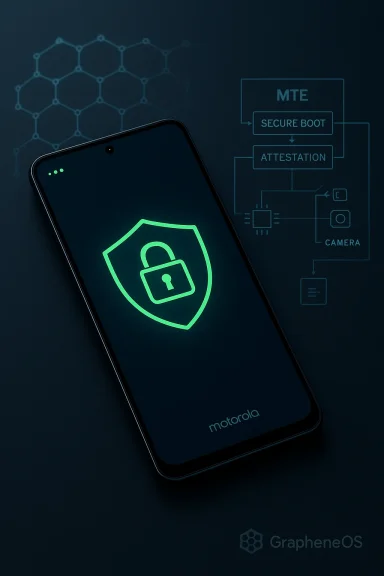 Background: how GrapheneOS became the privacy benchmark
GrapheneOS started as an uncompromising, open-source hardening of AOSP with a mission to push the state of the art on Android privacy and exploit mitigation. For years it has been tightly coupled with Google Pixel hardware because Pixel phones offer a combination of firmware transparency, verified boot and chip-level security primitives (including Google’s Titan-class secure elements and early MTE exposure on Tensor chips) that made high-assurance builds feasible. The project’s official build and releases pages list Pixel devices — Pixel 6 through Pixel 10 families among them — as fully supported, production-ready targets receiving monthly security updates. That narrow hardware support was deliberate: GrapheneOS has insisted on a clean, auditable firmware stack and access to device-specific driver/firmware code necessary for the project’s security features to function properly.For privacy-conscious users, GrapheneOS has been the de facto reference for a hardened Android: sandboxing improvements, a stricter permission model, exploit mitigations and a stance against telemetry and opaque vendor binaries. But that exclusivity also limited adoption: only Pixel owners could realistically run a fully patched and supported GrapheneOS device. The Motorola announcement signals an attempt to move beyond that constraint.
What Motorola actually announced and what it did not
At MWC, Motorola confirmed a partnership with the GrapheneOS Foundation to “work to strengthen smartphone security and collaborate on future devices engineered with GrapheneOS compatibility,” and GrapheneOS itself indicated that initial target hardware would be Motorola flagships expected to meet its requirements — devices similar in class to the current Motorola Signature and the razr fold/razr ultra families — with a delivery horizon pushed toward 2027. The project also said Motorola would adopt some GrapheneOS concepts into its standard OS builds, though it emphasized that such integration is separate from full GrapheneOS support.What both parties made clear was equally important: this is not an immediate shipping product. GrapheneOS repeatedly cites hardware prerequisites — especially hardware memory tagging and other low-level features — and Motorola acknowledged it is actively developing next‑generation devices to meet those constraints. In short: a collaborative roadmap exists, but the productization step is pending hardware and software alignment.
Why this matters: breaking Pixel exclusivity
The practical implication is straightforward and profound: GrapheneOS moving to mainstream OEM hardware would end a long-standing situation where the most hardened, privacy-first Android experience was effectively available only on Google’s own phones. That expands choice for privacy-minded users and raises the possibility that GrapheneOS design principles — from safer default permissions to stronger sandboxing — could influence broader Android UX and security practices if OEMs adopt them in their mainstream builds. Several outlets covering the announcement highlighted this as a watershed moment for privacy-first mobile platforms.But the implication also raises numerous technical, operational and trust-related questions. GrapheneOS’ decisions are not only technical; they are policy choices about how firmware, drivers and update infrastructure must be handled for the OS to remain verifiably secure. Translating that model to an OEM with different supply chains, SoC partners and business imperatives is non-trivial.
Technical hurdles: what GrapheneOS requires and why OEM alignment is hard
Hardware memory tagging and why it’s a gatekeeper
One of the single most often-cited requirements from GrapheneOS is support for hardware memory tagging — the ARM Memory Tagging Extension (MTE) or equivalent — which enables robust detection and mitigation of memory safety violations. GrapheneOS treats hardware memory tagging as an important mitigation for memory-corruption classes of bugs and expects full platform support for it to enable certain hardening features. Not all SoCs and their vendor stacks make MTE readily available to the OS, and even when silicon supports it, enabling it across the full firmware and kernel stack can require complex collaboration between the SoC vendor, the OEM and the OS project.The practical takeaway: GrapheneOS can only support non‑Pixel hardware at scale if the chosen SoC and vendor firmware expose the necessary hooks and if Qualcomm/MediaTek and other involved parties provide kernel sources, firmware updates, and functional MTE support across the device’s variants — a long, coordination-heavy process. Public reporting suggests MTE posture varies by SoC generation and vendor; some platforms (notably Pixel’s Tensor G3 and certain MediaTek Dimensity parts) have been early implementations of MTE, while Qualcomm’s coverage across flagship lines has been historically mixed. That nuance explains why GrapheneOS expects 2027 as the earliest realistic timeline for fully compatible Motorola hardware.
Secure boot, attestation and trusted hardware
GrapheneOS’ threat model relies on strong verified boot, reproducible firmware, and an attestation infrastructure that can demonstrate device state. Google Pixels have tightly integrated secure elements and a documented attestation path that made GrapheneOS’ high-assurance model viable. For Motorola devices to match that level, OEMs must provide an equally transparent chain-of-trust: well-documented secure elements or TEEs, attestation endpoints, and a commitment to releasing drivers and firmware sources when necessary for security updates. Achieving that in a supply chain that may include third-party binary blobs is a significant undertaking.Driver binaries, camera stacks and the messy middle layer
Many modern phones ship with closed-source camera ISPs, modem firmware and GPU drivers. GrapheneOS must be able to mitigate or outright avoid reliance on opaque components for anything in the trusted computing base. That often forces hard engineering trade-offs: better privacy may require working around or replacing vendor code, or accepting a narrower feature set until OEMs provide acceptable transparency. Motorola’s willingness to permit or engineer around these constraints will determine how feature-complete a Motorola‑branded GrapheneOS phone can be at launch.Trust, ownership and geopolitics: does Motorola’s Lenovo link matter?
Motorola Mobility’s ownership history is a familiar chapter: Google acquired Motorola Mobility in 2012 for roughly $12.5 billion and later sold the handset business to Lenovo in 2014 for about $2.91 billion. Lenovo’s stewardship has kept Motorola afloat as a recognizable consumer brand under a global supply chain. Those facts matter because some privacy-conscious users evaluate device provenance, firmware supply chains and the nationality of component suppliers as part of their threat assessment.GrapheneOS has historically marketed itself to users who care deeply about supply-chain integrity and firmware transparency. Any collaboration that increases the number of parties with privileged firmware access — or that concerns hardware components produced in jurisdictions of geopolitical interest — will be scrutinized by privacy advocates and researchers. Motorola and GrapheneOS both need to be explicit about what “compatibility” and “support” mean for firmware provenance, update control and the ability for independent auditors to verify security properties.
User experience trade-offs: privacy versus polish
GrapheneOS is intentionally conservative about user-facing conveniences when they conflict with its security model. That model influenced thousands of enthusiasts to adopt Pixel hardware despite its trade-offs in vendor features or UI niceties. If GrapheneOS ships on Motorola hardware, users will face choices:- Will camera, modem and biometrics match the polish users expect from flagship Motorola devices, or will some features be curtailed for isolation?
- How will carriers and preinstalled apps interact with a GrapheneOS image? Historically, carriers complicate alternative OS deployment through locked bootloaders and proprietary firmware.
- Will GrapheneOS-enabled Motorola devices provide an easy path for average consumers, or remain a niche product requiring technical fluency?
Potential benefits: competition, features and ecosystem influence
There are clear upside scenarios. A Motorola–GrapheneOS partnership could:- Make hardened Android available on larger volumes of hardware, increasing accessibility for privacy-conscious consumers and enterprises.
- Pressure other OEMs to improve firmware transparency and adopt better default security posture if GrapheneOS-backed devices prove commercially viable.
- Encourage SoC vendors to standardize and properly support MTE and other hardware-backed mitigations in mainstream product lines.
- Allow GrapheneOS to broaden its compatibility, improving developer testing and overall ecosystem robustness.
Risks and failure modes to watch
- Fragmented or partial support: If Motorola only commits to a limited set of devices or ships GrapheneOS with significant feature gaps (for example, degraded camera performance due to lack of ISP driver support), the value proposition will suffer.
- Update cadence and patching responsibility: GrapheneOS’ model depends on monthly security updates and firmware/driver patches. If device-specific updates are delayed by OEM bureaucracy, carriers, or SoC vendors, security promises could fail in practice.
- Opaque firmware and third-party blobs: Even with an OEM partnership, if crucial pieces of the device remain closed-source and unverified, GrapheneOS will either have to accept risk or strip functionality — both outcomes weaken mainstream adoption.
- Market and carrier resistance: Carriers often customize firmware and can lock bootloaders, complicating alternative OS deployment. GrapheneOS on an unlocked, carrier-neutral device is a different product than a carrier‑branded phone.
- Perception and geopolitical scrutiny: Lenovo’s ownership and the global nature of hardware supply chains will invite scrutiny from security-conscious customers and governments. Even unfounded concerns can affect enterprise procurement and consumer trust.
- Technical dependency on SoC vendors: If Qualcomm (or whichever SoC is used) delays or limits MTE support across silicon SKUs, the entire initiative’s timeline and technical feasibility can be set back. Past reporting shows MTE availability and enablement differs across SoC vendors and generations.
What success looks like: a checklist for a credible GrapheneOS‑Motorola product
For the collaboration to be more than a marketing headline, it should deliver on several concrete criteria:- OEM and SoC commitment to expose secure boot and attestation primitives compatible with GrapheneOS’ threat model.
- Public release of kernel sources, device trees and up-to-date firmware blobs that GrapheneOS can patch and ship with monthly updates.
- Verified support for hardware memory tagging (MTE) across targeted SKUs, validated by GrapheneOS and third‑party researchers.
- Unlocked or officially unlockable bootloader paths for end users, or a secure, auditable attestation model that supports user choice.
- Clear documentation on how modem, camera and other critical subsystems are handled — including which components remain closed-source and how GrapheneOS mitigates their presence.
- Transparent update policies with multi-year security support commitments, and mechanisms for independent audits.
Enterprise considerations: is this for business deployment?
GrapheneOS has always attracted advanced users and organizations with heightened security needs. From an enterprise perspective, a few features would determine viability:- Mobile device management (MDM) integrations that respect GrapheneOS’ security posture or provide alternative approaches for fleet management.
- Supply-chain attestations that meet enterprise procurement standards.
- Guaranteed long-term update windows and an OEM/GrapheneOS SLA for critical patches.
- Device management that allows enterprises to preserve user privacy while enforcing corporate policies.
Competitive dynamics: will other OEMs follow?
If Motorola’s experiment is successful, other OEMs will face pressure to offer comparable privacy-first hardware or risk losing a niche but influential segment of security-minded buyers. The economics are not trivial: building reproducible firmware stacks, working with SoC vendors to expose memory-tagging features, and providing multi-year firmware updates are investments with uncertain ROI. Nevertheless, competitive pressure could normalize better security practices across the Android OEM landscape. That could be the single most important long-term impact of this partnership.Consumer advice: what to watch and how to assess claims
For readers tracking this story, here are practical steps to separate marketing from substance:- Demand concrete model numbers and timelines. Vague statements about “future flagships” are not the same as confirmed device SKUs and ship dates.
- Verify whether the announced device has full GrapheneOS production support (not just an experimental port). GrapheneOS’ official build/release documentation is the canonical place for that status.
- Look for published kernel sources, device trees and firmware artifacts — these are the technical evidence that GrapheneOS can provide long-term patches.
- Confirm MTE support and whether it’s enabled in the bootloader/kernel on the particular SoC and SKU.
- Check the update policy: how many OS upgrades and how many years of security patches will Motorola/GrapheneOS commit to for the device?
- Watch for third-party security audits and independent researcher testing once hardware prototypes are available.
Final analysis — cautious optimism, not guaranteed transformation
Motorola partnering with GrapheneOS offers a plausible pathway to mainstreaming stronger privacy and mitigation techniques on Android hardware. The upside is significant: greater choice for privacy-focused consumers, competitive pressure on OEMs, and a clearer on‑device security baseline available outside of Google’s Pixel family. But the path is littered with technical and organizational obstacles: SoC and firmware cooperation, driver transparency, attestation architecture, and the hard economics of long-term update support.GrapheneOS’ careful insistence on hardware primitives like memory tagging, verified boot and accessible device support is exactly what makes it both compelling and hard to port. Motorola’s public commitment to tailor future flagships to those requirements is an important step, but it is the follow-through — published sources, confirmed SKUs, demonstrable MTE support, and a robust update story — that will determine whether this partnership is transformative or merely a headline.
For now, the announcement is cause for guarded optimism. If Motorola and GrapheneOS can bridge the remaining technical divides and make the engineering trade-offs visible and auditable, ordinary users may finally get access to a secure-by-design Android phone at scale. Until then, privacy advocates and enterprise buyers should continue to demand transparent evidence and resist marketing claims that aren’t backed by concrete technical deliverables.
Conclusion
This collaboration is one of the most consequential stories in mobile security in recent years: it tests whether a community-driven, security-first OS can escape hardware constraints and influence mainstream device design. The announcement at MWC is the start of a long, technically demanding journey; success will require sustained cooperation between GrapheneOS, Motorola, SoC vendors and the wider Android ecosystem. Observers should expect a multi-stage rollout, rigorous technical scrutiny, and plenty of debate about trade-offs — all healthy signs that the community and industry are taking secure, privacy-aware mobile computing seriously.
Source: theregister.com Motorola partners with GrapheneOS for future phones