

Mozilla’s latest broadside against Microsoft lands at a moment when Windows users are already signaling fatigue with the company’s push to thread Copilot through nearly every corner of the operating system. The core accusation is simple but powerful: Microsoft has not merely offered AI features, it has pushed them into places users didn’t ask for, and now it is only scaling back after backlash. That framing matters because it turns a product design debate into a broader argument about user consent, choice architecture, and how far platform owners can go before “helpful” becomes coercive. The result is a familiar but newly sharpened fight over who really controls the Windows experience.
The dispute between Mozilla and Microsoft is not new, and that history is exactly why this latest exchange resonates. Mozilla has spent years arguing that Windows has repeatedly nudged users toward Microsoft’s own browser and services, often through defaults, prompts, and interface design that favor Edge and other Microsoft properties. In Mozilla’s telling, that long-running pattern is now repeating itself with AI, only this time the product being pushed is Copilot rather than a browser.
Microsoft’s own public Windows messaging helps explain why the criticism sticks. In 2025, Microsoft announced Windows app updates that brought AI into Notepad and Snipping Tool, and later expanded Copilot’s presence in Windows Insider builds and other surfaces. Those moves were not hidden, and Microsoft often presented them as convenience features or productivity enhancements. But what looked like product evolution to Microsoft looked, to critics, like another round of platform overreach.
The timing is important. In March 2026, Microsoft said it was becoming more “intentional” about Copilot across Windows and reducing unnecessary entry points in apps such as Snipping Tool, Photos, Widgets, and Notepad. That wording suggests a partial retreat, but it also implicitly acknowledges that the earlier rollout was too expansive for many users. Once a platform giant starts talking about being “more intentional,” it usually means the company has heard enough complaints to know the old approach was creating friction.
Mozilla seized on that change immediately. In its blog post, the company argued that Microsoft’s own revisions amount to an admission that it made repeated choices to serve business goals over customer preferences. Mozilla also tied the Copilot rollout to older complaints about Edge, Windows Search, and default-app handling, presenting the AI issue as the latest chapter in a much longer story about dark patterns and forced engagement.
That historical context matters because it shifts the conversation from one app or one feature to the behavior of a whole ecosystem. A browser maker accusing a rival operating system vendor of manipulating defaults is a known refrain. What changes with AI is the scope of the claim: if AI is embedded into system surfaces, then the argument is no longer just about browser preference. It becomes a debate about whether the user can still meaningfully opt out of a technology the platform has chosen to promote.
Mozilla is also trying to draw a line between adding optional AI and normalizing AI by stealth. The company’s own position is that AI should be something a user consciously enables, not something they discover buried inside their workflow after an update. That is a very different philosophy from Microsoft’s recent Windows strategy, which has been to integrate AI into everyday tasks and let the market sort out the backlash later.
A few key claims stand out:
Microsoft’s challenge is that Copilot is not just a product feature; it is part of a larger commercial narrative. The company wants users to adopt its AI ecosystem, its subscription tiers, and its cloud-backed services. That makes the push feel less like optional convenience and more like platform monetization dressed as productivity.
At a practical level, this means Microsoft is trying to preserve the value of Copilot while making it feel less imposed. That is a delicate balance. If the company backs off too much, it risks weakening the AI narrative. If it backs off too little, it keeps feeding the perception that Windows is being used as a distribution channel for Microsoft services.
Microsoft’s own documentation shows that changing default apps in Windows is possible, but it still requires users to navigate into Settings and manage link-type associations. That may be straightforward for enthusiasts, yet it is still a multi-step process that has to be found and completed. Mozilla’s complaint is that the burden of choice remains unevenly placed on the user.
That matters now because AI is being layered on top of those same interfaces. If the browser war was about what opens when you click a link, the AI war is about what opens when you want help. The battlefield has shifted from web pages to workflows, but the underlying power dynamic looks very familiar.
Microsoft’s support materials reinforce that claim by noting that some AI features can be disabled in app settings, and that Microsoft has also described how those experiences work. In other words, the company is not denying user control outright. But the existence of a setting is not the same as a respectful design philosophy, particularly if users have to hunt for it after the fact.
That is especially true for long-time Windows users who are sensitive to platform creep. They remember when the operating system was primarily a place to launch apps, not a continuous funnel into vendor services. Microsoft’s AI strategy risks colliding with that memory in a way that makes every new surface look like one more unsolicited sales pitch.
That leads to a simple but crucial design principle:
The company also emphasizes that preferences persist across updates, which is a subtle but important point. Users are especially frustrated when settings revert after major upgrades, because that feels like the platform is quietly undoing their decisions. Persistence is one of those boring details that turns out to be central to trust.
That framing is smart because it avoids sounding anti-innovation. Mozilla is not saying “stop AI.” It is saying “stop deciding for users.” In policy debates, that distinction often matters more than the product itself.
Consumer resentment also tends to spread fast because it is emotional and highly visible. A user who feels nudged by an AI prompt is more likely to complain publicly than one who quietly appreciates a productivity gain. That means Microsoft’s consumer AI narrative can be undermined by a relatively small number of loud but credible complaints.
This is where Microsoft’s reassurances matter. If Copilot and related AI tools can be controlled through policy, disabled in managed environments, and limited to approved scenarios, the enterprise backlash will be much easier to contain. But if the consumer experience is messy, the brand damage can still spill over into business trust.
That produces a familiar enterprise dilemma:
Mozilla will likely keep pressing the issue because the broader argument serves its strategic goals and its worldview. If Microsoft has taught the industry anything over the past decade, it is that defaults are never just defaults; they are policy choices embedded in software. That makes every AI prompt, taskbar icon, or system suggestion part of a larger contest over power, permission, and platform behavior.
Source: TechRadar https://www.techradar.com/ai-platfo...er-backlash-forces-copilot-to-be-scaled-back/
 Background
The dispute between Mozilla and Microsoft is not new, and that history is exactly why this latest exchange resonates. Mozilla has spent years arguing that Windows has repeatedly nudged users toward Microsoft’s own browser and services, often through defaults, prompts, and interface design that favor Edge and other Microsoft properties. In Mozilla’s telling, that long-running pattern is now repeating itself with AI, only this time the product being pushed is Copilot rather than a browser.Microsoft’s own public Windows messaging helps explain why the criticism sticks. In 2025, Microsoft announced Windows app updates that brought AI into Notepad and Snipping Tool, and later expanded Copilot’s presence in Windows Insider builds and other surfaces. Those moves were not hidden, and Microsoft often presented them as convenience features or productivity enhancements. But what looked like product evolution to Microsoft looked, to critics, like another round of platform overreach.
The timing is important. In March 2026, Microsoft said it was becoming more “intentional” about Copilot across Windows and reducing unnecessary entry points in apps such as Snipping Tool, Photos, Widgets, and Notepad. That wording suggests a partial retreat, but it also implicitly acknowledges that the earlier rollout was too expansive for many users. Once a platform giant starts talking about being “more intentional,” it usually means the company has heard enough complaints to know the old approach was creating friction.
Mozilla seized on that change immediately. In its blog post, the company argued that Microsoft’s own revisions amount to an admission that it made repeated choices to serve business goals over customer preferences. Mozilla also tied the Copilot rollout to older complaints about Edge, Windows Search, and default-app handling, presenting the AI issue as the latest chapter in a much longer story about dark patterns and forced engagement.
That historical context matters because it shifts the conversation from one app or one feature to the behavior of a whole ecosystem. A browser maker accusing a rival operating system vendor of manipulating defaults is a known refrain. What changes with AI is the scope of the claim: if AI is embedded into system surfaces, then the argument is no longer just about browser preference. It becomes a debate about whether the user can still meaningfully opt out of a technology the platform has chosen to promote.
What Mozilla Is Actually Saying
Mozilla’s message is not simply that Copilot exists. It is that Microsoft introduced AI in ways that were not sufficiently asked for, not sufficiently explained, and not sufficiently reversible. Linda Griffin’s criticism is aimed at the mechanics of rollout as much as the technology itself. In practical terms, Mozilla is arguing that a feature becomes problematic when it arrives as a default assumption rather than a clear user choice.The consent argument
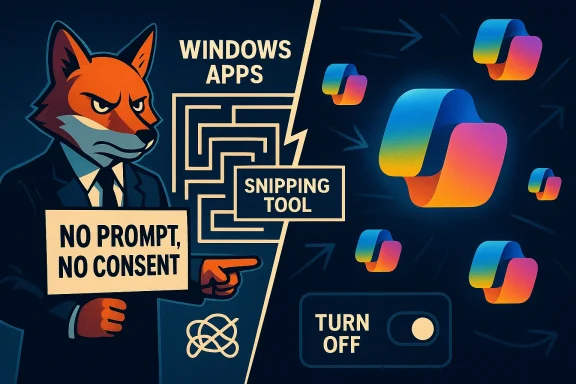
The word consent is doing a lot of work here. Mozilla’s blog says Microsoft’s Copilot push happened “with no prompt and no consent,” which reframes the issue as one of agency rather than product utility. That distinction is important because it challenges the idea that platform vendors can justify an intrusive feature simply by claiming it is useful.Mozilla is also trying to draw a line between adding optional AI and normalizing AI by stealth. The company’s own position is that AI should be something a user consciously enables, not something they discover buried inside their workflow after an update. That is a very different philosophy from Microsoft’s recent Windows strategy, which has been to integrate AI into everyday tasks and let the market sort out the backlash later.
Why the wording matters
Calling the rollout “forced” or “deceptive” is rhetorically strong, but it also serves a strategic purpose. Mozilla is not just describing annoyance; it is arguing that a platform can undermine competition by making defaults and switching costs harder to escape. That is a classic browser-war argument, but it translates cleanly to AI when the feature is embedded in OS-level touchpoints.A few key claims stand out:
- Microsoft has used design and distribution tactics to override user choice.
- Windows Search has historically pushed users toward Edge.
- Microsoft has not made switching defaults as frictionless as users expect.
- Copilot’s spread across Windows surfaces feels like a continuation of that pattern.
Microsoft’s Copilot Strategy Under Pressure
Microsoft’s Copilot strategy has always been ambitious, and ambition is part of the problem. The company has attempted to position Copilot as the connective tissue of the modern Windows experience, with access points in the taskbar, apps, browser, and system utilities. That breadth is what made Copilot feel omnipresent to many users, even before the criticism became louder.From feature to fixture
In 2025, Microsoft rolled out updates that brought AI summarization into Notepad and increased AI assistance in Snipping Tool. These were framed as productivity boosts, and for some users they likely were. But when every simple utility gains an AI layer, the perception shifts from enhancement to intrusion.Microsoft’s challenge is that Copilot is not just a product feature; it is part of a larger commercial narrative. The company wants users to adopt its AI ecosystem, its subscription tiers, and its cloud-backed services. That makes the push feel less like optional convenience and more like platform monetization dressed as productivity.
User backlash changed the tone
The March 2026 Windows blog post is revealing because it explicitly says Microsoft is reducing unnecessary Copilot entry points and being more careful about where AI belongs. That sounds like a course correction, but it also reads like a response to a sustained wave of criticism. Companies do not usually emphasize restraint unless their original enthusiasm has created visible pushback.At a practical level, this means Microsoft is trying to preserve the value of Copilot while making it feel less imposed. That is a delicate balance. If the company backs off too much, it risks weakening the AI narrative. If it backs off too little, it keeps feeding the perception that Windows is being used as a distribution channel for Microsoft services.
The Browser War Never Really Ended
Mozilla’s criticism lands so hard because it taps into a much older grievance: the feeling that Microsoft still wants to steer Windows users toward Microsoft-owned experiences by default. Even though the browser market is far more competitive than it was in the Internet Explorer era, Mozilla argues that Microsoft has continued to use Windows design in ways that advantage Edge.Defaults are power
Defaults matter because most users never change them. That is not a moral judgment; it is just how software works at scale. Whoever controls the default path controls much of the user journey, especially when the platform makes switching annoying enough to discourage experimentation.Microsoft’s own documentation shows that changing default apps in Windows is possible, but it still requires users to navigate into Settings and manage link-type associations. That may be straightforward for enthusiasts, yet it is still a multi-step process that has to be found and completed. Mozilla’s complaint is that the burden of choice remains unevenly placed on the user.
Search, links, and system gravity
Mozilla’s blog repeats a familiar set of grievances: Windows Search opens Edge, Outlook and Teams may ignore the user’s browser preference, and Windows lacks an elegant device-migration flow that preserves user choices across machines. Whether every user experiences each of those behaviors exactly the same way is less important than the larger impression they create. The system feels weighted toward Microsoft’s services.That matters now because AI is being layered on top of those same interfaces. If the browser war was about what opens when you click a link, the AI war is about what opens when you want help. The battlefield has shifted from web pages to workflows, but the underlying power dynamic looks very familiar.
Windows AI: Helpful Assistant or Unwanted Layer?
Microsoft’s best defense is that AI features can genuinely save time. A well-placed summarizer, a smart screenshot tool, or a contextual assistant can reduce friction for users who want them. The problem is that usefulness does not automatically equal appropriateness, especially when the same feature set is carried into apps people considered simple, local, and trustworthy.The productivity case
There is a credible argument that Notepad and Snipping Tool are exactly the kind of lightweight tools where AI can add value. Summarization, cleanup, annotation, and content extraction are all tasks people already do manually. A small, optional AI feature can be a genuine productivity boost if it is easy to disable and does not interfere with the core app.Microsoft’s support materials reinforce that claim by noting that some AI features can be disabled in app settings, and that Microsoft has also described how those experiences work. In other words, the company is not denying user control outright. But the existence of a setting is not the same as a respectful design philosophy, particularly if users have to hunt for it after the fact.
The annoyance case
The strongest criticism is not that AI exists, but that it keeps appearing where users did not request it. A taskbar shortcut, a Copilot entry point, an app menu suggestion, and a system-wide nudge all add up to a feeling of saturation. Once that happens, even useful features become emotionally expensive because they start to feel like persuasion rather than assistance.That is especially true for long-time Windows users who are sensitive to platform creep. They remember when the operating system was primarily a place to launch apps, not a continuous funnel into vendor services. Microsoft’s AI strategy risks colliding with that memory in a way that makes every new surface look like one more unsolicited sales pitch.
What users actually want
Most users do not reject AI wholesale. They reject uncertainty, loss of control, and surprise behavior. If a feature is genuinely valuable, users are more likely to adopt it when they understand it, trust it, and can turn it off without the experience breaking.That leads to a simple but crucial design principle:
- Offer the feature clearly.
- Explain what it does.
- Make it easy to disable.
- Preserve the user’s choice after updates.
- Avoid repeating the prompt after refusal.
Mozilla’s Own Position Is Strategically Smart
Mozilla is not speaking from pure altruism here; it is also speaking as a competitor. Still, that does not make the argument invalid. Mozilla has long built its brand around choice, privacy, and user agency, and those values naturally position it as a critic of any platform owner that centralizes control.A kill switch as a statement
Mozilla’s claim that its own browser AI can be turned off with a single kill switch is more than a product note. It is a branding move that says, in effect, we trust the user more than our rival does. That is a compelling contrast because it translates the abstract idea of openness into a concrete user experience.The company also emphasizes that preferences persist across updates, which is a subtle but important point. Users are especially frustrated when settings revert after major upgrades, because that feels like the platform is quietly undoing their decisions. Persistence is one of those boring details that turns out to be central to trust.
A familiar campaign, updated for AI
Mozilla has campaigned on browser choice for years, including research showing people want more control over their default browser selection. By linking Copilot to that older work, Mozilla is trying to extend the same argument into the AI era. The underlying message is that platform choice is platform choice, whether the issue is a browser, a search result, or an assistant.That framing is smart because it avoids sounding anti-innovation. Mozilla is not saying “stop AI.” It is saying “stop deciding for users.” In policy debates, that distinction often matters more than the product itself.
Enterprise vs Consumer Impact
The stakes are different depending on whether you are talking about a home user or an IT-managed fleet. Consumers often react first to annoyance and surprise, while enterprises focus on standardization, policy control, and supportability. Microsoft’s AI rollout touches both groups, but not in the same way.Consumers want relief
For consumers, the biggest issue is clutter. If Copilot shows up in Notepad, Snipping Tool, Widgets, or the taskbar, it can feel like one more thing to ignore, disable, or explain to a family member. That is not a catastrophic problem, but it is a persistent quality-of-life issue that shapes brand perception.Consumer resentment also tends to spread fast because it is emotional and highly visible. A user who feels nudged by an AI prompt is more likely to complain publicly than one who quietly appreciates a productivity gain. That means Microsoft’s consumer AI narrative can be undermined by a relatively small number of loud but credible complaints.
Enterprises want control
Enterprises, on the other hand, care about manageability and predictable behavior. They generally want feature flags, policy controls, auditability, and the ability to keep AI out of sensitive workflows unless explicitly approved. A feature that shows up by default in system apps raises governance questions, especially in regulated industries.This is where Microsoft’s reassurances matter. If Copilot and related AI tools can be controlled through policy, disabled in managed environments, and limited to approved scenarios, the enterprise backlash will be much easier to contain. But if the consumer experience is messy, the brand damage can still spill over into business trust.
Why the split matters
The split between consumer and enterprise is not just marketing jargon. It determines how much room Microsoft has to be aggressive in one market while cautious in another. The more the company pushes AI into the consumer shell of Windows, the more it risks forcing enterprises to spend time proving that those features can be tamed.That produces a familiar enterprise dilemma:
- The platform vendor is moving fast.
- IT wants slower, more controlled change.
- Users want less interruption.
- Security teams want clear boundaries.
- Procurement wants value without surprise costs.
Strengths and Opportunities
There is a reason Microsoft keeps leaning into Copilot: AI really can make Windows more capable, and when deployed well it can reduce friction for both casual and power users. Mozilla’s critique should not obscure the fact that the underlying features are often compelling. The opportunity for Microsoft is to keep the useful parts while stripping away the coercive feel.- Better productivity for common tasks like summarizing notes, capturing screens, and generating quick answers.
- Clearer AI boundaries if Microsoft keeps trimming back unnecessary entry points.
- More trust if users can disable features once and have those choices persist.
- Enterprise differentiation if Microsoft can demonstrate policy control and compliance-friendly deployment options.
- Competitive pressure on rivals to make their own AI features more transparent and optional.
- A more mature Windows experience if Microsoft truly focuses on the most useful AI surfaces rather than the most visible ones.
- Product clarity if the company distinguishes between system tools, cloud features, and subscription-backed AI tiers.
Risks and Concerns
The biggest danger for Microsoft is not that Copilot fails outright, but that it becomes associated with pushiness. Once users believe a feature is being inserted for business reasons rather than their benefit, every update becomes suspect. That distrust can outlive the specific features that caused it.- Backlash fatigue if users feel they must keep turning off the same things after each update.
- Brand erosion when “AI-powered” starts to mean “hard to avoid.”
- Regulatory scrutiny if governments interpret the rollout as a dark-pattern problem rather than a mere UX issue.
- Enterprise hesitation if admins worry consumer-style prompts will leak into managed environments.
- Feature bloat if too many utilities accumulate AI layers that nobody asked for.
- Competitive opening for Firefox and other alternatives that can market themselves as less intrusive.
- Update mistrust if settings or preferences appear to reset after major releases.
Looking Ahead
Microsoft appears to be in the middle of a course correction, even if it will not use that phrase. The company says it wants to be more intentional with where Copilot shows up, and that is a meaningful acknowledgment that Windows users do not want AI plastered across every task. The question is whether this is a genuine shift in product philosophy or just a tactical pause until the next wave of AI integration.Mozilla will likely keep pressing the issue because the broader argument serves its strategic goals and its worldview. If Microsoft has taught the industry anything over the past decade, it is that defaults are never just defaults; they are policy choices embedded in software. That makes every AI prompt, taskbar icon, or system suggestion part of a larger contest over power, permission, and platform behavior.
What to watch next
- Whether Microsoft continues removing Copilot entry points from Windows apps.
- Whether Copilot settings become easier to find and more durable across updates.
- Whether Mozilla and other browser vendors keep framing AI as a choice-and-control issue.
- Whether enterprise admins get clearer policy tools for AI features in Windows.
- Whether regulators start treating AI defaults like browser defaults in competition debates.
- Whether user sentiment improves if Microsoft proves it can make Copilot feel optional rather than pervasive.
Source: TechRadar https://www.techradar.com/ai-platfo...er-backlash-forces-copilot-to-be-scaled-back/
Last edited:
