

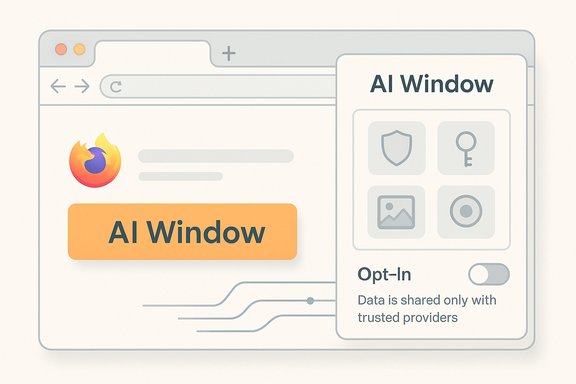
Mozilla’s new AI Window for Firefox is a clear, deliberate gambit: an opt‑in, third browsing mode that promises “smarter” browsing while staking the project’s claim to user choice, privacy, and openness — not vendor lock‑in.
Background
Mozilla’s AI Window arrives after months of experimentation inside Firefox: from the multi‑provider AI sidebar and Copilot tests in Nightly, to simpler features like the iPhone “shake to summarise” shortcut that hinted at a future in which the browser itself helps condense and clarify content. Those experiments set expectations for a measured, opt‑in approach rather than an aggressive, always‑on assistant baked into the UI. This timing also reflects a competitive landscape where browsers are rapidly becoming platforms for AI: Google has folded Gemini into Chrome and positioned the browser as an AI surface, while Microsoft continues to weave Copilot into Edge and Windows. Mozilla clearly frames AI Window as an alternative to those integrations — one that emphasizes choice over a single bundled assistant.What Mozilla is promising: AI Window explained
AI Window is described by Mozilla as a separate browsing mode — a sibling to the classic and private windows — designed to host AI‑powered tasks, summaries, and guidance in a contained, user‑controlled space. It is opt‑in by design and is currently under development with a public waitlist for early adopters and testers. Mozilla’s public messaging positions the feature as a place where users can pick which AI model to use, instead of forcing them into a single vendor’s assistant. Key elements Mozilla highlights:- AI Window will be a distinct browsing mode, not an overlay that interrupts normal navigation.
- Users will be able to select among models and providers — the precise UI and selection mechanics are still being developed.
- The project is being built with user feedback and transparency, with a waitlist and open development signals.
Why this matters: strategic and product context
Browsers are becoming AI platforms
Over the past year browser vendors have accelerated AI integration. Google’s Gemini is now embedded inside Chrome, offering webpage summarization, multi‑tab context and emerging agentic features; Edge doubles down on Copilot across the browser and OS. Those moves give users integrated, high‑friction AI experiences within the default browser — and they create a de facto advantage for whichever ecosystem controls the assistant. Mozilla’s AI Window is a direct response: provide similar utility while preserving openness and substitute choice for lock‑in.Market dynamics and stakes
Firefox’s market share is a contentious statistic because different trackers report different numbers; still, Firefox remains a minority desktop browser versus Chrome’s continued dominance. StatCounter and other aggregators show Chrome capturing a very large share of global usage while Firefox ranges from a few percent to low single digits depending on methodology and timeframe. That gap is the strategic urgency behind AI Window: without a compelling AI story, Firefox risks being sidelined as users migrate to browsers that promise tighter AI experiences. Use this context as the commercial and product pressure shaping Mozilla’s choices.How AI Window differs from prior Firefox AI experiments
Mozilla’s AI effort is not novel in concept — Firefox already supports an AI chat sidebar and other experiments — but AI Window reframes those capabilities as a mode rather than a feature toggle. Prior work provides direct technical and UX precedents:- The AI sidebar demonstrated a provider‑agnostic container that can surface multiple assistants (ChatGPT, Gemini, Copilot, etc. inside Firefox; those integrations have been web‑surface based (i.e., the provider’s cloud handles inference and data retention). AI Window appears to formalize and extend that approach into a full browsing mode.
- “Shake to summarise” and on‑page summarization experiments signaled Mozilla’s interest in small, focused AI helpers rather than a single always‑listening agent. AI Window looks to scale that idea while retaining user controls.
Technical design, model selection, and what to watch for
Mozilla’s public materials describe model selection as a core feature but leave many implementation details unspecified. Critical areas to scrutinize during development:- Provider plumbing: Will Firefox host connectors to major clouds (OpenAI, Anthropic, Google, Microsoft) or offer a simple URL/plugin mechanism so third‑party models (including local models) can be connected? Early signals indicate the architecture will be provider‑agnostic and support hosted providers — but specifics about authentication flows, per‑provider entitlements, and rate limits are not yet public.
- Local vs cloud inference: Mozilla has repeatedly signaled interest in on‑device or local model options for privacy‑sensitive features. However, high‑capability models remain compute‑intensive; expect local model support for light tasks or when users explicitly configure a local endpoint. Heavier, “smart” modes will likely default to cloud inference. Treat any claims about full on‑device parity with skepticism until technical documentation appears.
- UI for switching and controls: The usability of switching between providers will be decisive. If model switching requires complex sign‑ins or restarts, the promise of choice will fall flat. Smooth, frictionless flows (single sign‑in, per‑provider account mapping, clear privacy controls) are table stakes.
- Context and data scoping: How the AI Window scopes browsing context — whether it can read multiple open tabs, background pages, or system clipboard contents — will be a governance and privacy issue. Mozilla’s stated intent is to guide interactions rather than grant blanket access; technical defaults should minimize surprise data exfiltration.
Privacy, data flows, and enterprise governance
Mozilla’s public positioning highlights privacy and user control, but integration with third‑party models necessarily introduces complex data flows.- Third‑party processors: When a user selects a cloud model (for example, Microsoft Copilot or Google Gemini), prompts and any uploaded content will be routed to that provider’s servers and governed by the provider’s terms. Firefox’s role is the UI and connector; data residency, retention and usage are set by the model vendor. This is functionally similar to the AI sidebar experiments and remains a core privacy trade‑off.
- Defaults and discoverability: The UX must make data routing and sharing explicit. Users should be presented with clear prompts showing which provider will receive content, what context is being shared (active tab, selected text, or entire session), and whether the provider will store or use the content to improve models.
- Enterprise controls: For managed environments, IT needs centralized policy controls to disable AI Window, block certain providers, or restrict upload types. Mozilla’s prior work on per‑feature flags (about:config and enterprise policies) offers a mechanism for admins, but shipping a default Admin‑friendly policy bundle alongside AI Window will be essential for adoption in regulated settings.
- Treat a selected provider as a distinct SaaS endpoint and enforce governance accordingly.
- Use on‑device/local providers for sensitive content where possible, and require explicit consent for uploads.
- Audit telemetry and metadata that the browser may send to Mozilla versus data shared directly with third‑party providers.
UX, performance, and adoption risks
Even if Mozilla gets the policy and privacy framing right, product execution will determine whether AI Window moves the needle.- Friction in model switching: If provider selection is clumsy (separate sign‑ins, inconsistent limits, or different UX conventions), most users will stick with whichever assistant is fastest and easiest — typically the one in their default browser. Choice is meaningful only when switching is frictionless.
- Latency and battery impact: Cloud inference can be network‑heavy. Long analytic operations over many tabs or documents could increase CPU, memory and battery usage — particularly on laptops and resource‑constrained machines.
- Consistency and hallucinations: Generative models make mistakes. Summaries or guidance presented inside AI Window will need explicit provenance (links, snippets, confidence indicators) to avoid the user blindly accepting hallucinated results. Mozilla’s design language and UI affordances should emphasize verification and link‑back.
- Monetization and gating: Many advanced AI features across providers are gated behind paid tiers. Mozilla can offer broad choice, but parity of capability is a commercial problem: a user who wants the “smartest” experience may still need to pay the provider for premium levels, which undermines the perception of equal choice.
Competitive positioning: why Mozilla’s approach could work — or fail
Strengths (what Mozilla gains)- Choice as a differentiator: For users who distrust large ecosystems, the ability to point Firefox at alternative models (including local or privacy‑oriented providers) will be compelling. This respects Mozilla’s long‑standing brand promise of user control.
- Opt‑in, transparent development: Developing AI Window in the open with a waitlist and community feedback echoes Mozilla’s community roots and can build trust if executed genuinely.
- Preserving browser principles: By avoiding deep vendor lock‑in, Mozilla can serve users unwilling to hand more of their browsing life to a single cloud provider.
- Feature parity vs. integration depth: Chrome and Edge can build deeper platform integrations (e.g., cross‑service actions with Google apps or Windows agentic features) that Firefox may not match without close vendor partnerships. Users who prefer those cross‑service automations may favor the integrated browsers.
- Network effect of default browsers: Default browser inertia and account ecosystems (Google accounts, Microsoft accounts) favor Chrome and Edge. Choice matters less if the UX is slower or harder.
- Economic friction: If the most powerful model backends are paywalled, Firefox’s neutrality won’t overcome the reality that the best experiences cost money.
A practical rollout checklist (what Mozilla must get right)
- Implement simple, single‑click provider connections with OAuth and centralized account management.
- Provide clear, context‑first disclosures each time content is shared with a provider (which tabs, which files, how long retained).
- Offer a robust local‑model experience for low‑risk tasks and make it trivial to install or point Firefox at a local endpoint.
- Give enterprise admins out‑of‑the‑box policies to disable AI Window, restrict providers, and audit usage.
- Surface provenance in all AI outputs: include excerpted links, timestamps, and a “view source” affordance for summaries and answers.
What users and IT admins should do now
- Users who value privacy: Wait for detailed privacy docs and default settings; prefer local models or opt out until the controls are explicit.
- Power users and experimenters: Join the waitlist, test in a disposable profile, and evaluate provider switching, latency and provenance.
- IT administrators: Plan policy tests now. Simulate workflows in a controlled environment to decide whether to enable AI Window or block provider integrations via enterprise policies.
The broader implications for the web
AI Window embodies a larger debate about who shapes the future of browsing. The technical affordances are important, but the social contract is what matters: will browsers become proprietary AI gateways tuned to their ecosystem, or will open browsers support a heterogeneous marketplace of assistants that users can swap at will? Mozilla is literally betting the brand on the latter.If Mozilla succeeds, the result could be a healthier multi‑vendor landscape: users can pick assistants for specialized tasks, switch providers when privacy or quality issues arise, and run local models for sensitive work. If the project flounders on UX, performance or monetization, the likely outcome is consolidation: dominant ecosystems will continue to embed their assistants more deeply, and the choice promise will remain largely rhetorical.
Final analysis — measured optimism with clear caveats
AI Window is a credible, values‑consistent response to the AI arms race in browsers. It respects Mozilla’s strengths — transparency, community engagement, and a principled stance on user control — while acknowledging that users increasingly expect intelligent helpers in the browser. The project’s success will hinge on execution: frictionless provider switching, clear privacy boundaries, enterprise policy controls, and trustworthy output provenance.Mozilla must also contend with hard economic realities: the most capable models are controlled by large firms with commercial gates; local modeling is hard for advanced tasks; and users often prefer the path of least resistance (the default browser’s built‑in assistant). For AI Window to move the needle, Mozilla needs more than a principled manifesto — it needs an overwhelmingly practical, low‑friction experience that preserves privacy without sacrificing capability.
This is a high‑stakes, high‑potential moment. If Mozilla can combine real choice with polished UX and robust governance, AI Window could be the start of a pluralistic browser AI marketplace. If not, it may be remembered as a principled but niche experiment while the dominant ecosystems tighten their grip.
Appendix — quick facts and verification
- Mozilla announced AI Window as an opt‑in browsing mode and opened a waitlist for early access.
- The project follows earlier in‑browser AI experiments such as the AI sidebar and the iPhone “shake to summarise” feature.
- Firefox’s global market share sits well below Chrome’s; exact figures vary by tracker and timeframe (StatCounter and other aggregators report Chrome in the 60–73% range while Firefox data ranges from low‑single digits to mid single digits depending on measurement). Readers should treat market‑share numbers as approximate and time‑sensitive.
- Previous Firefox experiments (e.g., Copilot in the sidebar during the 143 cycle) demonstrate Mozilla’s provider‑agnostic architecture and the challenges of routing data to external AI services.
Source: The Hans India Firefox Introduces AI Window, Promising Smarter Browsing With User Choice at Its Core
