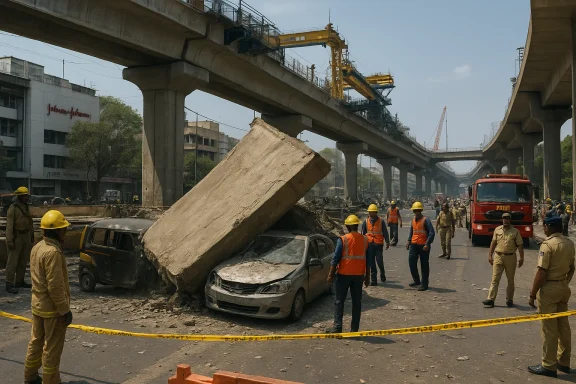
A heavy prefabricated slab from an under‑construction span of Mumbai Metro Line 4 collapsed onto LBS Road in Mulund on Saturday around midday, crushing an autorickshaw, killing one person and leaving several others injured — an accident that exposes both the engineering complexity of Mumbai’s rapidly expanding metro network and troubling gaps in on‑site safety practices.
Mumbai’s Metro Line 4 (Wadala – Kasarvadavali) is one of the city’s largest elevated corridors, designed as a 32.3 km green‑line connector with dozens of elevated piers, precast girders and parapet elements running over some of the busiest arterial roads. The project is being delivered under the Mumbai Metropolitan Region Development Authority (MMRDA), which has in recent months reported high percentages of civil completion while pushing for phased openings.
On February 14, 2026, at approximately 12:15–12:20 PM local time, a portion of a parapet segment — described by officials as a prefabricated cement slab — gave way near pier P196 on the Rajiv (Milan) stretch close to the Mulund Fire Station and the Johnson & Johnson facility. The falling slab struck an autorickshaw and a private car on the busy LBS Road, killing one person and injuring three to four others, who were rushed to nearby hospitals. Rescue teams from the Mumbai Fire Brigade, local police, BMC ward staff and the Metro project team responded to the scene.
The MMRDA issued an on‑site statement indicating the collapse occurred near Pier P196 and that its project team was leading relief and site‑securing operations in coordination with the Brihanmumbai Municipal Corporation (BMC) and disaster management authorities. Local political leaders, including Mumbai Mayor Ritu Tawde, described the incident as “huge negligence” and questioned whether safety norms were observed during the installation of the parapet body, which some reports say had been fitted only a day earlier.
Key immediate facts corroborated across independent outlets:
A parapet or beam‑like slab that separates the deck from the edge is not merely cosmetic — it can be an integral element providing lateral support during construction, a working platform for formwork and a barrier for public safety. A failure of a parapet segment can therefore be the result of:
Mayor Ritu Tawde’s on‑scene comments — calling the mishap “huge negligence” and noting the parapet had been fitted only the previous day — have amplified public outrage and placed political pressure on the MMRDA and the contractor to explain site procedures and who authorized work over live traffic. The mayor asked whether traffic should have been stopped during the activity, a point that strikes at the heart of work‑zone safety in urban construction.
State political leaders and the chief minister’s office reacted as well: according to multiple reports, the Maharashtra state leadership expressed grief and indicated compensation would be considered for the deceased; MMRDA announced a technical inquiry to ascertain sequence and cause. These are standard steps, but the true test will be the thoroughness and independence of the investigation.
Academic and industry studies repeatedly show collapse incidents during metro construction cluster around temporary works failures, poor supervision, inadequate inspection regimes and rushed operations — exactly the pressures that accompany accelerated urban infrastructure programs. Learning from pattern analysis is essential, but enforcement and cultural change on site remain the biggest operational hurdles.
Recommendations for short‑term action (operational checklist)
The full truth about why the Mulund slab fell will emerge only after careful engineering forensics. In the meantime, the collapsed parapet should force a pause — not only on Line 4 — but on how the city manages the interface between massive infrastructure ambitions and everyday public safety.
Source: ET Now Part of Mumbai Metro Rail pillar collapses in Mulund: 1 dead, 3-4 feared injured — Latest Updates
 Background / Overview
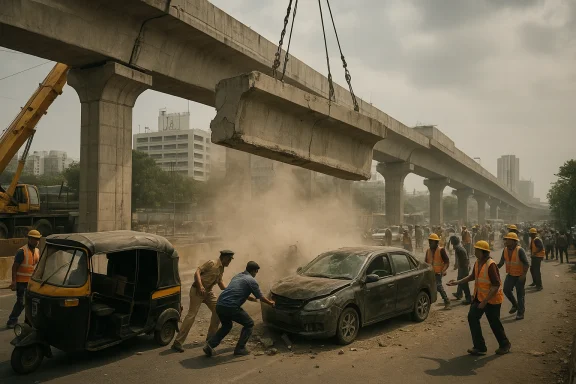
Mumbai’s Metro Line 4 (Wadala – Kasarvadavali) is one of the city’s largest elevated corridors, designed as a 32.3 km green‑line connector with dozens of elevated piers, precast girders and parapet elements running over some of the busiest arterial roads. The project is being delivered under the Mumbai Metropolitan Region Development Authority (MMRDA), which has in recent months reported high percentages of civil completion while pushing for phased openings.On February 14, 2026, at approximately 12:15–12:20 PM local time, a portion of a parapet segment — described by officials as a prefabricated cement slab — gave way near pier P196 on the Rajiv (Milan) stretch close to the Mulund Fire Station and the Johnson & Johnson facility. The falling slab struck an autorickshaw and a private car on the busy LBS Road, killing one person and injuring three to four others, who were rushed to nearby hospitals. Rescue teams from the Mumbai Fire Brigade, local police, BMC ward staff and the Metro project team responded to the scene.
What happened: sequence of events and immediate response
Eyewitnesses and preliminary reports describe the event as sudden: a prefabricated parapet section apparently detached and fell from height onto moving vehicles below. Videos circulating on social media (verified by multiple outlets) show dust, panicked bystanders and heavy concrete debris enveloping the autorickshaw and affecting adjacent traffic. Emergency crews used cutting tools and lifting equipment to extricate victims and clear the carriageway.The MMRDA issued an on‑site statement indicating the collapse occurred near Pier P196 and that its project team was leading relief and site‑securing operations in coordination with the Brihanmumbai Municipal Corporation (BMC) and disaster management authorities. Local political leaders, including Mumbai Mayor Ritu Tawde, described the incident as “huge negligence” and questioned whether safety norms were observed during the installation of the parapet body, which some reports say had been fitted only a day earlier.
Key immediate facts corroborated across independent outlets:
- Time and place: ~12:15–12:20 PM, LBS Road, opposite the Johnson & Johnson factory in Mulund (West).
- What fell: a parapet/trackside slab from an under‑construction elevated metro pier (described as a cement slab or parapet segment).
- Casualties: one person dead on arrival, three to four injured and admitted to hospital; names of deceased and injured have been reported by local outlets and confirmed by hospital/official sources.
Technical context: how elevated metro piers are built and why parapet/segment failures matter
Elevated metro viaducts are complex assemblies of piers, precast U‑ or I‑girders, deck segments and parapet or barrier elements. To accelerate delivery in congested urban corridors, large elements are often precast offsite and lifted into position; parapet sections and service closures are sometimes cast in situ or assembled from precast units. The Line 4 project specifically has used U‑girders and heavy steel spans in places, and MMRDA documentation and recent reporting describe substantial precast and overnight installation activity to minimize traffic disruption.A parapet or beam‑like slab that separates the deck from the edge is not merely cosmetic — it can be an integral element providing lateral support during construction, a working platform for formwork and a barrier for public safety. A failure of a parapet segment can therefore be the result of:
- defective anchorage or temporary supports during installation;
- inadequately cured concrete or poor bond with reinforcement;
- failure of formwork, clamps, or lifting gear;
- human error during hoisting and setting operations; or
- design/quality deviations in precast fabrication.
Official statements, local leaders and the MMRDA response
The MMRDA’s early statement confirmed the collapse near Pier P196 and said the authority’s project team was coordinating relief efforts with BMC and disaster management. Several outlets quoted the authority as saying two individuals were initially reported injured and were taken to hospital; other reports — reflecting hospital briefings and later confirmations — identified a fatality and up to four people admitted with varying injuries. This variation is common in fast‑moving incidents as casualty figures evolve.Mayor Ritu Tawde’s on‑scene comments — calling the mishap “huge negligence” and noting the parapet had been fitted only the previous day — have amplified public outrage and placed political pressure on the MMRDA and the contractor to explain site procedures and who authorized work over live traffic. The mayor asked whether traffic should have been stopped during the activity, a point that strikes at the heart of work‑zone safety in urban construction.
State political leaders and the chief minister’s office reacted as well: according to multiple reports, the Maharashtra state leadership expressed grief and indicated compensation would be considered for the deceased; MMRDA announced a technical inquiry to ascertain sequence and cause. These are standard steps, but the true test will be the thoroughness and independence of the investigation.
Names, injuries and human impact
Several outlets reporting from hospital sources and official briefings have named the deceased and injured: the person reported dead was identified in local reports as Ramdhan Yadav, and those admitted included Rajkumar Indrajeet Yadav (45, critical), Mahendra Pratap Yadav (52) and Deepa Ruhiya (40), with varying conditions noted by treating physicians. Whether all media lists will remain identical as investigations proceed, these on‑the‑ground patient disclosures provide early human detail to an otherwise technical story. Journalists and editors must treat victim identities with care while confirming next of kin notifications and official hospital records.Safety practices, legal standards and likely areas investigators will probe
Metro construction in India is governed by a mixture of contractual specifications, Indian national standards (BIS), guidelines such as the Indian Road Congress (IRC) for roadway interactions, and project‑level safety management systems mandated by the client (MMRDA) and enforced through the contractor’s safety officer. Key areas for any inquiry into this collapse should include:- Temporary works design and verification: Were hoisting anchors, staging and formwork designed by qualified engineers and checked by an independent temporary‑works engineer?
- Lifting and handling procedures: Was the parapet precast and lifted intact? Were certified cranes and slings used with correct load charts and tag lines?
- Quality control and material compliance: Were concrete mixes, reinforcement placement and curing certificates in place and traceable?
- Traffic exclusion and site demarcation: Were proper road closures, traffic diversions and safety umbrellas in place while heavy work occurred above a live carriageway? Mayor Ritu Tawde publicly questioned this point.
- Supervision and contractor competence: Did the contractor follow MMRDA’s safety plans and were safety officers on site? Past incidents across India have resulted in fines and accountability actions when contractors failed to implement mandatory safeguards.
Patterns, precedents and what the record shows
This Mulund collapse is not an isolated phenomenon. Over the past several years, India has seen multiple metro construction incidents — from fallen beams and reinforcement cages to pillar collapses — that have resulted in fatalities, serious injuries, project stoppages and punitive actions. Examples include a 2025 Chembur incident where a concrete element fell near residential premises (no fatalities reported), the 2025 Chennai Metro site collapse that led to fines and project review, and other high‑profile pier failures in Bengaluru that provoked criminal inquiries and compensation orders. Safety audits and third‑party checks have become more frequent after such events. These precedents suggest regulators and clients now possess a well‑worn check‑list of likely failures and remedies, but systemic pressure to meet deadlines and budgets continues to create risk.Academic and industry studies repeatedly show collapse incidents during metro construction cluster around temporary works failures, poor supervision, inadequate inspection regimes and rushed operations — exactly the pressures that accompany accelerated urban infrastructure programs. Learning from pattern analysis is essential, but enforcement and cultural change on site remain the biggest operational hurdles.
Accountability, compensation and legal consequences to expect
Immediate administrative actions commonly include:- a site closure or partial cessation of similar activities until safety checks are completed;
- an MMRDA‑led technical inquiry (often with third‑party experts);
- coordination with the municipal police for FIRs if negligence is suspected under criminal statutes;
- interim relief and compensation announcements by state leadership for families of deceased/injured; and
- notices and potential penalties to the contractor if contractual or statutory safety obligations are found breached.
Immediate lessons for commuters and urban managers
While inquiries proceed, there are practical steps civic authorities and project teams should adopt immediately on any active elevated corridor that runs above busy roads:- suspend heavy prefabrication or hoisting operations over live traffic unless a traffic exclusion plan is formally in force and traffic is physically diverted;
- implement protective canopies or temporary shielding over traffic during any overhead concrete work;
- require third‑party verification of temporary works for all lifts above public highways;
- ensure real‑time coordination with traffic police, BMC ward teams and local stakeholders when work is staged near commercial or industrial facilities; and
- publish transparent daily method statements for heavy lifts and make these available to local representatives to reduce the information asymmetry that fuels public alarm.
Longer‑term reforms the MMRDA and city must consider
Mumbai’s growth demands an extensive metro grid, but scale cannot come at the cost of basic site safety. The Mulund incident should trigger a systemic reassessment along several dimensions:- Independent temporary‑works approval: mandate certified independent design checks and third‑party sign‑off for all temporary works used in heavy lifts over public roadways.
- Safety‑critical red teams: create an independent safety verification cell within MMRDA that can suspend operations at first sight of protocol lapses.
- Public exclusion and compensation protocols: adopt mandatory traffic exclusion thresholds based on weight and height of lifts; if traffic cannot be excluded, suspend the lift. Also publish a faster, no‑questions interim compensation mechanism for families impacted by construction accidents.
- Transparency and community liaison: require pre‑work notices to local representatives and businesses, with a mechanism for immediate escalation and verification.
- Enhanced contractor pre‑qualification: factor historical safety performance into contractor selection, making safety records a weighted criterion rather than a pass/fail checkbox.
What investigators will need to publish to restore public confidence
Public trust depends less on statements of regret and more on concrete disclosure. Investigations should publish, in a timely manner:- the method statement for the parapet installation and the lifting plan used;
- the certification and inspection logs for the parapet element (material tests, curing records, reinforcement layout);
- the list of personnel and supervisors responsible for approving the lift and the traffic control plan;
- CCTV and site video of the operation (if available) with forensic frame‑by‑frame analysis; and
- the independent temporary works design report and the contractor’s equipment certification (crane load charts, sling certifications, operator licences).
Conclusion: emergency now, reform next
The Mulund parapet collapse is a human tragedy and a wake‑up call. Mumbai’s metro network is a lifeline for millions — and its construction corridors cut through densely occupied urban space where a single failure can cause death, injury and widespread public alarm. The immediate focus must remain on care for the injured, forensic investigation and site safety. But longer term, the episode must catalyse meaningful change: stronger temporary‑works oversight, tighter traffic exclusion rules during heavy lifts, transparent accountability and an enforcement regime that makes safety an executable constraint rather than an aspirational note in tender documents. Without these changes, Mumbai risks repeated incidents that will cost lives and undermine the very public value the metro is designed to deliver.Recommendations for short‑term action (operational checklist)
- Halt all similar parapet fitting operations above live traffic on Line 4 pending an independent safety audit.
- Publish the day‑by‑day method statements for all heavy lifts and notify traffic authorities 48 hours in advance.
- Institute mandatory protective canopies for active work zones above public roads.
- Launch an independent forensic team (external structural engineers, temporary‑works specialists) with a public remit and a 7‑day preliminary report deadline.
- Provide immediate interim financial support to the families of victims and expedited compensation to those hospitalised.
The full truth about why the Mulund slab fell will emerge only after careful engineering forensics. In the meantime, the collapsed parapet should force a pause — not only on Line 4 — but on how the city manages the interface between massive infrastructure ambitions and everyday public safety.
Source: ET Now Part of Mumbai Metro Rail pillar collapses in Mulund: 1 dead, 3-4 feared injured — Latest Updates