

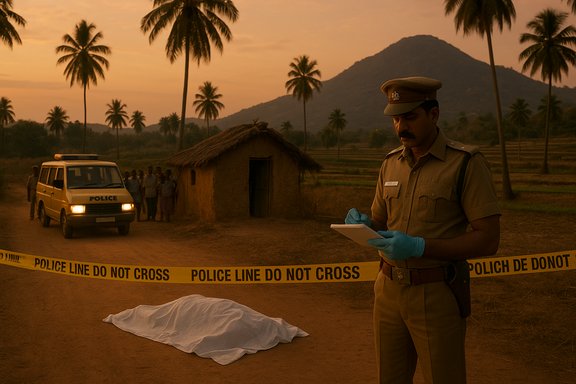
A 32‑year‑old man, identified in a local news report as P. Pandian of Mettupatti in Illupur taluk, was found murdered near Idaiyanparai within the Karaiyur police station limits, and Karaiyur police say they inspected the scene and have launched a probe into the killing.
The location named in the local report — Mettupatti in Illupur taluk — is a small rural settlement inside the Illupur administrative area, which is part of the Pudukkottai‑regional belt in central Tamil Nadu. Postal and constituency records place Mettupatti squarely in the Illupur area, which falls under the broader Viralimalai/Illupur political and revenue geography used for administration and policing. Karaiyur police station, cited in the report as the jurisdiction that inspected the scene, serves as the local first response and investigative unit for crimes in its limits. In rural Tamil Nadu, police stations such as Karaiyur are typically responsible for initial inquest, evidence collection, registration of cases, and forwarding of material for forensic analysis where needed.
The immediate facts reported — the discovery of the body near Idaiyanparai, identification of the deceased as P. Pandian of Mettupatti, and a police inspection with a subsequent probe launched — are the nucleus of this story. These are treated here as the initial, verified claim set reported by the local outlet that brought the case to public attention. Because this is a developing local criminal investigation, the public record at the time of writing contains limited additional detail: motive, time and manner of death, forensic findings, or named suspects have not been publicly released by police in the material reviewed here.
Understanding the local map matters for four practical reasons:
Because the case is active and details are emergent, core claims that remain unverified by independent sources include:
Source: The Hindu Man found murdered
 Background / Overview
The location named in the local report — Mettupatti in Illupur taluk — is a small rural settlement inside the Illupur administrative area, which is part of the Pudukkottai‑regional belt in central Tamil Nadu. Postal and constituency records place Mettupatti squarely in the Illupur area, which falls under the broader Viralimalai/Illupur political and revenue geography used for administration and policing. Karaiyur police station, cited in the report as the jurisdiction that inspected the scene, serves as the local first response and investigative unit for crimes in its limits. In rural Tamil Nadu, police stations such as Karaiyur are typically responsible for initial inquest, evidence collection, registration of cases, and forwarding of material for forensic analysis where needed.The immediate facts reported — the discovery of the body near Idaiyanparai, identification of the deceased as P. Pandian of Mettupatti, and a police inspection with a subsequent probe launched — are the nucleus of this story. These are treated here as the initial, verified claim set reported by the local outlet that brought the case to public attention. Because this is a developing local criminal investigation, the public record at the time of writing contains limited additional detail: motive, time and manner of death, forensic findings, or named suspects have not been publicly released by police in the material reviewed here.
What the on‑scene process looks like (legal and procedural context)
When a body is found in the open or in a suspicious circumstance in India, the investigating officer (IO) follows a legally defined sequence of steps that are broadly consistent across states:- The scene is secured and photographed; initial scene examination is performed and items are identified for collection.
- An inquest under Section 174 of the Code of Criminal Procedure (CrPC) is the routine step where the police record the circumstances of discovery and send the body for medico‑legal examination (post‑mortem) if required.
- The post‑mortem (medico‑legal autopsy) is conducted by a qualified medical officer; viscera and biological samples may be preserved and forwarded to a Forensic Science Laboratory (FSL) for chemical, toxicological, or DNA testing when indicated.
- Chain‑of‑custody procedures place responsibility for collected items with the police (malkhana / evidence store) and require proper sealing, documentation, and transfer to analysis labs to preserve evidentiary integrity.
Why geography and local administration matter
Rural pockets such as Mettupatti and the surrounding Idaiyanparai area are serviced by local police stations that are typically the first point of contact for violent crime reporting and inquest work. Administrative boundaries (taluk, district, police station limits) determine jurisdiction for investigation, whether neighbouring station support is required, and which judicial magistrate will oversee inquest formalities.Understanding the local map matters for four practical reasons:
- Who will conduct the post‑mortem and where (nearest taluk civil hospital or district medical examiner).
- Which FSL or forensic resources are nearest and how quickly they can be engaged.
- Whether the case may be transferred to a specialized unit (CID, DSP task force) depending on complexity or public sensitivity.
- How community relations and local politics can affect witness cooperation and information flow.
What wider crime statistics tell us — context, not causation
Homicide and violent‑crime trends provide essential context but do not explain any single case. National Crime Records Bureau (NCRB) data and state‑level reportage show that Tamil Nadu’s murder figures are relatively stable year‑to‑year, with thousands of incidents recorded statewide; across India, common motives reported in aggregated NCRB summaries are often disputes, personal enmity, and gain. These categories reflect patterns at scale but are not a substitute for evidence in a particular investigation. Key takeaways from the macro data:- Murders and violent crime in Tamil Nadu have shown modest fluctuations; in recent national reporting Tamil Nadu recorded well over a thousand murder cases in the most recent annual cycle.
- Motives recorded in aggregated murder statistics frequently list dispute or personal enmity as prominent categories; motive identification in any single case requires detailed investigation.
The likely investigative timetable and practical bottlenecks
A typical rural murder investigation will progress through steps that include fast, legally mandated actions and subsequent forensic and administrative work that may take weeks:- Immediate on‑scene work and inquest — hours to days.
- Post‑mortem and provisional cause of death — typically within 24–72 hours of recovery of the body, subject to hospital routing and availability.
- Forensic testing (toxicology, DNA, ballistic or trace evidence) — potentially weeks to months, depending on FSL workload and the nature of tests ordered.
- Witness interviews, charge sheet preparation and arrests — timing varies based on evidence developed and leads produced.
- Judicial processes and trial — months to years in many cases.
Critical analysis — strengths, weaknesses, and risks in early reporting and inquiry
Strengths (what, if handled correctly, can help a swift and lawful outcome)
- Prompt police action at discovery: The reported immediate inspection by Karaiyur police is the correct first step. Securing the scene and beginning formal inquest procedures quickly preserves the opportunity to collect usable forensic material.
- Clear identification of the deceased: Reporting the victim’s name and residence narrows inquiry pathways for investigators (family interviews, last known movements, social and economic ties).
- Local administrative clarity: Knowing taluk and police limits allows faster coordination between medical, forensic and investigative units.
Weaknesses and risks (practical and legal)
- Single‑source reporting risk: When a case appears in a single local report with few details, there is a risk of unverified narratives spreading — speculation can compromise witness testimony, tip off perpetrators, or skew public perception before investigators complete core tasks.
- Forensic delays and degradation: Rural scenes are vulnerable to contamination or loss of trace evidence if the scene is not immediately and effectively sealed. Where FSL capacity is limited, turnaround times may be long and evidence can become stale or legally vulnerable.
- Community tensions and misinformation: Violent deaths in small communities often trigger intense local speculation about motive or identity of suspects; this can escalate into vigilante action, intimidation of witnesses, or socially destabilising rumours.
Legal and ethical risks
- Presumption of innocence: Publicly naming suspects or blaming community groups before charges are framed risks miscarriage of justice and wrongful reputational damage.
- Privacy for the victim’s family: Media and police handling of personal details must balance public interest with the family’s privacy and dignity.
- Chain‑of‑custody errors: Procedural lapses at the scene or in storage can render forensic tests inadmissible or unreliable, affecting both prosecution and defence rights.
What sensible investigative best practices look like now
For Karaiyur police and district authorities, the following steps — aligned with standard legal procedure and forensic best practice — will materially improve the chances of producing a robust case:- Secure and quarantine the scene immediately; control entry to preserve trace evidence.
- Conduct a legally proper inquest under Section 174 CrPC, document every action with time‑stamped photographs and logs, and ensure an independent witness is present when possible.
- Arrange post‑mortem at the nearest qualified facility and ensure samples (viscera, blood, trace materials) are properly preserved in appropriate media and forwarded to the FSL promptly.
- Maintain an unbroken, documented chain of custody for all seized items; log each transfer to avoid later challenges to admissibility.
- Avoid public statements that disclose investigative details or that could prejudice the process; rely on measured briefings focused on confirmed facts.
- If the case raises complexities (multiple suspects, political sensitivity, cross‑jurisdictional leads), consider involving a higher‑level investigative team or CID support early to avoid evidence dilution.
Community impact and the media’s role
Small‑town murders reverberate through villages and can alter perceptions of safety, catalyse distrust between communities, and influence local political narratives. Responsible local reporting should:- Be factual, concise, and avoid unverified speculation.
- Refrain from naming potential suspects until police file formal charges.
- Protect the identity of minors and vulnerable witnesses.
- Encourage community cooperation with police while urging calm.
What we can and cannot say, and the verification gap
The immediate discovery and the victim’s identification are being reported through a single local news account. At the time of compiling this feature, that report is the primary published account available for public review. Independent confirmation — additional media reports, official press releases with forensic details, or public statements from district magistrates — were not found in the open record consulted while preparing this article.Because the case is active and details are emergent, core claims that remain unverified by independent sources include:
- The precise manner and time of death.
- Any forensic findings (toxicology, cause of death specifics).
- Whether arrests have been made or suspects identified.
- Any motive or background reason for the killing.
How readers should interpret early coverage (a quick checklist)
- Treat early reports as a statement of discovery and inquiry, not proof of motive or guilt.
- Watch for updates from the district police or official press notes rather than relying solely on social posts.
- Be cautious about sharing unverified names or accusations on social media.
- Expect the forensic timeline to extend beyond immediate headlines; toxicology and DNA can take weeks.
Conclusion
A young man’s death near Idaiyanparai — reported as P. Pandian of Mettupatti in Illupur taluk — has triggered a formal police inquiry and local concern. The initial, correct steps are visible in the fast police presence and a launched probe; the hard work ahead lies in meticulous forensic collection, careful witness work, and disciplined public communication. Systemic constraints that affect rural investigations — from FSL backlog to scene‑preservation issues — are real and may shape how quickly and conclusively this case is resolved. For the community and for those following the story, the immediate priority must remain a full, professional investigation conducted in accordance with law, backed by forensic standards and due process. Media and citizens should prioritise accuracy over haste, and authorities should prioritise transparent updates that protect evidence integrity, victim dignity, and the rights of any persons who may be implicated.- Key verified administrative facts: Mettupatti is located in Illupur taluk and is covered by local postal and administrative records.
- Forensic and legal context: Indian medico‑legal practice guides the use of Section 174 inquests, post‑mortems and forwarding of samples to FSLs; systemic capacity and chain‑of‑custody challenges are documented in national reviews.
- State crime context: Tamil Nadu records a significant absolute number of homicide cases annually; aggregate motives reported at scale commonly include disputes and personal enmity, but those are statistical observations not evidence in any single incident.
Source: The Hindu Man found murdered
