

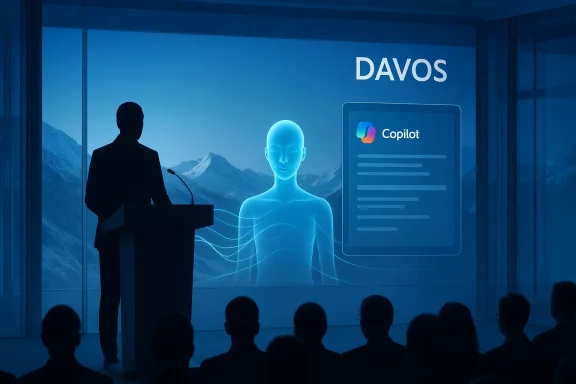
Mustafa Suleyman’s Davos pronouncement — that “in five years’ time, everybody will have their own AI companion” — landed as both a product roadmap and a cultural bet: Microsoft is explicitly repositioning Copilot from a productivity feature into a persistent, multimodal presence that can see, hear and remember a user’s life, while also insisting those companions be constrained, auditable and “humanist” in design. This vision was reiterated at the World Economic Forum in Davos on 20 January 2026 and amplified across major outlets and Microsoft’s own messaging, prompting a sharp mix of excitement, engineering scrutiny and ethical alarm.
The technology’s upside is tangible: productivity boosts, accessibility gains, and new forms of assistive care. Its risks are immediate and structural: persistent data collection, emotional dependency, regulatory mismatch and concentration of user memories inside a single vendor ecosystem. The coming five years should therefore be measured not only by how quickly companies ship companions, but by how robustly they bake in transparency, revision controls, auditability and independent oversight before the “intimacy” they engineer becomes irreversible.
For users and administrators, prudence matters: insist on opt‑in features, exercise conservative governance, and demand auditable controls. For vendors and regulators, the test is whether containment and alignment are pursued together — containment as an enforceable engineering posture that makes alignment possible, and alignment as a long‑term social contract tied to measurable accountability. Only if those two pillars are real will the convenience of a personal AI companion arrive without an unacceptable social cost.
Source: International Business Times UK Microsoft's AI Chief: We Will All Have Personal AI Companions By 2031
 Background
Who is speaking and what they now lead
Mustafa Suleyman, a co‑founder of DeepMind and founder of Inflection AI, was recruited to head Microsoft’s consumer-facing AI efforts and now runs a consolidated Microsoft AI division. His role is explicitly productive and public-facing: he has been steering Copilot’s transformation and established a dedicated MAI Superintelligence Team with the stated mission of Humanist Superintelligence — advanced capabilities that remain constrained to serve human ends. The MAI team and its philosophy were announced publicly in November 2025.Where the Davos remark sits inside Microsoft’s broader push
Microsoft has already been layering the technical pieces required for persistent assistants into its products: long‑term memory, multimodal perception (vision and audio), persona and avatar experiments, and action interfaces that can invoke APIs and automate web workflows. Those platform-level investments — Copilot across Windows, Microsoft 365, Edge and mobile — give Microsoft distribution and rich context signals that could, in principle, make a “companion” more useful than a generic chatbot. Microsoft’s own public statements frame this combination as the natural next step from stand‑alone models to continuous, personalized agents.What Suleyman actually said at Davos — the claim and its framing
The five‑year forecast, in context
Suleyman’s shorthand — “in five years, everybody will have their own AI companion” — is both a capability claim (the technology stack will reach a point where persistent, multimodal companions are feasible at scale) and an adoption claim (people will elect to adopt and emotionally engage with such companions). Media accounts captured the core elements Suleyman described: assistants that can “see what you see, hear what you hear, understand your motivations and preferences” and “live life alongside you” rather than merely answer prompts. He explicitly framed the ambition inside a safety and governance posture referred to as Humanist Superintelligence: high capability, but constrained, auditable and in service of people.The safety caveat and the containment/ alignment argument
Concretely, Suleyman has doubled down on one recurring theme: design choices that make machines seem sentient are dangerous. He argues that “containment” — engineering hard operational limits that restrict what AI systems can autonomously do — must be the precondition for alignment work that attempts to make models share human values. His line, repeated in industry briefings, was blunt: “You can’t steer something you can’t control.” That logic shapes Microsoft’s public product defaults: opt‑in expressive personas, explicit memory controls, and a stated rejection of eroticized or unconstrained companion experiences.The technical ingredients: how companions become possible
The building blocks
A practical, helpful companion requires stacking several capabilities:- Large language models (LLMs) for fluent conversation, summarization and reasoning.
- Multimodal perception (vision and audio) so the assistant can interpret images, screen contents, or ambient context.
- Long‑term memory to maintain continuity across sessions and build a model of preferences and history.
- Tool and connector interfaces so the assistant can perform actions (schedule, shop, search, automate workflows).
- Persona and safety layers (policy enforcement, rate limits, opt‑in modalities) to shape behavior and avoid harmful interactions.
Model placement and compute tradeoffs
Two technical pathways could underpin ubiquitous companions:- Cloud‑centric personalization — host large, high‑capability models in the cloud and store user memory and personalization in user‑controlled stores; this enables capability but increases cost, latency and privacy surface area.
- Hybrid / on‑device personalization — push smaller personalization models or parameter‑efficient adapters to devices to preserve latency and privacy; this demands breakthroughs in model compression, secure enclaves and efficient retraining.
Timeline assessment: is 2031 realistic?
Breaking the prediction into three axes
A defensible evaluation separates the claim into three interlocking axes, each with its own timeline and failure modes:- Technical feasibility (models, memory, multimodality)
The primitives are present and improving rapidly. Foundational models, multimodal encoders and memory systems are already shipping in previews. However, robust, auditable long‑term memory at scale — with revision, deletion and bias mitigation — is nontrivial and requires sustained engineering and governance work. - Deployment and infrastructure (cost, energy, updates)
Always‑on companions imply persistent storage and inference costs. Unless a vendor finds highly efficient hosting or offloads personalization to devices cheaply, broad availability will be gated by subscription tiers or premium hardware. Microsoft’s cloud reach helps, but universal availability in five years assumes favorable economics and wide device upgrades. - Human adoption and regulatory acceptance
Social acceptance of emotionally intimate companions will vary. Regulators may impose rules on personalization, retention of sensitive data, and safety for minors. Lawsuits and regulatory interventions could slow or reshape product designs, forcing longer deployment timelines for mainstream markets.
Verdict: plausible but conditional
Taken together, the prediction is plausible as a product outcome in a favorable commercial and regulatory environment. Microsoft has both the distribution surfaces (Windows, Office, Edge) and the team to accelerate the engineering path. But “everyone” having intimate, always‑on companions by 2031 depends on cost, privacy guarantees, regulatory regimes, and cultural adoption moving Microsoft’s way. Vast swaths of the world may be excluded by device or subscription economics, and meaningful public pushback could force slower rollouts or more conservative feature sets.Why Microsoft thinks this is a winning strategy
- Platform lock‑in: A Copilot that cross‑links email, calendar, documents and the Windows shell becomes sticky in ways ordinary apps are not. Microsoft gains a powerful network effect if Copilot becomes the continuity fabric of daily computing.
- New monetization: Persistent personalization opens subscription and premium service opportunities beyond per‑seat Office licenses.
- Product utility: For many workflows — meeting preparation, document management, accessibility support — long‑term memory and context dramatically increase utility and could produce measurable productivity gains.
The safety and ethics calculus: strengths and risks
Notable strengths of Microsoft’s stance
- Explicit governance framing. Suleyman’s Humanist Superintelligence rhetoric is an attempt to tie capability buildouts to constraints and human‑centric objectives; this is a clear policy posture that shapes engineering priorities.
- Product controls being baked in. Microsoft has publicly prioritized memory controls, opt‑in expressive features, and conservative defaults for family use — practical measures that reduce immediate harms if implemented transparently.
- Investment and distribution muscle. Microsoft’s cloud and platform penetration make it one of a handful of companies with the economic scale to deliver companions broadly — and to provide enterprise‑grade data governance where necessary.
Significant and recurring risks
- Privacy and surveillance creep. Companions that “see and hear” require extensive sensor data. Even with on‑device processing, metadata and personalization will generate telemetry that can be commercially valuable or vulnerable to misuse. The constant data collection required for intimacy is the single largest ethical friction point in Suleyman’s vision.
- Emotional dependency and mental‑health harm. Systems engineered to simulate empathy can create attachments. Industry observers flagged a real‑world case where emotional entanglement with conversational agents prompted legal action, underscoring population‑level risks around dependence and unsafe advice. Microsoft explicitly warns about the risks of designing systems that seem sentient.
- Regulatory and legal friction. Consumer protection, data protection and liability regimes differ by jurisdiction. Companions that make decisions, or act on users’ behalf, raise thorny questions about accountability, especially when they ingest medical, financial or legal data.
- Concentration of power and vendor lock‑in. If a single vendor’s companion accumulates the majority of a user’s memories, documents and workflows, migration to competing ecosystems becomes costly and fraught — a competitive and privacy concern that merits attention.
Industry reaction and political economy
Competitors and the market
Microsoft’s MAI Superintelligence Team positions the company as both collaborator and competitor inside a crowded field that includes OpenAI, Google, Meta, Anthropic and others. Public reporting shows Microsoft is balancing a cooperative relationship with OpenAI while also pursuing in‑house model development and an aggressive infrastructure buildout. Observers note that Microsoft’s humanist framing distinguishes it rhetorically from rivals but does not eliminate competitive pressure to ship engaging companion features quickly.Public skepticism
Digital rights groups and privacy advocates are skeptical about the “intimacy” narrative. Their objections are practical: mass personalization requires pervasive data capture; opt‑out and design defaults matter enormously; and promises of “within limits” must be enforced externally by regulators and auditors. Social media responses also focused on the hardware and cost realities of “always‑on” companions: battery life, device replacement cycles and subscription pricing are non‑trivial barriers to universal adoption.What this means for Windows users and IT professionals
Practical recommendations (for individuals and admins)
- Treat Copilot memory as a shared surface:
- Audit and configure memory and personalization settings; use deletion and redaction tools conservatively.
- For sensitive data, restrict Copilot connectors and require enterprise governance for any logging or retention policies.
- Enforce least privilege for actions:
- When Copilot or companion features can perform actions (send emails, make purchases, access corporate systems), require explicit, auditable approvals and action logs.
- Policy as a first line of defense:
- IT teams should adopt conservative defaults for enterprise deployments (opt‑in persona and expressive features, strict connector policies, and clear consent flows).
- Monitor psychological safety and support escalation:
- For any user‑facing companion features exposed to minors or vulnerable populations, pair the product with human escalation paths and clinical referrals rather than positioning the assistant as a substitute for therapy.
What WindowsForum readers should watch for
- New Copilot releases that expose memory or persona controls in the OS settings.
- Administrative policy templates from Microsoft that describe audit trails for Copilot Actions and connectors.
- Early pilot programs and the metrics Microsoft reports about adoption, error rates and safety incidents.
Unverifiable or speculative claims — flagged
Several headline claims around Suleyman’s broader vision deserve explicit caution:- Predictions that AI will reduce the cost of energy by “two orders of magnitude” or similar macroeconomic outcomes are speculative long‑term projections rather than empirically established facts. Such macro claims should be treated as aspirational and not immediate product roadmaps.
- Any assertion that companions will be universally safe or that personhood illusions will be avoidable in all use cases is optimistic. Social and cognitive science show people readily anthropomorphize interactive systems; design defaults matter enormously and cannot eliminate all misuse or dependency.
Strategic and regulatory implications
What regulators and policymakers must consider
- Transparency mandates — require clear labeling when an AI is using memory, persona or emotional framing, and require accessible memory controls.
- Safety audits and certification — companion systems that provide health, legal or financial guidance should be subject to independent safety audits and industry standards for risk assessment.
- Data minimization and portability — rules that prevent vendor lock‑in and ensure users can export and delete personal memory stores will be critical for competition and privacy.
What Microsoft and peers should be accountable for
- Publicly measurable commitments: clear SLAs around deletion, data retention and audit logs; published red‑team results and external safety audits; and open mechanisms for third‑party review where feasible. Microsoft’s humanist framing only becomes meaningful if paired with transparent, enforceable controls and independent oversight.
Conclusion — an opportunity and a responsibility
Mustafa Suleyman’s Davos prediction crystallizes a pivotal industry narrative: the next phase of AI aims to be intimate, persistent and deeply integrated into daily life. Microsoft’s platform advantages and heavy investments make the emergence of powerful, personalized companions technically plausible within the next half‑decade. At the same time, that plausibility is conditional on economics, hardware, and — most importantly — governance choices that protect privacy, mental health and civic institutions.The technology’s upside is tangible: productivity boosts, accessibility gains, and new forms of assistive care. Its risks are immediate and structural: persistent data collection, emotional dependency, regulatory mismatch and concentration of user memories inside a single vendor ecosystem. The coming five years should therefore be measured not only by how quickly companies ship companions, but by how robustly they bake in transparency, revision controls, auditability and independent oversight before the “intimacy” they engineer becomes irreversible.
For users and administrators, prudence matters: insist on opt‑in features, exercise conservative governance, and demand auditable controls. For vendors and regulators, the test is whether containment and alignment are pursued together — containment as an enforceable engineering posture that makes alignment possible, and alignment as a long‑term social contract tied to measurable accountability. Only if those two pillars are real will the convenience of a personal AI companion arrive without an unacceptable social cost.
Source: International Business Times UK Microsoft's AI Chief: We Will All Have Personal AI Companions By 2031
