

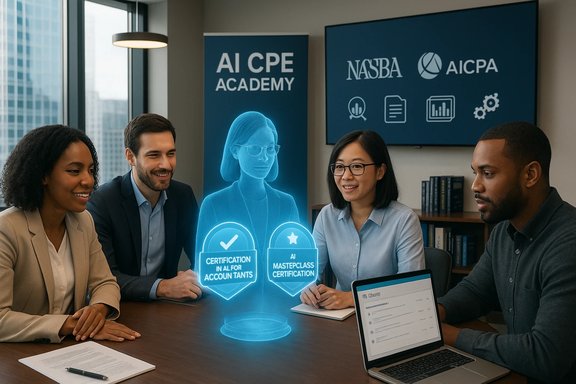
MYCPE ONE has quietly moved from being a broad CPE content aggregator to an active participant in the accounting profession’s AI upskilling race with the launch of the AI CPE Academy — a structured, certification-backed learning pathway that promises to teach accountants how to deploy generative AI, ChatGPT-style copilots, automation, and next-generation accounting technology inside real-world firm workflows.
Background
The accounting profession is in the middle of a rapid operational and educational pivot: routine, high-volume tasks are prime candidates for automation; narrative synthesis and tax research are increasingly aided by retrieval-augmented models and large language models (LLMs); and regulators and credentialing bodies are updating CPE standards to encompass new learning modalities and topical fields. NASBA and the AICPA revised the Statement on Standards for Continuing Professional Education in recent years and have been actively consulting on further updates to keep CPE aligned with evolving delivery models — a backdrop that makes CPE-approved AI training both timely and institutionally meaningful. MYCPE ONE, already known for a broad catalog of courses and subscription products, has packaged a set of focused, CPE-approved offerings under the umbrella AI CPE Academy. The new academy is positioned as a practical learning route: short-form and deep-dive classes, instructor-led modules, case studies, hands-on exercises, and badgeable certifications claimed to be designed specifically for accountants and firm teams. Independent industry reporting summarized the launch as part of a broader wave of vendor-led education offerings aimed at bridging AI literacy and operational adoption across firms.What the AI CPE Academy claims to offer
MYCPE ONE’s release and industry coverage highlight a compact but concrete set of features intended to accelerate practitioner adoption of AI:- Structured CPE-approved courses that claim to meld real-world case studies with hands-on practice and instructor-led modules.
- Certifications with badges and program names that purport to validate applied competency in generative AI and AI tools for accountants (titles announced include Certification in AI for Accountants (CAIA), AI Masterclass Certification (AIMC), Certified ChatGPT and AI Tools Mastery (CCAITM), Generative AI & ChatGPT for Management Consultants (GAICMC), and Certification in Practical AI Applications (CPAIA).
- A launch slate of courses aimed at immediate practical wins: day-to-day automation, workflow optimization, tax research aids, audit advisory copilots, and Microsoft Copilot integrations among others.
- Subscription access to the full academy plus the larger MYCPE ONE catalog — advertised as thousands of hours of content and a one-stop compliance and skills platform for firms. External profiles and customer reviews list the company’s library as substantial and its subscription model as the vehicle for accessing the new AI curriculum.
Course lineup and immediate use cases
The announced core course types reflect short-term, high-leverage use cases where accountants can apply AI today:- AI productivity and Copilot workflows — training accountants on Microsoft Copilot, prompt design, and embedding AI into everyday Office and practice-management workflows.
- Advanced ChatGPT for Accountants — deeper sessions on prompt engineering, verification, and tooling for tax and audit research.
- Controller & CFO-focused agents — building or supervising ChatGPT-style agents that can draft management commentary, flag exceptions, or synthesize contract clauses.
- Ethics and governance — courses intended to cover ethics, data handling, and human-in-the-loop safeguards when using generative models. This is a notable and necessary inclusion given the profession’s regulatory obligations.
Certifications and credibility
MYCPE ONE’s certification titles are deliberately framed to appeal to both practitioners and firm leaders: “Certification in AI for Accountants,” an “AI Masterclass Certification,” and a designated ChatGPT mastery credential. The marketing claim is straightforward: certifications provide evidence of applied capability and a measurable signal for clients and employers.Context matters here. Credentialing value depends on three things:
- Program rigor and assessment design — Are the certifications tested via proctored exams, practical projects, or supervised capstones?
- Recognized approvals and continuing education alignment — Does the credential have NASBA/AICPA CPE approval, and does it map to recognized Fields of Study? MYCPE ONE states CPE approvals are part of the offering, which aligns with existing regulatory pathways.
- Market recognition — Will employers and clients consider these certifications a reliable competency signal, or are they marketing badges primarily for internal training uptake?
Instructors and subject-matter expertise
MYCPE ONE highlights a roster of instructors described as industry veterans (for example, Garret Wasny, a former PwC consultant and AI accounting advisor; Victor Hartman, a CPA/CFF and former FBI special agent with forensic accounting experience; Gregory Holzel, a CPA and founder with a tech-forward finance approach; and Apoorv Dwivedi, a strategy and transformation lead). These credentials are presented to underscore the academy’s practical orientation. A responsible reader should treat instructor bios in two layers:- Reported expertise — The academy’s promotional materials and press coverage list their backgrounds and areas of specialization. This is standard for launch communications.
- Independent verification — Where instructor claims are pivotal to buyer decisions, firms should validate specific credentials, publications, and demonstrable project experience (e.g., published work, verifiable leadership of AI projects, vendor or firm references). At the time of writing, core instructor claims are reported in the launch materials; performing due diligence on instructor portfolios and public profiles is advised before using a certification for firm-level credentialing decisions.
The subscription package and platform capabilities
MYCPE ONE positions the AI CPE Academy inside a broader subscription product that advertises:- Over 15,000 hours of content across hundreds of subject areas (catalog breadth).
- Compliance and reporting features: instant certification, fast reporting, AI compliance tracking, and the ability to upload external certificates — all features designed to minimize administrative friction for busy firms.
- Mobile access and practical training programs, plus events and conferences as part of a single membership offering.
Why the launch matters for accounting firms and practitioners
The academy marks an important moment for three practical reasons:- Speed-to-adoption: Firms that want to move past one-off pilots need repeatable training paths that teach staff how to use, validate, and supervise AI-driven tools. A bundled CPE-approved academy helps standardize the baseline.
- Governance and compliance alignment: With NASBA and AICPA standards evolving to recognize modern delivery methods and fields of study, certified programs that claim CPE approval make it easier for firms to include AI skills in their professional development while preserving regulatory compliance.
- Operational leverage: Practical, workflow-focused courses reduce time wasted on trial-and-error deployments by teaching staff how to design prompts, verify outputs, and structure human-in-the-loop checks for auditability and quality control.
Critical analysis — strengths
- Practical, role-based curriculum: The academy’s emphasis on real-world cases, Copilot workflows, and role-specific courses aligns with how firms capture the most immediate ROI from AI: by automating repetitive effort and freeing staff for advisory work.
- CPE approval and structured certifications: Packaging AI training into CPE-approved courses and structured certifications addresses a key friction point: professionals need verifiable credits that meet state board and credential requirements, especially when learning new, potentially risky technologies.
- Subscription model that centralizes compliance and learning: For mid-size and larger firms that need to manage many professionals and track hours across multiple credentials, a single platform with compliance reporting and mobile access reduces administrative burden and improves adoption rates.
- Instructor-led, practical orientation: The promise of experienced practitioners teaching use-case based modules is a practical advantage over purely academic or vendor-demos; practitioners tend to retain and apply learning when it’s grounded in their own workflows.
Critical analysis — risks and limitations
- Vendor-centric bias and tool specificity: Training run by a single vendor or platform risks emphasizing specific tool chains (e.g., Microsoft Copilot, ChatGPT setups) and may understate vendor lock-in, long-term costs, or migration complexity. Firms should ensure training includes vendor-neutral governance principles and exit strategies.
- Assessment transparency required for meaningful certification: A badge or certificate is only valuable if it reflects rigorous assessment and practical competency. Prospective buyers should request details on assessment design: proctored exams, project-based capstones, or supervised pilots that prove applied skill. If a certification is primarily earned through attendance rather than assessment, its market value will be limited.
- Hallucination and professional liability: Generative AI systems can produce plausible but incorrect outputs. When AI assists in tax positions, attest work, or client deliverables, firms must retain human oversight and update engagement letters, QC checklists, and approval processes to reflect AI use and attendant responsibilities. Trainings that emphasize human-in-the-loop verification are essential; those that treat AI as a replacement for professional judgment are dangerous.
- Data privacy and vendor data usage: Not all commercial generative AI services provide clear “no-train” contractual protections. Firms should insist on contractual safeguards around data use, model training exclusions, data residency, and access logs before ingestion of client data into any LLM-powered tool. Training programs must cover these vendor governance considerations, not just prompt engineering.
- Unverified instructor claims: While the academy lists named instructors with detailed bios, organizations relying on instructor reputation for credentialing should independently verify credentials and prior work. Marketing claims are not a substitute for verifiable professional history.
Practical adoption playbook — how firms should evaluate and pilot the academy
- Define short-term, testable outcomes
- Identify 2–3 high-volume, low-judgment tasks (invoice capture, bank reconciliation, management commentary drafting) to pilot post-training.
- Map to governance and evidence requirements
- Specify who validates AI outputs, what audit trail is required, and how evidence will be retained for regulatory or client scrutiny. Require machine-readable lineage where possible.
- Request assessment and capstone details
- Ask MYCPE ONE for the certification assessment designs: are there project deliverables, proctored tests, or supervised pilots embedded in the certification? Prefer project-based assessments that produce exportable artifacts.
- Pilot with anonymized or synthetic data
- Test vendors and trained staff on non-sensitive datasets first to validate accuracy and traceability before moving to client data.
- Negotiate contractual protections
- Ensure vendor contracts for model access include data-use restrictions, no-train clauses where necessary, SOC 2 or ISO artifacts, and change-notification clauses for model updates.
- Measure outcomes and reprice services
- Track time saved, error reduction, and quality impact. Firms should consider re-pricing when automation materially reduces delivery time so value is captured and reinvested in advisory capacity.
How the AI CPE Academy fits into the broader CPE landscape
NASBA and the AICPA have been actively revising CPE standards to accommodate virtual delivery and new content areas, which makes the introduction of AI-focused CPE programs both practical and compliant — provided the programs adhere to the standards’ attendance monitoring and assessment requirements. Firms should confirm that course approvals are current and that the program aligns with the NASBA Fields of Study classification relevant to technology, ethics, and specialized practice areas. MYCPE ONE’s subscription model that bundles the AI curriculum with long-form catalogs and compliance tools mirrors broader trends: training providers are converging on subscriptions that reduce administrative overhead and make repeated, role-based learning feasible at scale. Independent reports and user reviews indicate strong demand for such consolidated catalogs, though user feedback often also highlights usability and refund policy concerns that buyers should evaluate.Buyer checklist — questions firms must ask before adopting the academy
- Are the AI courses NASBA/AICPA CPE-approved, and can MYCPE ONE provide approval documentation for the relevant state boards?
- How are the certifications assessed (exam, project, supervised pilot) and what artifacts will learners produce to demonstrate competency?
- What governance, security, and data-handling training is included? Are vendor data-use policies covered?
- Can the platform integrate with firm LMS and HR systems for assignment, tracking, and evidence export?
- What instructor verification can MYCPE ONE provide (bios, prior project case studies, references)?
- How is mobile access, reporting, and AI compliance tracking implemented, and can the firm export compliance logs for audits?
The broader regulatory and market lens
- NASBA and the AICPA’s recent and ongoing updates to the CPE Standards materially impact how training is delivered and credited; training providers and firms alike will need to be mindful of evolving guidance and public comment cycles. Programs that map clearly to the revised Fields of Study and adhere to the updated Standards will be more resilient and readily auditable.
- The market is responding with a proliferation of targeted initiatives and vendor-led academies. Industry reporting groups these launches as part of a coordinated maturation where education, governance, and piloting form the backbone of safe adoption. Firms should view vendor academies as one part of a wider enablement strategy that includes internal pilots, vendor governance, and iterative upskilling.
Final verdict — what MYCPE ONE’s AI CPE Academy delivers and where buyers should be cautious
MYCPE ONE’s AI CPE Academy is a logical and practical entry into the profession’s urgent need for role-specific AI education. The offering’s strengths are its focus on workflow-driven training, the presence of certification pathways, and the convenience of subscription-bundled compliance and reporting features. These elements match what mid-market and larger firms need to begin standardizing AI literacy and operational deployment across staff levels. At the same time, buyers must approach with disciplined procurement: verify certification assessment rigor, insist on governance and vendor-data protections, confirm instructor backgrounds, and measure real business outcomes in pilots before broad rollout. The most useful certifications will be those that require demonstrable, project-based competency and deliver artifacts firms can use as evidence of capability and appropriate human oversight.AI training is now a professional infrastructure task — like tax updates or audit standards — not merely a perk or optional workshop. MYCPE ONE’s academy is an important addition to the vendor ecosystem offering those services. Firms that integrate such training with governance, contractual protection, and staged piloting will translate learning into defensible client work and real advisory capacity; firms that treat certification as a compliance checkbox without practical assessment and oversight risk professional exposure in a world where generative outputs can be convincingly wrong.
Conclusion
The AI CPE Academy from MYCPE ONE reflects a pragmatic step toward standardizing AI skill development in accounting. It offers a convenient and potentially powerful package: CPE-approved courseware, role-specific certifications, and the administrative tooling needed to scale training across firms. Early indicators suggest the program aligns with what practitioners need — hands-on, applied courses, and governance-minded instruction — but real value will be proven by the academy’s assessment rigor, the transparency of instructor credentials, and how well it teaches teams to combine AI efficiency with human judgment and auditability. Firms evaluating the program should require pilots, demand contractual data protections, and insist that certification equals demonstrated capability rather than attendance alone. The profession’s future will be determined not by who sells the loudest AI course, but by firms that can embed safe, auditable AI workflows into everyday accounting practice — and that is the standard any credible AI CPE Academy must meet.Source: CPA Practice Advisor MYCPE ONE Launches AI CPE Academy for Accounting Professionals
