

Satya Nadella’s year‑end blog is less a plea for kinder language than a strategic reset: stop calling generative output “AI slop,” build reliable systems around models, and make 2026 the year AI proves its value in the real world.
The word “slop” became shorthand in 2025 for the tide of low‑quality, mass‑produced generative content flooding feeds, and Merriam‑Webster captured that cultural moment by naming slop its 2025 Word of the Year. That choice crystallized a broader public judgment: billions of plausible‑looking artifacts—images, short videos, articles and social posts—can be simultaneously polished and pointless, eroding trust in online information and user experience. Against that backdrop, Nadella published “Looking Ahead to 2026” on his new personal site, sn scratchpad, on December 29, 2025. The post sketches three linked priorities: (1) treat AI as a cognitive amplifier and design systems that preserve human agency; (2) shift from single‑model thinking to engineered systems that orchestrate models, memory, entitlements, and safe tool use; and (3) be deliberate about where and how scarce compute, energy and talent are applied so AI can earn societal permission. Nadella’s call is rhetorical, but it is not detached from Microsoft’s material interests. The company has deeply embedded Copilot and generative features across Windows, Microsoft 365 and developer tools, and its partnership with OpenAI — and the cloud contracts that support inference at scale — anchor Microsoft’s position in this next phase of computing. Independent reporting places Microsoft’s total investment in OpenAI at more than $13 billion, a figure that underpins both product strategy and public scrutiny.
Ironically, Nadella’s own blog drew scrutiny when Microsoft’s Copilot—used as a text‑analysis/detection tool in media coverage—indicated the post could plausibly be machine‑assisted. That meta‑observation amplified the debate about authorship, authenticity and corporate transparency. Several outlets ran skeptical takes noting that even leadership communications are now judged by AI detectors and that the line between human and machine authorship is blurred in practice.
If the effort falters, the opposite happens: public cynicism deepens, regulators impose stricter guardrails, rivals and smaller specialized players exploit the trust deficit, and large infrastructure investments struggle to justify themselves as operating costs outpace reliable monetization. Numerous industry commentators warned that 2026 will feel less like a new invention year and more like a test of discipline.
Nadella’s essay is a strategic invitation: the language matters, but outcomes matter more. The CEO framed 2026 as a year for discipline; the industry will judge the argument by whether the technology begins to make everyday work measurably better, not by whether executives succeed in rebranding a public critique.
Source: WebProNews Nadella Rejects ‘AI Slop’ Label, Eyes 2026 as AI Breakthrough Year
 Background / Overview
The word “slop” became shorthand in 2025 for the tide of low‑quality, mass‑produced generative content flooding feeds, and Merriam‑Webster captured that cultural moment by naming slop its 2025 Word of the Year. That choice crystallized a broader public judgment: billions of plausible‑looking artifacts—images, short videos, articles and social posts—can be simultaneously polished and pointless, eroding trust in online information and user experience. Against that backdrop, Nadella published “Looking Ahead to 2026” on his new personal site, sn scratchpad, on December 29, 2025. The post sketches three linked priorities: (1) treat AI as a cognitive amplifier and design systems that preserve human agency; (2) shift from single‑model thinking to engineered systems that orchestrate models, memory, entitlements, and safe tool use; and (3) be deliberate about where and how scarce compute, energy and talent are applied so AI can earn societal permission. Nadella’s call is rhetorical, but it is not detached from Microsoft’s material interests. The company has deeply embedded Copilot and generative features across Windows, Microsoft 365 and developer tools, and its partnership with OpenAI — and the cloud contracts that support inference at scale — anchor Microsoft’s position in this next phase of computing. Independent reporting places Microsoft’s total investment in OpenAI at more than $13 billion, a figure that underpins both product strategy and public scrutiny. What Nadella Actually Said
Three high‑level prescriptions
Nadella’s essay is compact but structured. Its three pillars are:- A new human‑centered framing: treat AI as scaffolding for human potential (an update to the “bicycles for the mind” metaphor).
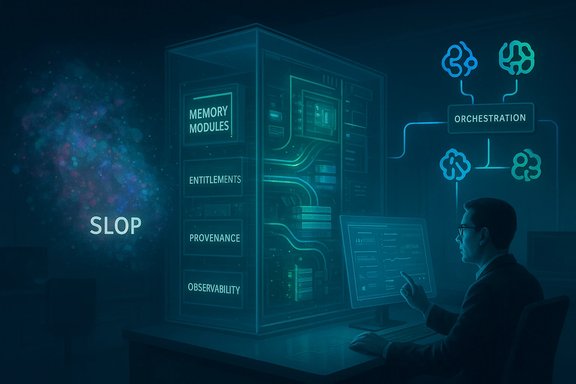
- Move from “models” to “systems”: orchestration, persistent memory, entitlements, provenance and safe tool integrations are the engineering work now required.
- Be strategic about diffusion: where and how AI is deployed should be chosen to deliver real‑world eval impact in service of earning societal permission.
The diagnosis: “model overhang”
A recurring technical phrase in Nadella’s note is model overhang—the idea that model capabilities have raced ahead of the product engineering, governance, and evaluation needed to use them reliably in the wild. That diagnosis reframes the problem: slop is a symptom of rushed deployment and thin scaffolding, not solely an indictment of the underlying research.Where the Rhetoric Meets Reality
Microsoft’s investment and leverage
Microsoft’s posture is shaped by scale and contracts: its multi‑billion dollar investment and Azure exclusivity arrangements with OpenAI give it privileged access to high‑end models and a strong commercial incentive to make agentic features work at enterprise scale. Recent investigative reporting and leaked documents showed heavy inference spend by OpenAI on Azure and described revenue‑sharing arrangements that materially link the two companies’ incentives. Those facts make Nadella’s systems‑first rhetoric both an engineering roadmap and a financial imperative.Product signals: Copilot, defaults and backlash
Copilot and other embedded assistants are Microsoft’s primary vehicle for the “cognitive amplifier” idea, but user reports and reviewer tests in 2025 documented brittleness: hallucinations, inconsistent multi‑step behavior, and intrusive defaults that shoved generative features into workflows without clear opt‑in. The public’s “slop” verdict is rooted in this day‑to‑day experience, not merely internet snark.Ironically, Nadella’s own blog drew scrutiny when Microsoft’s Copilot—used as a text‑analysis/detection tool in media coverage—indicated the post could plausibly be machine‑assisted. That meta‑observation amplified the debate about authorship, authenticity and corporate transparency. Several outlets ran skeptical takes noting that even leadership communications are now judged by AI detectors and that the line between human and machine authorship is blurred in practice.
The Tech Case for “Models → Systems”
Turning model capability into dependable product experiences is not glamorous research; it’s engineering discipline. Nadella’s prescription points to concrete technical building blocks that the industry must solve to reduce slop:- Persistent memory and context management so agents remember relevant facts without leaking private data.
- Entitlements and fine‑grained access controls so models only act on authorized data and perform sanctioned actions.
- Provenance and explainability layers that attach lineage and confidence to generative outputs.
- Observability, fallbacks and UX patterns that surface uncertainty and provide human‑in‑the‑loop controls.
- Orchestration and routing to dispatch tasks to the most appropriate specialist model rather than relying on a single monolith.
Community and Press Reactions: Praise, Skepticism, and Irony
Responses to Nadella’s note have been mixed and instructive.- Supporters welcomed the shift from spectacle to substance, arguing that a systems‑first agenda matches enterprise needs and that Microsoft’s scale positions it to lead on governance frameworks.
- Critics saw corporate self‑defense: a CEO defending a core bet while sidestepping product complaints and workforce impacts. Observers noted that the “stop calling it slop” message risks sounding like spin without measurable commitments.
- Meta‑level irony circulated widely: media coverage highlighted that Copilot flagged Nadella’s post as potentially AI‑generated, reinforcing public worries about circularity—companies using the same systems to create and judge the authenticity of the outputs those systems produce.
Strengths of Nadella’s Argument
- Accurate diagnosis of the problem. Nadella correctly identifies that capability alone does not equal dependable product value; the “model overhang” phrase succinctly captures a structural challenge.
- Alignment with enterprise needs. A systems‑first approach—observability, entitlements, traceability—maps directly to what regulated customers need before they will run mission‑critical workloads. That alignment is a competitive advantage for Microsoft if executed.
- Focus on measurable outcomes. Framing 2026 as a year for “real‑world eval impact” forces metrics over marketing; this could catalyze industry adoption of standardized KPIs for generative systems.
- Leverage of resources. Microsoft’s cloud scale and enterprise relationships make it plausibly capable of funding the expensive orchestration and governance layers necessary to move beyond slop.
Risks and Weaknesses: Why the Message Rings Hollow to Some
- Conflict between message and incentives. Microsoft benefits commercially when generative features proliferate; urging slower, more instrumented deployment clashes with growth incentives tied to product launches, usage metrics and partner revenue. Observers interpret the plea as both sincere and self‑protective.
- Execution is hard and slow. Building memory, entitlements and rigorous provenance across millions of users is expensive and time‑consuming; headcount reductions and organizational churn in 2025 add real risk to execution timelines.
- Reputational gap. Public trust has already been dented by years of flaky features and visible errors; rhetoric alone cannot erase a year of negative user experience. The “slop” label sticks until everyday tools demonstrably improve.
- Regulatory exposure. As countries tighten AI governance, promises of better design and outcomes will be legally and politically tested; failure to publish audit trails or independent evaluations could invite stricter controls.
Concrete Steps Microsoft (and Competitors) Should Take — A Practical Playbook
Nadella’s statement sets a direction; converting it into credibility requires measurable action. Below are specific steps that would translate rhetoric into reality:- Publish validated product quality metrics.
- Error/hallucination rates, confidence calibration, and regression benchmarks for Copilot features.
- Establish external evaluation programs.
- Invite independent third‑party audits and real‑world testing across regulated domains (healthcare, legal, education).
- Harden default UX and consent primitives.
- Turn off predictive generation by default in sensitive contexts; require granular, reversible opt‑ins for content capture.
- Invest in provenance and traceability.
- Attach source citations, model‑version metadata and determinism scores to outputs used in decision‑making.
- Publish energy and compute accounting.
- Transparently report inference costs and efficiency improvements to address environmental concerns and resource allocation decisions.
- Rebalance engineering incentives.
- Allocate explicit cycles for maintenance, long‑tail QA and regression prevention rather than release velocity alone.
- Fund human‑in‑the‑loop workflows.
- Design interfaces that make verification fast and reliable—reducing cognitive erosion and preserving critical thinking.
The Wider Competitive and Social Implications
If Microsoft succeeds in converting model capability into robust systems that demonstrably reduce low‑value outputs, the company could reset expectations for enterprise and consumer AI alike: trust would rise, regulators would have clearer signals for policy, and platform economics would favor scaffold providers that deliver measurable impact. Nadella’s framing, in that scenario, becomes a road‑map for product maturity.If the effort falters, the opposite happens: public cynicism deepens, regulators impose stricter guardrails, rivals and smaller specialized players exploit the trust deficit, and large infrastructure investments struggle to justify themselves as operating costs outpace reliable monetization. Numerous industry commentators warned that 2026 will feel less like a new invention year and more like a test of discipline.
Cross‑Referenced Facts and Verification
- Nadella’s December 29, 2025 post “Looking Ahead to 2026” appears on sn scratchpad and lays out the three priorities summarized above.
- Merriam‑Webster selected slop as its 2025 Word of the Year, defining it in contemporary terms as “digital content of low quality that is produced usually in quantity by means of artificial intelligence.” This selection underlines the cultural uptake of the term.
- Multiple reputable outlets and investigative reports place Microsoft’s cumulative investment in OpenAI at more than $13 billion, and leaked documents from 2025 showed substantial Azure inference spend by OpenAI; those financial links explain why Microsoft’s public posture is both strategic and material.
- Coverage from Windows Central and other outlets noted that Microsoft’s Copilot classified Nadella’s blog as plausibly AI‑assisted—fueling debates about authenticity and the company’s own role in the problem it seeks to fix.
Final Analysis: Is 2026 the Breakthrough Nadella Predicts?
Nadella’s request to “get beyond the slop vs sophistication” binary is the right reframing: the test for AI is not rhetorical elegance but whether products reduce friction, augment judgment, and preserve human agency. But the significance of his call depends entirely on follow‑through.- Short‑term plausibility: Microsoft has the money, cloud footprint and enterprise pull to fund the necessary engineering and governance work. That makes the “systems” pivot credible in principle.
- Long‑term credibility: converting rhetoric into durable trust requires transparency—published metrics, third‑party audit programs, and demonstrable improvements in default user experiences. Without those, “stop calling it slop” will read as PR.
- Systemic constraints: compute costs, energy use, regulatory pressure, and talent scarcity are real limits that force prioritization. Nadella’s insistence that the industry choose where to allocate scarce resources is an admission that not all AI use cases are equally justified.
Nadella’s essay is a strategic invitation: the language matters, but outcomes matter more. The CEO framed 2026 as a year for discipline; the industry will judge the argument by whether the technology begins to make everyday work measurably better, not by whether executives succeed in rebranding a public critique.
Source: WebProNews Nadella Rejects ‘AI Slop’ Label, Eyes 2026 as AI Breakthrough Year
