

Satya Nadella’s remark that “gaming’s competition is not other gaming — it’s short‑form video” landed like a surprise salvo: accurate in a narrow economic sense, tone‑deaf in a cultural one, and — as Windows Central’s Jez Corden argues — revealing more about Microsoft’s own identity problem than it does about TikTok.
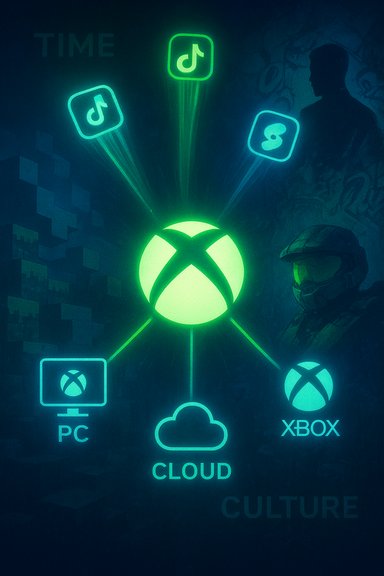
Microsoft’s leadership has recently reframed Xbox not simply as a hardware maker but as a multi‑device gaming business that must win time and attention, not just console sales. CEO Satya Nadella reiterated a vision of Xbox that treats consoles, PCs and cloud as variations on a single platform, and told interviewers he’s “looking forward” to the next Xbox while arguing the industry’s primary rival is the short‑form feed. That line — that TikTok, Instagram Reels and YouTube Shorts are gaming’s main competitors — touched off a predictable wave of commentary. Some dismissed it as corporate spin or a way to deflect from PlayStation and Nintendo. Others saw it as a candid acknowledgement of attention economics: in leisure time, a five‑minute scroll can substitute for a multi‑hour play session. Both readings contain truth. This article unpacks the comment, tests the data behind it, and examines Jez Corden’s contrarian thesis: that Xbox’s vulnerability to short‑form video stems less from external cultural forces than from Microsoft’s own anti‑culture posture.
The companies that succeed at the intersection of games and social video will be those that transform passive viewers into active creators without losing game fidelity or alienating core players. Microsoft has assets (Minecraft, cloud infrastructure, Game Pass, a Windows footprint), and it has shown the ability to execute in enterprise and platform engineering. The missing ingredient — the one Nadella’s comment implicitly admits — is cultural velocity: the capacity to create and sustain experiences that feel native, human, and worth returning to for reasons beyond engineered retention metrics.
If Xbox’s goal is to compete with TikTok, it needs to stop treating short‑form video as an enemy to be blamed and start treating it as a design problem to be learned from: build the features creators want, give them safe places to experiment, and let culture grow inside the Xbox ecosystem rather than trying to import it by fiat. Until then, Microsoft will continue to have the tools and the scale, but not necessarily the cool — and in attention markets, that gap is costly.
Source: Windows Central https://www.windowscentral.com/gami...-make-sense-but-not-for-the-reason-you-think/
 Background / Overview
Microsoft’s leadership has recently reframed Xbox not simply as a hardware maker but as a multi‑device gaming business that must win time and attention, not just console sales. CEO Satya Nadella reiterated a vision of Xbox that treats consoles, PCs and cloud as variations on a single platform, and told interviewers he’s “looking forward” to the next Xbox while arguing the industry’s primary rival is the short‑form feed. That line — that TikTok, Instagram Reels and YouTube Shorts are gaming’s main competitors — touched off a predictable wave of commentary. Some dismissed it as corporate spin or a way to deflect from PlayStation and Nintendo. Others saw it as a candid acknowledgement of attention economics: in leisure time, a five‑minute scroll can substitute for a multi‑hour play session. Both readings contain truth. This article unpacks the comment, tests the data behind it, and examines Jez Corden’s contrarian thesis: that Xbox’s vulnerability to short‑form video stems less from external cultural forces than from Microsoft’s own anti‑culture posture.What Nadella actually said — and why it matters
The quote and context
Nadella told interviewers that the next generation of Xbox hardware and software will be “innovative” and more PC‑like, yet he framed the company’s competitive problem in human attention, not strictly in console specs. Paraphrased in multiple outlets, he argued gaming competes for the same discretionary minutes that apps like TikTok occupy. Why this matters: CEOs choose language that signals strategy. Calling out short‑form video does two things at once — it reframes Xbox’s problem as one of engagement and retention, and it justifies a shift from hardware‑sales economics toward subscription and services (a la Game Pass) where marginal user minutes become monetizable through recurring payments. That strategic framing helps explain Microsoft’s push for cross‑device Xbox shells, cloud streaming, and deeper Windows integration.Independent confirmation (two sources)
This wasn’t just a social media boilover: mainstream gaming press and tech outlets reported the same comments and the same strategic interpretation. Windows Central covered Nadella’s remarks and Microsoft’s platform framing, while GamesRadar and other outlets followed with reporting that placed the comment against a broader backdrop of Xbox studio closures, layoffs, and Game Pass pricing changes — all of which sharpen the context for Nadella’s emphasis on margins and attention.Do TikTok and Instagram really “compete” with Xbox?
The attention economics argument
At the most abstract level, the claim is rational: leisure time is finite, attention is the scarcest resource, and platforms that attract it are competitors for both eyeballs and wallet. Global metrics show people spend roughly 2–2.5 hours per day on social media, a figure that climbs in some markets and demographics; that is a meaningful chunk of the waking, non‑work day. Gaming time is more nuanced. Aggregate studies show a wide distribution: casual mobile players may log short sessions adding up to less than an hour a day, while “super” or “core” gamers easily cross multiple hours per day. Industry analyses (which segment super‑users, core gamers and casual players differently) put average daily gaming in some markets near two to three hours for active gamers, though console‑only averages can be lower. In short, short‑form video captures many of the fleeting, repeat micro‑moments of the day; premium gaming tends to demand longer, more committed sessions by a smaller but engaged cohort.What the numbers really say
- Social media: global average ~141–143 minutes per day (roughly 2.3 hours). In the U.S., averages hover around 2 hours and change by market and generation.
- Gaming: estimates vary by segment. Broad U.S. industry data show gamers averaging between ~1.5 and 3 hours depending on the cohort and whether mobile is included; specialist “super‑users” skew much higher. These discrepancies matter; comparing average social media use per internet user to average gaming time per gamer is apples‑to‑oranges unless cohorts are aligned.
Bottom line
Yes: as an economic category, short‑form video competes for time with gaming. No: the formats and user expectations differ. Short clips win in the margin‑of‑ease — low friction, micro‑dopamine bursts; premium gaming demands investment and yields deeper but less frequent engagement. Treating them as identical products is a misread of user behavior.Jez Corden’s counterpoint: Microsoft is its own problem
The core claim
Windows Central’s piece argues that Microsoft’s inability to fight TikTok is not due to TikTok’s intrinsic superiority, but because Microsoft is culturally disconnected — “painfully uncool,” overly corporate, and unwilling to embrace the chaotic social layers where younger audiences congregate. The piece suggests Microsoft has the ingredients for social success (Minecraft, Roblox presence, ROG Ally experiments), but has repeatedly failed to convert product strength into cultural relevance.Why this matters to the strategy
If Jez Corden is right, the problem isn’t distribution or capital; it’s identity. Platforms that win social time do two things:- Make expression effortless and native to the platform, and
- Foster informal, viral culture (memes, remixing, rapid co‑creation).
A catalogue of missed cultural opportunities
Mixer and the streaming pivot
Microsoft’s 2019 Mixer experiment — an attempt to create a Twitch alternative and a social layer for Xbox — ended abruptly. Mixer’s shutdown remains a cautionary example of a platform that failed to scale despite high‑profile investments. That failure showed how quickly a social experiment can be lost if execution falters or corporate commitments shift. The lesson: social products require relentless, culture‑native iteration. (Historical coverage of Mixer’s closure is widely documented in press archives.Social features hidden, not surfaced
Xbox has social mechanics (clubs, parties, clip sharing), but many are tucked behind menus or inconsistent across console and PC. Surface friction reduces viral sharing and discovery — exactly what short‑form video platforms optimize. Even Microsoft’s own PC experiences sometimes block easy sharing or cross‑platform posting, disconnecting the Xbox experience from the networks where culture spreads.Minecraft and Roblox: proof of concept
Microsoft owns Minecraft — one of the most culturally participatory gaming worlds on the planet — and sells Microsoft titles on platforms that host social fabric. Yet the company has not fully translated those social ecosystems into a unifying Xbox social layer that rivals TikTok’s native virality. This gap is a structural failing of product strategy, not a shortcoming of user attention per se.Mico, Clippy, and the optics of being “uncool”
Microsoft’s new Copilot avatar
In October 2025 Microsoft introduced Mico, a voiced, animated Copilot avatar enabled in Copilot’s voice mode. Mico is intentionally cute, expressive, and even includes an easter egg that morphs it into Clippy after multiple taps. The avatar aims for a warmer, more human interface — a clear attempt to inject personality into Microsoft’s AI presence.Jez Corden’s critique in context
Windows Central’s article uses Mico as evidence of a paradox: Microsoft does try cultural plays, but often lands in the uncanny valley — a controlled, corporate version of culture rather than an authentic cultural product. The argument is that Microsoft’s aesthetic and governance priorities limit its ability to cultivate messy, user‑driven ecosystems that make platforms sticky in the way TikTok is. The Mico reveal is thus a data point: Microsoft attempted to personify Copilot, but chose a cautious, brand‑safe avatar rather than embracing the organic mischief that fuels social virality.A cautionary note
Mico is an experimental product with clear merits (accessibility, personality, onboarding), and Microsoft is correct to iterate carefully on safety and moderation. But the perception gap — the difference between corporate polish and authentic youth culture — is real, and matters for attention capture.Strategic options: how Microsoft could actually compete
If the goal is to tilt downstream minutes away from short‑form video, Microsoft has a few plausible routes — each with tradeoffs.1. Surface social primitives in Xbox UI
- Make clip capture, remixing, and sharing first‑class and frictionless.
- Integrate cross‑platform posting (clips → TikTok/Instagram/YT) with native discovery rather than gatekeeping.
- Lean into short‑form content generated from games (mini‑clips, challenges, in‑game creative tools).
2. Turn Game Pass into a social retention engine
- Build more community triggers into subscription: shared challenges, asynchronous co‑op rewards, and social discovery feeds that reward viral creativity.
- Use Game Pass curation to surface community‑created content alongside premium titles.
3. Embrace chaos in controlled pockets
- Launch experimental social sandboxes (e.g., a curated “meme lab” inside Minecraft/Xbox Live) where creators can remix, share and monetize.
- Treat these sandboxes as loss‑leaders for cultural relevance.
4. Adopt a bolder cultural brand
- Lean into heritage (Cortana/Halo, Clippy nostalgia) with authentic storytelling and creator partnerships.
- Sponsor creator funds, incubators, and in‑game creator tools that fold back into Xbox identity.
Risks and red flags
- Equating formats too literally. Treating TikTok as a gaming rival without acknowledging structural differences risks misallocating resources to mimicry rather than innovation. Nadella’s comment is directionally correct but risks being read as a strategic blunt instrument.
- Moderation overhead. Making Xbox more social invites moderation responsibilities that Microsoft may prefer to avoid. Building scaleable safety tools is expensive and operationally intensive — but unavoidable if Microsoft wants an authentic social surface.
- Alienating core audiences. Over‑optimizing for short‑form retention could change product expectations for core gamers who value long‑form experiences and ownership. Balancing the needs of diverse cohorts is essential.
- Cultural credibility gap. Microsoft’s corporate posture is not a short‑term fix; building cultural credibility requires time, patience, and genuine investment in creator communities. Cosmetic rebrands or avatars won’t substitute for grassroots resonance.
Tactical checklist for Xbox leadership
- Prioritize frictionless clip creation, editing and native sharing from console and handhelds.
- Bake community discovery into Game Pass curation with creator revenue paths.
- Pilot experimental, sandboxed social features tied to trusted IPs (e.g., Minecraft collab modes) with clear moderation tools.
- Invest in creator programs to seed cultural moments rather than buy them through ads alone.
- Align hardware UX (Ally, console, Windows full‑screen experience) with social primitives to offer a seamless share-and-view lifecycle.
Conclusion
Satya Nadella’s phrasing — that gaming’s competition is not other gaming but short‑form video — is accurate as a directional insight into attention economics, and it neatly explains why Microsoft prizes margins and platform reach. But Jez Corden’s pushback lands an important counterpunch: Microsoft can’t wish away culture. Platforms that win attention do so by being social, expressive, and frequently a little messy — characteristics that don’t naturally align with Microsoft’s historical strengths.The companies that succeed at the intersection of games and social video will be those that transform passive viewers into active creators without losing game fidelity or alienating core players. Microsoft has assets (Minecraft, cloud infrastructure, Game Pass, a Windows footprint), and it has shown the ability to execute in enterprise and platform engineering. The missing ingredient — the one Nadella’s comment implicitly admits — is cultural velocity: the capacity to create and sustain experiences that feel native, human, and worth returning to for reasons beyond engineered retention metrics.
If Xbox’s goal is to compete with TikTok, it needs to stop treating short‑form video as an enemy to be blamed and start treating it as a design problem to be learned from: build the features creators want, give them safe places to experiment, and let culture grow inside the Xbox ecosystem rather than trying to import it by fiat. Until then, Microsoft will continue to have the tools and the scale, but not necessarily the cool — and in attention markets, that gap is costly.
Source: Windows Central https://www.windowscentral.com/gami...-make-sense-but-not-for-the-reason-you-think/
