

NAGA’s deepened partnership with Microsoft signals a decisive shift: the online broker is moving from siloed marketing and customer processes to an AI-augmented, data-first operating model built on Microsoft Dynamics 365, Copilot, and the broader Microsoft data stack. The move — spotlighted in an FX News Group interview with CEO Octavian Patrascu and amplified by Microsoft’s own customer story — promises faster, more personalized customer engagement, operational scale, and a foundation for NAGA’s forthcoming NAGA One super‑app rollout.
NAGA, a social trading and fintech platform operating across many jurisdictions, has long positioned itself at the intersection of trading, payments, and community-driven finance. Facing the twin pressures of growth and regulatory complexity, the company has expanded its use of Microsoft Dynamics 365 Customer Insights, Copilot, Microsoft Fabric, and related tools to unify data, automate campaigns, and deliver personalized customer journeys at scale. Microsoft’s case profile of NAGA describes measurable improvements in campaign velocity, engagement, and marketing reach after consolidating multiple data sources and moving to Dynamics 365 Customer Insights. In parallel, NAGA is preparing a major product milestone: the phased launch of NAGA One, an all‑in‑one financial super‑app that will consolidate payments (NAGA Pay), card services, investing and trading, plus later modules for broader crypto and web3 services. NAGA’s own newsroom and comments from CEO Octavian Patrascu place the initial rollout and payment features in Q4 2025 (with company commentary citing a December milestone), making data and AI readiness a practical necessity for that launch.
For readers tracking the intersection of Windows‑centred enterprise stacks, AI augmentation, and fintech product launches, NAGA’s story is instructive: a clear roadmap to faster growth through platform consolidation exists, but the margin for error in finance is narrow. Expect NAGA One’s initial rollouts to be a litmus test for how well deep Microsoft integrations can support both operational scale and regulatory rigour in a global fintech.
NAGA’s next few quarters will be revealing: if the company can sustain the speed, maintain governance, and manage vendor and regulatory risk while delivering the convenience promised by NAGA One, the expanded Dynamics 365 partnership will look like a decisive strategic win. If not, the same dependencies that enable rapid innovation could become structural constraints. Either outcome will offer valuable lessons for fintechs pursuing the same path.
Source: FX News Group NAGA expands Microsoft Dynamics 365 partnership for data driven growth
 Background / Overview
NAGA, a social trading and fintech platform operating across many jurisdictions, has long positioned itself at the intersection of trading, payments, and community-driven finance. Facing the twin pressures of growth and regulatory complexity, the company has expanded its use of Microsoft Dynamics 365 Customer Insights, Copilot, Microsoft Fabric, and related tools to unify data, automate campaigns, and deliver personalized customer journeys at scale. Microsoft’s case profile of NAGA describes measurable improvements in campaign velocity, engagement, and marketing reach after consolidating multiple data sources and moving to Dynamics 365 Customer Insights. In parallel, NAGA is preparing a major product milestone: the phased launch of NAGA One, an all‑in‑one financial super‑app that will consolidate payments (NAGA Pay), card services, investing and trading, plus later modules for broader crypto and web3 services. NAGA’s own newsroom and comments from CEO Octavian Patrascu place the initial rollout and payment features in Q4 2025 (with company commentary citing a December milestone), making data and AI readiness a practical necessity for that launch. What NAGA implemented: the technical picture
Core components cited by NAGA and Microsoft
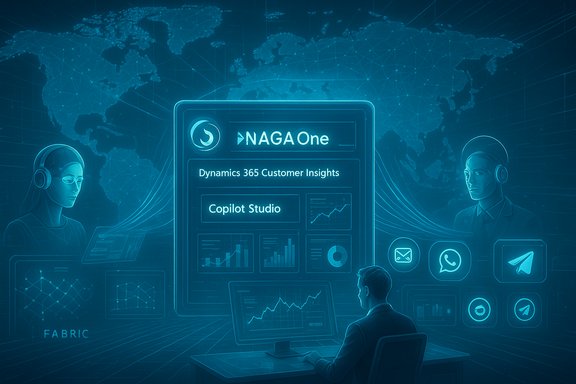
- Dynamics 365 Customer Insights — used as the customer data platform (CDP) to consolidate fragmented marketing and behavior data into a single profile for real‑time segmentation and activation.
- Microsoft Copilot — role- and scenario-specific copilots (marketing and service agents) used to speed creative production, campaign generation, and to automate routine tasks.
- Microsoft Fabric / Databricks-like data plane — used for high-throughput processing of trade events and behavioral signals that feed personalization and analytics layers.
- Omnichannel activation — marketing activations across email, in‑app push, WhatsApp, Telegram, Messenger, web chat and SMS to reach NAGA’s diverse global user base.
How it’s used in practice at NAGA
- Real‑time campaign generation: automated segmentation and dynamic creative to go from campaign concept to live in hours rather than days.
- Personalized onboarding and in‑product assistance: dynamic messaging tailored to account type, trading behaviour, and regulatory status.
- Operational automation: Copilot assists internal teams by drafting content, summarizing customer interactions, and accelerating analytic workflows.
- Product integration readiness: aligning data streams that will feed NAGA One’s payments, card and investing flows to deliver contextual, frictionless customer experiences on launch.
What the companies say — key claims and verified figures
Microsoft’s customer story reports rapid improvements after NAGA’s consolidation:- Campaign launch time reduced from days to hours.
- An alleged >50% increase in campaign launch efficiency, a 90% increase in dynamic content adoption, and a 150% lift in multichannel exposure; reported engagement spikes up to ~46%. These are presented as customer-reported outcomes within Microsoft’s case study.
Why this matters: business and technical analysis
Strategic upsides
- Faster time‑to‑market: Unifying customer data and automating segmentation materially reduces campaign setup friction. For a consumer fintech with rapid release cycles (NAGA says it ships updates fortnightly), that speed is a competitive advantage.
- Personalization at scale: When trading behavior, funding events, and social engagement feed a CDP, personalized journeys become actionable (e.g., targeted onboarding nudges or risk‑aware product suggestions).
- Operational efficiency: Automating routine content generation and data wrangling frees lean teams to focus on higher‑value product and compliance tasks. NAGA explicitly cites internal productivity gains from Copilot and integrated data workflows.
- Platform readiness for NAGA One: A unified data model and Copilot-driven automation lower the integration cost of adding payments, card, and account features into a single app ecosystem — essential for a successful super‑app rollout.
Technical realities and tradeoffs
- Data plumbing complexity: Ingesting millions of trade events and social signals, standardizing them, and keeping identity resolutions correct across geographies is non‑trivial. It requires robust data quality, schema governance, and latency management — areas where Microsoft Fabric and Dataverse help, but do not eliminate engineering effort.
- Dependence on vendor stack: Deep integration with Dynamics 365, Copilot, and Fabric accelerates time to value but increases coupling to Microsoft’s licensing, feature roadmap, and cloud topology.
- AI governance needs: As Copilot and AI agents move into customer‑facing tasks, NAGA must build audit trails, prompt governance, model validation, and human‑in‑the‑loop checkpoints to manage hallucination risk, regulatory exposure, and inconsistent advice. Public implementation patterns show that separating transactional storage (Dataverse) from agent behaviour (Copilot agents) aids governance; NAGA appears to follow this pattern.
Risks and compliance considerations
Regulatory and jurisdictional complexity
NAGA operates in multiple regulatory jurisdictions. When AI agents draft onboarding or investment guidance, regulators may treat algorithmic outputs as financial advice. This raises several obligations:- Clear disclosures about AI assistance limits.
- Human oversight for advice that could materially affect customer decisions.
- Data residency and consent controls for cross‑border processing of personal and financial data.
Model risk and hallucinations
Generative AI can produce fluent but incorrect outputs. For fintech, even small inaccuracies can trigger financial loss or reputational damage. Best practices include:- Constraining models with curated knowledge bases for regulated content.
- Using Copilot Studio to author constrained agent behaviours rather than open-ended models.
- Maintaining human review and audit logs for agent outputs used in sensitive contexts.
Data privacy and consent
- Messaging across WhatsApp, Telegram, and other channels introduces third‑party data handling considerations.
- If Azure OpenAI or other LLM endpoints are used for generating customer communications, contractual and telemetry boundaries must be explicit to prevent unintended data retention or exposure.
Cost, vendor lock‑in and operational resilience
Moving deep into a single cloud and SaaS ecosystem provides integration and operational benefits, but it also concentrates risk:- Licensing costs for Dynamics 365, Copilot, Fabric and Copilot Studio can scale quickly with usage and agent calls.
- Migration complexity if alternative platforms are considered in the future.
- Operational dependency on Microsoft’s feature roadmap and service SLAs for critical customer‑facing systems.
Implementation lessons and best practices (actionable takeaways)
- Start with a narrow, measurable pilot:
- Prioritize a single use case (e.g., onboarding messaging) with defined KPIs and monitoring.
- Separate the data plane from AI behavior:
- Use Dataverse / Fabric as canonical storage and Copilot agents as a supervised behaviour layer. This facilitates auditability and governance.
- Curate knowledge sources:
- For any financial or regulatory content, restrict AI retrieval to curated, versioned knowledge bases to limit hallucination.
- Human‑in‑the‑loop for risky outputs:
- Buffer any AI-generated investment guidance or account actions with human review and explicit consent flows.
- Monitor costs and consumption:
- Implement alerting and quotas on Copilot Studio and Fabric compute to minimize surprise billing.
- Map data residency and consent:
- Confirm where personal data is stored, processed, and logged; require contractual assurances for model telemetry retention if using Azure OpenAI or other managed LLM services.
What to expect from NAGA One and the near term
NAGA has committed to a phased rollout of NAGA One, starting with payments functionality (personal IBANs, virtual and physical debit cards, SEPA and P2P transfers) and instant funding paths into trading accounts. Public filings and corporate newsroom copy indicate a Q4 2025 availability window, and CEO statements in media place a practical milestone in December for certain services. These features require tightly integrated identity, KYC, and transactional plumbing — precisely the areas where unified customer data and automated processes are most valuable. Expect the following near‑term outcomes:- Improved onboarding funnel efficiency (lower time to first trade / first payment).
- Cross‑product lifecycle messaging (e.g., card approvals triggering funding prompts and trading offers).
- Increased regulatory scrutiny on payment and card flows, requiring robust AML/KYC and audit trails.
- Gradual introduction of AI assistance in product UX (e.g., intelligent onboarding helpers, contextual trading tips) with progressively stronger governance as the company scales.
Market implications and competitive context
NAGA’s approach mirrors a broader fintech pattern: combine a unified CDP, consumption of generative AI for productivity/customer engagement, and rapid product modularization to deliver “super‑app” convenience. Microsoft’s ecosystem — Dynamics 365, Copilot, Fabric — is increasingly marketed as the one‑stop stack for that strategy. For competitors and partners this implies:- A fast‑moving standard for marketing personalization and agentic automation is emerging.
- Firms that can operationalize AI governance and data engineering quickly will gain a practical advantage.
- Implementation skill (integrators, data engineers, AI governance experts) becomes a differentiator — not the choice of vendor alone.
Caveats and unverifiable claims
- Performance metrics quoted in Microsoft’s customer story (efficiency lifts, adoption rates, engagement increases) are presented as customer‑reported outcomes and are not independently audited in the published materials; treat them as directional evidence rather than independent verification.
- NAGA’s timeline statements (December go‑live for some NAGA One services) are company statements and align with the company’s Q4 2025 announcements; actual availability can vary by market and regulatory approvals — buyers and partners should confirm precise region‑by‑region launch dates directly with NAGA’s published rollout schedules.
Final assessment: strengths, risks, and the path forward
NAGA’s expanded Microsoft partnership is a textbook example of a data‑first fintech scaling with a major cloud vendor to accelerate product velocity and personalization. Strengths include faster campaign cycles, richer customer context, and a clear technical path to support a complex product like NAGA One. The integration with Dynamics 365 Customer Insights and Microsoft Copilot provides tangible operational advantages and a credible foundation for real‑time engagement. However, the approach also brings concentrated vendor dependencies, heightened regulatory and model‑risk exposure, and an engineering bar for data quality and governance that cannot be underestimated. The real test will be operationalizing governance, proving the robustness of AI controls in regulated contexts, and demonstrating consistent performance across jurisdictions as NAGA moves from marketing gains to payments and card services. Industry patterns and Microsoft’s own deployment recommendations suggest the right technical architecture — but success depends on disciplined governance, observability, and compliance execution.For readers tracking the intersection of Windows‑centred enterprise stacks, AI augmentation, and fintech product launches, NAGA’s story is instructive: a clear roadmap to faster growth through platform consolidation exists, but the margin for error in finance is narrow. Expect NAGA One’s initial rollouts to be a litmus test for how well deep Microsoft integrations can support both operational scale and regulatory rigour in a global fintech.
NAGA’s next few quarters will be revealing: if the company can sustain the speed, maintain governance, and manage vendor and regulatory risk while delivering the convenience promised by NAGA One, the expanded Dynamics 365 partnership will look like a decisive strategic win. If not, the same dependencies that enable rapid innovation could become structural constraints. Either outcome will offer valuable lessons for fintechs pursuing the same path.
Source: FX News Group NAGA expands Microsoft Dynamics 365 partnership for data driven growth
