

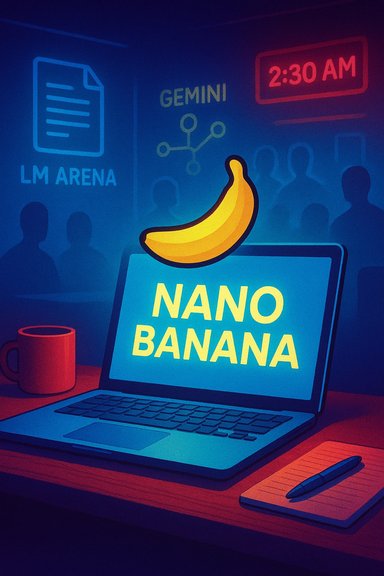
A late‑night joke, a crowd‑sourced testbed and a sticky bit of internet serendipity combined to turn a throwaway codename into one of the most recognizable labels in consumer image AI: Nano Banana—the nickname that followed Google’s Gemini image model from anonymous LM Arena entries to mass consumer surfaces and partner integrations. The story is as human as it is instructive: a product manager mashed together two personal nicknames at 2:30 a.m., submitted the model under that silly placeholder, and watched the internet do the rest.
Google’s image model family—officially framed inside the Gemini lineup and technically named variants such as Gemini 2.5 Flash Image—has proliferated across apps and OEM partnerships. In the middle of the development cycle, the Gemini team used a codename for anonymous evaluation on LM Arena; the name chosen, Nano Banana, was never intended to be public branding. User reactions to the model’s output and the charm of the name made the moniker viral; Google then leaned into it, adding ignposts in the Gemini app and AI Studio. That rapid rise from placeholder to public identity underscores three forces shaping modern AI products: the role of community testing channels, the power of memetic marketing even when accidental, and the dominanclity in sustaining attention. The codename happened to be memorable, but the model’s editing fidelity and speed are what made Nano Banana stick.
Important verification notes:
But the same dynamics also accelerate governance pressure. A viral creative tool becomes a mass‑market risk vector overnight if detection, provenance and moderation are not robust. Organizations should plan product rollouts knowing that early community feedback—not just formal marketing—can determine public identity and expectations.
For developers, product teams and Windows users alike, the practical takeaway is straightforward: treat emergent naming and viral interest as opportunities to accelerate adoption, but pair that popularity with clear model cards, provenance tools, and operational guardrails. That combination—capability, transparency and safety—turns a meme into a durable product rather than a fleeting fad.
Source: PCMag UK https://uk.pcmag.com/ai/162627/heres-how-googles-nano-banana-ai-model-got-its-name]
 Background / Overview
Google’s image model family—officially framed inside the Gemini lineup and technically named variants such as Gemini 2.5 Flash Image—has proliferated across apps and OEM partnerships. In the middle of the development cycle, the Gemini team used a codename for anonymous evaluation on LM Arena; the name chosen, Nano Banana, was never intended to be public branding. User reactions to the model’s output and the charm of the name made the moniker viral; Google then leaned into it, adding ignposts in the Gemini app and AI Studio. That rapid rise from placeholder to public identity underscores three forces shaping modern AI products: the role of community testing channels, the power of memetic marketing even when accidental, and the dominanclity in sustaining attention. The codename happened to be memorable, but the model’s editing fidelity and speed are what made Nano Banana stick.How the name happened: a quick origin story
The naming moment is simple and direct. During late‑night prep for submitting an in‑development image model to LM Arena, a product manager suggested using a placeholder. The PM—Naina Raisinghani—combined Naina Banana (a personal nickname) and Nano (another internal nickname) into “Nano Banana.” That whimsical choice became the model’s LM Arena handle; early human evaluations and social sharing amplified both the model’s capabilities and the name. Google later confirmed the anecdote on its company blog and through podcast comments from Gemini product leadership. Why this matters: LM Arena’s pairwise, anonymous testing model exposes high‑quality systems to human preferences without brand bias. But anonymity also means codenames cadiscourse when outputs impress and communities latch onto a name. For the Gemini team, that accidental identity became a growth vector they chose to embrace, converting a private tag into a friendly public brand.What Nano Banana actually is (and what it isn’t)
The technical baseline
- Nano Banana is the colloquial name for a variant in the Gemini image model family—commonly associated with the Gemini 2.5 Flash Image class of models and, more recently, an upgraded Nano Banana Pro label for newer image capabilities. The name refers to the consumer‑facing image editing and generation engine that emphasizes speed, multi‑image editing, and subject consistency.
- The model is available across Google consumer surfaces (Gemini app, Media AI, Google Photos features), as well as via developer APIs and partner OEM integrations that surface the model under different skins.
- Google’s own documentation and product announcements reference the official technical name while acknowledging the popular Nano Banana label; the company has publicly explained the codename’s origin.
What the model does well
- Likeness preservation: keep a subject consistent across edits and multiple images.
- Multi‑image compositing: merge references or combine elements from different source images into a coherent result.
- Improved text legibility in images: newer variants emphasize readable in‑image text—a historical weak spot for many image generation models.
- Low latency and iteration: engineered for fast, interactive edits that fit consumer workflows.
Why the naming story matters beyond a viral anecdote
A whimsical codename becoming a consumer brand is more than a cute PR anecdote; it reveals structural dynamics in punity testing shapes perception: Platforms like LM Arena provide early, raw human preference signals. That feedback loop can change product positioning before a formals soft power: a memorable, humanized name lowers friction for trial and sharing—especially for consumer creative tools where cultural trends spread fast.- Platform distribution makes virality systemic: when a single capability integrates across Search, Lens, Pixel, OEM gallery apps, and third‑party partners, discovery compounds and trends move from niche to mainstream quickly.
Governance, safety and the hidden costs of virality
Nano Banana’s popularity also surfaced perennial governance challenges for image generation systems.Safety mechanisms Google uses and why they matter
- SynthID & provenance tooling: Google employs invisible provenance signals and watermarking tools in its image generation pipeline to help downstream platforms detect AI‑generated content. These are part of a broader safety toolkit but are not a standalone solution to misuse.
- Content filters and multi‑pass QA: multi‑step internal checks and policy layers are used to reduce harmful outputs. However, edge cases—deepfakesy, and subtle misinformation—remain difficult to eliminate entirely.
Practical risks that rose with Nano Banana’s virality
- Rapid adoption outpaced some governance considerations, prompting scrutiny over watermark reliability, reviewer access to outputs, and the model’s possible generation of copyrighted or deceptive imagery. Several community reports and internal notes flagged over‑censorship and moderation inconsistencies in early releases.
Recommendations for product teams and platform operators
- Prioritize provenance: attach machine-readable content credentials to generated assets and make detection tools available to distribution partners.
- Keep human‑in‑the‑loop for high‑risk workflows: require explicit human approval for content involving real people or brand identities.
- Version and label models clearly: publication of model cards and explicit usage limits reduces ambiguity for nd auditors.
Nano Banana evolution: Nano Banana Pro and the rumor mill
Industry chatter and community leaks have suggested a successor—sometimes called Nano Banana 2, Nano Banana Pro, or internally referenced as GEMPIX 2—with promises of native 2K outputs, a multi‑step iterative generation workflow, and stronger instruction following. Those claims, circulating in forums and leaked code references, illustrate the common lifecycle of model rumors: rapid community dissection followed by selective vendor confirmation or repudiation.Important verification notes:
- Many details about “Nano Banana 2” remain unverified until Google publishes a model card or official product announcement. Treat leaked specs—native 2K, 4K upscaling, multi‑pass QA loop, or a migration to Gemini 3.x Pro—as provisional.
- Where claims aligbehavior (improved legible text, multi‑image fusion), they are plausible and consistent with Google’s stated roadmap. Where they involve device‑level offline operation for heavy workloads, skepticism is warranted: larger multimodal models typically require cloud inference at least initially.
Ecosystem impact: OEMs, apps and cross‑platform distribution
Nanoly inside Google’s own apps. The model’s distribution strategy illustrates how modern AI features scale:- OEM partnerships: Samsung, Oppo, Xiaomi and other Android OEMs have been quick to integrate Gemini image capabilities—often under local product names—turning gallery and camera apps into native AI creative surfaces. Oppo’s ColorOS, for example, surfaced Nano Banana editing features in phone workflows and even bundled limited Google AI Pro subscriptions for early buyers.
- Browser integration: Chrome Canary testing has shown UI experiments—like a “Create Images” chip and Omnibox shortcuts—that surface Nano Banana style capabilities directly in the browsing experience, lowering friction further.
- Enterprise & cloud: Developers can access Gemini image APIs and AI Studio / Vertex integration paths, extending the model’s uipelines and partner services.
Practical guidance for Windows users, creators and IT administrators
For a WindowsForum audience—power users, IT pros and creators—the Nano Banana phenomenon offers actionable takeaways.For creators and marketers
- Treat Nano Banana as a fast prototyping tool: use it for mockups, rapid creative iterations, and low‑stakes social content. Save source files and keep prompts and provenance metadata for auditing or rework.
- Validate all outputs for legibility and brand safety before production use: even high‑capability image models produce artifacts or unexpected substitutions. Maintain a QA step in any asset pipeline.
For IT administrators and security teams
- Expect distribution through partner apps and OEM updates: audit device provisioning and app permissions to understand which endpoints canages to cloud services.
- Implement content governance: where employees use image generation in official channels, require templates, explicit licensing checks, and provenance retention to mitigate IP and brand risks.
- Monitor protection capabilities: rely on SynthID‑style watermarks as part of a layered governance strategy, not the sole control.
For Windows power users
- Try the Gemini app or partner galleries fokeep sensitive personal photos offline or in private collections when experimenting with edits that involve real people.
- Keep track of subscription limins if using higher‑tier Google One / AI Pro features—daily generation quotas and rate limits are operational parameters that can change.
What we can verify (and what still requires proof)
Cross‑referenced confirmations:- Google publicly published a company post narrating the origin of the Nano Banana name and confirming LM Arena use and the late‑night naming anecdote.
- Multiple independent outlets re‑reported Google’s explanation and added context about the name’s viral effect and subsequent UI traces (banana emoji in Gemini). These independent reports corroborate the origin story and the company’s embrace of the codename.
- Community reporting and internal forum summaries consistently describe Nano Banana as shorthand for Gemini 2.5 Flash Image and note OEM and product integrations across Samsung, Oppo, Pixel feature drops, and Chromium experiments. Those ecosystem observations are corroborated in multiple developer and press write‑ups.
- Specific performance numbers for “Nano Banana 2” (native 2K, 3× instruction‑following improvements) are circulating but lack formal model cards or vendor documentation; treat those claims with caution.
- Exact daily generation quotas, API rate limits, or per‑account caps vary by plan and region and are operationally subject to change. Confirm in your account UI or official plan pages before planning large campaigns.
A checklist for journalists, admins and creators who want to verify Nano Banana claims
- Look for an official Google model card or developer blog poture, evaluation metrics and safety mitigations. Until one appears for a given variant, treat specs as provisional.
- Use independent benchmark suites and community testbeds to reproduce claims about text legibility and image consistency; human preference tests like LM Arena are useful, but cont help with nuanced claims.
- Inspect exported assets for provenance metadata (SynthID or Content Credentials) to confirm watermarking and downstream traceability.
- Confirm deployment surfaces listed in vendor announcements (GeEM galleries) to know where model variants are actually available to consumers.
The broader lesson: codenames can become brands—tunity and risk
Nano Banana’s arc from placeholder to household name highlights a modern marketing and engineering reality: the boundary between internal shorthand and public brand is porous. When community testing is public, internal names can leak and then define perception. That moment offers product teams an unusual lever: a chance to embrace human‑scale storytelling and playful touches that make a technical feature approachable.But the same dynamics also accelerate governance pressure. A viral creative tool becomes a mass‑market risk vector overnight if detection, provenance and moderation are not robust. Organizations should plan product rollouts knowing that early community feedback—not just formal marketing—can determine public identity and expectations.
Conclusion
The Nano Banana story—equal parts late‑night whimsy and systems engineering—offers a compact case study in how modern AI products spread, how community channels shape perception, and how branding can arise from the most accidental of origins. It proves that memorable names matter, but only when they ride on genuine technical capability and responsible governance.For developers, product teams and Windows users alike, the practical takeaway is straightforward: treat emergent naming and viral interest as opportunities to accelerate adoption, but pair that popularity with clear model cards, provenance tools, and operational guardrails. That combination—capability, transparency and safety—turns a meme into a durable product rather than a fleeting fad.
Source: PCMag UK https://uk.pcmag.com/ai/162627/heres-how-googles-nano-banana-ai-model-got-its-name]
