

Napster’s newest hardware — Napster Station — promises to drive conversational AI out of browser tabs and into the busiest public spaces, claiming to solve the long-standing problem of voice assistants in noisy, crowded environments with a purpose-built kiosk that combines a bespoke microphone array, multimodal sensing, and cloud‑backed realtime models from Microsoft Azure.
Napster, the company rebranded from its earlier identity as Infinite Reality, announced Napster Station on December 30, 2025 as an enterprise‑grade AI concierge kiosk aimed at hotel lobbies, retail floors, airports, healthcare waiting rooms, and other high‑traffic public spaces. The product launch is tied to a broader strategic partnership and integration with Microsoft Azure’s realtime AI tooling, which Napster cites as the runtime for low‑latency audio and video interactions. The vendor frames Station as the first physical kiosk engineered specifically to function reliably in environments where ambient noise, multiple simultaneous speakers, and visual clutter cause ordinary consumer voice assistants to fail. Napster pitches Station not as a consumer gadget but as an enterprise deployment offering persistent memory, video presence, and centralized management for thousands of specialised AI companions.
Napster’s CES demonstrations and the planned Q1 2026 enterprise availability will be the first practical testbeds for independent verification and pilot deployments; responsible buyers should use those early windows to confirm that the hardware, the Azure realtime stack, and Napster’s operational controls meet the standards demanded by public‑facing, privacy‑sensitive applications.
Source: The Manila Times Napster Launches Napster Station: The First AI Concierge Built to Provide Personalized Service in Crowded Spaces
 Background
Napster, the company rebranded from its earlier identity as Infinite Reality, announced Napster Station on December 30, 2025 as an enterprise‑grade AI concierge kiosk aimed at hotel lobbies, retail floors, airports, healthcare waiting rooms, and other high‑traffic public spaces. The product launch is tied to a broader strategic partnership and integration with Microsoft Azure’s realtime AI tooling, which Napster cites as the runtime for low‑latency audio and video interactions. The vendor frames Station as the first physical kiosk engineered specifically to function reliably in environments where ambient noise, multiple simultaneous speakers, and visual clutter cause ordinary consumer voice assistants to fail. Napster pitches Station not as a consumer gadget but as an enterprise deployment offering persistent memory, video presence, and centralized management for thousands of specialised AI companions. What Napster Station Claims to Be
Purpose-built hardware and sensory stack
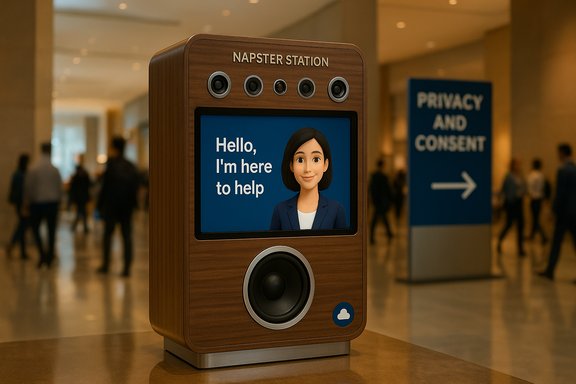
Napster’s press materials describe several headline features intended to separate Station from off‑the‑shelf kiosks and consumer smart speakers:- VoiceField™ Microphone Array — a proprietary near‑field microphone array designed to isolate a single user’s voice in chaotic, high‑decibel settings.
- Multimodal Presence Sensing — fused camera and audio logic to determine who is speaking and route the interaction accordingly.
- Audiophile‑Grade Sound — three precision tweeters and an integrated subwoofer for studio‑quality text‑to‑speech playback.
- Premium fit and finish — walnut wood and aluminum construction intended to make Station visually acceptable in high‑end lobbies and showrooms.
Cloud and model integration
Napster explicitly positions Station to run on Microsoft Azure services, including Azure OpenAI / Azure AI Foundry realtime APIs, to achieve sub‑second model responses and video‑enabled agent interactions. The company has previously announced multi‑year collaborations with Microsoft to deploy realtime models and enterprise infrastructure, making the Azure integration plausible and consistent with Azure’s published realtime model capabilities.Commercial positioning
Napster describes Station as an enterprise product that will be shown at CES and made available for enterprise deployment in Q1 2026. In marketing materials the company positions Station as a cost‑efficient alternative to human concierges, quoting an operational figure of roughly $1 per hour to run a Station compared to typical human or digital concierge alternatives. This per‑hour cost is a vendor assertion that enterprises should validate against expected traffic, concurrency, and cloud compute costs.Why this matters: the real problem Napster Station targets
Voice assistants have matured rapidly for quiet home environments but continue to struggle in places where human presence is dense and ambient noise is high. Commercial deployments face three interrelated technical problems:- Speech separation — distinguishing a single user’s voice from overlapping conversations.
- Speaker localization and turn‑taking — determining who is addressing the device and when an interaction starts and stops.
- Robustness to noise — maintaining accurate speech‑to‑text and intent extraction when ambient sound levels vary wildly.
Technical verification: what is independently verifiable today
- Napster’s Azure partnership and use of realtime model APIs is consistent with Microsoft’s public announcements and with Napster’s earlier collaboration press statements. Microsoft has made realtime audio/video model endpoints available via Azure AI Foundry and provides guidance on WebRTC and Realtime API usage for low‑latency interactions. That makes the claimed architecture (an edge kiosk or appliance streaming media to Azure realtime models) technically plausible.
- Hardware specifics — the VoiceField™ branding, the near‑field array, the three‑tweeter plus subwoofer audio stack, and the walnut/aluminum enclosure — are primarily vendor‑supplied details in Napster’s product announcement. These specifications are not yet supported by independent lab benchmarks or third‑party hands‑on reviews at the time of the announcement. Enterprises should therefore treat performance and cosmetic claims as vendor assertions until validated in representative environments.
- The cost claim of approximately $1 per hour is a vendor marketing figure and requires detailed cost modeling: it depends on model runtime pricing, session concurrency, cloud region egress/storage costs, human‑in‑the‑loop moderation, and local edge compute or fallback systems. The claim is plausible only with a specific workload profile and negotiated cloud/volume pricing; it is not a universal guarantee.
Strengths: where Napster Station could deliver real value
- Purpose‑built sensing and audio: If the VoiceField array and presence sensing actually achieve reliable single‑speaker isolation in crowded spaces, that is a significant engineering milestone. Speech separation that works in real airports or retail floors would be a major enabler for conversational services.
- Enterprise cloud integration: Running realtime models on Azure gives Napster a credible route to enterprise compliance tooling, global region availability, and the low‑latency inference required for natural conversation. Leveraging a major hyperscaler also simplifies procurement and enterprise risk assessments for some customers.
- Scalability and uniform UX: Centralized agent templates, persistent memory, and brandable conversational personas let organizations scale a consistent guest experience across many sites while updating knowledge and policies centrally.
- Hands‑free, multilingual support: Automated multilingual interactions with persistent memory could measurably improve throughput and satisfaction in hospitality and wayfinding scenarios — for example, reducing check‑in queue times or helping passengers find connecting gates during peak hours.
Risks, limitations, and governance issues
Privacy and data residency
Public kiosks that incorporate cameras and audio capture raise immediate privacy questions. Deployers must be explicit about:- What data is streamed to the cloud versus processed locally.
- Where transcripts, embeddings, and persistent memory are stored.
- Who has access and under what contractual restrictions.
Surveillance and consent
A kiosk that senses presence via vision sensors can be perceived as a surveillance device. Deployers should provide clear signage, visual cues showing the device is listening or recording, explicit consent flows where required, and an accessible opt‑out. Failing to do so risks reputational harm and regulatory scrutiny.Hallucination and liability
Generative models may produce confident‑sounding but incorrect information. In settings like healthcare or legal advisory, a kiosk misstatement could cause harm. Enterprises must strictly limit high‑risk domains, require human escalation for consequential advice, and instrument audit logs to trace any problematic outputs.Deepfakes, impersonation, and voice cloning
High‑quality TTS and video presence increase the risk of impersonation. Agents should be clearly marked as synthetic, and content policies must prevent agents from mimicking real staff or using a deceptive persona. Authentication and anti‑fraud controls are especially critical for any transactional scenarios.Vendor lock‑in and portability
Bundling hardware and a specific cloud backend simplifies operations but creates migration friction. Enterprises should insist on exportable agent configurations, conversation logs, and memory snapshots to avoid being locked into a single vendor’s platform or pricing trajectory.Practical procurement and pilot checklist
Enterprises considering Napster Station (or similar embodied AI kiosks) should run a disciplined pilot phase that validates UX, acoustic performance, governance, and cost. A concise pilot template:- Define a low‑risk scope. Start with wayfinding or FAQ in a single, controlled location. Avoid clinical or financial advice on day one.
- Run an acoustic audit. Measure signal‑to‑noise ratios during typical peak hours and test the device’s speech separation under realistic foot traffic.
- Validate privacy flows. Confirm what is transient vs. persisted, request a data flow diagram, and insist on CMK/BYOK or equivalent encryption controls for cloud artifacts.
- Instrument and measure. Track latency, STT accuracy, TTS clarity, escalation counts, and CSAT compared to human attendants.
- Test degraded modes. Simulate cloud outages and confirm fallback behaviors (local prompts, cached answers, or “sorry, I’m offline” messaging).
- Review cost modeling. Map expected queries per day, average session length, and peak concurrency to vendor pricing and cloud model costs to confirm the vendor’s cost claims.
Deployment scenarios — realistic vs. aspirational
Realistic near‑term wins
- Wayfinding in airports and malls: Simple, fact‑based routes and gate information are low risk and high value. Station can reduce human traffic at information desks and improve throughput.
- Hotel check‑in FAQ handling: Routine requests (towel service, breakfast hours, directions) are well suited to scripted, localized knowledge backed by persistent memory for guest preferences.
- Retail product discovery: On‑floor product lookups and basic configuration guidance can increase conversion if the kiosk integrates with inventory systems and in‑store maps.
Aspirational but riskier use cases
- Clinical triage in healthcare: Explaining procedures or answering medical questions introduces clinical risk and regulatory constraints; these should be limited to informational or deferential workflows with human escalation.
- Transactional interactions (payments, identity verification): These require robust authentication, fraud protections, and strict audit trails that are nontrivial to implement and verify on a kiosk surface.
Market context and competition
Napster is entering a space where hyperscalers provide realtime model runtimes and a growing set of ISVs productize voice/video UX with hardware. Embodied AI kiosks are not a new concept, but Napster’s play is notable for combining a hardware design focus with a claimed enterprise Azure integration and a “persistent companion” model. The competitive landscape includes specialized kiosk makers, established hospitality tech providers, booth integrators, and other startups focusing on embodied AI; success will depend on reliable acoustic performance, tight governance controls, and enterprise‑grade support for scaling thousands of units.Recommendations for IT leaders, procurement, and security teams
- Require a hands‑on demo in the actual acoustic environment where the unit will operate, not (only) at a trade show.
- Obtain a full architecture and data flow map showing where audio/video is processed, stored, and who can access it. Insist on CMK/BYOK and region scoping.
- Contractually define SLAs for latency, availability (including degraded modes), and human escalation SLAs.
- Limit initial deployments to non‑critical, informational tasks and instrument metrics for a minimum of 30 days during peak periods.
- Mandate exportability of conversation logs and agent configurations and a documented migration path in case the vendor relationship changes.
- Create a safety policy that excludes high‑risk advice and sets mandatory human involvement thresholds for medical, legal, or financial content.
How to evaluate Napster Station’s core technical claims
- Test the VoiceField array in mixed‑speaker noise conditions: measure word error rate (WER) and speaker identification accuracy at varying dB SPL and crowd densities.
- Measure end‑to‑end latency from wake word or touch activation to meaningful agent reply under peak concurrency.
- Validate TTS intelligibility under real acoustic reflections present in lobbies and concourses using MOS (Mean Opinion Score) ratings from blind listeners.
- Confirm presence sensing reliability by testing occlusion, multiple speakers, and non‑human motions (e.g., luggage wheels that make noise).
- Audit the memory persistence model: how long is memory kept, how is consent captured, and how can users request deletion?
Final assessment
Napster Station is an ambitious attempt to make conversational AI reliably usable in the physical world’s messiest environments. The product doubles down on what the industry has struggled with for years: robust speech separation, accurate speaker selection, and a natural, low‑latency conversational loop. The publicly documented Azure integration makes the realtime architecture credible, and Napster’s product positioning ties materially to the company’s broader embodied AI strategy. Yet the most important claims — the performance of the VoiceField microphone array in real world, the cost metric of ~$1 per hour, and the practical governance model for persistent video/audio memory in public spaces — remain vendor assertions at the time of launch. Independent lab tests, third‑party pilots, and enterprise contracts that lock in data residency and security guarantees are necessary to convert the marketing promise into operational reality. For organizations considering Napster Station, the path forward is pragmatic: start with a low‑risk pilot, insist on demonstrable acoustic performance in situ, verify privacy and export controls contractually, and instrument for safety and cost before scaling. If these checks are satisfied, companies could gain a reliable, brandable, and scalable way to provide 24/7 conversational assistance in public spaces — but the margin for error is small, and the governance obligations are large.Napster’s CES demonstrations and the planned Q1 2026 enterprise availability will be the first practical testbeds for independent verification and pilot deployments; responsible buyers should use those early windows to confirm that the hardware, the Azure realtime stack, and Napster’s operational controls meet the standards demanded by public‑facing, privacy‑sensitive applications.
Source: The Manila Times Napster Launches Napster Station: The First AI Concierge Built to Provide Personalized Service in Crowded Spaces
