

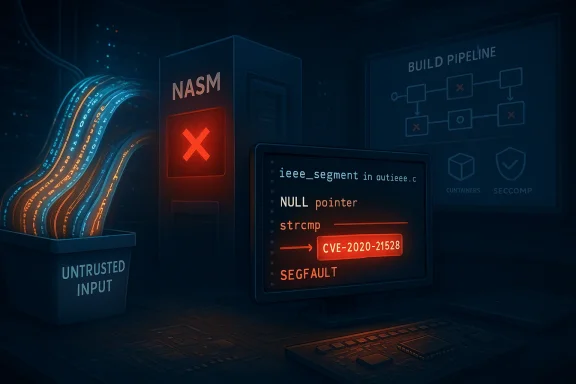
A segmentation fault in NASM’s ieee_segment routine quietly resurfaced as CVE‑2020‑21528: a small, narrowly scoped bug with outsized operational risk for build systems that accept untrusted assembly input. The flaw — rooted in outieee.c’s ieee_segment function — allowed a crafted assembly file to crash the assembler, creating a straightforward denial‑of‑service vector against any process or build pipeline that invoked NASM on attacker‑controlled input. In practice the vulnerability is simple to describe, easy to trigger, and, until distributions and packagers pushed fixes, surprisingly easy to overlook in real‑world environments where NASM is treated as a low‑privilege build tool rather than a network‑facing component.
NASM (the Netwide Assembler) is a widely used assembler for x86 and x86‑64 code. It is commonly shipped as a developer tool on Unix‑like systems and is used in a variety of contexts: local development, automated build systems, CI pipelines, package build daemons, and occasionally as a component inside tooling that consumes assembly text as part of larger workflows (for example, disassembly/assembly tools, instrumentation pipelines, or educational/learning platforms that assemble user‑submitted code).
Assembly formats and backends in NASM include support for a range of object formats such as ELF and COFF, plus less common formats such as IEEE for floating‑point data output. The ieee output format and its associated code paths are less exercised in many production setups, which contributed to the bug’s late discovery and the perception that the code path was low‑risk.
CVE‑2020‑21528 was reported in December 2019 and publicly tracked in the project’s bug tracker. The bug was reported against NASM versions 2.14.03 and 2.15; subsequent maintenance and vendor advisories grouped it alongside other NASM issues affecting similar release ranges. The public tracking entry contains the original proof‑of‑concept and an AddressSanitizer trace that makes the bug’s mechanism clear: the assembler attempted to perform a string comparison against an uninitialized or cleared pointer, which resulted in an access to address zero and an immediate segmentation fault.
The original reporter included an AddressSanitizer stack trace showing strcmp as the crash site, with the crash being triggered when the assembler processed constructs in a crafted input file. The trace shows the problem occurring at or near line 705 of outieee.c in the versions reported, consistent with an attempt to compare or inspect a section name that had not been initialized for the code path exercised by the PoC.
However, denial of service at build time can be operationally critical. Consider these realistic scenarios:
That mid‑range CVSS correctly signals a medium‑severity operational impact: not a remote code execution wormable bug, but a very practical denial‑of‑service risk for automation and build infrastructure.
Packaging and patch timing across distributions varied. Some distributions made the fixed NASM version available quickly; others delayed updates due to release policies, backporting plans, or platform constraints. A number of Linux distribution security advisories referenced the issue as resolved in NASM 2.16.01 (or in backported packages built from the fixed code), and security tooling vendors added detection signatures to vulnerability scanners.
Key remediation guidance that applied broadly:
Where this vulnerability really matters:
CVE‑2020‑21528 may never be the most sensational entry in the record of assembler vulnerabilities, but it is a reminder that even small, niche code paths in ubiquitous developer tools can produce outsized operational headaches. The fix is straightforward; the harder work is ensuring that the myriad places NASM lives — from a developer’s laptop to CI agents and package builders — all receive timely attention. Treat toolchains as part of the attack surface, isolate them, and keep them current; those small habits protect not just binaries, but the integrity and availability of your entire software delivery pipeline.
Source: MSRC Security Update Guide - Microsoft Security Response Center
 Background
NASM (the Netwide Assembler) is a widely used assembler for x86 and x86‑64 code. It is commonly shipped as a developer tool on Unix‑like systems and is used in a variety of contexts: local development, automated build systems, CI pipelines, package build daemons, and occasionally as a component inside tooling that consumes assembly text as part of larger workflows (for example, disassembly/assembly tools, instrumentation pipelines, or educational/learning platforms that assemble user‑submitted code).Assembly formats and backends in NASM include support for a range of object formats such as ELF and COFF, plus less common formats such as IEEE for floating‑point data output. The ieee output format and its associated code paths are less exercised in many production setups, which contributed to the bug’s late discovery and the perception that the code path was low‑risk.
CVE‑2020‑21528 was reported in December 2019 and publicly tracked in the project’s bug tracker. The bug was reported against NASM versions 2.14.03 and 2.15; subsequent maintenance and vendor advisories grouped it alongside other NASM issues affecting similar release ranges. The public tracking entry contains the original proof‑of‑concept and an AddressSanitizer trace that makes the bug’s mechanism clear: the assembler attempted to perform a string comparison against an uninitialized or cleared pointer, which resulted in an access to address zero and an immediate segmentation fault.
Technical analysis: what went wrong in outieee.c
The immediate cause
At its core, the fault arises from unsafe handling of section name state inside the IEEE output path. The function responsible for emitting IEEE formatted output — ieee_segment in output/outieee.c — ended up calling strcmp on a pointer that could be NULL (or not updated), which in turn dereferenced the NULL pointer and triggered a kernel‑level segmentation fault.The original reporter included an AddressSanitizer stack trace showing strcmp as the crash site, with the crash being triggered when the assembler processed constructs in a crafted input file. The trace shows the problem occurring at or near line 705 of outieee.c in the versions reported, consistent with an attempt to compare or inspect a section name that had not been initialized for the code path exercised by the PoC.
Why this class of bug slipped through
There are several reasons this type of bug is both plausible and insidious in a mature codebase:- The ieee output path is rarely used for mainstream development; it is niche. Code paths that are lightly exercised in everyday usage tend to accumulate assumptions that go untested.
- The bug is triggered only by crafted input that exercises a specific branch of state transition logic; passing standard assembly files will not hit the bug, so typical test suites miss it.
- The code used a C standard library string routine (strcmp) on state that could be unset. Because strcmp is ubiquitous and fast, it’s easy for code to rely on it without defensive checks for NULL. That pattern is a classic source of segmentation faults in C.
- The symptomatic behavior — a crash of the assembler binary — doesn’t immediately look like an exploitable memory corruption for arbitrary code execution; instead it appears as a denial of service. That lower perceived impact reduces urgency during triage.
Exploitability: DoS vs escalation
The vulnerability is a reliable crash (segfault) when a crafted assembly file is fed to NASM. The observed and widely reported impact is denial of service: the assembler process terminates. There is no public evidence that this bug can be leveraged for remote code execution or privilege escalation in NASM’s published PoC or in the developer discussion.However, denial of service at build time can be operationally critical. Consider these realistic scenarios:
- A continuous integration server or build farm that pulls external code snippets or assembly fragments may be trivially brought down or broken for the duration of a broken job.
- A package build daemon that receives upstream patches and attempts to assemble them without isolation could crash while processing malicious test patches, delaying or denying package builds.
- An online educational platform or sandbox that lets students submit assembly text for instant assembly could be trivially abused to crash worker processes at scale.
Severity scoring and nuance
Public vulnerability databases assigned CVSS v3.1 scores in the mid‑range (a common representation is 5.5/10), reflecting that this is a reliable crash (availability impact) but has no confidentiality or integrity impact. The vector string reflects low complexity and, depending on context, requires user interaction (nasm must be invoked on the crafted file) or effectively no authenticaton when build systems process untrusted input automatically.That mid‑range CVSS correctly signals a medium‑severity operational impact: not a remote code execution wormable bug, but a very practical denial‑of‑service risk for automation and build infrastructure.
Timeline and remediation
The original bug report was filed with a PoC and ASAN log that pinpointed ieee_segment. Project maintainers bisected the regression to a commit and created a patch; the bug tracker entry records that the fix committed under hashes that the project used during maintenance. A subsequent official NASM release updated the code to resolve the issue; community advisories and distro security teams referenced that release when producing their advisories.Packaging and patch timing across distributions varied. Some distributions made the fixed NASM version available quickly; others delayed updates due to release policies, backporting plans, or platform constraints. A number of Linux distribution security advisories referenced the issue as resolved in NASM 2.16.01 (or in backported packages built from the fixed code), and security tooling vendors added detection signatures to vulnerability scanners.
Key remediation guidance that applied broadly:
- Upgrade NASM to the fixed release (the NASM project’s maintenance release that includes the ieee_segment fix).
- If you cannot immediately upgrade, avoid assembling untrusted files with NASM in production contexts or run NASM inside tightly controlled sandboxes.
- For build farms and CI, block or vet any assembly artifacts drawn from untrusted sources before feeding them into the assembler.
Risk assessment for Windows‑forum readers
Most Windows‑focused readers will never encounter this NASM bug in desktop Windows environments because NASM is primarily used on Unix‑like systems in the wild. However, the practical lessons are universal for toolchain security and apply to Windows developers who operate CI infrastructure, cross‑compile toolchains, or build hosts that run on Linux or macOS.Where this vulnerability really matters:
- CI/CD pipelines that automatically build third‑party projects or accept user‑submitted code snippets are directly in scope. A single crafted commit or pull request can break a build agent or force administrators to rotate worker processes.
- Shared build services and community package builders that execute upstream build steps are vulnerable when assembly phases are not sandboxed.
- Educational or sandbox websites that allow users to submit assembly examples for compilation are an easy target for denial‑of‑service abuse if worker isolation is weak.
- Local desktop developers assembling their own code with NASM in an isolated environment are at low risk unless they purposefully assemble untrusted files.
- Systems that do not use NASM at all — for example, Windows developers using MSVC, clang on Windows, or purely managed languages — do not need to take action specifically for this CVE.
Practical mitigations and hardening recommendations
Even when a bug only causes a crash, there are robust operational measures to reduce risk and avoid disruption. Here’s a prioritized list of mitigations for both administrators and developers:- Upgrade NASM
- Identify the NASM version installed on each host: run the assembler’s version command or inspect package metadata.
- If a vendor package is available with the fix, apply the vendor package update through your package manager.
- If you must build from source, compile a NASM version that includes the ieee_segment fix (the maintainer patch was merged into the mainline and included in the next maintenance release).
- Reduce attack surface
- Do not feed untrusted text files directly to NASM in production. Validate or sanitize input upstream.
- If your build system accepts external input, require pull request gating and manual review for any changes touching assembly files.
- Isolate NASM execution
- Run assembler jobs in ephemeral containers or sandboxed build workers terminating after each job.
- Use container runtimes or VM‑based workers in CI to ensure a single crash cannot affect other concurrent workloads.
- Employ OS‑level mitigations such as seccomp, AppArmor, or SELinux policies that restrict what a crashed worker can do.
- Monitor and detect
- Add crash detection and automated restarts for build agents, with alerting that surfaces repeated crashes triggered by a particular input set.
- Log input artifacts that cause crashes so they can be analyzed and blocked centrally.
- Long‑term toolchain hygiene
- Treat any tool that consumes external input as a potential attack surface — document attack surface maps for build infrastructure.
- Invest in regression testing for niche code paths (like less‑used output formats) when you update core toolchain components.
- Subscribe to distribution and upstream advisories for toolchain projects used in your environment.
Developer and maintainer perspective: code hygiene lessons
This vulnerability is instructive for maintainers as much as for operators. A few concrete lessons:- Defensive programming is essential in code paths that parse or compare strings. A single missing NULL check combined with common library calls is a routine recipe for crashes.
- Code paths that are rarely used deserve targeted fuzz testing and unit tests that exercise boundary conditions. Existing regression suites often miss these cases because they focus on common happy‑path behavior.
- When a project supports multiple output formats, the interface surface area grows non‑linearly. Ensure that state transitions between formats (for example, section name updates) are robustly modeled and guarded by assertions in debug builds.
- Maintain a low‑friction path for reporting and tracking bugs that include PoCs and sanitizer logs. The original report for this issue included an ASAN trace, which significantly eased diagnosis and remediation.
Distribution and ecosystem friction: why patching lagged
Projects like NASM are upstream open source components; distribution packaging and security teams must coordinate upgrades, backports, and redeployment. Several practical constraints explain why patch availability varied across distributions:- Conservative update policies: Stable distribution releases sometimes prefer backporting fixes rather than major upstream version bumps, resulting in delays while maintainers determine whether a backport is safe.
- Resource prioritization: Maintainers triage many issues and may schedule low‑impact DoS fixes behind higher‑severity CVEs.
- Testing matrix complexity: A small change in assembler behavior can potentially affect countless packages in distribution repositories, necessitating broad testing before a version bump is accepted.
Detection and forensic hints
If you suspect this CVE was triggered in your environment, look for the following indicators:- Repeated NASM process crashes correlated with build jobs that process assembly files.
- Build logs showing assembler invocation with the IEEE format (for example, command lines specifying the IEEE output format) or explicit references to outieee or ieee assemblers in the logs.
- Core dumps of nasm that show a fault in a string comparison routine or a stack trace that points into outieee.c or its equivalents.
- Commit or pull request content that introduces unexpected section or segmentation directives in assembly files shortly before crash events.
Closing analysis: strengths, caveats, and risk posture
CVE‑2020‑21528 is a textbook example of a mid‑severity toolchain bug that is easy to describe and fix but difficult to eradicate entirely from complex ecosystems. Its strengths as a learning case include:- Clarity of root cause: a NULL or stale pointer fed into strcmp — the diagnostic is concrete and fixable.
- Fixability: the project maintained a transparent bug tracker, produced a targeted fix, and upstream releases bundled the change.
- Practical mitigation: simple operational patterns (isolation, input validation, upgrades) efficiently mitigate the risk.
- Operational exposure remains until all relevant build hosts and packaging systems are upgraded or isolated. Large organizations and distributions may have systems that continue to run unaffected NASM versions for months.
- The relative obscurity of the affected code path can mean long intervals between discovery and remediation; similar code paths in other tools may harbor latent bugs.
- Even though this bug does not appear to allow code execution, denial of service against build infrastructure is a meaningful disruption vector for attackers interested in sabotage, supply‑chain interference, or causing operational churn.
Practical checklist for administrators (quick actionable steps)
- Confirm NASM presence and version:
- Check installed package versions on build and CI hosts.
- Upgrade:
- If your distribution provides a patched package, apply it through the normal package manager.
- If not, plan a controlled build and deployment of the fixed NASM release.
- Harden:
- Run assembler jobs in ephemeral, constrained workers; disable access to host resources.
- Validate or quarantine incoming assembly files before they reach build workers.
- Monitor:
- Add alerts for repeated nasm crashes and for jobs failing at the assembly stage.
- Audit:
- Review any public interfaces that accept assembly text (education sandboxes, online tools) and ensure they enforce strict isolation.
CVE‑2020‑21528 may never be the most sensational entry in the record of assembler vulnerabilities, but it is a reminder that even small, niche code paths in ubiquitous developer tools can produce outsized operational headaches. The fix is straightforward; the harder work is ensuring that the myriad places NASM lives — from a developer’s laptop to CI agents and package builders — all receive timely attention. Treat toolchains as part of the attack surface, isolate them, and keep them current; those small habits protect not just binaries, but the integrity and availability of your entire software delivery pipeline.
Source: MSRC Security Update Guide - Microsoft Security Response Center
