
National Poop Day landed on my calendar the way most odd holidays do: as a cartoonish, slightly embarrassing curiosity that suddenly demands a moment of attention because it touches something universal and stubbornly human. What began as a children’s museum referendum in 2016 has quietly become a small annual prompt to talk about bowel habits, the gut microbiome, and how ordinary food choices—especially in the United States—shape daily digestion. The day after the Super Bowl is fitting: it’s when many of us wake up to the digestive consequences of indulgence. But beneath the jokes and the emoji-laden headlines lies a useful public-health opportunity to rethink diet, understand what “normal” bowel habits mean, and—just as importantly for a tech-savvy readership—consider how we collect and protect personal health data when we choose to track it.
National Poop Day was conceived in a community setting as a lighthearted way to remove shame from an essential bodily process, and to educate families—children and parents—about sanitation, hydration, and digestion. That backstory is important because the holiday’s origin is educational, not commercial: local museum polling produced a referendum to celebrate the topic in a kid-friendly way. From that starting point, the observance spread online and into broader media coverage, largely as an invitation to combine humor with factual public-health messaging.
Why should a mostly silly holiday register with people who care about system design, privacy, and evidence-based wellness? Because bowel habits are an accessible, measurable signal of physiological function—and because the advice the day prompts (eat more fiber, stay hydrated, move your body, manage stress) is the same core guidance that appears in national dietary recommendations and medical guidelines. For clinicians and researchers, stool frequency and form are legitimate screening clues to digestive or systemic disease; for the rest of us, simple changes can often produce clear improvements.
Digestive health sits at an intersection: biology, behavior, culture, and technology. Treat it with the respect it deserves—minus the shame and full of practical, testable steps that actually move the needle on comfort, function, and long-term health.
Source: WorldHealth.net National Poop Day: Have You Heard of It? - WorldHealth.net
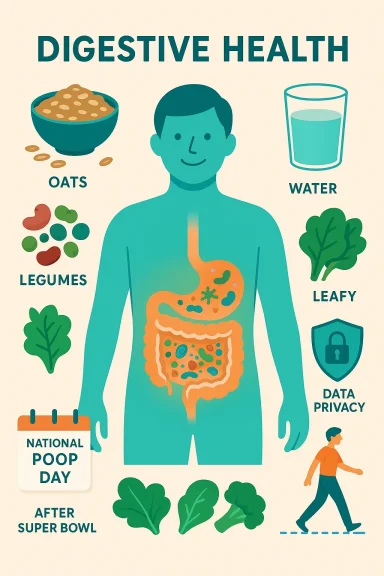 Background: National Poop Day and why it matters
National Poop Day was conceived in a community setting as a lighthearted way to remove shame from an essential bodily process, and to educate families—children and parents—about sanitation, hydration, and digestion. That backstory is important because the holiday’s origin is educational, not commercial: local museum polling produced a referendum to celebrate the topic in a kid-friendly way. From that starting point, the observance spread online and into broader media coverage, largely as an invitation to combine humor with factual public-health messaging.Why should a mostly silly holiday register with people who care about system design, privacy, and evidence-based wellness? Because bowel habits are an accessible, measurable signal of physiological function—and because the advice the day prompts (eat more fiber, stay hydrated, move your body, manage stress) is the same core guidance that appears in national dietary recommendations and medical guidelines. For clinicians and researchers, stool frequency and form are legitimate screening clues to digestive or systemic disease; for the rest of us, simple changes can often produce clear improvements.
Overview: What “normal” bowel habits look like
The “three and three” rule
A useful rule-of-thumb repeated across clinicians and public resources is the so-called “three and three” rule: a healthy range of bowel movements is roughly three times per day to three times per week. That wide window recognizes individual variation—diet, activity, age, medication, and the gut microbiome all influence frequency. What matters is change from an individual’s baseline, associated symptoms (pain, bleeding, dramatic weight loss), and stool form—not just how often you sit down.Stool form and the Bristol Stool Form Scale
Alongside frequency, stool consistency matters. The Bristol Stool Form Scale (Type 1 = hard lumps to Type 7 = watery) is a practical clinical tool: Type 3–4 are considered the “ideal” for comfortable, regular elimination. Chronic deviation toward the extremes—hard, pellet-like stools or consistently watery stools—warrants evaluation.Signs of trouble
- Less than three bowel movements per week with straining or discomfort may indicate constipation and deserves attention.
- More than three watery stools per day, especially with urgency or systemic symptoms (fever, blood), may indicate infection, inflammatory disease, or medication effects.
- Nighttime bowel movements that wake you from sleep are a red flag and should prompt consultation with a clinician.
Why fiber, water, and movement still top the list
Fiber: the single most actionable dietary lever
A consistent thread through dietary guidance is: increase dietary fiber. Fiber accelerates transit time for many people, softens stool, and promotes a diverse microbiome. Official guidance from nutrition experts recommends daily fiber intake that varies by age and sex—commonly in the range of roughly 25–38 grams per day for adults depending on source and demographic group. Most populations fall short of these targets; the typical North American diet averages well under recommended amounts.- High-fiber foods to prioritize: oats, whole grains, legumes (beans, lentils), vegetables, fruits (especially berries and pears), nuts, and seeds.
- Practical tip: introduce fiber slowly over 2–4 weeks while increasing water intake to avoid bloating and gas.
Hydration and movement
- Hydration makes fiber effective; without sufficient fluid, added fiber can contribute to hardness and bloating. A practical range for many adults is to aim for consistent water intake throughout the day rather than chasing a specific glass count.
- Physical activity stimulates intestinal motility; even short walks after meals are an evidence-backed nudge for regularity.
Mindful eating and routine
- Chewing thoroughly, eating at regular times, and avoiding large late-night meals help the gut establish a predictable rhythm. Stress, irregular schedules, and poor sleep disrupt that rhythm.
The microbiome, probiotics, and prebiotics: what works, what’s hype
Strengths of the evidence
The modern picture of digestive health increasingly centers on the gut microbiome—the trillions of microbes that interact with our digestion, immune function, and metabolic health. Two practical, evidence-supported levers to support beneficial gut microbes are:- Prebiotics: nondigestible fibers (inulin, resistant starches) that feed beneficial bacteria. Foods like garlic, onions, asparagus, leeks, green bananas, oats, and legumes contain prebiotic fibers.
- Probiotics: live organisms found in fermented foods (yogurt with live cultures, kefir, sauerkraut, kimchi) or supplements. Some probiotic strains have trial evidence for specific conditions (for example, certain Lactobacillus or Bifidobacterium strains and irritable bowel symptoms), but benefits are strain-specific and not universal.
Limits and risks
- Supplements are not tightly regulated in most markets; product quality, accurate labeling of strains and colony-forming units (CFUs), and storage conditions vary. For immunocompromised individuals, probiotics may carry risk and should be used only under medical advice.
- Prebiotic foods can worsen symptoms for people with FODMAP sensitivities or certain IBS subtypes—introduce them gradually and track symptoms.
Takeaway
A food-first approach—more diverse plants, whole grains, legumes, fermented foods where tolerated—gives the gut the best chance to adapt. Use supplements with targeted intent, ideally guided by a clinician or dietitian.“Hangry” and the gut–brain connection: why food affects mood
We’ve all seen it: the colleague who becomes short-tempered before lunch or the family member who turns hangry after skipping breakfast. The term hangry—a portmanteau of hungry and angry—captures a real physiological phenomenon.- When blood glucose falls, the body triggers a counterregulatory response. The nervous system and endocrine axes release hormones (epinephrine/adrenaline, and with more sustained hypoglycemia, cortisol and growth hormone) to restore glucose. Those same hormones affect arousal, anxiety, and irritability.
- Gut-derived hormones—ghrelin (the “hunger hormone”) and leptin (satiety)—alter brain circuits that influence reward, impulsivity, and mood. Experimental and imaging studies have shown that fluctuation in these hormones shifts how people respond to negative feedback and to food cues.
Cultural and systemic dimensions: why the American pattern matters
The Standard American Diet—often high in ultra-processed foods, refined carbohydrates, and saturated fats—promotes low fiber intake and microbiome patterns associated with inflammation and metabolic risk. Two system-level realities amplify the problem:- Ubiquity of refined, fast foods makes defaults unhealthy for busy people and those without easy access to fresh produce.
- Work culture and erratic schedules push people to skip meals, prioritize convenience over nutrition, and ignore early warning signs (bloating, irregularity).
National Poop Day as a communications moment: opportunities and pitfalls
What works
- Destigmatization: Making bowel health conversational reduces embarrassment and can shorten delays to medical care when symptoms are concerning. Normalizing simple screening questions (frequency, form, pain, blood) in primary care could catch problems earlier.
- Practical nudges: Use the day to promote concrete actions—adding one vegetable to every meal for a week, replacing refined breakfast carbs with oatmeal and fruit, or encouraging a 10-minute post-meal walk.
What to avoid
- Overmedicalization: Not every variation in bowel habits is pathological. Overemphasis on “optimal” microbiome profiles can generate anxiety and promote unnecessary testing or expensive, unproven supplements.
- Commercial exploitation: Expect opportunistic marketers around quirky holidays. Distinguish evidence-based interventions from products that promise “instant microbiome reset.”
A technology angle: tracking bowel habits, privacy, and data risks
If you read Windows forums, you know the attraction of tracking: CPU temps, network throughput, uptime. People increasingly track health metrics with apps—steps, sleep, food diaries, and for some, bowel logs. That creates utility and risk.Benefits of tracking
- Identifying patterns: frequency, triggers, and correlations with food, stress, or sleep.
- Better clinical discussions: a simple, timestamped diary can help a clinician differentiate chronic constipation from episodic irregularity, or link symptoms to particular foods or medications.
Privacy and security concerns
- Apps that collect sensitive health details—including digestive health—may store data in third-party clouds, share with advertisers, or be sold as health-adjacent consumer data. Health information has privacy implications: insurance underwriting, employment bias, or targeted marketing.
- Many health apps are not bound by medical privacy laws depending on jurisdiction; users should check privacy policies, prefer apps that store data locally or encrypt data in transit and at rest, and use strong account protections.
Practical advice for trackers
- Choose reputable apps with transparent privacy policies and clear data-retention practices.
- Prefer apps that allow export of your data in standard formats so you can share selectively with clinicians.
- Avoid linking digestive logs to public social profiles. Keep sensitive health details private.
Critical appraisal: strengths of the current guidance and what remains unsettled
Strong, evidence-backed points
- Fiber, hydration, and movement reliably improve stool form and frequency for many people.
- Monitoring change from baseline is a simple, effective screening heuristic.
- Hypoglycemia and hunger hormones meaningfully influence mood and impulsivity—so eating patterns matter not just for digestion but for social behavior.
Areas needing nuance or more research
- Microbiome personalization: While science shows correlations between gut community composition and health, translating that into individualized, clinically useful advice is still emerging. Many claims about “boosting gut diversity” with specific capsules or narrow food lists are oversimplified.
- Efficacy of over-the-counter probiotics is strain-specific; broad recommendations are premature without specifying strains, doses, and target symptoms.
- Ecological claims (for example, exact tonnes of carbon sequestered thanks to whale feces) are scientifically plausible and supported by ecological studies indicating whales contribute to iron cycling and phytoplankton productivity, but the scale and net carbon impacts are complex and model-dependent.
Practical, science-forward checklist to support digestive health (for individuals and workplaces)
- Prioritize fiber-rich foods: aim to increase plant-based fiber via whole grains, legumes, vegetables, and fruits.
- Hydrate consistently and match increased fiber with increased fluid intake.
- Move daily: even short walks after meals help intestinal motility.
- Schedule meals or at least consistent snacks to avoid prolonged fasting that can trigger extreme hunger and impulsive eating.
- Track changes, not isolated numbers: note persistent shifts in frequency, form, or the presence of blood or pain.
- Use fermented foods as a low-cost source of live microbes; consult professionals about supplements.
- If you use apps to track bowel habits, review privacy settings and export options.
Fun science notes and curiosities (poop trivia that’s also informative)
- Sloths descend to the ground roughly once a week to defecate—an extraordinary behavioral exception explained by complex ecological hypotheses and still under study. Their “poop dance” is one of nature’s stranger rituals and a vivid reminder of how digestion intersects with life-history strategies.
- Coprolites (fossilized feces) have been invaluable to archaeology. Samples dating back roughly 50,000 years at certain Paleolithic sites contain chemical traces that provide direct windows into ancient diets.
- Marine megafauna have an outsized role in nutrient cycling: whale feces is disproportionately rich in iron and other micronutrients that can stimulate phytoplankton growth in iron-limited regions, with cascading ecological effects.
Risks, red flags, and when to seek medical care
Some bowel symptoms require prompt evaluation:- New, persistent rectal bleeding or black tarry stools.
- Sudden, unexplained weight loss accompanied by changes in bowel habits.
- Severe abdominal pain, high fever, or signs of systemic infection.
- Marked and prolonged changes in stool frequency or consistency, particularly if accompanied by anemia, appetite loss, or nocturnal symptoms.
- Bowel habits that significantly disrupt daily functioning, or severe constipation resistant to basic interventions.
Conclusion: From Super Bowl recovery to everyday health
National Poop Day is a cheeky reminder that digestion is both ordinary and telling. The day’s lighter moments—the memes, the puns, the sloth clips—provide an entrée into meaningful public-health talk: eating a few more plants, drinking enough water, moving a bit more, and watching for changes are simple, high-value actions. For technologists and data-minded readers, the same curiosity that drives system optimization can be harnessed to optimize personal habits—but with vigilance about privacy, evidence quality, and clinical boundaries.Digestive health sits at an intersection: biology, behavior, culture, and technology. Treat it with the respect it deserves—minus the shame and full of practical, testable steps that actually move the needle on comfort, function, and long-term health.
Source: WorldHealth.net National Poop Day: Have You Heard of It? - WorldHealth.net