

Navi Mumbai International Airport’s opening day didn’t just mark a new node in India’s aviation map — it staged a deliberate return to the human side of travel, pairing ceremonial warmth with the operational choreography of a modern greenfield airport and sending a clear message about what passenger-first infrastructure can look like in practice.
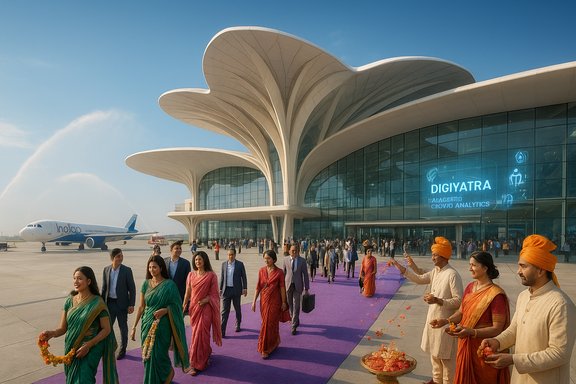
Navi Mumbai International Airport (NMIA) — a Zaha Hadid–designed terminal rising in Ulwe to relieve Mumbai’s overcrowded airspace — began commercial operations on December 25, 2025. The airport opened with a single 3,700-metre runway and a Terminal 1 built to handle an initial 20 million passengers per annum (MPPA), with masterplan capacity to scale up to roughly 90 MPPA over future phases. Operationally the launch day saw around 48 flights and just over 4,000 passengers served, with carriers including IndiGo, Air India Express, Akasa Air and regional Star Air operating the initial services. What made the day different — and rapidly visible on social platforms — was a curated, culturally rooted welcome for travellers: garlands, rose-water showers, aarti ceremonies, purple-carpet walks and personalised greetings at gates. Organisers framed these gestures as a modern enactment of Atithi Devo Bhava, the Indian ethos that “the guest is god,” and positioned the inauguration as as much a people-first moment as an engineering one. Media coverage and an official release from the airport operator described Chairman Gautam Adani personally greeting passengers, participation from Param Vir Chakra awardees, and special invitations for construction workers, Adani Foundation beneficiaries, differently-abled staff and food-court teams to be part of the ceremonies.
There are three clear incentives behind that choice:
However, symbolic warmth should be designed to scale. A hospitality-first posture brings unmistakable PR advantages, but it must be coupled with robust crowd-control design, security discipline and a clear plan for how ceremonial elements translate into repeatable, sustainable passenger experiences when the facility grows from thousands to tens of thousands of passengers per day.
For other operators, the pragmatic takeaway is straightforward: design for dignity, but test for throughput. NMIA’s opening shows that infrastructure can be both impressive and warm — provided the warm moments are engineered into the operational fabric and not layered on top of it as one-off theatre.
Note: Descriptions of specific ceremonial items and individual passenger anecdotes originate in local reporting; where details appear in a single outlet’s coverage they are noted as reported and should be understood as journalistic accounts rather than independently verified operational policies.
Source: Mid-day When Travel Feels Tiring, NMIA Chose Warmth Over Protocol
 Background / Overview
Navi Mumbai International Airport (NMIA) — a Zaha Hadid–designed terminal rising in Ulwe to relieve Mumbai’s overcrowded airspace — began commercial operations on December 25, 2025. The airport opened with a single 3,700-metre runway and a Terminal 1 built to handle an initial 20 million passengers per annum (MPPA), with masterplan capacity to scale up to roughly 90 MPPA over future phases. Operationally the launch day saw around 48 flights and just over 4,000 passengers served, with carriers including IndiGo, Air India Express, Akasa Air and regional Star Air operating the initial services. What made the day different — and rapidly visible on social platforms — was a curated, culturally rooted welcome for travellers: garlands, rose-water showers, aarti ceremonies, purple-carpet walks and personalised greetings at gates. Organisers framed these gestures as a modern enactment of Atithi Devo Bhava, the Indian ethos that “the guest is god,” and positioned the inauguration as as much a people-first moment as an engineering one. Media coverage and an official release from the airport operator described Chairman Gautam Adani personally greeting passengers, participation from Param Vir Chakra awardees, and special invitations for construction workers, Adani Foundation beneficiaries, differently-abled staff and food-court teams to be part of the ceremonies. What happened on Day One: the facts
The operational snapshot
- Opening date: December 25, 2025.
- Flights handled: ~48 on Day One across a small number of domestic routes.
- Passenger count: Reported at just over 4,000 passengers served on the first day.
- First arrival and ceremonial moments: The first arrival reported was IndiGo flight 6E460 from Bengaluru, greeted with a water-cannon salute; departures began shortly after.
The welcome rituals that stood out
The launch incorporated visible cultural rituals and gift-centric hospitality designed for memorable first impressions:- Traditional garlanding and aarti at gates.
- Rose-water sprinkling and floral paths.
- Purple-carpet exits and photo-op areas for first-time flyers.
- Presentation of special hampers, takeaway merchandise and keepsakes for inaugural passengers.
Why NMIA chose “warmth over protocol”: design and PR logic
The emotional logic of an airport launch
Large infrastructure openings often follow two axes: strict procedural formality (regulated VIP flows, tightly scripted operations) or high-visibility public engagement (festivals, rituals, community inclusion). NMIA’s organizers leaned toward the latter, aiming to generate civic pride and emotional resonance for a project that took decades from conception to completion.There are three clear incentives behind that choice:
- Reputation and social license. A new airport is not only a transport asset but a civic symbol. Warmth-driven ceremonies provide instant positive narratives and local buy-in.
- Media impact and social amplification. Visual rituals — garlands, flag-raising with national heroes, personalised gifts — produce shareable moments that dominate news cycles and social feeds.
- Recognition of workforce contributions. Featuring construction workers, food-court staff and differently-abled employees in the program broadcasts inclusivity and frames the airport as a community achievement, not merely a corporate or political milestone.
How design and culture connected
Zaha Hadid Architects’ lotus-inspired terminal already foregrounded an architectural narrative — the building itself acts as a cultural signifier. Pairing structural symbolism with ceremonial hospitality makes a consistent story: NMIA both looks and feels like an expression of national identity and progress. Multiple outlets described the lotus motif, the airy petal-shaped roof and the terminal’s daylight-led volume, connecting the physical architecture with the ceremonial program.Passenger-first experience: strengths and early wins
Tangible benefits seen on Day One
- High visibility and morale: Publicly celebrating first passengers and frontline staff created strong, shareable imagery that turned operational openings into relatable human stories. This can rapidly boost public perception and acceptance.
- Inclusive recognition: Inviting construction crews, Adani Foundation beneficiaries and differently-abled staff into launch ceremonies was a visible commitment to acknowledging the workforce and community stakeholders who enabled the project. That reduces the risk of alienating affected communities that were part of the decades-long development process.
- Seamless PR and stakeholder alignment: Having the operator’s chairman and celebrated public figures participate offers a single, coherent narrative which smooths political optics and investor communications.
Operationally credible elements
The launch day was not only symbolic. It showed the airport could handle a concentrated wave of flights and passengers, at least in a constrained 12-hour initial operating window that the operator announced for the first phase. Aircraft movements, ground handling, baggage flows and security checkpoints were exercised at scale — early proof points for operational readiness.Risks, trade-offs and unanswered questions
The warmth-first strategy brings immediate PR upside, but it warrants a careful risk assessment before being adopted as standard operating posture across routine operations.Crowd management, security and safety trade-offs
A ceremonial, celebratory environment can blur lines between public hospitality and controlled operational space. Airports are security-sensitive zones governed by strict protocols; rituals that increase congregation near gates, trolley lanes and jetbridges must be tightly risk-assessed.- Potential for congestion: Floral aisles, garlanding lines and photo areas can create pinch points in passenger flows if not segregated from security lanes. No reports on Day One indicated safety incidents, but the risk exists when emotional moments draw crowds within restricted areas.
- Security perimeter management: Any ceremonial access requiring additional non-travelers on airside needs pre-cleared security plans. The press notes indicate special charters and staged access were organized, but the operational model for daily recurrence (for example, offering keepsakes to large passenger volumes) remains unclear.
Protocol dilution vs operational discipline
Celebratory gestures are positive for one-off openings. However, routinely blending ritualized hospitality with standard operating procedures may:- Increase processing times if staff must balance ceremonial duties with ticketing, screening and regulatory checks.
- Introduce expectations among passengers for non-standard services that are not scalable (free hampers, ceremonial greetings) and therefore unsustainable once traffic scales to millions annually. The airport operator can manage this by clearly delimiting inaugural-day gestures from ongoing service design.
Transparency and verifiability of some claims
A number of impressions — for example, the scale and reach of the “special hampers” and precise details of individual social media reports — are well documented by local outlets like Mid-Day but are not uniformly reported across all national press. Where a claim appears solely in a single outlet, it should be treated as reported by that outlet until independently corroborated. The Mid-Day coverage is rich in descriptive detail about gestures and participants; other national outlets and the operator’s press release corroborate the event’s inclusive intention and high-profile participants but do not enumerate every ceremonial element. Treat those single-source details with cautious acceptance.The broader operational picture: what the numbers say
Capacity, phasing and future growth
- Phase 1 capacity: Terminal 1 designed for ~20 MPPA; initial operations limited to daytime hours (reported 8 am–8 pm) for a phased maturity of systems.
- Long-term masterplan: Multiple phases that envision up to 90 MPPA with two parallel runways and four terminals when fully realised. This is consistent across operator materials and independent architecture coverage.
- Cargo ambition: The airport’s cargo handling ambitions (hundreds of thousands of tonnes in initial phase, rising to multi-million tonnes in full build-out) are central to its development model of combining passenger and logistics growth.
Digital and AI-enabled passenger flow claims
Coverage of the opening day and operator statements also referenced digital features planned to underpin passenger experience: DigiYatra-enabled entry workflows, AI-driven passenger flow analytics, and smart surveillance for assistance-needing passengers. These are promising on-paper features but, like any system, require phased integration and independent verification of performance metrics once fully operational.Practical lessons and recommendations for other airports
For airport operators and municipal authorities considering a people-first opening, NMIA offers a useful case study. The following practical steps balance emotional impact with operational prudence:- Define clear zones: Create separate ceremonial spaces that do not intersect primary security and boarding corridors. This preserves rituals while protecting flows.
- Time-boxed gestures: Reserve high-touch hospitality for finite phases (inauguration week, anniversary events) and design a low-cost, repeatable passenger welcome experience for regular operations.
- Scalable souvenirs: Replace resource-heavy physical hampers with digital mementos (photo downloads, commemorative e-covers, QR-linked stories) that maintain memory without scaling expenses or waste.
- Conduct tabletop security rehearsals: Any activity that allows additional public access to sensitive areas must be rehearsed with security agencies to ensure compliance and contingency readiness.
- Measure and publish: Collect data on how ceremonial activities affect processing times, queue lengths and passenger satisfaction; publish the results to show trade-offs and build trust.
Culture, inclusivity and reputational impact
There is a reputational premium to be gained by making a major public infrastructure moment feel inclusive. NMIA’s decision to spotlight construction workers, differently-abled staff and Adani Foundation beneficiaries was widely reported and will likely pay dividends in civic sentiment.- For communities displaced or affected by large projects, visible recognition at launch can ease tensions and build a narrative of shared ownership.
- For labour and service staff, inclusion in the spotlight can be morale-boosting and help social media narratives that portray the airport as “for the many.” The operator’s messaging intentionally emphasised that point.
Conclusion: a useful template — with caveats
Navi Mumbai International Airport’s inaugural day was effective in two ways: it demonstrated operational readiness at scale, and it consciously positioned the passenger as a celebrated guest. That combination — operational competence plus cultural welcome — is an alluring template for future airport launches and major civic infrastructure openings.However, symbolic warmth should be designed to scale. A hospitality-first posture brings unmistakable PR advantages, but it must be coupled with robust crowd-control design, security discipline and a clear plan for how ceremonial elements translate into repeatable, sustainable passenger experiences when the facility grows from thousands to tens of thousands of passengers per day.
For other operators, the pragmatic takeaway is straightforward: design for dignity, but test for throughput. NMIA’s opening shows that infrastructure can be both impressive and warm — provided the warm moments are engineered into the operational fabric and not layered on top of it as one-off theatre.
Note: Descriptions of specific ceremonial items and individual passenger anecdotes originate in local reporting; where details appear in a single outlet’s coverage they are noted as reported and should be understood as journalistic accounts rather than independently verified operational policies.
Source: Mid-day When Travel Feels Tiring, NMIA Chose Warmth Over Protocol