

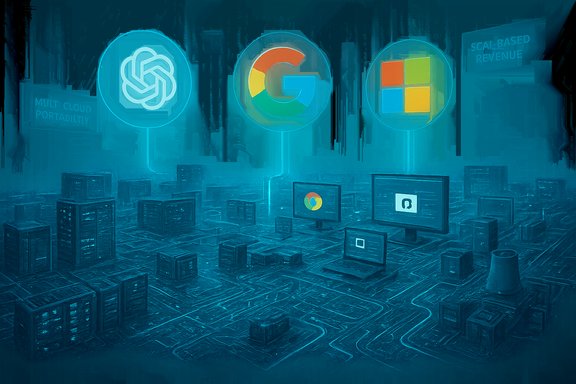
The AI market is rapidly consolidating around a handful of dominant competitors — a pragmatic oligopoly where model capability, cloud distribution, and monetization strategy intersect — and that concentration is reshaping enterprise IT, developer choices, and regulatory scrutiny.
The generative-AI wave that began with large open demos and APIs has moved decisively from novelty to commercialization. Early consumer traction and developer mindshare gave companies like OpenAI outsized attention, but the story quickly evolved: the race is now about converting model capabilities into durable revenue while solving the brutal economics of compute and distribution. That strategic pivot is why industry commentators describe the current landscape as a three-player contest centered on OpenAI, Google (Alphabet), and Microsoft — each with complementary strengths and distinct vulnerabilities.
The playing field is defined by three interlocking axes:
Key strengths:
Key strengths:
Key strengths:
For IT leaders and Windows practitioners, the sound strategy is concrete and conservative: design for portability, demand governance and auditability, pilot carefully to measure real cost‑per‑task, and avoid single‑vendor lock‑in for mission‑critical AI workloads. These are the best defenses against the market turbulence that emerges as compute constraints, regulation, and monetization dynamics resolve the oligopoly’s contours.
Caution: specific headline numbers about consumption commitments and revenue targets have been widely reported but compress different contractual categories. Where such figures are cited in public discussions, treat them as directional and request contractual detail before making long-term procurement decisions.
Bold strategic moves — capacity commitments, distribution integration, or a pivot to sell compute — will determine which of the three players expands dominance and which must adapt. The intersection of technical capability, distribution muscle, and durable monetization will decide the winners; for customers, the right move is preparation and prudence.
Source: FourWeekMBA The Three-Player Oligopoly in AI - FourWeekMBA
 Background / Overview
The generative-AI wave that began with large open demos and APIs has moved decisively from novelty to commercialization. Early consumer traction and developer mindshare gave companies like OpenAI outsized attention, but the story quickly evolved: the race is now about converting model capabilities into durable revenue while solving the brutal economics of compute and distribution. That strategic pivot is why industry commentators describe the current landscape as a three-player contest centered on OpenAI, Google (Alphabet), and Microsoft — each with complementary strengths and distinct vulnerabilities.The playing field is defined by three interlocking axes:
- Compute and infrastructure — who controls GPUs, TPUs, and data-center capacity.
- Distribution and product integration — who embeds AI into operating systems, productivity suites, and consumer touchpoints.
- Monetization and governance — how usage converts into seats, subscriptions, ads, or cloud consumption while satisfying safety, privacy, and regulatory requirements.
The Three Players: Strengths, Strategies, and Risks
OpenAI — speed, developer mindshare, and the compute problem
OpenAI’s early advantage came from product velocity and a developer-first, API-centric posture that made it easy to embed state-of-the-art models across many apps. That has translated into massive awareness and a clear route to enterprise adoption. But OpenAI’s rapid growth exposed a central tension: model capability is expensive to scale. Training and inference of frontier models require vast GPU fleets, driving large infrastructure commitments and complex partner relationships. OpenAI has pursued a multi‑vendor compute strategy while exploring ways to improve unit economics — including discussions about selling compute or packaging an AI cloud offering — but any move into first‑party infrastructure is materially capital‑intensive and politically sensitive.Key strengths:
- Developer mindshare and product-led growth.
- Platform neutrality that supported broad third‑party integration.
- Colossal compute bill and need for sustainable monetization.
- Complex co-opetition with major cloud partners (notably Microsoft) and potential governance/neutrality concerns if OpenAI becomes a cloud operator.
Google (Alphabet) — vertical integration, TPUs, and ad monetization leverage
Google’s advantage is embedded distribution: Search, Android, Chrome, Workspace, and Google Cloud provide natural placements to deploy conversational UX and capture commercial value. Google also benefits from proprietary silicon (TPUs) and a vertically integrated stack that can improve cost-per-inference and deployment efficiency. Where Google excels is converting attention into monetized interactions — provided it can preserve ad economics while shifting toward conversational formats. Regulatory scrutiny and the challenge of integrating new UX models with ad revenue make that a delicate balancing act.Key strengths:
- Massive distribution channels and data flows.
- Custom silicon and integrated cloud hardware/software stack.
- Antitrust and regulatory pressures tied to platform defaults and data access.
- The need to preserve ad-driven margins if search behavior changes.
Microsoft — enterprise bundling, Copilot, and ecosystem leverage
Microsoft’s strategic play couples deep enterprise relationships, Microsoft 365/Office distribution, Azure cloud capacity, and investments in model suppliers. Embedding copilots into productivity workflows (Office, Windows, Edge) creates seat-based monetization opportunities that map directly to enterprise budgets. Microsoft’s advantage is the ability to bundle AI capabilities across identity, productivity, and developer tools to raise switching costs and capture recurring revenue. Still, Microsoft must manage capacity timing, supply risks, and trust/safety at scale.Key strengths:
- Enterprise reach and bundle commerce (Office + Azure + GitHub).
- Strong financial capacity to underwrite multi-year infrastructure investments.
- Operational scaling of GPU capacity and the vulnerability introduced by model-supplier dependencies.
- Regulatory scrutiny if Microsoft’s bundling is viewed as exclusionary.
Infrastructure: GPUs, Power, and the New Bottlenecks
The AI era re-centered infrastructure as the single most important bottleneck. Frontier model training and large-scale inference are dominated by accelerator hardware — today primarily Nvidia’s Blackwell-family GPUs — and by data-center capacity for power and cooling. Securing continuous GPU supply, long-term OEM commitments, and grid agreements is now a strategic moat. Several themes are critical:- GPU vendor concentration creates bargaining power for GPU suppliers and fragility for buyers.
- Data-center scale requires gigawatt-class power planning, permitting, and local grid deals — projects that take years, not months.
- Hyperscalers (AWS, Azure, Google Cloud) remain essential capacity providers, but companies like OpenAI are exploring a staged path to selling or owning compute to improve unit economics. That path can be implemented as a reseller/marketplace approach, co‑build partnerships, or a long-term first‑party cloud; each step increases capital intensity and operational complexity.
Business Models: Ads, Seats, and Compute Sales
How AI generates revenue is reshaping corporate strategy:- Google’s most plausible large-scale monetization remains ad and commerce integration across conversational experiences, if it can preserve engagement formats that generate ad inventory. This path scales but carries regulatory scrutiny.
- Microsoft and OpenAI are leaning heavily into seat-based and subscription models (Copilot, ChatGPT Pro/Enterprise). These yield recurring revenue and align with corporate procurement cycles, but they require convincing customers that seat fees translate to measurable ROI and healthy unit economics.
- OpenAI exploring compute-as-product — packaging model+compute or even reselling capacity — would shift the economics again. Selling compute converts capex into recurring revenue but places OpenAI into direct competition with hyperscalers and faces vertical-integration friction.
Competitive Scenarios: How the Oligopoly Might Resolve
There are several plausible medium‑term outcomes — each with different implications for customers and regulators:- Microsoft/OpenAI win enterprise productivity: Microsoft’s bundling and OpenAI’s model portfolio convert usage into stable, seat-based ARPU across enterprises. This scenario favors companies willing to pay for integrated copilot capabilities.
- Google defends consumer reach and ad monetization: Google integrates conversational AI into search and Workspace, monetizing at scale through ads and commerce without destroying ad economics. This preserves Alphabet’s margin engine.
- Multi‑vendor equilibrium: Regulatory action, open-source model improvements, and procurement patterns produce a pluralistic market where AWS, Azure, Google Cloud, and specialized providers coexist, with enterprises adopting hybrid/multi-cloud AI stacks to avoid lock-in. This is the politically and economically plausible long-run outcome.
Regulatory & National-Security Risks
Concentration of AI capability and integrated vertical stacks invite regulatory attention across three vectors:- Antitrust scrutiny — bundling AI features into operating systems or productivity suites risks enforcement actions that could force unbundling or constrained defaults. Regulators are already probing platform preloads and exclusivity.
- Data access and platform neutrality — exclusive data flows or preferential API access may trigger mandates for interoperability or data portability.
- National-security and export controls — the strategic nature of compute and foundational models may attract export restrictions, local‑sourcing requirements, or other sovereignty-driven measures that fragment global markets.
Practical Implications for IT Teams and Windows Customers
The oligopoly favors firms that plan for vendor diversity, governance, and observability. Concrete steps to prepare:- Prioritize multi‑cloud portability: separate data, compute, and model artifacts so workloads can migrate if pricing or capacity changes.
- Insist on contractual protections: SLAs, audit logs, data‑residency guarantees, and explicit terms around model training/use of customer data.
- Bake governance into production pipelines: model lineage, automated validation, versioning, and human-in-the-loop signoffs for critical outputs.
- Pilot and measure cost-per-task, not just per-token or per‑API-call pricing. Monitor real ROI before scaling seat subscriptions.
- Use hybrid trust patterns for sensitive data: keep sensitive data local and route less-sensitive inference to managed services; implement DLP and least-privilege connectors.
Strengths of the Oligopoly — Why It Emerged
Several structural forces produce concentration:- Scale effects on compute — large models and rich inference workloads favor players who can commit to massive, predictable GPU consumption and amortize capex across many products.
- Distribution advantages — embedding AI into ubiquitous endpoints (search, Office, Windows) accelerates adoption and monetization in ways APIs alone do not.
- Ecosystem lock-in — bundling across identity, developer tools, and productivity creates switching costs that favor incumbents.
Weaknesses & Material Risks
Concentration is not the same as invulnerability. Key vulnerabilities include:- Compute supply shocks: GPU shortages (Nvidia concentration) create a systemic risk that can slow training and inference capacity for all players.
- Margin pressure and capital intensity: Scaling models without matched monetization leads to losses and investor pressure. Publicly reported runway and ARR targets should be read carefully and verified.
- Regulatory backlash: antitrust actions or mandates on defaults and data portability could force architecture changes that erode incumbents’ advantages.
- Trust and safety incidents: hallucinations, data leakage, or misuse incidents can reduce enterprise uptake and invite tighter governance. Continuous investment in red‑teaming and auditability is essential.
What to Watch Next — Key Signals and Milestones
Enterprises and investors should track a short list of high‑signal indicators:- Capacity deliveries and GPU availability: who secures long‑lead GPU supplies and announces concrete data‑center builds? Delays or shortages will reshape vendor timelines.
- Q‑quarter financials and guidance: look for durable bookings-to-revenue conversion and commentary on AI-capex pacing and unit economics. Q4 results and early‑next‑year guidance are pivotal.
- Regulatory actions and legislative moves: any antitrust or data‑sovereignty rulings in major markets will materially alter default vendor behaviors.
- Open-source model advancements: breakthroughs that materially close the gap on cost/perf can accelerate multi‑model and hybrid cloud strategies.
Conclusion — A Practical Assessment
The current AI landscape looks less like a chaotic free-for-all and more like a strategic triage: a concentrated set of powerful players jockeying across compute, distribution, and monetization. OpenAI brings developer momentum and model focus but wrestles with the economics of compute. Google brings vertical integration and ad monetization muscle while managing regulatory exposure. Microsoft brings enterprise distribution and bundling advantages backed by deep pockets and product integration. Together, they form a pragmatic oligopoly that will shape which enterprise patterns and developer flows dominate the next phase of computing.For IT leaders and Windows practitioners, the sound strategy is concrete and conservative: design for portability, demand governance and auditability, pilot carefully to measure real cost‑per‑task, and avoid single‑vendor lock‑in for mission‑critical AI workloads. These are the best defenses against the market turbulence that emerges as compute constraints, regulation, and monetization dynamics resolve the oligopoly’s contours.
Caution: specific headline numbers about consumption commitments and revenue targets have been widely reported but compress different contractual categories. Where such figures are cited in public discussions, treat them as directional and request contractual detail before making long-term procurement decisions.
Bold strategic moves — capacity commitments, distribution integration, or a pivot to sell compute — will determine which of the three players expands dominance and which must adapt. The intersection of technical capability, distribution muscle, and durable monetization will decide the winners; for customers, the right move is preparation and prudence.
Source: FourWeekMBA The Three-Player Oligopoly in AI - FourWeekMBA
