

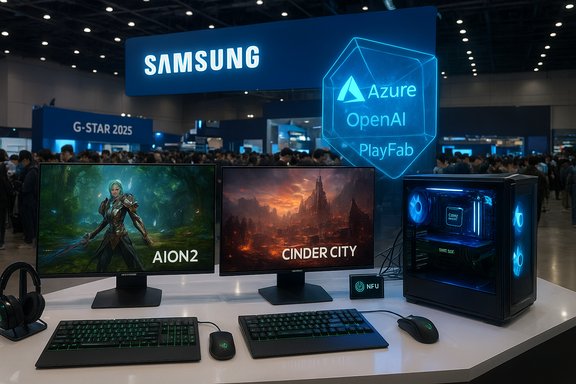
NCSOFT is staging one of the most ambitious hardware-and-cloud showcases this year at G‑STAR 2025, enlisting Samsung, NVIDIA, Intel, Microsoft and RAZER to power playable demos of AION2 and the open‑world tactical shooter CINDER CITY — a partnership slate that blends bleeding‑edge displays, next‑generation GPUs and cloud AI tooling to create a curated “best‑in‑class” show floor experience.
NCSoft is the headline sponsor of G‑STAR 2025 and is using the event to put its two flagship demos — AION2 (launching November 19 in Korea/Taiwan) and CINDER CITY — in front of players and press on top‑tier hardware. The studio has publicly detailed the collaborators and the specific tech each partner will supply for the booth buildout, positioning the showcase as a coordinated technology demonstration as much as a game reveal. This is not a simple marketing tie‑up. NCSoft’s announcements and related press coverage show a layered technical agenda: visually striking client demos running on the latest monitors, RTX 50‑class GPUs with NVIDIA’s newest frame‑generation and responsiveness toolchain, Intel Core Ultra platforms with on‑chip NPUs, and a formal cooperation with Microsoft around Azure cloud infrastructure and Azure OpenAI tooling for CINDER CITY.
The strategy’s strengths are clear: optimized demo rigs reduce on‑floor variability, DLSS 4 and RTX 50 promise eye‑catching frame generation, Intel’s NPU allows local AI features, and Microsoft Azure brings scale and enterprise governance. These choices are aligned with industry trends toward hybrid local/cloud AI stacks and are likely to produce an attractive show experience. But important technical and governance questions remain. The most consequential practical risks are latency/determinism for shooter gameplay, the operational cost of cloud AI at scale, and the degree of vendor lock‑in created by deep Azure integration. Furthermore, headline performance claims (such as the reported ~40% mobile FPS uplift on Samsung devices) should be treated cautiously until detailed methodologies and independent benchmark data are published.
For the games industry and WindowsForum readers, NCSoft’s G‑STAR program is a compelling demonstration of where AAA development is headed: premium client hardware working alongside cloud‑native AI pipelines. The immediate payoff will be a polished public reveal and playable demos; the long‑term implication is a continuing shift in engineering priorities toward AI governance, FinOps and hybrid architecture design that studios will need to master for consistent global live‑service operations.
Conclusion: G‑STAR 2025 will be a practical stress test of NCSoft’s claims — not only for how pretty AION2 and CINDER CITY look, but for how robustly NCSoft and its partners manage responsiveness, cost, and content safety in a complex hybrid stack. The booth will likely set a new bar for expo showmanship; whether the lessons there translate into sustainable, responsible engineering practices in production will be the story to watch after the show.
Source: 에이빙 [Pangyo Game] NCSOFT Partners with Samsung, NVIDIA, Microsoft, and Others for G-STAR 2025 |
 Background
NCSoft is the headline sponsor of G‑STAR 2025 and is using the event to put its two flagship demos — AION2 (launching November 19 in Korea/Taiwan) and CINDER CITY — in front of players and press on top‑tier hardware. The studio has publicly detailed the collaborators and the specific tech each partner will supply for the booth buildout, positioning the showcase as a coordinated technology demonstration as much as a game reveal. This is not a simple marketing tie‑up. NCSoft’s announcements and related press coverage show a layered technical agenda: visually striking client demos running on the latest monitors, RTX 50‑class GPUs with NVIDIA’s newest frame‑generation and responsiveness toolchain, Intel Core Ultra platforms with on‑chip NPUs, and a formal cooperation with Microsoft around Azure cloud infrastructure and Azure OpenAI tooling for CINDER CITY. What NCSoft announced — the headline items
- NCSoft will outfit its G‑STAR booth with hardware from Samsung Electronics, NVIDIA, Intel, Microsoft, and RAZER to run live demos of AION2 and CINDER CITY.
- Samsung will provide two Odyssey OLED monitors: the 27‑inch Odyssey OLED G6 (advertised with a 500 Hz OLED refresh capability) for AION2, and the 27‑inch Odyssey OLED G5 (180 Hz, 0.03 ms response time) for the shooter demo. Samsung’s Glare Free surface treatment is being used across the demo fleet.
- NVIDIA’s next‑generation GeForce RTX 50 series GPUs will be used across the booth, and both AION2 and CINDER CITY are announced to support DLSS 4 multi‑frame generation and NVIDIA Reflex for frame generation and input responsiveness.
- Intel will supply Intel® Core™ Ultra processors (with an integrated NPU and hybrid core architecture) to power PC builds optimized for open‑world rendering and AI‑assisted features.
- Microsoft will act as an official sponsor; NCSoft and Microsoft Korea signed an MOU covering technical cooperation that includes adopting Azure cloud services and Azure OpenAI technologies for CINDER CITY’s development pipeline.
- RAZER will supply gaming peripherals (keyboards, mice, headsets) and sponsor giveaways tied to NC’s on‑site events.
Why these specific technologies matter — features and player impact
Samsung Odyssey OLED displays: more than headline refresh numbers
Samsung’s new Odyssey OLED family brings three features important for a live demo environment: extreme refresh rates and low response latency, OLED burn‑in mitigation and glare control, and color fidelity for cinematic presentation.- The Odyssey OLED G6 is positioned as a QD‑OLED 27‑inch panel with a headline 500 Hz refresh capability — a marketing first for an OLED gaming monitor — aimed at producing ultra‑smooth visuals in high‑fps demonstrations. The G5 targets shooter workloads with a high refresh (180 Hz) and a 0.03 ms response spec.
- Samsung’s Glare Free surface treatment and OLED Safeguard thermal/burn‑in mitigation features are engineered to make OLED usable continuously in an exhibition setting without the image retention worries older OLEDs carried. That matters at events where static UI elements and long hours can expose displays to burn‑in risk.
NVIDIA GeForce RTX 50 series + DLSS 4 + Reflex: pushing frame generation
NVIDIA’s RTX 50 series is being used as the rendering backbone for the demos. The most relevant software features announced for the RTX 50 launch are:- DLSS 4 Multi‑Frame Generation (MFG): a transformer‑based upscaling and frame‑generation system that can synthesize frames and dramatically increase perceived frame rates while retaining image quality. This technology is central to making high‑resolution, ray‑traced scenes feel fluid on mid‑to‑high range hardware.
- NVIDIA Reflex: a kit for lowering frame‑render and input latency, especially useful for shooter demos where responsiveness is judged instantly by players.
Intel Core Ultra: hybrid cores plus on‑chip NPU
Intel’s Core Ultra family integrates a hybrid core CPU topology (P‑cores and E‑cores) alongside a discrete Neural Processing Unit (NPU) that accelerates AI inference locally. For game developers and demonstrators, this means:- Local device‑side AI (model inference for camera smoothing, client‑side LLM features, or enhanced upscaling preprocessing) can run without cloud round‑trips, reducing latency for time‑sensitive features.
- The hybrid core design enables balancing single‑threaded, latency‑sensitive workloads with background AI and streaming tasks — helpful in a demo rig where telemetry, capture and background services run alongside the game client.
Microsoft Azure and Azure OpenAI: the cloud side of the demo
NCSoft’s MOU with Microsoft Korea frames Azure as both a development and operational platform for CINDER CITY. The practical playbook includes:- Using Azure OpenAI/RAG patterns for localized dialogue, quest scaffolding, and dynamic flavor text.
- Leveraging PlayFab / Azure multiplayer services for matchmaking, session orchestration and telemetry for live‑ops.
- Applying Copilot/Copilot Studio workflow tooling to accelerate iteration inside the studio pipeline.
How NCSoft’s demo stack is assembled (what you’ll see at the booth)
- All demo stations will pair Odyssey OLED displays with PC builds running GeForce RTX 50 GPUs and Intel Core Ultra processors. This mix is intended to showcase both visual fidelity and responsiveness for AION2 and CINDER CITY.
- Mobile AION2 demos will run on Samsung’s latest flagships — specifically referenced are the Galaxy S25 Ultra and the Galaxy Z Fold7 — where NCSoft says it optimized rendering and frame rates. Independent product launches for these devices are recent, and Samsung’s Galaxy Z Fold7 is already on market.
- RAZER peripherals and branded giveaways are being used to round out the expo experience and provide player‑facing engagement.
Critical analysis — strengths of NCSoft’s approach
- Bold, integrated showcase reduces friction for demos
Delivering developer‑approved configurations across display, GPU and CPU minimizes the risk that audience rigs will underperform. Using uniform, validated hardware reduces “works on paper” surprises that often plague expo demos. - Combining local device AI (Intel NPU) and cloud AI (Azure) creates a sensible separation of concerns
Keeping latency‑sensitive systems local (camera smoothing, client‑side interpolation) while moving bulk generative tasks and live‑ops personalization into Azure is an industry‑sensible hybrid approach that preserves both responsiveness and scale. - Marketing + technical credibility
Partnering with Samsung, NVIDIA and Intel gives NCSoft compelling talking points for specs and performance, while Microsoft’s MOU signals a long‑term tooling and cloud relationship — useful both for investor perception and developer hiring. - Show floor design that anticipates operational realities
Samsung’s Glare Free and OLED safeguard tech directly addresses the operational headaches of long‑running panels and static UI elements in exhibition settings. That attention to hardware‑level detail is practical and reduces risk of on‑floor failures.
Risks, unknowns and points that need careful scrutiny
- Vendor lock‑in and portability
Heavy reliance on Azure PlayFab/managed services and Microsoft Copilot tooling can accelerate development but raise migration costs later. NCSoft will need clear portability plans (IaC, containerization) if multi‑cloud or on‑prem options are desirable in future phases. - Latency and determinism for a shooter
Real‑time shooters require deterministic, low‑latency authoritative servers for hit registration. Any temptation to shift authoritative decisions to cloud LLM endpoints or high‑latency inference loops risks introducing unfairness or perceptible lag in PvP. The engineering approach must be conservative: AI for flavor and personalization, not authoritative game state. - Cost and FinOps risk from AI usage at scale
Azure OpenAI inference, frequent RAG lookups, and cloud‑hosted personalization can be expensive. Studios must budget caching, model selection, and batching strategies from the start to avoid runaway cloud bills. - Model reliability and safety
LLMs hallucinate. Using them for dialogue, mission rules, or shop descriptions requires grounding (RAG with canonical lore), editorial review gates, and robust moderation pipelines to avoid narrative or moderation problems that damage player trust. - Unverified performance claims (exercise caution)
Some coverage circulating ahead of the show has repeated a claim that Samsung‑device mobile builds of AION2 saw an approximate 40% FPS improvement following NCSoft’s optimization work on Galaxy S25 Ultra / Z Fold7 devices. That specific percentage appears in secondary reporting but is not yet backed by verifiable lab data or an explicit NCSoft benchmark disclosure in the public press materials examined. Treat headline percentage gains as reported claims, not independently validated facts.
Technical verification — what independent sources confirm
- Samsung’s Odyssey OLED lineup, Glare Free treatment and high‑refresh OLED claims are documented in Samsung’s product materials and press coverage (Odyssey OLED G6/G8 family details). These confirm the presence of OLED burn‑in mitigation and glare‑reduction technologies used in show‑floor displays.
- NVIDIA’s DLSS 4 and the RTX 50‑series frame‑generation story are widely reported and documented in GPU press coverage; DLSS 4’s Multi‑Frame Generation is an important part of the RTX 50 feature set referenced by NCSoft.
- Intel’s Core Ultra product briefs and NPU datasheets confirm the presence of an integrated NPU and a hybrid performance architecture that Intel bills as suitable for on‑device AI acceleration in client PCs. That matches NCSoft’s claim that Intel hardware will accelerate client‑side AI and camera smoothing.
- NCSoft’s own press pages and local coverage confirm the list of partner companies and the overall plan for G‑STAR exhibitor support. Those official notices are the primary source for the partnership list and the booth plan.
Practical takeaways for players, press and technical audiences
- If you’re attending G‑STAR, expect polished demos on identical, validated rigs that will emphasize image fidelity and snappy controls; the hardware mix NCSoft chose is engineered to produce clean hands‑on experiences.
- For PC builders and enthusiasts watching these demos: take the show‑floor experience as a best‑case demonstration. Exhibition rigs are configured and tuned heavily; actual home performance will depend on your own GPU, display and OS tuning. DLSS 4 and RTX 50‑class GPUs can materially raise perceived frame rates, but real‑world gains will vary by resolution, settings and game engine work.
- For developers and studios: NCSoft’s stack is a useful case study in hybrid design — local hardware acceleration (NPUs, client GPUs) plus cloud scale for content and personalization. But the common pitfalls (latency, governance, FinOps and model safety) are real and require explicit planning before broad adoption.
A short checklist NCSoft and partners should publish (recommended)
- Publish the methodology behind any performance claims (test resolution, quality settings, thermal conditions) before the show.
- Share a short technical note on which game systems are authoritative locally versus which rely on cloud AI.
- Provide concrete FinOps guardrails or expected per‑player inference cost ranges for AI‑assisted live features.
- Disclose the data governance model for any telemetry or player chat that will be fed into cloud AI tooling (retention durations, in‑country processing).
- Offer a short demo playlist that lets press reproduce key sequences of the on‑floor experience for fair apples‑to‑apples comparisons.
What to expect from the G‑STAR showcase itself
- AION2 playable on both PC and mobile stations, highlighting character customization and the “Ulgrug (or equivalent)” dungeon demo samples NCSoft has signposted. AION2’s November 19 launch is the public anchor for timed content at the show.
- CINDER CITY playable demos emphasizing shooter responsiveness, with NVIDIA Reflex and RTX 50 features promoted in live signage. Expect narrative or campaign vignettes centered on the character “Seven” as part of the exhibitor demo script.
- Developer talks, giveaways and on‑stage sessions supported by RAZER gear and Samsung hardware stations, plus Microsoft‑branded content around Azure use cases and tooling.
Final assessment
NCSoft’s G‑STAR 2025 program is an engineered display of how modern AAA publishers combine hardware PR and cloud partnerships to create a high‑impact presence at major events. The partner list — Samsung, NVIDIA, Intel, Microsoft and RAZER — provides both the narrative (top‑tier visuals, AI‑powered content, and hyperscaler support) and the practical tooling to deliver a high‑quality demo.The strategy’s strengths are clear: optimized demo rigs reduce on‑floor variability, DLSS 4 and RTX 50 promise eye‑catching frame generation, Intel’s NPU allows local AI features, and Microsoft Azure brings scale and enterprise governance. These choices are aligned with industry trends toward hybrid local/cloud AI stacks and are likely to produce an attractive show experience. But important technical and governance questions remain. The most consequential practical risks are latency/determinism for shooter gameplay, the operational cost of cloud AI at scale, and the degree of vendor lock‑in created by deep Azure integration. Furthermore, headline performance claims (such as the reported ~40% mobile FPS uplift on Samsung devices) should be treated cautiously until detailed methodologies and independent benchmark data are published.
For the games industry and WindowsForum readers, NCSoft’s G‑STAR program is a compelling demonstration of where AAA development is headed: premium client hardware working alongside cloud‑native AI pipelines. The immediate payoff will be a polished public reveal and playable demos; the long‑term implication is a continuing shift in engineering priorities toward AI governance, FinOps and hybrid architecture design that studios will need to master for consistent global live‑service operations.
Conclusion: G‑STAR 2025 will be a practical stress test of NCSoft’s claims — not only for how pretty AION2 and CINDER CITY look, but for how robustly NCSoft and its partners manage responsiveness, cost, and content safety in a complex hybrid stack. The booth will likely set a new bar for expo showmanship; whether the lessons there translate into sustainable, responsible engineering practices in production will be the story to watch after the show.
Source: 에이빙 [Pangyo Game] NCSOFT Partners with Samsung, NVIDIA, Microsoft, and Others for G-STAR 2025 |
