

Cloudforce’s elevation to Microsoft’s 2025 Education Partner of the Year is a clear inflection point for campus-focused AI: the award spotlights nebulaONE®, Cloudforce’s Azure-native secure AI gateway, and amplifies a pragmatic — if still imperfect — model for how universities can deliver generative AI at scale while attempting to keep sensitive data under institutional control.
Microsoft’s Partner of the Year program names winners across multiple categories and is widely used as a market signal for partner capability and Microsoft-aligned execution. The 2025 awards drew thousands of submissions and were publicized in the run-up to Microsoft Ignite, which underscores the program’s ongoing commercial and co-sell importance for winners and finalists alike. Cloudforce’s announcement frames the Education Partner of the Year recognition as validation of nebulaONE’s impact on higher education, asserting broad campus adoption and promising further expansion into research and clinical settings. Independent partner and sector materials reviewed alongside vendor communications show consistent messaging: nebulaONE is designed to run inside a customer’s Microsoft Azure tenancy, offering multi-model access, governance controls, and low-code agent tooling targeted at universities and academic medical centers.
Flag: any headline adoption number not backed by named, auditable references should be treated as promotional until validated.
But a critical caution: tenant deployment is a necessary condition for protection — not a sufficient one. Misconfiguration of private endpoints, overly permissive role assignments, or incorrectly wired telemetry pipelines can still create leak paths to external providers. Independent penetration testing, review of Azure network security groups, verification of private endpoint enforcement, and contractual telemetry retention terms are required to turn the theoretical promise into an operational reality.
For universities, the right posture is pragmatic optimism: embrace the possibilities nebulaONE and similar platforms promise, but bind that optimism to surfacing measurable outcomes, building institutional safeguards, and retaining the contractual and technical levers necessary to protect students, research, and institutional reputation.
Source: The Malaysian Reserve https://themalaysianreserve.com/202...-of-nebulaone-cloudforces-secure-ai-platform/
 Background / Overview
Microsoft’s Partner of the Year program names winners across multiple categories and is widely used as a market signal for partner capability and Microsoft-aligned execution. The 2025 awards drew thousands of submissions and were publicized in the run-up to Microsoft Ignite, which underscores the program’s ongoing commercial and co-sell importance for winners and finalists alike. Cloudforce’s announcement frames the Education Partner of the Year recognition as validation of nebulaONE’s impact on higher education, asserting broad campus adoption and promising further expansion into research and clinical settings. Independent partner and sector materials reviewed alongside vendor communications show consistent messaging: nebulaONE is designed to run inside a customer’s Microsoft Azure tenancy, offering multi-model access, governance controls, and low-code agent tooling targeted at universities and academic medical centers. What nebulaONE actually is
Product positioning and core features
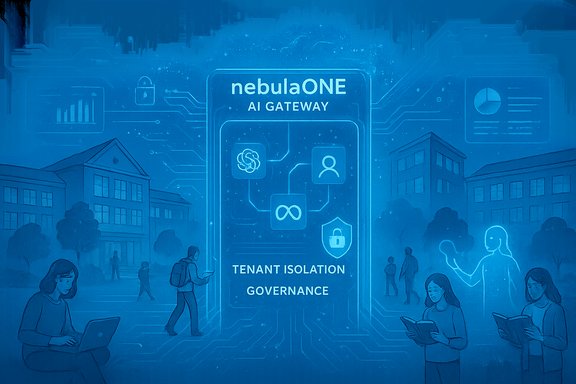
Cloudforce markets nebulaONE as an Azure-native AI gateway that:- Deploys inside an institution’s Azure subscription to keep compute and telemetry in the customer’s tenancy.
- Aggregates and routes queries to multiple foundation model providers (OpenAI, Anthropic, Meta/Llama, Mistral and others), enabling model choice by task and risk profile.
- Provides governance, audit logging, per-user usage limits, and chargeback reporting to help control cost and compliance exposure.
- Offers low-code tools for building branded chatbots and agents tailored to campus workflows (admissions triage, tutoring helpers, research summarization, administrative automation).
How nebulaONE differs from consumer AI tools
The product’s stated differentiators are twofold: tenant isolation (institutional control of keys, telemetry, and network boundaries) and operational governance (usage limits, model inventories, and audit trails). In practice, these are the exact controls universities and hospitals have asked for when they seek alternatives to open consumer tools that may re-use uploaded data for model training.Why the Microsoft award matters (and what it does — and doesn’t — prove)
Winning Microsoft’s Education Partner of the Year confers important practical benefits: marketing amplification, potential co-sell and field introductions from Microsoft, and a reputation halo that eases conversations with procurement and institutional leaders. The award is also a validation of Cloudforce’s alignment with Microsoft’s education playbook and Azure AI ecosystem. That said, awards are signals — not guarantees. Independent technical and procurement diligence remains essential. Vendor recognition should accelerate conversations and references, not replace operational audits, contractual guarantees, or pilot proof points. Multiple independent assessments of Cloudforce materials recommend exactly this approach: treat awards as validation of GTM and capability, but insist on measurable production KPIs, security attestations, and contractual exportability before large-scale rollout.Adoption claims — what’s verified and what to treat with caution
Cloudforce’s press materials and Microsoft partner pages describe rapid institutional uptake, citing named customers and broad campus deployments. Those materials contain overlapping but not identical numerical claims:- Cloudforce press assets claim nebulaONE is in use at scores of institutions and references a global adoption footprint across universities and academic medical centers.
- Microsoft / partner case materials and earlier Cloudforce releases describe “more than 40” university Azure OpenAI customers and other pilot-to-prod stories.
Flag: any headline adoption number not backed by named, auditable references should be treated as promotional until validated.
Technical architecture — verification and caveats
Tenant containment and network topology
nebulaONE’s core technical claim is that the orchestration layer and inference endpoints operate inside the customer’s Azure tenant, giving the institution control over encryption keys, network isolation, and logging. When implemented correctly, this topology offers genuine benefits for data residency and auditability: private endpoints, managed identities, and SIEM integration can keep prompts and telemetry within the institution’s control plane.But a critical caution: tenant deployment is a necessary condition for protection — not a sufficient one. Misconfiguration of private endpoints, overly permissive role assignments, or incorrectly wired telemetry pipelines can still create leak paths to external providers. Independent penetration testing, review of Azure network security groups, verification of private endpoint enforcement, and contractual telemetry retention terms are required to turn the theoretical promise into an operational reality.
Multi-model orchestration: benefits and complexity
Allowing multiple models is powerful: cheaper or smaller models can handle high-volume student support, while larger models can be reserved for research tasks requiring greater accuracy. However, orchestration adds layers of complexity:- Model provenance and version control must be tracked to support audits.
- Routing decisions need to be policy-driven and traceable (which model is permitted for clinical summaries vs. homework assistance).
- Different models present different hallucination and bias profiles, so model validation is required for high‑stakes use cases.
Data residency, telemetry, and non-training guarantees
Cloudforce materials emphasize that customer data is not used to train external models. This is a commercial and legal point, and institutions should demand explicit contractual language and technical evidence (e.g., private endpoints, documented telemetry retention policies, and audit logs) to substantiate non-training guarantees. Public statements are a starting point; legally binding contract clauses and ongoing audit rights are what convert a promise into protection.Real-world use cases and early results
Vendor and partner case studies cited in the awards cycle and press materials show a consistent set of campus applications:- Student-facing study aids and personalized tutoring that integrate course materials and syllabus content.
- Administrative chatbots for admissions, registration, and common student queries, with chargeback and usage controls.
- Research assistants that accelerate literature review and summarization while preserving research data within the tenant.
- Integrations with institutional identity (Microsoft Entra / Azure AD), learning management systems (Canvas), and data platforms (Microsoft Fabric / OneLake).
Procurement, legal, and operational checklist — what buyers must insist on
- Contractual guarantees:
- Explicit non-training clauses and telemetry handling.
- Data residency and exportability terms (including agent and prompt export on contract termination).
- SLAs for incident response, security patching, and breach notification windows.
- Security and compliance evidence:
- SOC 2 / ISO 27001 / pen-test reports for the production deployment.
- Independent security assessments and red-team results.
- Azure tenant configuration review and proof of private endpoint enforcement.
- Operational controls:
- FinOps and cost governance: per-user hard caps, departmental budgets, and real-time alerts.
- Model inventory with versioning and documented validation for high-stakes domains.
- Named delivery leads, runbooks, and escalation paths for outages and incidents.
- Pedagogical and academic policy:
- Assessment redesign requirements (process-based evaluation, oral components, prompt submission logs).
- Mandatory faculty training and student AI literacy modules that include hallucination detection and citation standards.
- Exit and portability:
- Export formats for agents, prompts, and logs that let the institution migrate or archive assets without vendor lock‑in.
- Defined timelines and technical artifacts for decommissioning.
Strengths: where nebulaONE and Cloudforce earn praise
- Platform-first, governance-aware design: nebulaONE’s Azure-native, tenancy-contained model addresses one of the largest barriers to campus AI adoption: data governance risk. When paired with strong contracts and proper configuration, the architecture materially reduces the exposure schools fear when exposing student or research data to consumer models.
- Model choice and flexibility: Multi-model access gives institutions practical options for cost vs. capability trade-offs and reduces dependency on a single provider’s model behavior.
- End-to-end services: Cloudforce’s forward-deployed engineers and professional services (integration with Entra/Azure AD, Canvas, Fabric/OneLake, Copilot Studio) help bridge the common gap between PoC and production. For many campuses, that people-led delivery model is the single biggest acceleration factor.
- Market validation: Microsoft’s Education Partner of the Year award and Cloudforce’s prior supplier recognitions give Cloudforce practical co-sell and partner prominence that can ease procurement and implementation conversations.
Risks and weaknesses to watch
- Vendor lock-in and operational dependence: The orchestration, low-code tooling, and agent lifecycle management reside with Cloudforce. Over time, accumulated prompts, agents and integrations create switching friction unless exit and portability are contractually assured.
- Cost unpredictability: “Pay-for-consumption” economics can balloon as usage grows, especially with multimodal workloads. Institutions must run realistic pilots and lock down FinOps controls before broad deployment.
- Residual configuration risk: Tenant-based deployment reduces but does not eliminate leakage risk. Misconfigurations, permissive IAM policies, or poorly routed telemetry can still expose data. Independent verification is essential.
- Academic integrity and pedagogy: Institution-provided AI complicates detection of misuse. Assessment design must move away from output policing to process verification (portfolios, supervised tasks, or oral defenses). Technical controls alone will not solve the pedagogical challenge.
- Model bias and hallucination: Generative AI remains fallible. Faculty and administrators must build verification workflows and require students to learn how to cite and validate AI outputs. Automated disclaimers aren’t enough.
Practical recommendations for campus IT and CIOs
- Start with measured pilots that mirror realistic scale and modality mix; estimate token consumption and project FinOps implications before committing to campus-wide rollouts.
- Require named institutional references and request customer KPIs and audit reports for any vendor-claimed production deployments.
- Insist on external security attestation and an Azure tenant configuration review as a pre-condition for any proof-of-concept moving to production.
- Build a cross-functional AI governance board (IT, legal, academic leads, students) to define permitted use-cases, assessment rules, and escalation procedures.
- Treat exports and portability as mandatory contract terms; ensure you can extract agents, prompts, and logs in a usable form if you later choose a different orchestration layer.
Broader implications for the higher‑education market
This award — and nebulaONE’s rising profile — crystallize an industry trend: institutions want structured, auditable access to generative AI, not consumer-grade, opaque services. The Azure-tenancy model paired with multi-model orchestration is emerging as the de-facto architecture for organizations that require custody of their data. Microsoft’s partner ecosystem is responding by packaging these architectures into productized offerings that combine platform, governance, and services. At the same time, successful campus AI adoption will be measured less by awards and press stories and more by three outcomes: demonstrable improvements in student services or research productivity, stable and predictable total cost of ownership, and a documented pathway for preserving academic integrity and inclusivity as AI is embedded in curricula.Conclusion
Cloudforce’s Microsoft Education Partner of the Year accolade is a meaningful market milestone for nebulaONE and for the broader push to industrialize secure, governed generative AI on campus. The recognition amplifies a technical approach — tenancy-contained orchestration plus multi-model choice and low-code agents — that many institutions find attractive because it addresses the twin imperatives of capability and compliance. However, the award should be treated as the beginning of a due-diligence checklist rather than its end. Procurement teams must validate adoption claims, insist on contractual non-training guarantees and exportability, and require independent security testing and tenant configuration audits. When these elements are in place, nebulaONE-style gateways can deliver high-impact campus services; without them, the same investments risk becoming expensive, opaque, and operationally brittle.For universities, the right posture is pragmatic optimism: embrace the possibilities nebulaONE and similar platforms promise, but bind that optimism to surfacing measurable outcomes, building institutional safeguards, and retaining the contractual and technical levers necessary to protect students, research, and institutional reputation.
Source: The Malaysian Reserve https://themalaysianreserve.com/202...-of-nebulaone-cloudforces-secure-ai-platform/
