

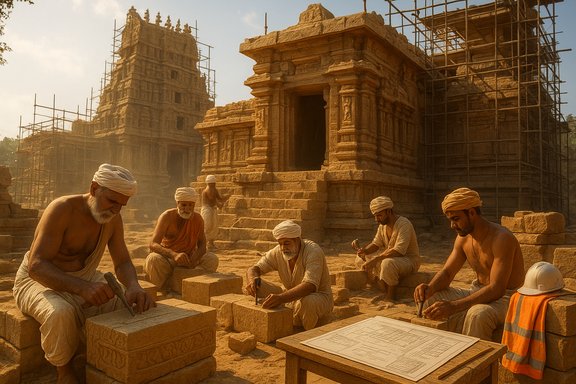
The Endowments Department has ordered an accelerated, “war-footing” push to finish the reconstruction of the Rukmini‑Satyabhama Sametha Venugopala Swamy temple in Nellore, with the minister explicitly requiring adherence to traditional Agama Shastra rites and artisan-led stone work as the project moves from planning to execution.
Background
Andhra Pradesh’s Endowments Department, led by Minister Anam Ramanarayana Reddy, has over the last year announced a large-scale program to repair, renovate and — where necessary — reconstruct ancient temples across the state. Those public commitments include multi‑crore allocations and an insistence that work follow established Agama Shastra prescriptions and the guidance of traditional Sthapathis (temple architects and masons). The most recent local inspection in Nellore focused on the Venugopala Swamy shrine complex in Mulapeta (also reported as Moolapeta/Mulapet in some briefings), where officials say work is under way and being fast‑tracked. Local reporting and departmental statements indicate this project is one of several in Nellore district covered under a larger funding envelope that the state has announced for temple preservation and revamps.Overview of the Nellore intervention
What the minister ordered
- A directive to officials to complete the Rukmini‑Satyabhama Sametha Venugopala Swamy temple reconstruction on a war‑footing — a phrase used repeatedly in local media to signal priority scheduling, daily oversight and accelerated procurement.
- A mandatory requirement that reconstruction follow Agama Shastra guidelines, with involvement from Agama scholars and traditional temple architects (Sthapathis) to preserve ritual correctness and historical authenticity.
The project in numbers (reported)
- Local reporting cites the Venugopala Swamy reconstruction as part of a set of works that include 50 temples in Nellore district with an estimated sum of Rs 158 crore allocated for related cultural and tourism projects in the region.
- Other state‑level announcements by the minister place the government’s temple reconstruction/rescue program in larger fiscal frames: figures reported in recent months include allocations of Rs 500 crore for a revamp program and broader packages that vary in scope (one report cited Rs 772 crore for the renovation of approximately 9,098 temples). These numbers appear in multiple press briefings and media stories and reflect a multi‑phased approach to restoring sacred sites across Andhra Pradesh.
Caution: news sites and department briefings use different aggregates and framing (for example, a Rs 500 crore revamp vs. a Rs 772 crore renovation round), so the total fiscal commitment depends on whether one aggregates separate pots (revamp, reconstruction, routine ritual funding) or treats them as distinct programs. Where totals differ across reports this article flags the discrepancy and notes where each figure appeared.
Why Agama Shastra matters — ritual, archaeology and materials
The doctrine and practical implications
Agama Shastra is a corpus of canonical texts governing temple form, ritual procedures, iconography and the consecration of deities. For governments and heritage practitioners the decision to require Agama compliance has both symbolic and technical implications.- Symbolic: it signals respect for religious tradition and reassures devotees that reconstructions will not be merely cosmetic or modern‑stylistic interventions.
- Technical: it obliges project teams to consult Agama scholars, use traditional proportions for sanctum (garbhagriha), mandapa and gopuram features, and in some cases to restore or reuse original stonework, sculptures and ornamentation following historic patterns.
Stone, mortar and the craft challenge
Reconstructing ancient stone temples requires skills that are not interchangeable with modern civil construction:- Traditional masonry techniques, carving and jointing differ substantially from reinforced concrete practice.
- Sthapathis and trained stone masons are necessary to reproduce mouldings, iconography and interlocking stone assemblies.
- Where original stone is extant, conservation best practice calls for documentation, cataloguing and, where possible, reintegration rather than wholesale replacement.
Funding and financial architecture
State allocations and program layers
Public briefings and regional reporting show a layered funding approach:- A state‑announced revamp package to the tune of Rs 500 crore to support a range of temple development and safety works.
- Separate announcements have referenced Rs 772 crore aimed at renovation of over 9,000 temples as part of broader district programs.
- Local allocations for clusters of temple and tourism development projects in Nellore — cited as Rs 158 crore — appear in regional planning announcements and are sometimes grouped with tourism infrastructure spending.
How funds are being used (reported categories)
- Structural reconstruction: Antharayalam, Garbhalayam and Rajagopuram works, often prioritised where sanctums or towers are unsafe.
- Ritual funding: allocations for Dhoopa‑Deepa‑Naivedyam support, honorariums for priests and subsistence elements for temple operation.
- Devotee amenities and safety: queue management, sanitation, annadanam (food services) and festival crowd control measures.
Accountability: trust boards, committees, and oversight
Officials have said the government will form or reconstitute trust boards, local committees and safety panels for larger temples. Those local governance arrangements are cited as essential for day‑to‑day operations and for supervising reconstruction contracts. However, the repeated reassignment and creation of committees can also generate delay if roles are not spelled out and procurement rules are not harmonised with heritage requirements.Timeline expectations and execution pressures
Ministerial timeline directives
Public statements from the Endowments Department have repeatedly asked officials to finish major temple reconstruction projects within 18–24 months, with some local project teams asked to compress work further where feasible. For the Venugopala Swamy temple the minister’s inspection explicitly emphasized a rapid completion schedule and close monitoring.Practical constraints that can slow progress
- Skilled labour shortfall: expert carvers and Sthapathis are neither plentiful nor quickly replaceable. Training pipelines take time.
- Stone procurement: matching historic stone type and grain for carvings can be geographically constrained and require environmental clearances.
- Archaeology and documentation: careful dismantling, recording and reassembly can be time‑consuming but are essential to preserving authenticity.
- Quality vs speed tension: accelerated schedules increase the risk of cutting corners unless contracts explicitly require conservation standards and independent inspection.
Governance, transparency and risks
Political dynamics and centralisation of oversight
The current administration’s drive to restore temples is politically salient: temples are both cultural heritage and sites of political symbolism. Recent statements suggesting bringing privately managed temples under Endowments Department oversight — motivated by safety failures in unrelated stampede incidents — indicate a tendency to centralise supervision. Centralisation can standardise safety and conservation norms, but it can also introduce bottlenecks if the department lacks capacity.Key operational risks
- Procurement and contract design that treat temple reconstruction as a civil engineering job rather than a conservation project risk destroying features that are not easily recreated.
- Fast timelines without staged quality checks can lead to poor repointing, inappropriate mortar mixes, or ill‑fitting stone replacement.
- Political pressure to show quick wins may favour superficial fixes (plastering, painting) over proper stone conservation and ritual re‑consecration procedures.
Financial and audit transparency
Multiple funding streams (state allocations, central tourism funds, trust donations) can complicate audit trails. Public reporting varies across press outlets, which makes it important for citizen groups and heritage NGOs to have clear, published project plans, budgets and timelines for each temple so that local stakeholders can monitor progress.Heritage best practice — a checklist for reconstruction on a “war‑footing”
To reconcile the minister’s rapid timeline with conservation best practice, reconstruction teams should adopt a dual discipline approach: heritage conservation plus modern project management.- Assemble a multidisciplinary team:
- Agama scholars for ritual correctness.
- Certified conservation architects and archaeologists for documentation.
- Master Sthapathis and stone masons for sculptural and structural work.
- Structural engineers with heritage training for stabilization.
- Document before dismantling: full photographic, measured and 3D survey records of existing fabric.
- Catalogue material: label and store carved stones for reuse where possible.
- Use reversible interventions where modern materials are necessary.
- Institute independent inspection milestones tied to payments to prevent rushed or hidden defects.
- Publish transparent timelines and periodic progress reports to district stakeholders.
Community and socio‑economic implications
Pilgrimage, tourism and local economies
Rebuilt temples revive pilgrim circuits, festival economies, and ancillary livelihoods (priests, artisans, hotels, transport). Nellore’s reported Rs 158 crore cluster for tourism and temple projects explicitly ties restoration to local tourism development, signalling an economic rationale beyond ritual upkeep. Revived temples also create short‑term construction jobs and medium‑term service roles around pilgrim flows.Social sensitivities
Temple reconstructions intersect with caste, community roles and ritual office holders (priests, management committees). The government’s decisions on trust boards, appointments or direct oversight can unsettle local stakeholders if changes appear top‑down. Inclusive consultation with local priests, hereditary custodians, and village communities reduces conflict and ensures that ritual reinstallation meets congregational expectations.Comparative examples: lessons from recent temple projects
Several recent projects illustrate both successful and problematic approaches:- Where governments partnered with traditional architects and allowed heritage teams to control the conservation process, projects produced durable, authentic outcomes and strong pilgrim satisfaction.
- Conversely, projects that prioritised speed and used modern materials for ornamental parts sometimes required rework within a few years due to weathering, poor mortar choices, or improper anchoring of sculptures.
Technical considerations: what engineers and conservation teams must address
Structural stability and seismic considerations
Many ancient Indian temples were designed without modern seismic detailing. Where towers (gopurams) or superstructures are rebuilt, engineers should:- Assess existing foundations and subsoil conditions.
- Design reversible structural strengthening (stainless steel dowels, concealed grout injections) that do not alter visible stone patterns.
- Avoid invasive anchoring that damages original fabric.
Materials and chemical compatibility
- Mortars: select mixes compatible with original stone porosity and thermal expansion; avoid high‑cement mixes that trap moisture.
- Stone matching: quarry matching stone for color, grain and strength reduces the risk of differential weathering.
- Protective finishes: limit protective coatings to breathable, reversible treatments to avoid long‑term damage.
Ritual reinstallations and consecration
Agama procedures for reconsecration are as important to devotees as the physical work. Scheduling must accommodate ritual calendars and seers’ availability, and documentation must record pre‑ and post‑consecration states for heritage records.Recommendations for officials and stakeholders
- Publish a project ledger for each major temple with budgets, timelines, and appointed conservation leads.
- Tie payments to independent heritage inspections and milestone verifications.
- Create a rapid training program to expand the pool of qualified masons and Sthapathis, combining master‑apprentice deployment with accelerated courses.
- Use pilot projects (one or two temples) to test procurement clauses that preserve heritage standards before scaling.
- Establish a transparent grievance and whistleblower channel for local communities to report quality or governance issues.
What to watch next
- Progress reports and photographic documentation for the Venugopala Swamy temple over the next 6–12 months to see whether accelerated schedules meet conservation standards.
- Publication of detailed project budgets or government orders that specify the split between renovation, reconstructions, ritual funding and tourism infrastructure.
- Formation and staffing of trust boards and safety committees to see whether governance reforms improve project delivery without sidelining local stakeholders.
Conclusion
The Endowments Ministry’s push to reconstruct the Rukmini‑Satyabhama Sametha Venugopala Swamy temple in Nellore on a war‑footing encapsulates the tension between urgent political timelines and the slow, exacting needs of heritage conservation. Ministerial insistence on Agama Shastra compliance and stone‑based reconstruction is an important commitment to authenticity; it raises expectations that projects will respect ritual, sculptural detail and archaeological continuity. But accelerated schedules, large aggregate budgets and centralised oversight will require disciplined procurement, independent inspection, and close engagement with artisans and local custodians to avoid the familiar pitfalls of rushed heritage work.If departments pair rapid execution with conservation‑aware contracts, independent oversight and transparent reporting, the program could deliver renewed pilgrimage circuits and economic benefits — while genuinely protecting sacred architecture for future generations. The coming months will reveal whether the rhetoric of war‑footing translates into a model that balances speed, ritual fidelity and long‑term preservation.
Source: The Hans India Complete temple reconstruction works on a war-footing manner: Anam

