

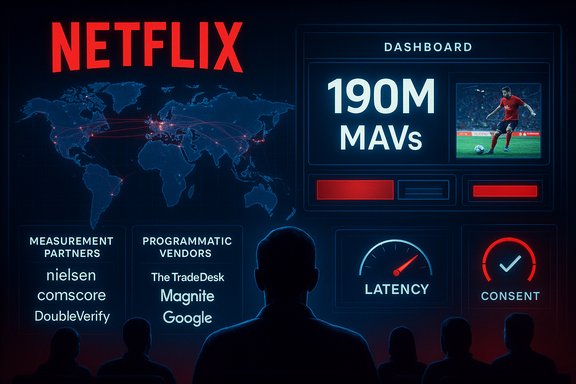
Netflix says its ad-supported offering now reaches more than 190 million monthly active viewers (MAVs), and the company is rolling new ad technologies — including dynamic ad insertion for live events — into a broader international footprint as it pushes to scale advertising alongside subscriptions.
Netflix introduced an ad-supported subscription tier in late 2022 as a deliberate move to diversify revenue beyond subscriptions, and the business has been iterating quickly ever since. Over the past year the company has broadened measurement partnerships, launched programmatic integrations and experimented with interactive ad formats, all while positioning live events and sports as the strategic next frontier for ad inventory. Recent company updates formalize that evolution by replacing a profile-based metric with a viewer-centred measure and by testing dynamic ad technology for live programming.
For advertisers, MAV and DAI create new opportunities to reach a large, potentially addressable audience — but only if Netflix pairs the headline numbers with rigorous measurement, independent verification and consistent product behaviour across devices. For viewers and Windows-focused power users, the rollout means watching how ad experiences interact with platform nuances (app vs. browser playback, DRM and codec support) and whether Netflix maintains the premium viewing experience that made it the industry’s poster child for subscription streaming. Netflix’s next moves — the global scaling of DAI, the depth of measurement transparency, and the cadence of advertiser adoption — will determine whether the company converts reach into a durable, high‑quality advertising business or merely a short‑term growth story.
Source: Storyboard18 Netflix’s ad-supported tier hits 190 million monthly viewers; expands dynamic ad tech globally
 Background
Netflix introduced an ad-supported subscription tier in late 2022 as a deliberate move to diversify revenue beyond subscriptions, and the business has been iterating quickly ever since. Over the past year the company has broadened measurement partnerships, launched programmatic integrations and experimented with interactive ad formats, all while positioning live events and sports as the strategic next frontier for ad inventory. Recent company updates formalize that evolution by replacing a profile-based metric with a viewer-centred measure and by testing dynamic ad technology for live programming. Why this announcement matters now
- It reframes Netflix’s ad audience from account-level counts to a people-based metric, which has direct consequences for how advertisers price and value inventory.
- It shows Netflix accelerating technical investment in live-event advertising — historically the highest-value TV inventory — through dynamic ad insertion (DAI) and personalization features.
- It updates the company’s revenue story: executives signalled that ad sales are growing quickly and that the business is on track to roughly double ad revenue this year. That claim — important for investors and media buyers alike — was underscored on Netflix’s recent earnings commentary.
What Netflix means by “Monthly Active Viewers” (MAV)
Netflix’s new MAV definition is straightforward in description but impactful in implication: Netflix counts as a MAV any person who watched at least one minute of ad‑supported programming in a given month, then multiplies that number by the company’s internal estimate of the average number of people who share a Netflix household. The result is a viewer-based reach metric rather than a profile- or account-based one.How MAV differs from previous measures
- Previous internal measures focused on profiles or on account-level activity, which can undercount communal viewing sessions (families, roommates, watch parties). Netflix says MAV corrects for that by reflecting co‑viewing.
- The one‑minute threshold is notably stricter than some competitor thresholds: industry comparisons cited by reporters show other platforms using much lower time cutoffs (for example, single‑digit seconds). Netflix argues one minute better indicates a committed viewing session rather than an accidental impression.
Practical implications for advertisers
- Reach vs. attention: Counting people rather than profiles increases reported reach, which can be attractive to brand advertisers focused on gross impressions. But the metric does not directly certify quality of attention (complete ad watches, viewability, ad engagement), so buyers will still demand impression-level verification and third‑party measurement.
- Cross‑platform comparability: Because MAV uses a household multiplier and a one‑minute rule, it is not strictly apples-to-apples with other platforms’ audience metrics. Advertisers and agencies will ask for transparency on the household multiplier methodology and on comparisons to commonly used standards.
Dynamic Ad Insertion (DAI) and live-event advertising
Netflix confirmed it has begun testing dynamic ad insertion (DAI) for live programming — starting with WWE Raw and SmackDown — and will deploy DAI across a set of markets for an upcoming live sports push tied to NFL Christmas Gameday. The initial country rollouts cited include the United States, Brazil, Canada, Germany, Mexico and the U.K., with plans to scale DAI to more live titles in 2026.What DAI brings to Netflix’s toolbox
- DAI allows ads to be swapped, targeted or personalized in real time for individual viewers during a live stream without interrupting the program. For a platform moving into sports and large live events, DAI is the technical foundation for selling higher CPMs and delivering addressable inventory to advertisers.
- The move also brings Netflix closer to the ad economics of broadcast and linear sports, where advertisers pay premiums for guaranteed reach during marquee events. Netflix’s ability to insert different ads per household during the same live moment is a major step toward addressable TV on the streaming side.
Technical challenges and operations
- Latency and synchronization: Live streams must keep end‑to‑end latency low while enabling precise ad cueing and substitution.
- Inventory packaging: Netflix will need to design ad pods and frequency caps that work for both advertisers and viewers (too many or poorly timed ads will erode experience).
- Measurement and verification: Real‑time ad stitching requires robust measurement partners and viewability verification so buyers can trust impressions. Netflix has expanded measurement partnerships and programmatic integrations to address this.
What the numbers mean for Netflix’s business
Executives told analysts Netflix recorded its “best‑ever ad sales quarter” in Q3 and that the ad business is on course to more than double ad revenue this year. Those are headline-friendly statements, but they require careful reading. The ad business remains a smaller fraction of Netflix’s total revenue compared with subscriptions — but its growth trajectory and high CPM potential for sports/live could materially increase the company’s revenue mix over time.Read between the lines
- Doubling ad revenue in a year is an aggressive growth claim that likely reflects a small base and rapid product expansion (more markets, more inventory, higher CPMs for live). The exact dollar amounts and margin economics for ad revenue have not been disclosed in full detail; advertisers will want more line‑item reporting.
- High growth expectations make sense given Netflix’s scale: a viewer base measured in hundreds of millions creates attractive gross reach for global advertisers, especially when coupled with live and event inventory. But maintaining ad quality, measurement integrity and user experience will determine whether advertisers remain willing to pay premium rates.
Ad product and ecosystem moves: measurement, programmatic, partners
Alongside MAV and DAI, Netflix is expanding measurement and programmatic integrations. The company is broadening LiveRamp integrations and adding partners across markets to give advertisers first‑party data onboarding and planning tools. Netflix also named a slate of brand integrations and programmatic partners as it builds an advertising stack that looks more like linear TV and programmatic digital media combined.- New measurement partners and local vendors have been added across Europe, Latin America and Asia to validate reach and viewability.
- Programmatic partnerships now include demand‑side platforms and ad tech firms needed to sell scaled inventory efficiently.
Why advertisers care
Advertisers prize three things: scale, measurability and buyability. Netflix is addressing all three: MAV communicates scale, third‑party measurement and partnerships increase trust, and programmatic integrations make inventory easier to transact at scale. The missing piece — for many buyers — will be standardized reporting that ties MAV reach to actionable conversion and attention metrics.User experience, privacy and regulatory concerns
Shifting to ad-funded models and sophisticated ad targeting raises predictable UX and privacy questions. Industry experience shows that viewers tolerate short, well‑targeted prerolls more readily than frequent mid‑program interruptions. Netflix’s emphasis so far has been on preserving a strong viewer experience while expanding ad capabilities.- Privacy and consent: Adding first‑party data onboarding and more granular targeting requires transparent consent flows and clear privacy controls, especially in jurisdictions with strict data rules. Netflix’s LiveRamp expansion and partnerships will be scrutinized under GDPR, CCPA and similar frameworks.
- Ad fatigue and community viewing: Netflix’s household multiplier assumes viewers experience ads communally; if ads are repetitive or poorly targeted, communal viewing can magnify annoyance. The MAV metric captures reach but not sentiment, which matters for brand outcomes.
Practical notes for Windows users and power viewers
For WindowsForum readers — many of whom care about playback quality and platform quirks — a few technical realities are worth calling out. Netflix’s streaming fidelity and DRM behaviour on Windows devices have historically depended on the client used (Microsoft Store app vs. browsers) and system-level codec/DRM support. If higher-fidelity streams or certain ad experiences require a specific app environment, Windows users should be prepared to test and adjust.- 4K playback and highest fidelity are typically gated by the Microsoft Store Netflix app or the Microsoft Edge browser due to DRM (PlayReady) and codec support (HEVC), as well as display chain requirements like HDCP 2.2. These platform details affect whether you see the same quality and ad behaviours as other devices.
- Ad delivery can differ between client implementations (server‑side ad insertion vs client‑side); server‑side ad stitching reduces buffering and improves continuity but requires robust CDN and cache strategies. Windows users who care about consistency should prefer the official Netflix UWP/Microsoft Store app or Edge in cases where Netflix recommends those clients.
Strengths of Netflix’s approach
- Scale and distribution: Converting account‑level metrics to a viewer-centric measure amplifies Netflix’s reported reach and aligns ad inventory with how advertisers buy reach.
- Live-event potential: DAI for sports and major live events is a high-margin, high-visibility opportunity; the NFL Christmas Gameday partnership and WWE tests signal Netflix is serious about premium live inventory.
- Product momentum: Measurement partnerships and programmatic integrations reduce friction for advertisers and make Netflix inventory easier to buy programmatically.
Risks, unanswered questions and caveats
- Metric comparability and transparency: MAV uses a household multiplier and a one‑minute threshold; without publication of the multiplier methodology and sensitivity analysis, advertisers may treat the figure as directional rather than definitive. Independent verification will be required before brands fully reallocate budgets.
- Ad quality vs. ad volume: Reaching 190 million people is only valuable if impressions convert to outcomes brands care about. Overloading users with ads or delivering poor creative risks diluting long‑term value.
- Operational complexity of live DAI: Stitching personalized ads into live streams at scale across geographies introduces latency, measurement and rights-management complexity. The country rollout for NFL Christmas Gameday is a meaningful test but not a guarantee of seamless global scaling.
- Privacy and regulation: Expanded targeting and first‑party data onboarding will draw regulatory scrutiny and demand robust consent frameworks. Any misstep could generate legal and reputational costs.
What advertisers and buyers should demand now
- Clear methodology documentation for MAV: publish the household multiplier methodology, regional variations, and sensitivity testing.
- Third‑party verification: independent measurement vendors and viewability partners should be allowed to audit impressions and stitched ad playback.
- Inventory and quality SLAs for live DAI: advertisers buying premium live inventory should insist on guaranteed start times, viewability minimums and reconciliation reports.
- Privacy and consent reporting: granular controls and transparent logs of what signals are used for targeting should be part of any onboarding agreement.
What to watch next
- Expansion of DAI into more live titles and geographies during 2026; initial NFL testing across six markets is the first large-scale litmus test.
- Independent verification and advertiser uptake: the speed at which brands adopt MAV‑priced inventory will indicate whether the metric has earned buyer trust.
- Detailed ad revenue disclosures in quarterly filings: more granular reporting (ad revenue by geography, CPMs, fill rate, direct‑sold vs programmatic splits) will clarify whether Netflix’s ad business is a sustainable growth engine or an opportunistic uplift.
Conclusion
Netflix’s announcement that its ad tier reaches over 190 million MAVs and the simultaneous push into dynamic ad insertion for live events mark a deliberate pivot: the company is building an ad business that borrows lessons from both linear television and modern programmatic digital advertising. The strategic strengths are clear — scale, live-event leverage and a fast‑maturing ad stack — but so are the operational and reputational risks: measurement transparency, ad quality, privacy compliance and the complexity of delivering personalized ads into global live feeds.For advertisers, MAV and DAI create new opportunities to reach a large, potentially addressable audience — but only if Netflix pairs the headline numbers with rigorous measurement, independent verification and consistent product behaviour across devices. For viewers and Windows-focused power users, the rollout means watching how ad experiences interact with platform nuances (app vs. browser playback, DRM and codec support) and whether Netflix maintains the premium viewing experience that made it the industry’s poster child for subscription streaming. Netflix’s next moves — the global scaling of DAI, the depth of measurement transparency, and the cadence of advertiser adoption — will determine whether the company converts reach into a durable, high‑quality advertising business or merely a short‑term growth story.
Source: Storyboard18 Netflix’s ad-supported tier hits 190 million monthly viewers; expands dynamic ad tech globally