

Neudesic today unveiled a purpose-built Digital Workforce Management platform that promises to move enterprises from piecemeal agent pilots to a governed, Azure-native production environment for autonomous and semi‑autonomous AI agents.
Azure AI Foundry emerged as Microsoft’s enterprise play for building, orchestrating, and running agentic applications — an “agent factory” that combines models, tools, observability, and governance into a single platform. Enterprises adopting agentic architectures now require not just tooling to build agents, but operational controls to manage them across the lifecycle: provisioning, role assignment, monitoring, compliance, versioning, and remediation.
Neudesic, an IBM Company with a long Microsoft partnership footprint, positions its new platform as exactly that operational layer for Azure AI Foundry: centralized governance, role-based orchestration, and lifecycle management for fleets of AI agents deployed across business functions. The vendor pitches the capability as “Digital HR” for AI — treating agents similarly to employees, with defined roles, accountability, and performance telemetry.
Neudesic’s approach targets three acute enterprise needs:
Strengths include Azure-native integration, lifecycle management, and packaged compliance artifacts that lower the barrier for regulated customers. The offering is particularly well-suited to organizations already committed to Azure AI Foundry and Microsoft’s enterprise stack.
That said, several critical questions remain for buyers: the practical behavior of automated remediation, the granularity of data and connector controls, cost predictability at scale, and the platform’s portability outside Azure. These are not fatal flaws, but they must be validated in a time‑boxed pilot. Marketing claims about “enterprise readiness” and packaged compliance should be treated as starting points that require audit and technical verification.
Ultimately, the value for an enterprise will depend less on a single vendor feature list and more on the rigor of the governance and operational practices it puts around the platform. Neudesic supplies the scaffolding; the organization must supply the policies, processes, and ongoing oversight to ensure agents amplify productivity instead of multiplying risk.
Conclusion
Neudesic’s announcement signals the next phase of enterprise agent adoption: moving beyond engineering prototypes to a managed, auditable, and scalable digital workforce. For Azure-first enterprises, the proposition is compelling — a pathway to deploy agentic capabilities with controls that align to corporate security and compliance needs. Successful adoption will hinge on realistic pilots, careful governance, and disciplined cost and risk management, but for organizations that get those pieces right, the promise of an ordered, productive digital workforce is now an operational choice rather than a speculative experiment.
Source: Milwaukee Journal Sentinel Neudesic Unveils Digital Workforce Management for Enterprise-Scale AI Agents on Microsoft Azure AI Foundry
 Background
Azure AI Foundry emerged as Microsoft’s enterprise play for building, orchestrating, and running agentic applications — an “agent factory” that combines models, tools, observability, and governance into a single platform. Enterprises adopting agentic architectures now require not just tooling to build agents, but operational controls to manage them across the lifecycle: provisioning, role assignment, monitoring, compliance, versioning, and remediation.Neudesic, an IBM Company with a long Microsoft partnership footprint, positions its new platform as exactly that operational layer for Azure AI Foundry: centralized governance, role-based orchestration, and lifecycle management for fleets of AI agents deployed across business functions. The vendor pitches the capability as “Digital HR” for AI — treating agents similarly to employees, with defined roles, accountability, and performance telemetry.
Overview: what Neudesic is offering
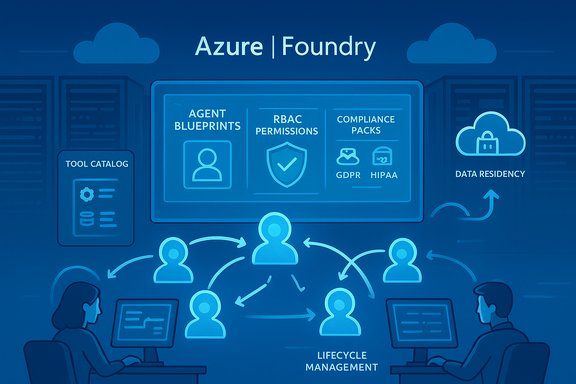
Neudesic’s Digital Workforce Management platform is framed as an enterprise-grade orchestration and governance layer built natively on Microsoft Azure AI Foundry. Key capabilities the vendor highlights include:- A secure content layer to control what knowledge and data agents can access.
- A governed catalog of tools and skills so agents rely on vetted integrations and connectors.
- Built-in safety, compliance, and automated remediation workflows for policy violations or risky outputs.
- Dynamic workflow automation that coordinates agents with human teams and other systems.
- Version control and telemetry for agent behaviors, including audit trails and observability.
- Prepackaged compliance packs (examples cited include GDPR, HIPAA, ISO frameworks) to accelerate regulatory readiness.
Why this matters for enterprise AI
The jump from isolated generative-AI proof-of-concept projects to enterprise-scale deployments is nontrivial. Organizations must solve not only engineering scale, but operational scale: how to keep many agents safe, auditable, and aligned with corporate policy while they take actions across systems.Neudesic’s approach targets three acute enterprise needs:
- Scale with control: Instead of dozens of fragmented pilots, IT needs a platform to provision, assign, monitor, and retire agents with consistent guardrails.
- Risk reduction: Built-in safety filters, identity controls and remediation reduce the surface area for data leakage, prompt injection, or noncompliant behavior.
- Faster time-to-outcome: Catalogs of vetted tools and prebuilt compliance templates aim to shorten the gap between an idea and a production workflow.
How it integrates with Azure AI Foundry
Agent runtime and orchestration
Azure AI Foundry provides a production-grade runtime for agents: models, tools, threads (conversations), and observability. Neudesic’s platform layers on top of these primitives to:- Provision and catalog agent blueprints.
- Control agent-to-agent and agent-to-human escalation paths.
- Enforce enterprise policies that Foundry can apply at runtime.
Security, identity and compliance
Azure Foundry exposes enterprise security building blocks – Microsoft Entra identity, RBAC, network isolation, and telemetry. Neudesic’s platform bundles these with automation that maps compliance requirements to agent behaviors:- Role-based access for agents (who they can query, which tools they may call).
- Data residency and content access policies to restrict retrieval and storage.
- Automatic remediation workflows for policy violations or anomalous outputs.
Practical features and enterprise benefits
Neudesic frames concrete outcomes from adoption of its platform. These, in practice, translate to capabilities buyers will evaluate:- Greater operational efficiency by automating repetitive, rule-bound tasks.
- Effortless scalability through catalog-driven provisioning and templated agent roles.
- Improved decision support with dynamic reasoning and analytics-equipped agents.
- Faster innovation via rapid prototyping and controlled promotion of agents from dev to production.
Strengths: what Neudesic brings to the table
- Azure-native integration: Building on Azure AI Foundry gives Neudesic immediate enterprise‑grade primitives for identity, networking, and observability that few startups can replicate.
- Partner credibility and Microsoft experience: Neudesic has deep Microsoft partnership history and Azure specializations, which reduces risk for Azure-first customers.
- End-to-end lifecycle focus: The product explicitly treats agent management as a lifecycle problem — from provisioning and versioning to retirement and remediation — which addresses a gap many early agent pilots miss.
- Compliance-first packaging: Prebuilt compliance packs (GDPR/HIPAA/ISO) speed enterprise reviews and reduce lift for regulated customers, if the packs are kept current and auditable.
Risks and open questions
Adopting an agent fleet introduces technical, governance, and financial risks. Key concerns enterprises must evaluate include:- False confidence in “automated remediation”: Automated remediation workflows can mitigate issues but can also introduce new failure modes if incorrectly configured. Enterprises should insist on clear delineation between automatic and manual remediation actions.
- Data exposure and tool access scope: Agents that bridge multiple systems pose an elevated risk of unintended data flows. Review how the platform enforces granular least‑privilege access and how it logs cross-system transactions.
- Escalation and human-in-the-loop design: Autonomy levels must be tunable. The platform needs deterministic escalation paths, safe stop‑gaps, and transparent decision trails so humans can intervene effectively.
- Cost and operational overhead: Running large fleets of agents — especially those invoking multiple model calls, tool executions, and telemetry — can incur significant cloud costs. Total Cost of Ownership (TCO) modeling must include compute, storage, network, and monitoring.
- Vendor lock-in and portability: A management plane tightly coupled with Azure AI Foundry accelerates adoption on Azure but may make it harder to move to multi-cloud or on-prem alternatives in the future.
- Regulatory and audit readiness: Compliance packs accelerate baseline work, but enterprises must validate whether the packaged controls meet their specific audits and whether the vendor provides necessary artifacts during regulatory review.
Technical considerations for evaluation
When assessing Neudesic’s platform (or any enterprise agent management offering), prioritize these technical checkpoints:- Identity and Access
- Does the platform integrate with corporate identity providers and enforce RBAC for agents?
- Are agent privileges auditable and discoverable?
- Data residency and encryption
- Where are agent logs, threads, and state stored? Are these customer‑owned resources?
- Can the customer enforce encryption keys and region restrictions?
- Observability and traceability
- Is thread-level tracing available for every agent decision and tool call?
- Are logs exportable to existing SIEMs and analytics platforms?
- Tooling and connector governance
- How are external connectors vetted, sandboxed, and versioned?
- Is there a catalog with approval workflows for new connectors?
- Model governance
- How does the platform support switching or upgrading the underlying models?
- Are model prompts, instructions, and policy filters version-controlled?
- Testing, staging, and rollout
- Does the lifecycle include Canary or blue/green promotions for agents?
- Can agents be tested in synthetic environments that mimic production data?
- Incident response and remediation
- How fast are automated remediation policies executed, and can they be safely disabled?
- What human-in-the-loop options are available for emergency stops?
- Cost controls
- Does the platform provide actionable telemetry for cost per agent, tool call, or workflow?
- Are throttles, quotas, or budget alerts available?
Competitive landscape
The market for agent orchestration and “digital workforce” platforms is nascent but active. Several vendors — from specialist startups to established integration and middleware companies — are offering agent orchestration, centralized governance, and no/low-code authoring environments.- Newer platforms emphasize a unified agent catalog, no-code designer experiences, and plugin marketplaces that deliver discoverability and reuse.
- Cloud incumbents and systems integrators offer managed services that combine agent orchestration with enterprise systems integration.
- Differentiation tends to come down to platform depth (observability, security), prebuilt connectors, compliance support, and the ability to operate at enterprise scale.
Procurement checklist for enterprise buyers
Enterprises considering Neudesic’s Digital Workforce Management should request specific artifacts and guarantees during the procurement process:- Demonstration of thread-level observability and a sample audit trail for a multi-step agent action.
- Documentation for compliance packs showing mappings to GDPR, HIPAA, ISO controls and the vendor’s update cadence.
- Clear description of data residency, export controls, and where stateful agent data is stored (customer-owned vs. vendor-managed).
- SLAs for platform availability, incident response times, and security patching.
- Pricing model examples including typical cost drivers: model inference, tool execution, storage for threads, telemetry ingestion, and connector licensing.
- A disaster recovery and business continuity plan that includes how agent state is backed up and recovered.
- A pilot plan with measurable KPIs and a rollback strategy.
Governance, ethics, and operational policy
Autonomous agents that act across systems require mature governance and an ethical guardrail framework. The following governance elements should be adopted alongside any Digital Workforce Management platform:- A cross-functional agent advisory board (Legal, Compliance, Security, Business Ops, and IT).
- A risk classification for agent tasks (low, medium, high autonomy) with corresponding approval workflows.
- Mandatory evaluation suites for agents that include adversarial testing (prompt injection, hallucination tests), and stress tests for connector interactions.
- Logging and retention policies aligned to corporate and regulatory requirements.
- Continuous evaluation metrics for agent performance, errors, and business outcomes.
Where this fits in an enterprise AI roadmap
Adopting agentic automation should be phased and outcomes-driven. A recommended rollout pathway:- Discovery and prioritization: Identify high-volume, policy-bound tasks suitable for agent automation.
- Proof-of-value pilot: Deploy small, instrumented agent(s) with tight human oversight and measurable KPIs.
- Compliance and security review: Validate data flows, logging, and remediation behavior against regulatory needs.
- Scale and catalog: Promote successful agents into a governed catalog with versioning and reusable templates.
- Continuous improvement: Use telemetry and evaluations to fine-tune agent reasoning, models, and tool bindings.
Final assessment and cautionary note
Neudesic’s Digital Workforce Management platform is a logical, pragmatic step in the maturation of agentic enterprise AI. By focusing on the operational and governance gaps that hamper scaling, the offering addresses a real pain point for enterprises that want to run agents in production rather than scattered pilots.Strengths include Azure-native integration, lifecycle management, and packaged compliance artifacts that lower the barrier for regulated customers. The offering is particularly well-suited to organizations already committed to Azure AI Foundry and Microsoft’s enterprise stack.
That said, several critical questions remain for buyers: the practical behavior of automated remediation, the granularity of data and connector controls, cost predictability at scale, and the platform’s portability outside Azure. These are not fatal flaws, but they must be validated in a time‑boxed pilot. Marketing claims about “enterprise readiness” and packaged compliance should be treated as starting points that require audit and technical verification.
Ultimately, the value for an enterprise will depend less on a single vendor feature list and more on the rigor of the governance and operational practices it puts around the platform. Neudesic supplies the scaffolding; the organization must supply the policies, processes, and ongoing oversight to ensure agents amplify productivity instead of multiplying risk.
Conclusion
Neudesic’s announcement signals the next phase of enterprise agent adoption: moving beyond engineering prototypes to a managed, auditable, and scalable digital workforce. For Azure-first enterprises, the proposition is compelling — a pathway to deploy agentic capabilities with controls that align to corporate security and compliance needs. Successful adoption will hinge on realistic pilots, careful governance, and disciplined cost and risk management, but for organizations that get those pieces right, the promise of an ordered, productive digital workforce is now an operational choice rather than a speculative experiment.
Source: Milwaukee Journal Sentinel Neudesic Unveils Digital Workforce Management for Enterprise-Scale AI Agents on Microsoft Azure AI Foundry
