

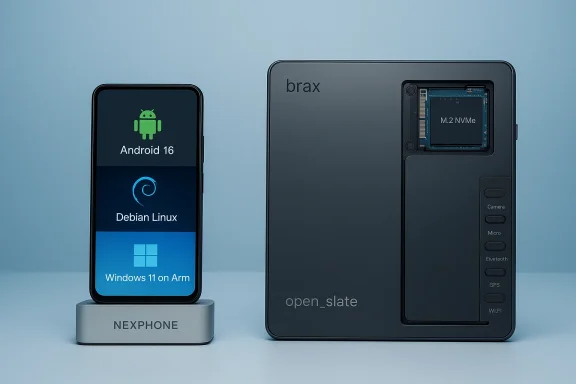
Nex and Brax have just reignited a long-running dream: a pocketable device that can honestly behave like a full desktop. In the span of a few weeks, two small outfits — Nex (the maker behind the NexDock line) and Brax Technologies (the team behind the Brax3 privacy phone) — announced devices that explicitly ship with multiple, native operating systems or the official capability to run them: Nex’s NexPhone promises Android 16 as the everyday handset, an on‑demand Debian desktop, and an optional reboot‑to Windows 11 (Arm) partition; Brax’s open_slate tablet promises a modular, replaceable‑storage design and the ability to run a range of de‑Googled Android variants and mainstream Linux distributions, including Ubuntu and Debian. These announcements mark a potential pivot in how enthusiasts, road warriors, and privacy‑minded users think about mobile computing. s://nexphone.com/blog/the-tale-of-nexphone-one-phone-every-computer)
What both vendors are selling is a familiar idea with a new, plausible twist: instead of shoehorning a desktop shell inside a mobile OS (Samsung DeX, Motorola Ready For, Microsoft’s long‑dead Continuum), they’re promising real multi‑OS workflows — native Linux for developer tools and utilities, a standard Android 16 experience for phone tasks, and in Nex’s case, a true Windows 11 desktop that you boot into when you need it. Nex’s pitch is explicit: make the phone the compute engine, include a docking hub, and let the same hardware shape three distinct workflows — smartphone, Linux workstation, and Windows desktop. Brax is approaching from a different angle: build a tablet with mainness (user‑replaceable battery, M.2 NVMe slot, full‑size ports) and an open, modular boot story that welcomes multiple OS projects.
Both vendors have history. Nex’s lineage is the NexDock — a lapdock-style shell that turns phones into productivity rigs — and its founder Emre Kosmaz has publicly narrated the NexPhone’s long gestation and engineering rationale. Brax Technologies emerged from the privacy‑focused niche and rode a successful crowdfunding run with the Brax3 privacy phone, which deployed a de‑Googled Android variant (iodéOS) and attracted substantial backing; open_slate is their attempt to scale that privacy‑first, modular approach into a tablet class device.
However, processor listing is a necessary but not sufficient condition. Windows 11 on Arm — especially on phone‑scale hardware — demands a lot more:
Brax’s approach — shipping tablet hardware friendly to native Linux — removes many of those constraints. An M.2 NVMe socket, user‑replaceable battery, and full ports make the open_slate a feasible daily driver for Ubuntu or Debian. That said, shipping with mainstream Linux support is different from ensuring polished, full‑feature experiences (GPU acceleration, power management, touchscreen drivers) across multiple distros. Brax’s developer tooling and community support will determine success.
Therlications: if one of these devices succeeds, expect more niche vendors to attempt convergent devices, and expect established OEMs to pay attention to the enthusiast market’s appetite for modularity, long‑life support, and privacy features.
That said, the engineering and operational bar remains high. The most challenging tasks ahead are not designing menus or UI skins; they are sustaining driver ecosystems, delivering robust update channels, solving telephony‑desktop interplay, and running reliable customer support at scale. Buyers should treat preorder deposits as backing an ambitious roadmap more than buying a finished, proven tool. Ask for specifics — driver signing, Windows Update policy, kernel source publication, and RMA procedures — before committing.
If Nex and Brax can follow through on their promises, these devices will be powerful tools for developers, privacy advocates, and users who genuinely want one device to cover phone, Linux workstation, and (for Nex) Windows desktop duties. For now, the market has a reason to lean in and watch closely: every milestone — shipping dates, independent reviews, driver disclosures — will either validate the dream or reveal the hard engineering reality behind it.
Conclusion
The idea of a “PC in your pocket” is no longer purely aspirational. Nex and Brax demonstrate two different but complementary paths toward that future: Nex by attempting tri‑OS convergence including Windows 11 on Arm, and Brax by building Linux‑friendly, privacy‑first hardware that welcomes multiple operating systems. Both offer tantalizing possibilities and realistic tradeoffs. If you value privacy, modularity, or the promise of a single device that can be a phone, a Linux workstation, and (in Nex’s case) a Windows desktop, follow the rollout closely, demand technical detail from the vendors, and prepare for early‑adopter dynamics. The next six to twelve months of reviews and firmware disclosures will determine whether these are practical tools or merely compelling prototypes.
Source: theregister.com Penguin in your pocket: Nexphone dual boots into Windows
 Background / Overview
What both vendors are selling is a familiar idea with a new, plausible twist: instead of shoehorning a desktop shell inside a mobile OS (Samsung DeX, Motorola Ready For, Microsoft’s long‑dead Continuum), they’re promising real multi‑OS workflows — native Linux for developer tools and utilities, a standard Android 16 experience for phone tasks, and in Nex’s case, a true Windows 11 desktop that you boot into when you need it. Nex’s pitch is explicit: make the phone the compute engine, include a docking hub, and let the same hardware shape three distinct workflows — smartphone, Linux workstation, and Windows desktop. Brax is approaching from a different angle: build a tablet with mainness (user‑replaceable battery, M.2 NVMe slot, full‑size ports) and an open, modular boot story that welcomes multiple OS projects. Both vendors have history. Nex’s lineage is the NexDock — a lapdock-style shell that turns phones into productivity rigs — and its founder Emre Kosmaz has publicly narrated the NexPhone’s long gestation and engineering rationale. Brax Technologies emerged from the privacy‑focused niche and rode a successful crowdfunding run with the Brax3 privacy phone, which deployed a de‑Googled Android variant (iodéOS) and attracted substantial backing; open_slate is their attempt to scale that privacy‑first, modular approach into a tablet class device.
NexPhone: hardware, software, and the tri‑OS pitch
What Nex is claiming
Nex publicly lays out the NexPhone as a “one device, multiple computers” product. Core vendor claims include:- Android 16 as the default handset environment, with a desktop‑friendly shell when docked.
- A containerized Debian desktop that can run with hardware acceleration inside Android for near‑instant access to Linux tooling.
- An optional, separately installed Windows 11 on Arm partition that requires a reboot and is intended for docked desktop use.
- Hardware: Qualcomm QCM6490 (Dragonwing family), 12 GB RAM / 256 GB storage (vendor‑announced variant), a 6.58‑inch FHD+ 120 Hz display, robust ingress protection (MIL‑STD‑810H, IP68/IP69K), and a 5,000 mAh battery in vendor materials. Nex is bundling a USB‑C hub for docking.
Price, timing, and commercial terms
Nex is taking refundable reservation deposits ($199) to secure an early price of $549, with target shipments in Q3 2026. The company’s blog and product pages make clear that the reservation is refundable and will be applied to the final purchase balance. The boxed bundle is meant to include a USB‑C hub to simplify the docked experience.Why the QCM6490 matters (and what it doesn’t guarantee)
Selecting the QCM6490 is conservative and strategic. The Dragonwing‑family modules are enterprise‑focused chips with long‑life support and common driver paths that make multi‑OS wan picking a phone‑only flagship SoC with shorter support windows. Microsoft’s published processor lists are the practical threshold for “possible” Windows 11 on Arm; the QCM6490 appears on that list under IoT/enterprise applicability, which means OEMs have a documented route to produce Windows images for that silicon.However, processor listing is a necessary but not sufficient condition. Windows 11 on Arm — especially on phone‑scale hardware — demands a lot more:
- Signed, modern Windows drivers for every piece of hardware (display controllers, GPU, Wi‑Fi, modem, audio, cameras).
- A validated UEFI/boot chain and firmware that supports a separate Windows boot path without compromising telephony or Android state.
- Thermal and power‑budget tuning so that Windows desktop workloads don’t turn the phone into a hot, throttled paperweight.
- Clear update and security patching commitments for all three OSes.
Brax open_slate: modularity, privacy hardware switches, and Linux friendliness
The hardware story
open_slate is pitched explicitly at the privacy‑ and freedom‑focused buyer. Key vendor statements and community details show:- Two memory/storage configurations: 8 GB RAM + 128 GB flash, and 16 GB RAM + 256 GB flash.
- A user‑replaceable battery and a microSD slot supporting up to 1 TB.
- An M.2 slot for an NVMe SSD — uncommon in tablets and very useful for running mainstream Linux distributions with fast swap and large working storage.
- Two USB‑C ports and one USB‑A port, multiple full‑size connectors, and a pogo connector for accessories.
Multi‑OS goals
Brax lists planned support across a number of operating systems:- Multiple Android variants (BraxOS, iodéOS, LineageOS, AOSP).
- Native Linux distributions: Ubuntu Touch, Ubuntu (mainline desktop), Debian, Yocto, and others.
The company’s provenance and risk profile
Brax Technologies leveraged a successful crowdfunding run with the Brax3 privacy phone (reported to have raised over $1M on Indiegogo) and partnerships with iodéOS. The company presents itself as a boutique vendor focused on privacy and modularity, and its community‑first approach includes forum megathreads and developer resources. But small vendors have well‑documented track records of delays, limited warranty throuer‑sales support; readers should interpret the promise of open_slate in that operational context.How plausible are these claims? A technical reality check
1) Windows 11 on a phone: feasible, but fragile
Nex’s single most audacious claim is the resettable Windows 11 partition on a handset. The pieces that say it’s feasible:- The QCM6490 is on Microsoft’s supported processor list, which provides a vendor‑level path for Windows 11 on that silicon. That listing is concrete and verifiable.
- Nex has dock lineage and accessory experience (NexDock), which reduces integration friction for display/peripheral plumbing.
- Driver completeness: Most phone vendors never needed to ship a fully signed Windows driver stack for their mobile components. The modem, in particular, is an ecosystem of its own; Windows requires specific vendor drivers and a strategy for telephony/Android coexistence.
- Telephony vs. desktop mode: Will Windows 11 run while the phone keeps cellular calls active? Or will switching to Windows require shutting down Android telephony? Nex’s materials are vague on this; until hands‑on reviews confirm, treat phone‑to‑PC switching as potentially disruptive.
- Thermal and battery constraints: Windows workloads can be sustained CPU/GPU tasks. Thermals in a slim phone are limited, and battery life expectations for intensive desktop usage will differ dramatically from normal mobile tasks. Independent tests will be the decisive evidence here.
2) Linux in a container vs. native Linux
Nex claims a hardware‑accelerated Debian desktop that runs inside Android as a container. That approach is practical: containerized desktops can provide developer tooling, terminal work, and many GUI apps without rebooting. It sidesteps the driver problem for display and GPU (the Android stack already has those).Linux will always be less flexible than a full native install — certain low‑level drivers, kernel modules, and kernel version dependencies will remain constraints for power users.Brax’s approach — shipping tablet hardware friendly to native Linux — removes many of those constraints. An M.2 NVMe socket, user‑replaceable battery, and full ports make the open_slate a feasible daily driver for Ubuntu or Debian. That said, shipping with mainstream Linux support is different from ensuring polished, full‑feature experiences (GPU acceleration, power management, touchscreen drivers) across multiple distros. Brax’s developer tooling and community support will determine success.
3) Security, updates, and long‑term support
Both projects make commitments that hinge on ongoing updates across three ecosystems (Android, Linux, Windows). This is where small vendors often stumble: sustaining kernel patches, DCH‑style Windows drivers, and Android security updates is engineering‑heavy, expensive, and requires close vendor cooperation with silicon partners like Qualcomm.- A practical buying rule: ask for a clear, written update policy and driver provenance before you pre‑order. Does Nex commit to Windows driver updates and Windows Update compatibility? Will Brax publish kernel sources, frequently patched firmwares, and clear warranty terms around user‑replaceable components? These are non‑trivial questions that determine whether the product is a long‑term tool or a one‑off novelty.
Strengths — why enthusiasts should pay attention
- Real convergence, not just a shell. A rebootable Windows partition and a containerized Linux desktop move beyond “just another DeX” and toward genuine workflow consolidation. When it works, you can carry one device and access Windows‑only apps, Linux tooling, and native Android apps without carrying separate hardware.
- Hardware pragmatism. Nex’s QCM6490 choice and Brax’s M.2 slot show thoughtfulness: both vendors prioritized platform support and real‑world storage performance rather than chasing flagship benchmarks.
- Privacy and modularity. Brax’s hardware kill switches and replaceable battery are genuine differentiators for privacy‑minded and power‑user markets. These features signal a device built to be opened and maintained, not locked down.
- Dock ecosystem alignment. Nex’s NexDock lineage means there’s a practical ecosystem approach to n advantage over one‑off “phone as PC” demos that lack accessory support.
Risks and unknowns — what buyers should worry about
- Driver and firmware maturity. The single biggest operational risk for Nex’s Windows pitch is driver completeness. If key pieces lack signed Windows drivers, the desktop mode will degrade to a demo.
- Service, warranty, and vendor scale. Smaller vendors promise fast innovation, but historically struggle with returns, refunds, and timely RMA support. Brax has had enthusiastic backers, but anecdotes online suggest customers should be cautious and read warranty/return terms carefully before pre‑ordering. Independent community experiences and forum reporting are already mixed.
- Thermal and battery realities. Expect compromises: sustained Windows workloads will hit thermals and battery life hard. Device form factors dictate performance ceilings. Ask for independent battery and thermal benchmarks when review units arrive.
- Licensing and Windows Update mechanics. Shipping Windows 11 on an unconventional device may invite extra complexity around licensing, Windows Update behavior, and potential limitations in Microsoft’s driver signing or update channels. Nex must document how future Windows updates will be delivered and supported.
Practical buyer guidance
- If you are a tinkerer who values experimentation: these devices are exciting. Reserve only if you accept the pre‑production risk and aim to be an early adopter. Expect software rough edges.
- If you require stable Windows application support for work: wait for independent hands‑on reviews that test driver completeness, Windows Update behavior, and modem/telephony interaction. Ask Nex whether Windows mode preserves or disables telephony, and how dual‑SIM/VoLTE behaves when rebooted into Windows.
- For Linux users: Brax’s open_slate will likely be the safer bet for a daily‑driver Linux tablet due to its M.2 slot and replaceable battery, but validate upstream kernel and driver support for the chosen SoC before committing. Check whether community ports (Ubuntu Touch, UBports, mainline kernels) are active and the vendor’s willingness to upstream patches.
- Always demand clarity on updates and warranties. Ask the vendor: how long will the device receive Android security updates? Will kernel sources be published? What is the Windows update policy and driver sign answers determine long‑term viability.
The broader significance: why this matters to Windows and Linux ecosystems
These launches signal a renewed attempt to blur device class boundaries. For Windows, it’s proof that Arm‑based Windows can creep into non‑traditional form factors if vendors care enough to do the work. Microsoft’s processor lists already allowed for this possibility; now vendors are building consumer products that try to exploit it. For the Linux ecosystem, open_slate‑style hardware lowers barriers to run mainstream desktop distributions on tablet hardware and could spur richer upstream driver support if community engagement is sustained.Therlications: if one of these devices succeeds, expect more niche vendors to attempt convergent devices, and expect established OEMs to pay attention to the enthusiast market’s appetite for modularity, long‑life support, and privacy features.
Final verdict — cautious optimism
Nex’s NexPhone and Brax’s open_slate are among the most interesting consumer experiments in the last several years. Both projects show maturity in hardware thinking: QCM6490’s platform lineage for Nex; M.2/NVMe and physical kill switches for Brax. Those choices aren’t just marketing — they materially increase the chances these devices will be useful beyond demos.That said, the engineering and operational bar remains high. The most challenging tasks ahead are not designing menus or UI skins; they are sustaining driver ecosystems, delivering robust update channels, solving telephony‑desktop interplay, and running reliable customer support at scale. Buyers should treat preorder deposits as backing an ambitious roadmap more than buying a finished, proven tool. Ask for specifics — driver signing, Windows Update policy, kernel source publication, and RMA procedures — before committing.
If Nex and Brax can follow through on their promises, these devices will be powerful tools for developers, privacy advocates, and users who genuinely want one device to cover phone, Linux workstation, and (for Nex) Windows desktop duties. For now, the market has a reason to lean in and watch closely: every milestone — shipping dates, independent reviews, driver disclosures — will either validate the dream or reveal the hard engineering reality behind it.
Conclusion
The idea of a “PC in your pocket” is no longer purely aspirational. Nex and Brax demonstrate two different but complementary paths toward that future: Nex by attempting tri‑OS convergence including Windows 11 on Arm, and Brax by building Linux‑friendly, privacy‑first hardware that welcomes multiple operating systems. Both offer tantalizing possibilities and realistic tradeoffs. If you value privacy, modularity, or the promise of a single device that can be a phone, a Linux workstation, and (in Nex’s case) a Windows desktop, follow the rollout closely, demand technical detail from the vendors, and prepare for early‑adopter dynamics. The next six to twelve months of reviews and firmware disclosures will determine whether these are practical tools or merely compelling prototypes.
Source: theregister.com Penguin in your pocket: Nexphone dual boots into Windows
