

NHS England said on June 8, 2026, that it will give 505,000 clinicians and support staff access to Microsoft 365 Copilot by October 2026, expanding a 30,000-person pilot across 90 NHS organisations that reported average administrative savings of 43 minutes per worker per day. The announcement is not just another public-sector software procurement; it is a test of whether generative AI can survive contact with one of the world’s most politically visible, operationally strained health systems. Microsoft gets a marquee deployment in a sector where trust is scarce, while the NHS gets a productivity story at a time when waiting lists, staffing pressure, and budget discipline are all colliding. The wager is simple: if AI can shave enough friction from paperwork, the health service might convert minutes into care — but only if governance keeps pace with scale.
The phrase “AI in healthcare” still tends to conjure diagnostic systems, radiology algorithms, drug discovery models, and futuristic triage bots. NHS England’s Copilot rollout is more prosaic, and that is precisely why it matters. The first half-million users are not being promised an oracle for clinical judgment; they are being handed a productivity assistant embedded in Word, Excel, Outlook, Teams, and the rest of the Microsoft 365 estate.
That makes the move less glamorous than a medical breakthrough and more consequential than a lab demo. Healthcare is held together by administrative connective tissue: referral letters, discharge summaries, meeting notes, rota plans, procurement documents, finance reports, board papers, and endless status updates. Anyone who has worked around hospitals knows that “paperwork” is not a side quest. It is the hidden operating system of care.
NHS England is therefore attacking a problem that is both boring and existential. Clinicians routinely complain that administrative load steals time from patients, while non-clinical staff are expected to hold together increasingly complex flows of people, beds, equipment, appointments, and information. Copilot’s promise is not that it can make the NHS effortless. It is that the organisation can use a general-purpose AI layer to sand down some of the repetitive work that consumes human attention.
The sheer number of licences turns this from an experiment into infrastructure. A pilot with 30,000 users can be framed as innovation. A deployment to 505,000 people becomes a new dependency. By October 2026, if the schedule holds, Microsoft’s AI assistant will be present across a meaningful share of NHS knowledge work, and the question will shift from whether staff can try it to whether the service can manage what they do with it.
This is the kind of metric that public-sector technology programmes love because it sounds concrete. It lets officials tell a productivity story without promising fewer staff, better diagnoses, or instant reductions in waiting lists. In a system where demand is rising faster than capacity, “freeing up time” is the safest possible reform slogan.
But the number also deserves scrutiny. Time-saving claims in AI pilots often capture perceived gains, task-specific improvements, or self-reported diary data rather than hard organisational transformation. A worker who saves ten minutes drafting a letter may spend that time on another task, checking the AI’s output, attending another meeting, or simply absorbing work that had previously been delayed. Productivity in a hospital is not a spreadsheet cell that automatically turns into patient throughput.
That does not make the figure useless. It means the 43 minutes should be treated as a signal, not a settled dividend. The real question is whether local NHS organisations can convert fragmented time savings into measurable improvements: faster discharge paperwork, fewer delays in correspondence, cleaner rota planning, better preparation for meetings, or more responsive back-office processes. The NHS does not need Copilot to produce a miracle. It needs the tool to remove enough drag, consistently enough, that teams notice the difference.
The deployment is aimed at the document-heavy middle layer of healthcare work. This is where generative AI is currently strongest: summarising, drafting, restructuring, comparing, extracting, and turning rough input into polished output. It is also where the consequences of error can often be contained through review, approval, and professional oversight.
This is the sensible end of the AI wedge. Asking Copilot to draft a discharge letter that a clinician reviews is a different proposition from asking it to determine whether a patient should be discharged. Asking it to summarise meeting notes is not the same as allowing it to set clinical policy. The NHS is positioning the technology as a bureaucratic accelerant rather than a clinical authority.
That distinction will have to be defended in practice. The boundary between administration and care is porous. A badly drafted letter can mislead a GP, a missed caveat in a summary can affect a follow-up, and a rota or bed-management analysis can influence real operational decisions. The safety argument therefore depends less on Microsoft’s branding than on workflow design: who reviews, who signs off, what data is used, and how errors are caught.
For years, Microsoft’s advantage in the enterprise has been less about any single application than about gravity. Outlook, Teams, SharePoint, OneDrive, Word, Excel, PowerPoint, Entra, Purview, Intune, and the rest form a mesh that many organisations already live inside. Copilot turns that mesh into an AI surface. If your files, meetings, and messages are already in Microsoft’s cloud, the assistant can sit directly in the flow of work.
That is attractive for the NHS because it reduces friction. Staff do not have to learn an entirely separate system, and IT teams do not have to integrate a niche AI vendor into every trust’s existing productivity stack. The deployment rides on tools many staff already use.
It also deepens dependence. Once Copilot becomes the way board papers are drafted, letters are templated, meetings are summarised, and spreadsheets are interrogated, Microsoft is no longer just providing productivity software. It is mediating institutional memory and routine decision support. That may be efficient, but it increases the strategic cost of ever moving away.
For WindowsForum readers, this is the broader Microsoft story hiding inside an NHS announcement. Copilot is not being adopted one app at a time. It is being woven into the default enterprise desktop. The NHS rollout shows what Microsoft wants every large organisation to believe: that AI is not a separate procurement category but the next layer of Microsoft 365.
But “not used for training” is not the same as “risk-free.” Copilot can only be as well governed as the information environment it sits on top of. If an organisation has sprawling SharePoint sites, over-permissive Teams channels, poorly labelled documents, inconsistent retention policies, or legacy access groups no one understands, an AI assistant may surface problems that were previously buried under bad search and human inconvenience.
This is the oversharing problem, and it is one of the least glamorous but most serious issues in enterprise AI. Traditional search already exposes messy permissions, but generative AI makes discovery easier and synthesis faster. A user who might never have found a sensitive spreadsheet manually may be able to ask a natural-language question and receive a concise summary if the permissions allow it.
Healthcare heightens the stakes because sensitive information is everywhere. The NHS has to manage patient data, staff records, safeguarding information, procurement details, legal correspondence, and operational plans. Even if Copilot respects technical permissions, administrators must ask whether those permissions reflect real-world need-to-know boundaries.
This is where the rollout becomes a test of information hygiene. The NHS cannot simply distribute licences and call it transformation. It needs permission reviews, data classification, staff training, logging, incident processes, and local accountability. The AI layer will not create governance discipline by itself. It will punish the absence of it.
The risk is that Copilot becomes another tool handed to exhausted staff with a short training deck and a promise of productivity. Generative AI is easy to try and hard to institutionalise. The difference between a useful assistant and a novelty often comes down to whether teams redesign work around it rather than merely adding it to old processes.
The earlier pilot suggests there is demand and potential. But pilots are usually staffed by motivated participants, supported by project teams, and watched closely. A national rollout has to reach sceptics, busy wards, unevenly resourced back offices, and managers who may be asked to show savings before workflows have matured.
The NHS will need local champions, not just central messaging. Medical secretaries, ward clerks, junior doctors, nurses, finance staff, and operational managers will each find different use cases. Some will discover genuine improvements; others will find that Copilot produces drafts that require too much checking, or that it works well in Teams but less well with the messy data they actually rely on.
This variation is not a failure. It is the reality of enterprise software. The danger comes if national leadership treats licence deployment as equivalent to adoption. The only meaningful rollout is the one that changes the work.
That narrative has obvious appeal. If staff can spend less time on admin, patients might get faster communication, discharge delays might shrink, managers might make decisions with better-prepared information, and clinicians might reclaim time for care. In a system where every hour is contested, even modest gains matter.
Yet the politics of productivity can become dangerous if it assumes every saved minute is recoverable cash. Healthcare work expands to fill gaps because the gaps are real. If Copilot saves time, much of that time may be absorbed by unmet demand rather than released as budget savings. Staff may do more, not less; quality may improve before costs fall.
That may still be a good outcome. A public health system does not exist to maximise software ROI in isolation. If AI helps staff complete necessary work with less frustration, that has value even when it does not immediately appear as a line-item saving. But politicians should resist the temptation to pre-spend the productivity dividend.
The more honest case is that Copilot may improve capacity at the margins. It may reduce administrative burden, standardise routine drafting, speed internal analysis, and make meetings less wasteful. Those are real gains, but they are not a substitute for workforce planning, estates investment, clinical systems modernisation, or social care reform.
This matters because the enterprise AI market is moving from experimentation to justification. Large organisations have spent the past two years testing generative AI, but many are still trying to prove durable value beyond demos and executive enthusiasm. Microsoft’s pitch is that Copilot is most valuable when it is everywhere: in the apps people already use, governed by the controls IT already understands, and connected to the data the organisation already stores.
The NHS announcement reinforces that pitch. If a health service with severe governance obligations can adopt Copilot, Microsoft can argue that other public bodies and regulated industries have fewer excuses. The deployment becomes a reference architecture as much as a customer win.
But the showcase cuts both ways. If the rollout produces visible productivity gains without major incidents, it will strengthen Microsoft’s claim that Copilot is becoming ordinary enterprise infrastructure. If it stumbles through privacy concerns, poor adoption, disappointing savings, or local backlash, critics will use the NHS as evidence that large-scale generative AI procurement is running ahead of proof.
Microsoft therefore inherits part of the NHS’s reputational risk. The company can provide controls, documentation, training materials, and product improvements. It cannot guarantee that every trust’s data estate is tidy, every user is trained, or every generated draft is checked properly. In a deployment this large, the product story and the implementation story will be inseparable.
That changes the role of IT. Administrators are being asked to enable tools whose outputs are probabilistic, whose usefulness depends on organisational data quality, and whose risks often reflect pre-existing permission problems. The old model of deploying software and patching it is not enough. AI adoption requires ongoing stewardship.
In the NHS, that stewardship will be distributed across national bodies, local trusts, clinical governance teams, information governance officers, security teams, and departmental managers. The IT function will be expected to make Copilot available, safe, and useful while also explaining its limits to users who may see “AI assistant” and assume more intelligence than the system can reliably provide.
This is where Microsoft’s integration strategy becomes both helpful and uncomfortable. Because Copilot uses familiar Microsoft 365 controls, organisations are not starting from scratch. But because it is deeply embedded, disabling, segmenting, monitoring, or shaping its use may become politically harder once staff begin to depend on it.
The lesson for every enterprise watching the NHS is clear: prepare the tenant before you celebrate the tool. AI readiness is not a keynote slide. It is permissions cleanup, lifecycle management, sensitivity labelling, retention discipline, and a sober understanding of where business data actually lives.
The NHS’s safest use cases will be those where Copilot accelerates a human-owned process. Drafting a letter from structured notes, summarising a meeting with participants present, turning a policy outline into a first draft, or helping a manager interrogate a spreadsheet are all plausible. The user remains responsible for judgment.
Problems begin when convenience erodes review. If staff are overloaded, the temptation will be to accept outputs quickly. If managers are chasing productivity metrics, the pressure may be to use Copilot more often rather than more carefully. If the tool is framed too aggressively as a time-saver, verification can start to look like a drag on the promised benefit.
This is why training cannot be limited to prompt tips. Staff need to know when Copilot is likely to help, when it is likely to mislead, what information should not be entered, how to check outputs, and what accountability remains with the human author. They also need permission to say that a workflow is not suitable for AI assistance.
The best AI deployments are boring in a specific way: they create repeatable patterns for safe use. The NHS should identify task categories where Copilot consistently helps, standardise those patterns, and resist the urge to turn every administrative frustration into an AI use case.
Copilot will not flatten those differences. It may amplify them. A trust with well-structured document repositories, disciplined access controls, and clear templates may get value quickly. A trust with chaotic SharePoint permissions, inconsistent naming conventions, and unclear document ownership may find that AI makes the mess more visible.
That is not necessarily bad. Sometimes a new tool forces organisations to confront technical debt they have normalised. If Copilot adoption leads trusts to clean up permissions, standardise templates, improve records management, and modernise collaboration practices, the secondary benefits may be as important as the AI itself.
But this also means the national rollout will require patience. The NHS should expect uneven adoption, inconsistent benefits, and some uncomfortable discoveries. Any honest assessment in 2027 will probably show pockets of strong value, areas of modest use, and teams that barely touch the tool. That is normal for enterprise technology; it only becomes scandalous if leaders pretend otherwise.
The rollout’s success should therefore be measured with more than aggregate licence counts or average time-saved claims. NHS England will need evidence about workflow outcomes, staff experience, safety incidents, information governance issues, and whether time savings accrue in places that matter operationally.
The harder milestone will come months later, when trusts can show whether Copilot has changed the cadence of work. Are discharge documents moving faster? Are clinical letters less delayed? Are meeting actions clearer? Are managers spending less time assembling papers and more time acting on them? Are staff less frustrated by routine admin, or merely dealing with another system layered on top of existing pressure?
Those questions matter because the NHS does not have spare attention to waste. Every digital tool competes with clinical systems, mandatory training, compliance processes, and the daily reality of delivering care. A product that requires too much ceremony will lose, even if it is technically impressive.
Microsoft and NHS England appear to understand that the initial target is administrative friction. That is the right target. But friction is often organisational, not just technological. A slow discharge process may involve policy, staffing, transport, pharmacy, social care, and bed availability. Copilot can draft and summarise; it cannot dissolve every bottleneck.
The most successful uses may therefore be narrow and cumulative. A few minutes saved on meeting notes. A better first draft of a patient letter. A quicker summary of service data. A cleaner template for procurement. A faster board briefing. None of these alone transforms healthcare. Together, at national scale, they might matter.
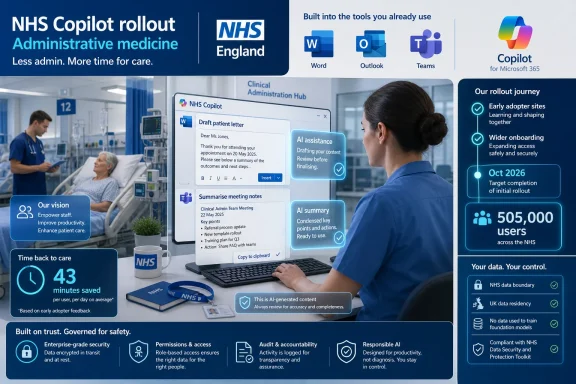 Microsoft’s Biggest NHS Win Is Really a Bet on Administrative Medicine
The phrase “AI in healthcare” still tends to conjure diagnostic systems, radiology algorithms, drug discovery models, and futuristic triage bots. NHS England’s Copilot rollout is more prosaic, and that is precisely why it matters. The first half-million users are not being promised an oracle for clinical judgment; they are being handed a productivity assistant embedded in Word, Excel, Outlook, Teams, and the rest of the Microsoft 365 estate.That makes the move less glamorous than a medical breakthrough and more consequential than a lab demo. Healthcare is held together by administrative connective tissue: referral letters, discharge summaries, meeting notes, rota plans, procurement documents, finance reports, board papers, and endless status updates. Anyone who has worked around hospitals knows that “paperwork” is not a side quest. It is the hidden operating system of care.
NHS England is therefore attacking a problem that is both boring and existential. Clinicians routinely complain that administrative load steals time from patients, while non-clinical staff are expected to hold together increasingly complex flows of people, beds, equipment, appointments, and information. Copilot’s promise is not that it can make the NHS effortless. It is that the organisation can use a general-purpose AI layer to sand down some of the repetitive work that consumes human attention.
The sheer number of licences turns this from an experiment into infrastructure. A pilot with 30,000 users can be framed as innovation. A deployment to 505,000 people becomes a new dependency. By October 2026, if the schedule holds, Microsoft’s AI assistant will be present across a meaningful share of NHS knowledge work, and the question will shift from whether staff can try it to whether the service can manage what they do with it.
The 43-Minute Figure Carries the Whole Political Case
The headline statistic is irresistible: 43 minutes saved per staff member per day, or roughly five weeks per person annually. NHS England and the Department of Health and Social Care used that number from the earlier trial to argue that a broader rollout could free millions of hours every month. Ministers and executives have translated it into a more digestible claim: around two days of admin time saved each month.This is the kind of metric that public-sector technology programmes love because it sounds concrete. It lets officials tell a productivity story without promising fewer staff, better diagnoses, or instant reductions in waiting lists. In a system where demand is rising faster than capacity, “freeing up time” is the safest possible reform slogan.
But the number also deserves scrutiny. Time-saving claims in AI pilots often capture perceived gains, task-specific improvements, or self-reported diary data rather than hard organisational transformation. A worker who saves ten minutes drafting a letter may spend that time on another task, checking the AI’s output, attending another meeting, or simply absorbing work that had previously been delayed. Productivity in a hospital is not a spreadsheet cell that automatically turns into patient throughput.
That does not make the figure useless. It means the 43 minutes should be treated as a signal, not a settled dividend. The real question is whether local NHS organisations can convert fragmented time savings into measurable improvements: faster discharge paperwork, fewer delays in correspondence, cleaner rota planning, better preparation for meetings, or more responsive back-office processes. The NHS does not need Copilot to produce a miracle. It needs the tool to remove enough drag, consistently enough, that teams notice the difference.
Copilot Is Being Sent Where the Risk Is Lowest and the Workload Is Highest
The announced use cases are revealing. NHS England expects Copilot to support clinical administration, patient letters, registrar training, discharge processes, service data analysis, rota building, bed management, meeting minutes, templates, procurement, finance, human resources, board papers, and organisational analysis. That is a broad sweep, but it is not random.The deployment is aimed at the document-heavy middle layer of healthcare work. This is where generative AI is currently strongest: summarising, drafting, restructuring, comparing, extracting, and turning rough input into polished output. It is also where the consequences of error can often be contained through review, approval, and professional oversight.
This is the sensible end of the AI wedge. Asking Copilot to draft a discharge letter that a clinician reviews is a different proposition from asking it to determine whether a patient should be discharged. Asking it to summarise meeting notes is not the same as allowing it to set clinical policy. The NHS is positioning the technology as a bureaucratic accelerant rather than a clinical authority.
That distinction will have to be defended in practice. The boundary between administration and care is porous. A badly drafted letter can mislead a GP, a missed caveat in a summary can affect a follow-up, and a rota or bed-management analysis can influence real operational decisions. The safety argument therefore depends less on Microsoft’s branding than on workflow design: who reviews, who signs off, what data is used, and how errors are caught.
The NHS Is Buying a Platform, Not Just an Assistant
Microsoft 365 Copilot is not a standalone chatbot bolted onto the NHS from the outside. Its power comes from proximity to Microsoft Graph, organisational documents, meetings, messages, calendars, and permissions. That is why it can be useful. It is also why it creates a governance challenge that ordinary software rollouts do not.For years, Microsoft’s advantage in the enterprise has been less about any single application than about gravity. Outlook, Teams, SharePoint, OneDrive, Word, Excel, PowerPoint, Entra, Purview, Intune, and the rest form a mesh that many organisations already live inside. Copilot turns that mesh into an AI surface. If your files, meetings, and messages are already in Microsoft’s cloud, the assistant can sit directly in the flow of work.
That is attractive for the NHS because it reduces friction. Staff do not have to learn an entirely separate system, and IT teams do not have to integrate a niche AI vendor into every trust’s existing productivity stack. The deployment rides on tools many staff already use.
It also deepens dependence. Once Copilot becomes the way board papers are drafted, letters are templated, meetings are summarised, and spreadsheets are interrogated, Microsoft is no longer just providing productivity software. It is mediating institutional memory and routine decision support. That may be efficient, but it increases the strategic cost of ever moving away.
For WindowsForum readers, this is the broader Microsoft story hiding inside an NHS announcement. Copilot is not being adopted one app at a time. It is being woven into the default enterprise desktop. The NHS rollout shows what Microsoft wants every large organisation to believe: that AI is not a separate procurement category but the next layer of Microsoft 365.
Data Protection Promises Will Not End the Security Argument
Microsoft says Microsoft 365 Copilot for organisational use operates within enterprise data protection commitments and that customer prompts, responses, and Microsoft Graph data are not used to train foundation models. That assurance matters, especially in healthcare, where patient confidentiality and regulatory compliance are not optional niceties. NHS organisations will also be relying on existing Microsoft 365 permissions, compliance tooling, identity controls, and audit capabilities.But “not used for training” is not the same as “risk-free.” Copilot can only be as well governed as the information environment it sits on top of. If an organisation has sprawling SharePoint sites, over-permissive Teams channels, poorly labelled documents, inconsistent retention policies, or legacy access groups no one understands, an AI assistant may surface problems that were previously buried under bad search and human inconvenience.
This is the oversharing problem, and it is one of the least glamorous but most serious issues in enterprise AI. Traditional search already exposes messy permissions, but generative AI makes discovery easier and synthesis faster. A user who might never have found a sensitive spreadsheet manually may be able to ask a natural-language question and receive a concise summary if the permissions allow it.
Healthcare heightens the stakes because sensitive information is everywhere. The NHS has to manage patient data, staff records, safeguarding information, procurement details, legal correspondence, and operational plans. Even if Copilot respects technical permissions, administrators must ask whether those permissions reflect real-world need-to-know boundaries.
This is where the rollout becomes a test of information hygiene. The NHS cannot simply distribute licences and call it transformation. It needs permission reviews, data classification, staff training, logging, incident processes, and local accountability. The AI layer will not create governance discipline by itself. It will punish the absence of it.
Local Trusts Will Decide Whether the National Rollout Works
NHS England can announce the agreement, allocate licences, and set expectations, but the NHS is not a single office with a single workflow. Trusts differ in digital maturity, staffing pressure, EPR systems, document practices, local policies, and appetite for change. A central allocation of around 2,000 licences per trust may sound neat, but the practical impact will depend on who gets them first and how they are supported.The risk is that Copilot becomes another tool handed to exhausted staff with a short training deck and a promise of productivity. Generative AI is easy to try and hard to institutionalise. The difference between a useful assistant and a novelty often comes down to whether teams redesign work around it rather than merely adding it to old processes.
The earlier pilot suggests there is demand and potential. But pilots are usually staffed by motivated participants, supported by project teams, and watched closely. A national rollout has to reach sceptics, busy wards, unevenly resourced back offices, and managers who may be asked to show savings before workflows have matured.
The NHS will need local champions, not just central messaging. Medical secretaries, ward clerks, junior doctors, nurses, finance staff, and operational managers will each find different use cases. Some will discover genuine improvements; others will find that Copilot produces drafts that require too much checking, or that it works well in Teams but less well with the messy data they actually rely on.
This variation is not a failure. It is the reality of enterprise software. The danger comes if national leadership treats licence deployment as equivalent to adoption. The only meaningful rollout is the one that changes the work.
The Productivity Dividend Is Political Before It Is Financial
The NHS is under constant pressure to demonstrate that new spending produces visible results. AI gives ministers and executives a language of modernisation that sounds less painful than restructuring and more tangible than “digital transformation.” In that context, Copilot is not merely a tool; it is a productivity narrative.That narrative has obvious appeal. If staff can spend less time on admin, patients might get faster communication, discharge delays might shrink, managers might make decisions with better-prepared information, and clinicians might reclaim time for care. In a system where every hour is contested, even modest gains matter.
Yet the politics of productivity can become dangerous if it assumes every saved minute is recoverable cash. Healthcare work expands to fill gaps because the gaps are real. If Copilot saves time, much of that time may be absorbed by unmet demand rather than released as budget savings. Staff may do more, not less; quality may improve before costs fall.
That may still be a good outcome. A public health system does not exist to maximise software ROI in isolation. If AI helps staff complete necessary work with less frustration, that has value even when it does not immediately appear as a line-item saving. But politicians should resist the temptation to pre-spend the productivity dividend.
The more honest case is that Copilot may improve capacity at the margins. It may reduce administrative burden, standardise routine drafting, speed internal analysis, and make meetings less wasteful. Those are real gains, but they are not a substitute for workforce planning, estates investment, clinical systems modernisation, or social care reform.
Microsoft Gets a Showcase Customer in the Hardest Possible Sector
For Microsoft, the NHS deployment is commercially and symbolically valuable. Healthcare is one of the hardest markets for AI vendors because the tolerance for error is low, the data is sensitive, and procurement scrutiny is intense. A half-million-seat deployment lets Microsoft point to a public-sector health system adopting Copilot at national scale.This matters because the enterprise AI market is moving from experimentation to justification. Large organisations have spent the past two years testing generative AI, but many are still trying to prove durable value beyond demos and executive enthusiasm. Microsoft’s pitch is that Copilot is most valuable when it is everywhere: in the apps people already use, governed by the controls IT already understands, and connected to the data the organisation already stores.
The NHS announcement reinforces that pitch. If a health service with severe governance obligations can adopt Copilot, Microsoft can argue that other public bodies and regulated industries have fewer excuses. The deployment becomes a reference architecture as much as a customer win.
But the showcase cuts both ways. If the rollout produces visible productivity gains without major incidents, it will strengthen Microsoft’s claim that Copilot is becoming ordinary enterprise infrastructure. If it stumbles through privacy concerns, poor adoption, disappointing savings, or local backlash, critics will use the NHS as evidence that large-scale generative AI procurement is running ahead of proof.
Microsoft therefore inherits part of the NHS’s reputational risk. The company can provide controls, documentation, training materials, and product improvements. It cannot guarantee that every trust’s data estate is tidy, every user is trained, or every generated draft is checked properly. In a deployment this large, the product story and the implementation story will be inseparable.
The Windows Desktop Is Becoming the Front Door to Institutional AI
For sysadmins and Windows professionals, the NHS rollout is another sign that AI is becoming a management problem rather than a curiosity. Copilot is not just something users open in a browser. It appears across Microsoft 365, Windows experiences, Teams workflows, and administrative consoles. The practical questions are now about licensing, identity, governance, endpoint readiness, retention, audit, sensitivity labels, and user education.That changes the role of IT. Administrators are being asked to enable tools whose outputs are probabilistic, whose usefulness depends on organisational data quality, and whose risks often reflect pre-existing permission problems. The old model of deploying software and patching it is not enough. AI adoption requires ongoing stewardship.
In the NHS, that stewardship will be distributed across national bodies, local trusts, clinical governance teams, information governance officers, security teams, and departmental managers. The IT function will be expected to make Copilot available, safe, and useful while also explaining its limits to users who may see “AI assistant” and assume more intelligence than the system can reliably provide.
This is where Microsoft’s integration strategy becomes both helpful and uncomfortable. Because Copilot uses familiar Microsoft 365 controls, organisations are not starting from scratch. But because it is deeply embedded, disabling, segmenting, monitoring, or shaping its use may become politically harder once staff begin to depend on it.
The lesson for every enterprise watching the NHS is clear: prepare the tenant before you celebrate the tool. AI readiness is not a keynote slide. It is permissions cleanup, lifecycle management, sensitivity labelling, retention discipline, and a sober understanding of where business data actually lives.
The Hard Part Is Not Drafting Faster but Trusting Wisely
Generative AI’s most impressive workplace trick is making rough work look finished. That is also its most dangerous trick. A polished paragraph, a neat table, or a confident summary can disguise missing context, misread nuance, or invented connections. In healthcare administration, that means users need to stay alert precisely when the tool is trying to reduce effort.The NHS’s safest use cases will be those where Copilot accelerates a human-owned process. Drafting a letter from structured notes, summarising a meeting with participants present, turning a policy outline into a first draft, or helping a manager interrogate a spreadsheet are all plausible. The user remains responsible for judgment.
Problems begin when convenience erodes review. If staff are overloaded, the temptation will be to accept outputs quickly. If managers are chasing productivity metrics, the pressure may be to use Copilot more often rather than more carefully. If the tool is framed too aggressively as a time-saver, verification can start to look like a drag on the promised benefit.
This is why training cannot be limited to prompt tips. Staff need to know when Copilot is likely to help, when it is likely to mislead, what information should not be entered, how to check outputs, and what accountability remains with the human author. They also need permission to say that a workflow is not suitable for AI assistance.
The best AI deployments are boring in a specific way: they create repeatable patterns for safe use. The NHS should identify task categories where Copilot consistently helps, standardise those patterns, and resist the urge to turn every administrative frustration into an AI use case.
A National AI Rollout Will Expose the NHS’s Uneven Digital Foundations
The NHS has made major digital strides, but its technology landscape remains uneven. Some organisations have mature cloud practices, strong data governance, and modern collaboration habits. Others are still dealing with fragmented systems, inconsistent records, aging workflows, and local workarounds built up over years of pressure.Copilot will not flatten those differences. It may amplify them. A trust with well-structured document repositories, disciplined access controls, and clear templates may get value quickly. A trust with chaotic SharePoint permissions, inconsistent naming conventions, and unclear document ownership may find that AI makes the mess more visible.
That is not necessarily bad. Sometimes a new tool forces organisations to confront technical debt they have normalised. If Copilot adoption leads trusts to clean up permissions, standardise templates, improve records management, and modernise collaboration practices, the secondary benefits may be as important as the AI itself.
But this also means the national rollout will require patience. The NHS should expect uneven adoption, inconsistent benefits, and some uncomfortable discoveries. Any honest assessment in 2027 will probably show pockets of strong value, areas of modest use, and teams that barely touch the tool. That is normal for enterprise technology; it only becomes scandalous if leaders pretend otherwise.
The rollout’s success should therefore be measured with more than aggregate licence counts or average time-saved claims. NHS England will need evidence about workflow outcomes, staff experience, safety incidents, information governance issues, and whether time savings accrue in places that matter operationally.
The Real Test Comes After the Licences Arrive
By October 2026, the visible milestone will be access. Half a million NHS staff will either have Copilot or be close to receiving it. That will be the easy part to announce and the easiest part to misunderstand.The harder milestone will come months later, when trusts can show whether Copilot has changed the cadence of work. Are discharge documents moving faster? Are clinical letters less delayed? Are meeting actions clearer? Are managers spending less time assembling papers and more time acting on them? Are staff less frustrated by routine admin, or merely dealing with another system layered on top of existing pressure?
Those questions matter because the NHS does not have spare attention to waste. Every digital tool competes with clinical systems, mandatory training, compliance processes, and the daily reality of delivering care. A product that requires too much ceremony will lose, even if it is technically impressive.
Microsoft and NHS England appear to understand that the initial target is administrative friction. That is the right target. But friction is often organisational, not just technological. A slow discharge process may involve policy, staffing, transport, pharmacy, social care, and bed availability. Copilot can draft and summarise; it cannot dissolve every bottleneck.
The most successful uses may therefore be narrow and cumulative. A few minutes saved on meeting notes. A better first draft of a patient letter. A quicker summary of service data. A cleaner template for procurement. A faster board briefing. None of these alone transforms healthcare. Together, at national scale, they might matter.
The NHS Copilot Gamble Comes Down to Five Concrete Realities
The Copilot rollout should neither be dismissed as vendor hype nor celebrated as a cure for the NHS’s structural problems. It is a serious deployment with plausible benefits, real risks, and a lot of implementation detail standing between announcement and outcome.- NHS England is moving from a 30,000-user pilot to a 505,000-user rollout by October 2026, which makes Copilot part of the health service’s working infrastructure rather than a limited experiment.
- The central productivity claim rests on reported average savings of 43 minutes per staff member per day, but the value will depend on whether those minutes translate into better workflows and patient-facing capacity.
- The safest early uses are administrative and document-heavy tasks, including drafting letters, summarising meetings, analysing service data, preparing board papers, and supporting rota or discharge processes.
- The biggest governance risks are likely to come from permissions, data quality, sensitivity labelling, staff training, and overreliance on polished AI-generated output.
- Microsoft gains a powerful public-sector proof point, but the company also inherits reputational exposure if a high-profile healthcare deployment produces disappointing adoption or avoidable data problems.
- NHS trusts that treat Copilot as a reason to improve information hygiene will get more from the rollout than those that treat licence allocation as transformation.
References
- Primary source: THINK Digital Partners
Published: Tue, 09 Jun 2026 08:21:16 GMT
Loading…
www.thinkdigitalpartners.com - Independent coverage: Wired-Gov
Published: 2026-06-09T08:19:09.564962
Loading…
www.wired-gov.net - Related coverage: england.nhs.uk

NHS England » 500,000 NHS staff to get new artificial intelligence tools to help free up more time for patients
NHS England » 500,000 NHS staff to get new artificial intelligence tools to help free up more time for patientswww.england.nhs.uk
- Related coverage: gov.uk

Major NHS AI trial delivers unprecedented time and cost savings
Microsoft 365 Copilot trial demonstrates monthly time savings of potentially 400,000 hours for NHS staff.www.gov.uk
- Related coverage: techmarketview.com
NHS England scales Microsoft Copilot adoption
Bringing you opinionated, authoritative research & analysis on the UK technology scene. www.techmarketview.com
- Related coverage: healthcare-management.uk

NHS England announces Microsoft 365 Copilot roll out
Each NHS trust will receive a central allocation of licences based on organisational headcount, typically starting at around 2,000 Copilot Microsoft 365 licences. ...www.healthcare-management.uk
- Related coverage: htn.co.uk
- Related coverage: resultsense.com

505,000 NHS staff to get Microsoft Copilot to cut admin
NHS England will roll out Microsoft 365 Copilot to 505,000 staff after a trial saved 43 minutes a day, freeing clinicians for patient care by October 2026.www.resultsense.com
- Related coverage: investing.com

NHS England to deploy Microsoft 365 Copilot to 505,000 staff By Investing.com
NHS England to deploy Microsoft 365 Copilot to 505,000 staffwww.investing.com
- Related coverage: windowsforum.com

NHS England Rolls Out Microsoft 365 Copilot: Time-Saving AI for Admin Work
NHS England has announced a national rollout of Microsoft 365 Copilot to 505,000 clinicians and support staff, giving workers across English trusts access to Microsoft’s AI assistant for administration, analysis, document drafting, workflow automation, and internal service support. The stated... windowsforum.com
- Related coverage: healthcare-outlook.com
Loading…
www.healthcare-outlook.com - Related coverage: technologyrecord.com

NHS to roll out Microsoft Copilot to 505,000 staff
NHS England is to give 505,000 clinicians and support staff access to Microsoft 365 Copilot, following a trial that found the AI tool could save an average of 43 minutes per staff member per day – equivalent to five weeks per person annually. The rollout follows what NHS England describes as...www.technologyrecord.com
- Related coverage: easterneye.biz
Loading…
www.easterneye.biz - Related coverage: imperial.ac.uk
Loading…
www.imperial.ac.uk - Official source: microsoft.com
Loading…
www.microsoft.com - Official source: learn.microsoft.com
Loading…
learn.microsoft.com - Related coverage: productionai.institute
Microsoft 365 Copilot AI Data Use: Training & Privacy | Production AI Institute
Microsoft says files, communications, prompts, responses, and Microsoft Graph data used with Microsoft 365 Copilot are not used to train foundation models. www.productionai.institute
- Official source: developer.microsoft.com
Microsoft 365 Copilot | Extend and Customize Copilot
Extend, enrich, and customize Microsoft Microsoft 365 Copilot. Explore Copilot extensibility options such as agents, API plugins, and Copilot connectors to expand AI-powered productivity, skills, and creativity.developer.microsoft.com - Official source: support.microsoft.com
Loading…
support.microsoft.com - Related coverage: windowscentral.com
Loading…
www.windowscentral.com - Related coverage: techradar.com

Microsoft admits an Office bug exposed confidential user emails to Copilot
M365 Copilot Chat was summarizing your emails, whether you granted it access or not. This bug affected Sent and Draft folders.www.techradar.com
- Related coverage: tomsguide.com
Loading…
www.tomsguide.com - Related coverage: pcgamer.com

Microsoft used Copilot chats to form data that basically says users think AI is good
There's dozens of us who don't!www.pcgamer.com
- Official source: cdn-dynmedia-1.microsoft.com
Loading…
cdn-dynmedia-1.microsoft.com
