

Nielsen’s move to bake measurement tags into the ad delivery process with XR (Extreme Reach) is a quiet operational shift that matters: by embedding the Nielsen Tagging API directly into XR’s creative and delivery workflows, brands and agencies can apply Nielsen ONE measurement tags automatically at campaign setup and delivery — reducing manual steps, lowering tagging errors, and shortening time-to-activation for cross‑platform campaigns.
The advertising stack is fragmenting faster than ever. Campaigns now span linear TV, streaming apps, connected TV devices, web video, and mobile — and each placement frequently requires a separate tagging or measurement configuration. That multiplicity of manual handoffs between creative teams, trafficking operators, and measurement vendors creates delays and opens the door to misconfiguration that degrades measurement quality.
Nielsen and XR announced their integration on December 18, 2025: XR’s ad delivery platform can now query the Nielsen Tagging API during campaign setup and automatically attach properly formatted Nielsen ONE ad tags to creative assets. The result is that marketers selecting Nielsen as their measurement provider inside XR see measurement applied automatically rather than through separate, manual vendor handoffs. This operational integration sits alongside — but is distinct from — Nielsen’s broader methodological modernization. Nielsen’s Big Data + Panel work (now MRC-accredited) and the expansion of Nielsen ONE as a cross-media measurement product are aimed at improving the quality and scope of what gets measured. The XR partnership focuses on how those measurement tags get deployed operationally at scale.
Nielsen’s broader product shifts — MRC accreditation for Big Data + Panel and the company’s strategic partnerships with platform owners like Roku — show a two-track strategy: improve measurement quality and expand operational reach. The XR collaboration is representative of the second track: making it easier for advertisers to turn on that measurement. At the same time, ad tech fragmentation remains a systemic impediment. No single integration resolves the orchestration problem for advertisers that work across many ad servers, DSPs, and publisher ad stacks. Industry efforts around standardized protocols and interoperability frameworks would deliver a larger systemic benefit; in their absence, API-by-API integrations are the practical incremental step forward.
Source: PPC Land Nielsen teams with XR to automate measurement tagging for advertisers
 Background
The advertising stack is fragmenting faster than ever. Campaigns now span linear TV, streaming apps, connected TV devices, web video, and mobile — and each placement frequently requires a separate tagging or measurement configuration. That multiplicity of manual handoffs between creative teams, trafficking operators, and measurement vendors creates delays and opens the door to misconfiguration that degrades measurement quality.Nielsen and XR announced their integration on December 18, 2025: XR’s ad delivery platform can now query the Nielsen Tagging API during campaign setup and automatically attach properly formatted Nielsen ONE ad tags to creative assets. The result is that marketers selecting Nielsen as their measurement provider inside XR see measurement applied automatically rather than through separate, manual vendor handoffs. This operational integration sits alongside — but is distinct from — Nielsen’s broader methodological modernization. Nielsen’s Big Data + Panel work (now MRC-accredited) and the expansion of Nielsen ONE as a cross-media measurement product are aimed at improving the quality and scope of what gets measured. The XR partnership focuses on how those measurement tags get deployed operationally at scale.
What exactly changed: the technical architecture
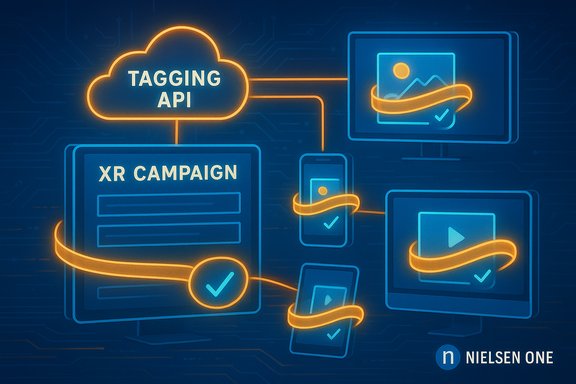
How the Nielsen Tagging API integration works in practice
- Within XR’s campaign setup UI, a marketer selects Nielsen as the measurement provider.
- XR’s platform calls the Nielsen Tagging API programmatically and receives the correct Nielsen ONE tags for the campaign’s parameters.
- XR attaches those tags to the creative assets as they are packaged for delivery across platforms, removing the need for trafficking teams to paste tags manually or coordinate separate vendor insertions.
The API-level details that matter to ad ops
- Programmatic tag generation: the Tagging API returns properly formatted measurement tags based on campaign metadata, which avoids manual parameter errors.
- Versioning and compatibility: XR must address tag-version updates (e.g., when Nielsen changes tag schema) and implement robust error-handling if API calls fail or tags are incompatible with a particular creative format.
- Format coverage: the system works straightforwardly for standard digital video and display assets, but edge cases often require fallbacks — for example, bespoke interactive creatives or closed-circuit linear insertions that rely on different delivery mechanics.
Why this matters: operational benefits and measurable outcomes
1) Fewer operational steps, fewer mistakes
Large advertisers and agencies often run hundreds or thousands of campaigns per year. Each campaign can include multiple creative versions across formats and regions. Removing the manual step of finding, configuring, and inserting measurement tags prevents common errors such as:- Missing tags on specific creative versions, causing partial measurement gaps.
- Incorrect tag parameters (e.g., wrong campaign IDs), producing misattribution.
- Delays when trafficking teams must chase creative owners or measurement vendors for the correct snippet.
2) Scale without proportional headcount increases
Automation matters most where volume is high. Agencies with large creative catalogs can offload repetitive tagging work from trafficking teams and dedicate staff to strategic tasks (audience planning, creative testing, incrementality experiments). For many organizations, that’s a direct efficiency gain: lower manual overhead and faster time-to-insight.3) Improved data integrity and fewer “launch without tags” incidents
Campaigns that go live without measurement tags create blind spots and can trigger billing disputes or require retroactive patches that never fully recover lost impressions or early conversions. Integrations like Nielsen‑XR reduce the frequency of such incidents by attaching measurement at the point of delivery. XR’s documentation explicitly calls this out as a way to reduce pixel errors and the need for campaign credits.The strategic context: why Nielsen is pushing operational integrations
Nielsen’s business case for operational integration is twofold:- Extend the footprint of Nielsen ONE by making tags easier to adopt across an advertiser’s delivery ecosystem.
- Lower the friction for advertisers to use Nielsen measurement — removing operational obstacles often translates to higher adoption and more consistent measurement coverage.
What the integration does not magically solve
Fragmentation beyond XR
The industry remains a patchwork of ad servers, DSPs, CDNs, publisher ad stacks, and proprietary platform silos. While XR’s integration automates measurement tag application inside its own delivery domain, advertisers running campaigns across multiple ad servers and platforms still face orchestration challenges. The XR-Nielsen tie is a single integration point — useful and meaningful, but not a universal fix for cross‑platform tag governance.Measurement feature parity
Nielsen ONE includes reach/frequency, advanced audiences, planning, and outcomes measurement. The XR integration automates tag deployment, but it’s not explicit in public materials whether all Nielsen ONE features and advanced tag variants are covered by the automated workflow. Some advanced outcomes or audience features may require additional configuration or post-processing outside XR’s automated path. Until implementation details are disclosed for every Nielsen ONE capability, advertisers should treat the integration as a compelling operational improvement but not a feature expansion.Edge cases and failure modes
- API failures: network outages, authentication errors, or schema changes could interrupt automated tagging. XR must implement reliable retries, alerting, and clear manual fallbacks.
- Non-standard creative formats: bespoke interactive units, certain connected TV insertion paths, or publisher-specific wrappers may still require manual intervention.
- Change management: organizations must update internal SOPs so teams know when automation applies and how to validate tags post‑deployment.
How this compares with platform-level auto-tagging
Major platform operators have already moved toward automated tagging inside their own ecosystems:- Google enabled YouTube auto‑tagging for Display & Video 360 advertisers (a platform-level change that appends GCLID/DCLID identifiers to improve conversion tracking and optimization). That rollout removed a manual setup step for DV360 customers and demonstrates how platform-level enforcement simplifies measurement inside a closed stack.
- Microsoft Advertising auto-enabled Microsoft Click ID (MSCLKID) in April 2024 for new/eligible accounts, a move to ensure click-level identifiers are present even when cookies are blocked; this reduced tracking gaps caused by browser privacy changes.
Risks, compliance, and vendor governance
Measurement transparency and auditability
Automated tagging simplifies operations, but it must not obscure provenance or make auditing harder. Advertisers should insist on:- Audit logs that record when the Tagging API was called and what tag payload was returned.
- Version metadata attached to tags to show which tag schema was used.
- Post-deployment validation reports confirming impressions and events are being received by Nielsen correctly.
Data protection and privacy controls
Measurement tags often collect impression- and device-level signals. Automating tag application must occur within privacy-compliant guardrails:- Ensure tag behavior aligns with consent states and CMP signals (e.g., suppress specific tags when consent is withheld).
- Confirm whether tag payloads include any identifiers that constitute personal data under regional laws.
- Map the flows: which parties receive which signals and where they store them.
Vendor lock-in and portability
Operational integrations are valuable, but they also can increase coupling between partners. Advertisers should maintain exit plans and portability safeguards:- Keep canonical campaign metadata in advertiser systems of record (not solely inside XR).
- Ensure tags and logs can be exported if an advertiser shifts measurement vendors.
- Negotiate SLAs for tag generation, version updates, and post-launch remediation.
Practical checklist for ad operations teams
- Validate availability
- Confirm whether your XR implementation includes the Nielsen Tagging API integration and if your account requires any onboarding steps.
- Update SOPs
- Document when campaigns must be created in XR to benefit from automated tagging and define manual fallbacks.
- Require auditability
- Insist on API call logs, tag payloads, and timestamped confirmation that measurement tags were attached.
- Test end-to-end
- Run a pilot campaign that exercises all creative formats you use (video, display, VAST wrappers, CTV manifests) and verify impressions and events land in Nielsen reporting correctly.
- Monitor versioning
- Subscribe to XR and Nielsen developer notices so you can schedule tests before tag schema changes are rolled into production.
- Validate privacy wiring
- Ensure CMP signals and consent flags are honored, and confirm that tag application respects regional opt-outs and GPC-like signals where required.
Broader market implications
Nielsen’s emphasis on operational integrations reflects an industry recognition: measurement adoption is as much a people-and-process problem as a methodological one. Even the best measurement systems fail to deliver value if they are not consistently implemented.Nielsen’s broader product shifts — MRC accreditation for Big Data + Panel and the company’s strategic partnerships with platform owners like Roku — show a two-track strategy: improve measurement quality and expand operational reach. The XR collaboration is representative of the second track: making it easier for advertisers to turn on that measurement. At the same time, ad tech fragmentation remains a systemic impediment. No single integration resolves the orchestration problem for advertisers that work across many ad servers, DSPs, and publisher ad stacks. Industry efforts around standardized protocols and interoperability frameworks would deliver a larger systemic benefit; in their absence, API-by-API integrations are the practical incremental step forward.
What marketers and procurement teams should ask vendors
- Will the automated tagging apply to all creative formats we use, including CTV manifests, VAST wrappers, and custom interactive units?
- What are the API SLAs (latency, retries) and what is the vendor’s remediation workflow if tags fail or are malformed?
- How are consent and privacy signals handled? Can the automation suppress tags when users opt out?
- Can we access audit logs showing tag generation and attachment per campaign and creative version?
- How will tag schema updates be communicated and staged to avoid surprises during peak periods (holiday, launches)?
Conclusion
The Nielsen-XR integration is a pragmatic, high‑leverage improvement for ad operations: it applies a targeted fix to a real and recurrent pain point — the manual and error-prone deployment of measurement tags across campaign assets. By embedding Nielsen ONE tagging into XR’s delivery flow, the partnership reduces friction and error vectors that previously undermined measurement coverage and campaign activation speed. That said, the integration is an incremental, not a transformational, answer to measurement fragmentation. Advertisers should welcome the operational gains while continuing to push for broader interoperability standards, rigorous auditability, and robust privacy controls. Automation that improves consistency and speed is valuable, but it must be instrumented, auditable, and governed to ensure measurement remains trustworthy and compliant as campaigns scale.Source: PPC Land Nielsen teams with XR to automate measurement tagging for advertisers
