

The Platform Ban Solves a Legal Problem, Not a Security Problem
The instinct to remove working exploit code from mainstream developer platforms is understandable. GitHub and GitLab are not neutral file lockers in the abstract; they are commercial services with abuse policies, malware rules, legal exposure, and customers who expect them not to host tools that are already being folded into intrusions. When a researcher posts compiled binaries and source code for live Windows flaws, the line between proof-of-concept and turnkey weapon can disappear quickly.
But the ban is not the end of the story, because the exploit economy does not depend on one account at one forge. Nightmare Eclipse has already moved to a personal blog, and the claims attributed to the researcher suggest that the move has not softened the campaign. If anything, de-platforming appears to have reinforced the public theater around the disclosures.
That is the uncomfortable center of this episode. A platform can remove a repository, but it cannot make the vulnerability undiscovered again. Once exploit logic has been described, mirrored, analyzed, and tested, the defensive value of takedown narrows to reducing casual access and corporate liability. The operational risk remains with every Windows machine that is vulnerable, reachable, and insufficiently monitored.
For Microsoft, that distinction matters. The company can rightly object to weaponized code being published outside coordinated disclosure channels. It can also still be judged on how quickly it triages reports, issues fixes, communicates impact, and protects users after the code is in the wild.
Six Disclosures Turned a Grievance Into an Incident Pattern
The Nightmare Eclipse campaign has unfolded with an unusual cadence: six Windows zero-day disclosures in roughly six weeks, each carrying a dramatic name and each landing near some part of the endpoint trust boundary. BlueHammer, RedSun, UnDefend, YellowKey, GreenPlasma, and MiniPlasma are not all identical in impact, but the pattern is clearer than the branding. These are not remote worm bugs in the classic sense; they are flaws that become more dangerous once an attacker has a foothold.
That should not comfort administrators. Modern intrusions often begin with stolen credentials, phishing, exposed remote access, or a commodity loader. Local privilege escalation and security-tool tampering are what turn that foothold into persistence, credential access, lateral movement, and recovery-resistant compromise. A zero-day that moves a standard user to SYSTEM, or weakens Defender at the wrong moment, is not a side issue. It is how a breach stops being theoretical.
Microsoft has patched three of the six, according to the current public reporting. BlueHammer was assigned CVE-2026-33825 and addressed in the April 14 Patch Tuesday release. RedSun and UnDefend were later addressed out of band on May 21 as CVE-2026-41091 and CVE-2026-45498, after active exploitation was reported.
That leaves YellowKey, GreenPlasma, and MiniPlasma in a more anxious category: public, discussed, reportedly reproducible in at least some cases, and not yet fully resolved by Microsoft at the time of the Notebookcheck report. MiniPlasma is especially troubling because it reportedly targets the Windows Cloud Filter driver and can elevate a standard user account to SYSTEM on fully patched Windows 11 systems with May 2026 updates installed.
The naming can make this all sound like security folklore. It is not. The practical issue is that the disclosures cluster around the layers Windows users trust when something has already gone wrong: Defender, BitLocker-adjacent recovery assumptions, cloud file-system plumbing, and privilege boundaries that are supposed to contain compromise.
Microsoft’s Patch Rhythm Is Being Used Against It
Patch Tuesday is one of Microsoft’s great administrative inventions. It gives enterprises a predictable rhythm for testing, staging, and deploying fixes. It also gives attackers, researchers, and drama merchants a calendar to exploit.
That is why the July 14 date matters. July 14, 2026 is the next Patch Tuesday after June, and Nightmare Eclipse’s threat appears designed to collide with that schedule. The researcher has reportedly said there will be no new June disclosures, while reserving the right to change course, and has directed explicit language at Microsoft about July 14.
There are two ways to read that. One is as a threat of another public proof-of-concept timed to embarrass Microsoft on its own maintenance day. The other is as a threat to release something qualitatively worse — possibly the remote code execution class the researcher had previously hinted at if Microsoft continued to dismiss their reports. Neither reading is reassuring, and neither should be treated as confirmed until code or credible technical detail appears.
The calendar gamesmanship is still damaging even if nothing happens. Administrators must now spend the next several weeks planning for two possibilities at once: Microsoft may ship fixes for the remaining issues, or a new disclosure may land before defenders have had time to absorb the old ones. The mere prospect of a Patch Tuesday surprise can change testing windows, staffing assumptions, and incident-response posture.
This is the asymmetry of public exploit disclosure. A researcher needs one post to create urgency. Microsoft needs engineering validation, regression testing, documentation, distribution, and telemetry. Enterprises then need change-management approval, maintenance windows, deployment rings, and rollback plans. The attacker, meanwhile, only needs the gap.
The GitHub and GitLab Removals Reveal the Limits of Moderation
GitHub’s role in this story is politically loaded because Microsoft owns GitHub. If a Windows exploit researcher is banned from GitHub after attacking Microsoft, skepticism is inevitable, whether or not the enforcement decision was justified by platform rules. The situation becomes cleaner, and in some ways more damning for the researcher, when GitLab reportedly suspends the account as well for hosting weaponized zero-day exploit code.
That second ban weakens the argument that this is merely Microsoft suppressing criticism. GitLab has its own policies and its own incentives, and it has little reason to host code that may be used in active attacks against Windows environments. The platforms are not courts of vulnerability disclosure. They are infrastructure providers drawing boundaries around abuse.
Still, moderation is a blunt tool in a world where exploit code can move faster than takedown notices. A repository can be cloned. A gist can become an archive. A blog can host a zip file. A forum post can reproduce enough detail for a skilled actor to rebuild the weapon. Once the technical method circulates, takedowns mostly shape who gets easy access, not whether access exists.
That does not mean takedowns are pointless. They can reduce opportunistic misuse, slow script-kiddie adoption, and signal that mainstream development infrastructure will not act as a frictionless exploit CDN. But defenders should not mistake platform enforcement for mitigation. If the vulnerability exists and exploit details are public, the security work begins after the takedown, not before it.
The Researcher’s Motive Is Less Important Than the Blast Radius
The public story around Nightmare Eclipse is thick with personal grievance. The researcher has reportedly claimed Microsoft ignored or mishandled reports, suggested financial harm, invoked unpaid bounty frustration, and used increasingly hostile language toward Microsoft and MSRC. That makes for dramatic copy, but it can also distract from the part administrators can actually act on.
Motives matter to law enforcement, platform trust teams, and vulnerability-disclosure programs. They matter less to the Windows admin deciding what to patch tonight. Whether the researcher sees themselves as a wronged whistleblower, an unpaid expert, a vandal, or some mixture of all three, the effect is the same when working exploit code reaches adversaries.
There is also a trap in turning the researcher into the entire story. Microsoft’s vulnerability ecosystem is not absolved because a researcher behaves recklessly. Researchers are not absolved because a vendor is slow, opaque, or stingy with bounty decisions. Both things can be true: coordinated disclosure can fail researchers, and public release of weaponized zero-days can endanger users who had no role in that failure.
This is where the industry’s moral language often becomes useless. “Responsible disclosure” sounds clean until a researcher claims months of silence. “Full disclosure” sounds principled until real intrusions begin using the code. “Bug bounty” sounds like a market until participants learn that payout rules are narrower than their expectations. The Windows ecosystem lives in the messy middle, where incentives are misaligned and defenders absorb the cost.
Defender Bugs Hurt Because Defender Is the Default Safety Net
The most alarming thread through the patched disclosures is the focus on Microsoft Defender. Defender is not a niche enterprise product sitting off to the side. It is the default antimalware layer for vast numbers of Windows endpoints, the baseline security assumption for consumers, small businesses, and many enterprise devices, and a component tied into broader Microsoft security telemetry.
That ubiquity changes the risk math. A Defender local privilege escalation or denial-of-service issue is not just a bug in a security product; it is a bug in the thing many organizations depend on to catch the next stage of the attack. If an attacker can elevate privileges and then impair Defender, the victim loses both containment and visibility.
The reported exploit chain makes this concrete. Security analysts have described combinations in which privilege escalation via BlueHammer, RedSun, or MiniPlasma is paired with Defender suppression through UnDefend. That is the kind of chain incident responders dread, because each step makes the next step easier: get higher privileges, weaken protection, persist, dump credentials, move laterally, and erase evidence.
Microsoft did move. The April Patch Tuesday fixed BlueHammer, and the May 21 out-of-band updates addressed RedSun and UnDefend under CVE-2026-41091 and CVE-2026-45498. CISA’s addition of the exploited flaws to the Known Exploited Vulnerabilities catalog raised the pressure further, giving U.S. federal civilian agencies a June 3 deadline for remediation of the May flaws.
But the existence of out-of-band patches is also an admission of urgency. Microsoft does not break the monthly rhythm casually. When it does, administrators should hear the subtext: this is not a wait-for-the-next-maintenance-window situation if the affected systems are exposed, high-value, or already under suspicious activity.
MiniPlasma Is the Kind of Bug That Keeps Endpoint Teams Awake
MiniPlasma stands out because it reportedly works on fully patched Windows 11 systems with the latest May 2026 updates installed. Its target, the Windows Cloud Filter driver, is not a household name, but it sits in the modern Windows reality of synced files, placeholders, cloud-backed storage, and filesystem virtualization. That is precisely the sort of deep plumbing where a privilege-boundary mistake can be obscure until someone turns it into a repeatable exploit.
The reported impact is straightforward and serious: a standard user can escalate to SYSTEM. In Windows security terms, SYSTEM is not just “administrator but louder.” It is the local identity that can alter services, touch protected areas, manipulate security tooling, and become the launchpad for further compromise. If a phishing victim, helpdesk account, or low-privileged local user can become SYSTEM, a large part of the endpoint security model has failed.
This matters even when the initial access vector is mundane. Attackers do not need every exploit to be remote. They need reliable steps after the first click, stolen password, malicious macro, browser escape, or unmanaged app install. Local privilege escalation is the connective tissue of real-world intrusion chains.
The fact that multiple independent parties reportedly confirmed MiniPlasma’s exploitability without modification gives it more weight than a speculative blog claim. At the same time, public reporting cannot substitute for a Microsoft advisory. Until Microsoft documents scope, affected builds, mitigations, and patch status, administrators are left with an awkward combination of credible risk and incomplete vendor guidance.
That is exactly the zone where enterprises struggle. Security teams can warn. Desktop teams can ask what to deploy. Change boards can ask for a CVE. Executives can ask whether the vulnerability is “real.” Attackers, meanwhile, do not wait for the paperwork to mature.
CISA’s KEV Catalog Has Become the Reality Check
The Known Exploited Vulnerabilities catalog has become one of the clearest signals in modern vulnerability management because it strips away some of the theater. A flaw either has evidence of exploitation and a remediation deadline for federal agencies, or it does not. When BlueHammer, RedSun, and UnDefend-related CVEs land there, the conversation changes from “interesting research” to “observed attacker behavior.”
For non-federal organizations, KEV is not legally binding in the same way, but treating it as optional is poor risk management. The catalog is increasingly used as a prioritization spine for enterprises that cannot patch everything at once. If a Windows vulnerability is in KEV, has public exploit code, and touches endpoint protection or privilege escalation, it belongs near the top of the queue.
The June 3 deadline for the May Defender fixes is particularly tight, and appropriately so. Out-of-band patches for actively exploited Defender vulnerabilities should not sit in pilot rings for weeks unless there is a compelling compatibility reason. Even then, the exception should trigger compensating controls and monitoring, not complacency.
This is also where asset inventory becomes more than a compliance checkbox. Organizations need to know which endpoints have Defender engine and platform versions at or below affected levels, which devices missed April or May cumulative updates, and which systems have local users or service accounts that could be abused for privilege escalation. Without that inventory, a KEV deadline becomes a slogan instead of an action plan.
The Unpatched Remainder Forces a Shift From Patching to Containment
For the patched flaws, the advice is familiar: deploy the updates, verify versions, and hunt for indicators of prior exploitation. For YellowKey, GreenPlasma, and MiniPlasma, the response is harder because patching may not yet be available or sufficiently documented. That pushes defenders into containment, monitoring, and exposure reduction.
The obvious move is to harden the path attackers would use before invoking these local exploits. Reduce local admin sprawl. Audit standard-user execution paths. Lock down software installation. Tighten remote access. Review endpoint detection rules for suspicious driver interaction, Defender tampering, unexpected service creation, privilege token abuse, and sudden changes to security-tool health.
BitLocker and recovery workflows deserve scrutiny if YellowKey and GreenPlasma reporting proves accurate. Organizations should review how recovery keys are stored, who can retrieve them, how boot configuration changes are monitored, and whether physical-access assumptions still match reality. In many environments, the weakest link is not the cryptography but the operational process around recovery and device trust.
For MiniPlasma-like risk, defenders should pay attention to machines with cloud file integration, OneDrive-heavy workflows, and users who handle untrusted files. That does not mean disabling cloud sync across the estate based on public reporting alone. It means recognizing that filesystem-adjacent privilege bugs can be triggered from places ordinary users touch all day.
The broader lesson is that unpatched local privilege escalation bugs make least privilege matter again. If everyone is effectively local admin, the exploit is less necessary. If standard users are genuinely constrained, the exploit becomes more valuable to attackers — but also more detectable when it is used to cross a boundary.
The July 14 Threat Turns Patch Tuesday Into a Security Drill
The next Patch Tuesday should now be treated as a planning event, not just a date on the update calendar. July 14 may bring nothing. It may bring another local exploit. It may bring a remote code execution proof-of-concept. It may bring a blog post full of noise. The correct response is not panic; it is preparation for uncertainty.
Security teams should pre-stage decision paths before that day arrives. Who evaluates a new Nightmare Eclipse release if it appears? Who determines whether to block domains or hashes? Who talks to legal if exploit code appears in internal chat? Who owns emergency patch testing if Microsoft ships fixes? Who tells executives what is known, what is rumored, and what is being done?
This may sound bureaucratic, but it is how organizations avoid improvising under pressure. The difference between a difficult day and a chaotic one is often whether the escalation map already exists. July 14 is close enough that defenders can build the map now.
Microsoft also has a communications challenge. Silence can be responsible when details would help attackers, but silence becomes corrosive when public exploit code already exists and administrators need scope. The company does not need to narrate every internal triage step. It does need to give customers timely, specific, actionable guidance when flaws are public, weaponized, and reportedly exploited.
Microsoft’s Bigger Problem Is Trust in the Intake Pipe
The ugliest part of this story is not that one researcher is angry. Security history is full of angry researchers, eccentric exploit writers, bounty disputes, and vendors accused of indifference. The bigger problem is that the public now has to ask whether Microsoft’s intake and response machinery is fast enough for the Windows threat environment it actually inhabits.
MSRC has long been a central institution in coordinated vulnerability disclosure. When it works, it quietly absorbs chaos: reports arrive, severity is assessed, fixes are engineered, researchers are credited, customers are protected. When it fails, or is perceived to fail, the alternatives are public drops, private sales, criminal reuse, and reputational damage.
Bounty programs make this tension worse because they attach money to judgment calls. A researcher may believe a bug is worth a major payout. A vendor may decide it is out of scope, duplicated, insufficiently novel, or lower severity than claimed. That disagreement is normal. What is not normal is a six-week run of public Windows zero-days followed by threats tied to the patch calendar.
Microsoft cannot solve this by paying everyone who shouts loudly. It also cannot solve it by treating public grievance as proof that the underlying reports were unworthy. The company needs to demonstrate, through patch quality and advisory clarity, that its process works even when the messenger is hostile.
For Windows users, trust is not philosophical. Trust means updates arrive before exploit chains become commodity. Trust means security products do not become the easiest way around security. Trust means a vulnerability report does not need a public meltdown to receive attention.
The Platforms Are Drawing a Boundary the Industry Still Hasn’t Defined
GitHub and GitLab’s actions reopen an old argument: where does legitimate security research end and exploit distribution begin? The answer is easy at the extremes. A paper explaining a bug class is research. A compiled weapon for an unpatched vulnerability being used in intrusions is dangerous. Most real cases live between those poles.
Security professionals need proof-of-concept code to validate exposure, write detections, and pressure vendors. Attackers need the same code to move faster. Platforms are left to judge intent, context, technical content, and harm at internet speed. There is no moderation policy elegant enough to make that easy.
In this case, the presence of weaponized code, active exploitation, and explicit threats makes the platform decisions easier to defend. Even so, the industry should not pretend that moderation is a substitute for a healthier disclosure economy. If researchers believe vendors ignore them, more will choose spectacle. If vendors believe researchers are extortionists, they will close ranks. If platforms are the only visible enforcement point, everyone will blame the messenger infrastructure.
The Windows ecosystem needs better off-ramps before a report becomes a public weapon. That means clearer bounty expectations, faster initial triage, credible escalation channels, and more transparency when a report is rejected or deferred. None of that excuses reckless release. It simply reduces the number of cases where recklessness becomes the route to attention.
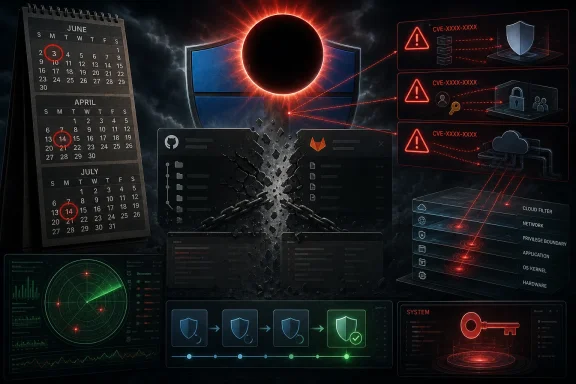
The Admin’s Calendar Now Has Three Dates Circled in Red
The practical lesson from the Nightmare Eclipse affair is that defenders cannot wait for the narrative to settle. The public dispute may continue for weeks, and the researcher’s July 14 threat may or may not materialize. The patch and monitoring work has to proceed anyway.
- Organizations should verify that the April 14, 2026 fixes covering CVE-2026-33825 have been deployed across supported Windows systems.
- Organizations should prioritize the May 21, 2026 out-of-band fixes for CVE-2026-41091 and CVE-2026-45498, especially where Microsoft Defender is the primary endpoint protection layer.
- Security teams should treat CISA’s June 3, 2026 KEV deadline as a practical benchmark even outside the U.S. federal environment.
- Administrators should assume that YellowKey, GreenPlasma, and MiniPlasma require monitoring and compensating controls until Microsoft provides complete patch guidance.
- Incident responders should hunt for suspicious privilege escalation, Defender tampering, unexpected security-service failures, and post-exploitation behavior rather than waiting for a perfect indicator list.
- Change managers should prepare an emergency review path for July 14, 2026 in case Microsoft ships urgent fixes or new exploit material appears.
The uncomfortable truth is that the ban from GitHub and GitLab may have changed the distribution story without changing the risk. Nightmare Eclipse has turned a vulnerability dispute into a countdown, and Microsoft now has to answer in the only language that matters to Windows users: patches, clarity, and evidence that the security layer beneath everyone’s daily work can still be trusted. July 14 may pass as noise or arrive as another rupture, but the lesson is already here — when endpoint defenses become the target, the whole Windows maintenance model is on trial.