

Microsoft is pushing harder to define what it actually means to move AI agents from demo to deployment, and Nimble is emerging as a sharp example of why the data layer now matters as much as the model layer. The company’s pitch is simple but timely: enterprises do not just need agents that can talk, they need agents that can retrieve fresh, structured, and auditable web data and operate reliably inside business workflows. Microsoft’s own platform story increasingly points in the same direction, with Foundry IQ, governance controls, and agent tooling built to ground production systems in enterprise data and controls. (azure.microsoft.com)
The enterprise AI market has entered a more demanding phase. Early enthusiasm centered on copilots, chatbots, and quick proofs of concept, but buyers have since learned that “smart” is not the same as “shippable.” In production, the questions change fast: Where does the data come from? How current is it? Can it be audited? Can the system survive permissioning, policy, and edge cases? Those are the questions Nimble is trying to answer with a more specialized web retrieval stack, and Microsoft is clearly investing in adjacent platform capabilities that make that approach easier to operationalize. (learn.microsoft.com)
That broader shift is visible in Microsoft’s startup messaging as well. Microsoft for Startups describes Azure as a way for startups to move prototypes into production-grade agents with enterprise reliability and compliance, while also offering a path to faster development, testing, and market readiness. Microsoft’s partner story is not just about cloud credits anymore; it is about helping startups prove they can work inside enterprise buying criteria. (microsoft.com)
Nimble sits in the middle of that transition. The company is not merely claiming to do search better than a generic crawler or a static index. It is positioning its platform as a live, structured data layer for agents in industries where information changes quickly and decisions have consequences. That makes the company interesting not because it is chasing the loudest AI narrative, but because it is solving one of the least glamorous and most important problems in enterprise AI: reliable retrieval. (azure.microsoft.com)
At the same time, Microsoft’s own platform evolution gives this story a second layer of significance. Foundry now emphasizes secure grounding, access controls, observability, and integration with the wider Microsoft ecosystem. In other words, the market is converging on a simple truth: if agents are going to act, the systems behind them must be trustworthy, current, and governed. Nimble’s value proposition lands squarely in that gap. (azure.microsoft.com)
That is why Nimble’s message resonates. The company is focused on the problem that makes many enterprise agents brittle: the data they rely on is often stale, noisy, incomplete, or too hard to use directly. When retrieval is generic, the output is generic. When retrieval is structured and current, the agent can support actions instead of just generating text. That distinction is becoming the defining line between experimentation and production. (azure.microsoft.com)
Nimble’s approach is designed to reduce that tax by returning data in forms that are easier for downstream systems to consume. That matters because enterprise AI rarely fails in the model call itself; it fails in all the handoffs around it. More structured retrieval means less brittle orchestration and fewer places where a task can go sideways. (azure.microsoft.com)
The practical point is that agents need more than answers. They need context, recency, and formatting that can be consumed by downstream automation. If a system is extracting vendor data, travel availability, pricing signals, or market intelligence, the burden is not just to find the web page. It is to normalize the result into something usable and repeatable. That is where Nimble appears to be staking its claim. (azure.microsoft.com)
Nimble’s emphasis on structure also reflects a broader market truth: many enterprise buyers do not want a search engine, they want a data product. They want source-linked fields, validation-friendly results, and fewer manual steps between retrieval and action. That is a more demanding standard, but it is also the standard that production AI now requires. (azure.microsoft.com)
Microsoft’s own messaging is unusually explicit on this point. The company says it helps startups move faster through infrastructure and foundational support, and it notes that services on Azure that are production-ready can be vetted for inclusion to help drive leads and accelerate sales cycles. That is not a casual perk; it is a real route into enterprise credibility. (microsoft.com)
That makes the startup relationship more than a branding exercise. It becomes a signal that the company is not operating on the edge of enterprise systems but inside a platform designed for them. In practical sales terms, that can reduce friction, especially when the buyer is already standardized on Azure or Microsoft’s enterprise stack. (microsoft.com)
Microsoft’s Foundry platform increasingly reflects that reality. It now emphasizes secure grounding on enterprise data, observability, security and governance controls, and identity-aware access across the agent lifecycle. That tells us the platform market is maturing in the same direction as the startup market: from experimentation to managed behavior. (azure.microsoft.com)
That is especially true in regulated or high-stakes workflows. Financial services, market intelligence, and enterprise sales all rely on data that changes quickly but still needs to be accountable. A system that cannot explain its inputs is, in practice, a system that will be limited to low-risk use cases. (azure.microsoft.com)
That advantage is particularly visible in sectors like travel, e-commerce, and financial intelligence. In those environments, stale information is not merely inconvenient. It can cause bad recommendations, broken workflows, and poor customer outcomes. Fresh retrieval, by contrast, supports decisions that are more likely to be useful at the moment they matter. (azure.microsoft.com)
This is also why structured web retrieval is so attractive to automation teams. The more a system can rely on live data instead of brittle scrapes or cached pages, the more it can support dynamic decisions. In enterprise AI, freshness is a control surface, not just a performance metric. (azure.microsoft.com)
This matters because enterprise AI buyers increasingly want a coherent stack rather than a pile of point solutions. They want models, retrieval, orchestration, monitoring, and policy to live in a system that can be managed as a whole. Microsoft’s platform narrative is designed to satisfy that need, and Nimble complements it by addressing the web-data side of the problem. (azure.microsoft.com)
That makes the Nimble story more than a vendor case study. It becomes an illustration of how Microsoft wants the modern enterprise AI stack to work: a startup supplies a specialized capability, while the platform supplies the governance and deployment surface. The result is a tighter journey from innovation to production. (microsoft.com)
The reason is straightforward. These sectors rely on external signals, current information, and fast turnaround. A system that can reliably collect, structure, and deliver that information gives teams a practical advantage. It can help a marketplace compare listings, a travel workflow assess availability, or a sales team prioritize accounts with better context. (azure.microsoft.com)
That difference changes product design. Consumer tools can optimize for delight and speed; enterprise tools must optimize for repeatability and governance. Nimble’s positioning suggests it understands that divide and is building for the side of the market where reliability buys budget. (azure.microsoft.com)
Microsoft’s ecosystem multiplies that opportunity. Azure, Foundry, and Microsoft for Startups give Nimble a technical and commercial pathway into enterprise buyers who want more than a point solution. When that ecosystem fit is strong, startups can move faster and look more credible earlier. (microsoft.com)
There is also execution risk. Enterprise AI is unforgiving when reliability slips, and web data introduces complexity that is hard to eliminate entirely. The more dynamic the source environment, the more likely a retrieval product must handle variability, schema drift, and edge cases that can quietly erode trust. (learn.microsoft.com)
Microsoft’s platform direction suggests the company sees the same trend. Foundry, Foundry IQ, security controls, monitoring, and ecosystem integrations all point toward a production model in which agents are governed systems, not just clever prompts. If that vision continues to solidify, startups that specialize in trustworthy retrieval will have a stronger story to tell. (azure.microsoft.com)
Source: Microsoft How Nimble helps enterprises move AI agents from prototype to production
 Overview
The enterprise AI market has entered a more demanding phase. Early enthusiasm centered on copilots, chatbots, and quick proofs of concept, but buyers have since learned that “smart” is not the same as “shippable.” In production, the questions change fast: Where does the data come from? How current is it? Can it be audited? Can the system survive permissioning, policy, and edge cases? Those are the questions Nimble is trying to answer with a more specialized web retrieval stack, and Microsoft is clearly investing in adjacent platform capabilities that make that approach easier to operationalize. (learn.microsoft.com)That broader shift is visible in Microsoft’s startup messaging as well. Microsoft for Startups describes Azure as a way for startups to move prototypes into production-grade agents with enterprise reliability and compliance, while also offering a path to faster development, testing, and market readiness. Microsoft’s partner story is not just about cloud credits anymore; it is about helping startups prove they can work inside enterprise buying criteria. (microsoft.com)
Nimble sits in the middle of that transition. The company is not merely claiming to do search better than a generic crawler or a static index. It is positioning its platform as a live, structured data layer for agents in industries where information changes quickly and decisions have consequences. That makes the company interesting not because it is chasing the loudest AI narrative, but because it is solving one of the least glamorous and most important problems in enterprise AI: reliable retrieval. (azure.microsoft.com)
At the same time, Microsoft’s own platform evolution gives this story a second layer of significance. Foundry now emphasizes secure grounding, access controls, observability, and integration with the wider Microsoft ecosystem. In other words, the market is converging on a simple truth: if agents are going to act, the systems behind them must be trustworthy, current, and governed. Nimble’s value proposition lands squarely in that gap. (azure.microsoft.com)
Why Prototype Success Is Not Production Success
A prototype can be impressive for all the wrong reasons. It can answer a handful of questions well, hide its weaknesses behind polished prompts, and still fail the moment a customer asks it to support a real workflow. In enterprise environments, that gap is often where AI projects stall. The issue is not usually intelligence; it is the operational scaffolding around intelligence. (learn.microsoft.com)That is why Nimble’s message resonates. The company is focused on the problem that makes many enterprise agents brittle: the data they rely on is often stale, noisy, incomplete, or too hard to use directly. When retrieval is generic, the output is generic. When retrieval is structured and current, the agent can support actions instead of just generating text. That distinction is becoming the defining line between experimentation and production. (azure.microsoft.com)
The hidden cost of “good enough” retrieval
For a prototype, broad search results may be acceptable. For production, they can be expensive. Teams then spend time cleaning outputs, validating sources, and building workaround logic that should have been part of the retrieval layer from the start. Over time, that maintenance burden becomes a product tax on the whole AI stack. (learn.microsoft.com)Nimble’s approach is designed to reduce that tax by returning data in forms that are easier for downstream systems to consume. That matters because enterprise AI rarely fails in the model call itself; it fails in all the handoffs around it. More structured retrieval means less brittle orchestration and fewer places where a task can go sideways. (azure.microsoft.com)
- Prototype speed can hide production fragility.
- Generic search often returns broad, SEO-driven results.
- Static indexes can age out quickly.
- Structured retrieval reduces downstream cleanup.
- Reliable inputs make agent workflows easier to govern.
What Nimble Is Building
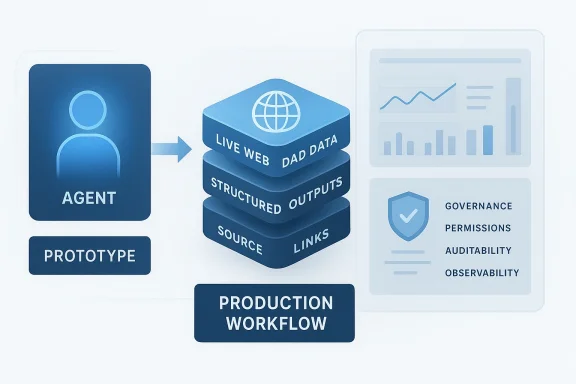
Nimble is building an AI web search infrastructure layer meant for enterprise use cases, not casual search. Instead of relying on a broad, consumer-style indexing approach, the company emphasizes live web data, use-case-specific shaping, and structured outputs that can be dropped into workflows with less manual transformation. That is a subtle difference in product design, but a major one in enterprise utility. (azure.microsoft.com)The practical point is that agents need more than answers. They need context, recency, and formatting that can be consumed by downstream automation. If a system is extracting vendor data, travel availability, pricing signals, or market intelligence, the burden is not just to find the web page. It is to normalize the result into something usable and repeatable. That is where Nimble appears to be staking its claim. (azure.microsoft.com)
Structured outputs as a product strategy
Structured outputs are often discussed as a technical convenience, but in enterprise AI they are really a control mechanism. They reduce ambiguity, improve repeatability, and make it easier to verify whether the system is behaving consistently over time. That gives businesses a stronger basis for deploying agents into real processes. (azure.microsoft.com)Nimble’s emphasis on structure also reflects a broader market truth: many enterprise buyers do not want a search engine, they want a data product. They want source-linked fields, validation-friendly results, and fewer manual steps between retrieval and action. That is a more demanding standard, but it is also the standard that production AI now requires. (azure.microsoft.com)
- Live web data is more useful than stale indexed content.
- Structured outputs reduce hallucination risk downstream.
- Use-case shaping matters more than raw query volume.
- Enterprise buyers want data they can validate.
- Retrieval quality is becoming a competitive moat.
Why Microsoft for Startups Matters Here
Nimble’s relationship with Microsoft for Startups is significant because it shows how startup infrastructure and enterprise distribution now reinforce each other. Microsoft has long argued that startups need more than credits: they need technical foundation, access to enterprise ecosystems, and help turning early traction into credible sales motion. That is exactly the combination Nimble appears to have used. (microsoft.com)Microsoft’s own messaging is unusually explicit on this point. The company says it helps startups move faster through infrastructure and foundational support, and it notes that services on Azure that are production-ready can be vetted for inclusion to help drive leads and accelerate sales cycles. That is not a casual perk; it is a real route into enterprise credibility. (microsoft.com)
The startup-to-enterprise bridge
For AI startups, the hardest part is often not building a proof of concept. It is convincing enterprise buyers that the product can survive procurement, security review, and operational pressure. Microsoft’s ecosystem can shorten that path because many buyers already trust the platform and understand the controls around it. (microsoft.com)That makes the startup relationship more than a branding exercise. It becomes a signal that the company is not operating on the edge of enterprise systems but inside a platform designed for them. In practical sales terms, that can reduce friction, especially when the buyer is already standardized on Azure or Microsoft’s enterprise stack. (microsoft.com)
- Microsoft for Startups adds technical credibility.
- Azure infrastructure supports scaling and testing.
- Enterprise buyers often trust Microsoft’s governance posture.
- Platform alignment can shorten sales cycles.
- Ecosystem fit can matter as much as product features.
Why Trust and Governance Are Now the Real Product
The biggest misconception in agentic AI is that the hardest part is the model. In enterprise settings, the harder problem is trust. Buyers want to know which sources are used, what permissions apply, how outputs are generated, and whether results can be reproduced or audited later. Those questions are not peripheral; they are core requirements. (azure.microsoft.com)Microsoft’s Foundry platform increasingly reflects that reality. It now emphasizes secure grounding on enterprise data, observability, security and governance controls, and identity-aware access across the agent lifecycle. That tells us the platform market is maturing in the same direction as the startup market: from experimentation to managed behavior. (azure.microsoft.com)
Verifiability as a deployment gate
Nimble’s insistence on source-linked, structured outputs is important because it aligns with what enterprises need to approve an agent for real work. If a response can be traced and repeated, it becomes easier to validate. If it cannot, it becomes hard to trust, no matter how good the demo looks. (azure.microsoft.com)That is especially true in regulated or high-stakes workflows. Financial services, market intelligence, and enterprise sales all rely on data that changes quickly but still needs to be accountable. A system that cannot explain its inputs is, in practice, a system that will be limited to low-risk use cases. (azure.microsoft.com)
- Auditable outputs support enterprise approval.
- Permissions matter as much as retrieval quality.
- Repeatability is essential in regulated workflows.
- Source-linked data builds confidence.
- Governance reduces operational surprises.
Why Fresh Data Beats Static Indexes
A static index is inherently vulnerable to drift. The web changes constantly, and businesses that depend on current information cannot afford retrieval layers that lag behind the market. Nimble’s live-data focus is therefore not just a technical choice; it is a competitive one.That advantage is particularly visible in sectors like travel, e-commerce, and financial intelligence. In those environments, stale information is not merely inconvenient. It can cause bad recommendations, broken workflows, and poor customer outcomes. Fresh retrieval, by contrast, supports decisions that are more likely to be useful at the moment they matter. (azure.microsoft.com)
The business value of recency
The value of current data often shows up only after deployment. A prototype may work fine with yesterday’s snapshot, but a production workflow may need pricing, availability, or market signals that change hourly or even faster. That is where a live retrieval layer pays for itself.This is also why structured web retrieval is so attractive to automation teams. The more a system can rely on live data instead of brittle scrapes or cached pages, the more it can support dynamic decisions. In enterprise AI, freshness is a control surface, not just a performance metric. (azure.microsoft.com)
- Static indexes go stale quickly.
- Live retrieval supports dynamic workflows.
- Fresh data reduces bad automation decisions.
- Time-sensitive industries need current inputs.
- Recency is part of reliability, not just speed.
How Nimble Fits the Microsoft Stack
Microsoft’s platform story is clearly converging around agent grounding, security, and operational control. Foundry IQ now frames grounding as a secure multi-source entry point with built-in permissions, while the wider Foundry ecosystem connects agents to tools, data sources, observability, and governance. That makes it a natural environment for startups like Nimble that want to sit upstream of enterprise agent workflows. (azure.microsoft.com)This matters because enterprise AI buyers increasingly want a coherent stack rather than a pile of point solutions. They want models, retrieval, orchestration, monitoring, and policy to live in a system that can be managed as a whole. Microsoft’s platform narrative is designed to satisfy that need, and Nimble complements it by addressing the web-data side of the problem. (azure.microsoft.com)
Azure as an operational base
Azure’s role is not only compute. It is the operational foundation that supports scale, security, and integration with enterprise processes. Microsoft explicitly positions Azure and Foundry as a path for startups to prototype and then move into production-grade agents with compliance and enterprise reliability built in. (learn.microsoft.com)That makes the Nimble story more than a vendor case study. It becomes an illustration of how Microsoft wants the modern enterprise AI stack to work: a startup supplies a specialized capability, while the platform supplies the governance and deployment surface. The result is a tighter journey from innovation to production. (microsoft.com)
- Foundry IQ emphasizes secure grounding.
- Azure provides the production base.
- Microsoft’s ecosystem supports integration depth.
- Platform coherence reduces operational friction.
- Specialized startups fill the retrieval gap.
Which Industries Benefit Most
Nimble’s traction is strongest where data is fragmented, fast-moving, and commercially valuable. That includes e-commerce, travel, financial services, and B2B sales or growth teams. Those are not random categories; they are the places where a better retrieval layer can directly improve revenue, conversion, and decision quality. (azure.microsoft.com)The reason is straightforward. These sectors rely on external signals, current information, and fast turnaround. A system that can reliably collect, structure, and deliver that information gives teams a practical advantage. It can help a marketplace compare listings, a travel workflow assess availability, or a sales team prioritize accounts with better context. (azure.microsoft.com)
Enterprise use cases versus consumer use cases
Enterprise use cases are narrower but more valuable. Consumer AI can get away with broader, lighter-weight responses because the stakes are lower. Enterprise AI has to be correct enough to act on, which means the data layer carries more responsibility. (learn.microsoft.com)That difference changes product design. Consumer tools can optimize for delight and speed; enterprise tools must optimize for repeatability and governance. Nimble’s positioning suggests it understands that divide and is building for the side of the market where reliability buys budget. (azure.microsoft.com)
- E-commerce benefits from current pricing and inventory signals.
- Travel workflows depend on live availability.
- Financial services needs timely and auditable intelligence.
- Sales teams need structured account and market context.
- High-stakes use cases reward repeatability over novelty.
Strengths and Opportunities
Nimble’s strongest advantage is that it solves a real production problem rather than a headline-friendly one. Enterprises already know how to build prototypes; they struggle to make agents trustworthy at scale. By focusing on structured, fresh, and source-linked retrieval, Nimble is aiming at the part of the stack that most directly influences adoption. That is a good place to build a moat. (azure.microsoft.com)Microsoft’s ecosystem multiplies that opportunity. Azure, Foundry, and Microsoft for Startups give Nimble a technical and commercial pathway into enterprise buyers who want more than a point solution. When that ecosystem fit is strong, startups can move faster and look more credible earlier. (microsoft.com)
- Nimble addresses a core enterprise pain point.
- Structured outputs improve downstream reliability.
- Live web data supports real-time workflows.
- Azure provides a scalable production base.
- Microsoft ecosystem alignment helps credibility.
- Enterprise buyers value verifiability.
- Focused industry use cases can accelerate adoption.
Risks and Concerns
The main risk for Nimble is that the market will increasingly expect this kind of capability as a baseline rather than a differentiator. Once major platforms and incumbents deepen their own grounding and retrieval layers, niche providers may face pressure to prove why they are better, faster, or more specialized. That is a real challenge in a market moving quickly toward consolidation. (azure.microsoft.com)There is also execution risk. Enterprise AI is unforgiving when reliability slips, and web data introduces complexity that is hard to eliminate entirely. The more dynamic the source environment, the more likely a retrieval product must handle variability, schema drift, and edge cases that can quietly erode trust. (learn.microsoft.com)
- Platform competition can compress differentiation.
- Web data is inherently messy and variable.
- Reliability failures can damage enterprise trust.
- Sales cycles can stretch if governance questions remain.
- Overly broad messaging can weaken positioning.
- Maintenance overhead may rise as use cases expand.
Looking Ahead
The next phase of this market will be defined by whether enterprises treat retrieval as a strategic layer or merely a utility. If agents are expected to do actual work, then the quality of the data layer becomes central to business outcomes. That is the opening Nimble is trying to exploit, and it is why the company’s positioning feels aligned with where the market is heading.Microsoft’s platform direction suggests the company sees the same trend. Foundry, Foundry IQ, security controls, monitoring, and ecosystem integrations all point toward a production model in which agents are governed systems, not just clever prompts. If that vision continues to solidify, startups that specialize in trustworthy retrieval will have a stronger story to tell. (azure.microsoft.com)
What to watch next
- Whether Nimble expands into more industry-specific retrieval modes.
- Whether it deepens integration with Microsoft’s enterprise AI stack.
- Whether more customers demand structured outputs as a default requirement.
- Whether platform vendors absorb more of the retrieval layer over time.
- Whether enterprise buyers prioritize auditability over raw search breadth.
Source: Microsoft How Nimble helps enterprises move AI agents from prototype to production
