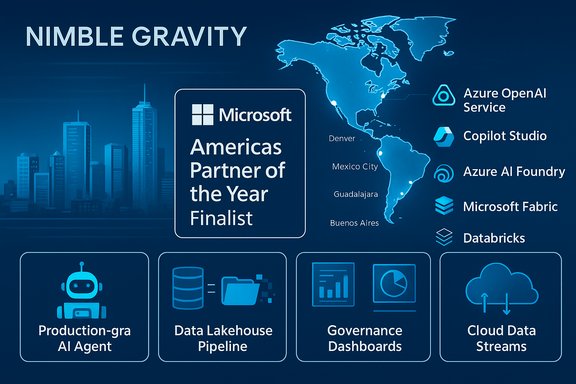
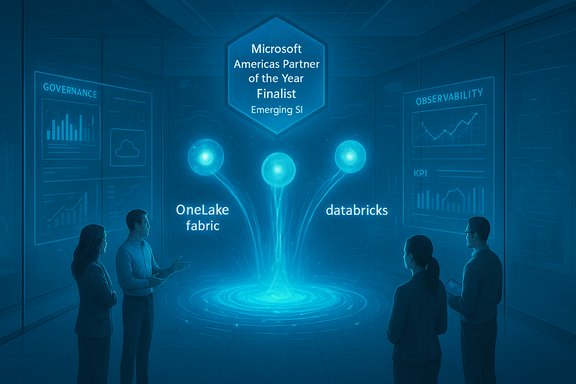
Nimble Gravity has been named a Microsoft Americas Partner of the Year finalist in the Emerging SI category — a recognition the firm announced in a press release and local coverage that frames the award as validation of its rapid growth, production-grade AI practice, and deepening partnership with Microsoft across Azure, Copilot Studio, Microsoft Fabric and Databricks.
Nimble Gravity is a Denver‑headquartered data, AI and digital engineering consultancy that, according to company materials, was founded in 2019 and operates across North and Latin America. The firm positions itself as a practitioner‑led systems integrator focused on moving enterprises from AI experimentation into production AI systems with governance, observability and measurable business KPIs. Microsoft’s Partner of the Year awards are an annual program that recognizes partner innovation and customer impact across global and regional categories. The Americas awards include a mix of country and region prizes and typically name one winner and up to three finalists per category; the program’s nomination windows and categories are documented by Microsoft’s partner team. Nimble Gravity’s announcement states the firm was selected from more than 2,100 nominations across the Americas, and highlights two core “pragmatic accelerators” the company uses to scale customers to production AI: an agentic AI application accelerator (built on Azure OpenAI, Copilot Studio and Azure AI Foundry) and a data lakehouse accelerator (built on Microsoft Fabric and Azure Databricks). These accelerators are aimed at shortening time to production and tying AI deployments to defined metrics.
Nimble Gravity’s announcement underscores broader industry momentum: enterprises are increasingly demanding partners that can translate generative AI and agent experiments into governed, observable, and cost‑manageable production systems. For IT leaders, the opportunity is clear — but the path forward requires both speed and stringent controls to convert potential into durable business value.
Source: ColoradoBiz Nimble Gravity earns spot as Microsoft Partner of the Year finalist
 Background / Overview
Nimble Gravity is a Denver‑headquartered data, AI and digital engineering consultancy that, according to company materials, was founded in 2019 and operates across North and Latin America. The firm positions itself as a practitioner‑led systems integrator focused on moving enterprises from AI experimentation into production AI systems with governance, observability and measurable business KPIs. Microsoft’s Partner of the Year awards are an annual program that recognizes partner innovation and customer impact across global and regional categories. The Americas awards include a mix of country and region prizes and typically name one winner and up to three finalists per category; the program’s nomination windows and categories are documented by Microsoft’s partner team. Nimble Gravity’s announcement states the firm was selected from more than 2,100 nominations across the Americas, and highlights two core “pragmatic accelerators” the company uses to scale customers to production AI: an agentic AI application accelerator (built on Azure OpenAI, Copilot Studio and Azure AI Foundry) and a data lakehouse accelerator (built on Microsoft Fabric and Azure Databricks). These accelerators are aimed at shortening time to production and tying AI deployments to defined metrics. Why this finalist placement matters
Being named a finalist in the Microsoft Americas Partner of the Year program is more than a PR badge — it acts as a market signal with practical implications for partners, customers and talent.- Platform validation: Finalist status signals alignment with Microsoft’s strategic priorities (Azure, Fabric, Copilot and AI governance) and is often backed by submission materials that emphasize measurable customer outcomes.
- Go‑to‑market leverage: Finalists typically receive amplification through Microsoft channels, which can accelerate co‑sell opportunities and field introductions.
- Recruiting and trust: Award recognition makes it easier to recruit senior practitioners and can reduce friction in procurement conversations where customers look for Microsoft‑aligned vendors.
The technical stack Nimble Gravity highlights — what it means in practice
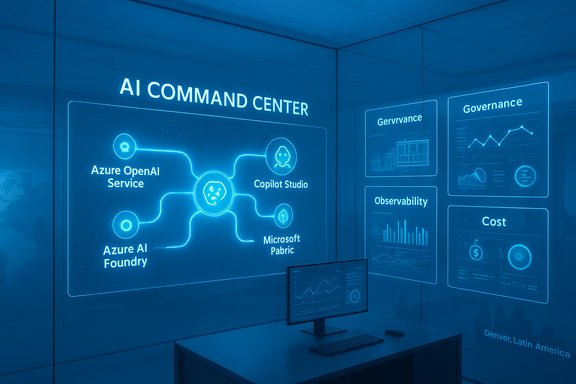
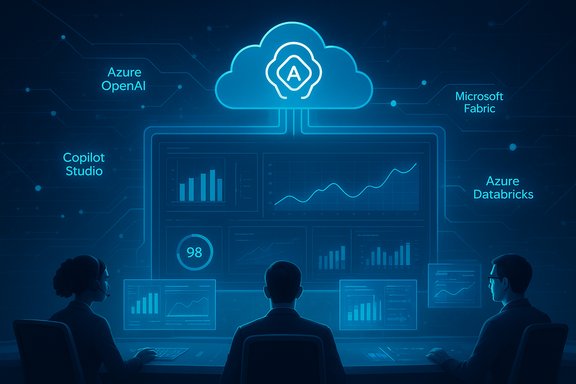
Nimble Gravity’s announcement specifically calls out Azure OpenAI Service, Copilot Studio (and Azure AI Foundry), Microsoft Fabric and Databricks as the core tooling for its accelerators. Each of these components plays a distinct role in moving models, agents and analytics into production.Azure OpenAI Service and Azure AI Foundry
- Azure OpenAI provides access to foundation models and reasoning models under Azure’s enterprise controls; it supports model APIs, embeddings, and fine‑tuning patterns used in production deployments. Azure AI Foundry functions as a managed lifecycle layer for models and agents, adding cataloging, observability and governance features critical for regulated enterprise use. These platform features are explicitly designed to enable enterprise‑grade agent and model deployment.
- Practical implication: Using Azure OpenAI + Foundry gives teams a path to integrate large language models with identity, logging and regional compliance controls — reducing the gap between prototype and auditable production systems. However, it also introduces operational requirements (cost governance, logging/retention and red‑team testing) that customers must validate contractually.
Microsoft Copilot Studio
- Copilot Studio is Microsoft’s workspace for building and managing AI agents and copilots; it supports custom agents, connectors to business data, and publishing across enterprise channels. For organizations that previously relied on one‑off LLM experiments, Copilot Studio provides standardized tooling to accelerate adoption while embedding governance patterns.
- Practical implication: Copilot Studio speeds adoption for citizen builders and product teams, but outputs and agent behaviors must be tested against business data to avoid hallucination‑driven errors and to capture traceability for compliance.
Microsoft Fabric and OneLake
- Microsoft Fabric is an integrated analytics, governance and lakehouse offering with OneLake as the unified data layer. Fabric provides a single data foundation designed to support analytics, ML feature stores and the dataset needs that underpin reliable generative experiences. Fabric’s OneLake catalog and governance features are intended to make data discoverable and governed across teams.
- Practical implication: A governed lakehouse reduces brittle integrations between analytics and agent layers. For buyers, the critical questions are around lineage, sensitivity labeling, and exportability of data should they need to move away from a particular vendor or platform.
Azure Databricks
- Azure Databricks remains a leading lakehouse and data engineering platform on Azure, optimized for Spark workloads and integrated with Azure services (Power BI, Azure storage, Azure AD). Databricks is often used for large‑scale ETL/feature engineering and for model training/serving pipelines.
- Practical implication: Combining Fabric (for governed enterprise data) with Databricks (for heavy data engineering and ML) is a common enterprise pattern. The advantage is engineering scale; the risk is complexity in cost and engineering ownership if roles and FinOps are not defined.
Strengths in Nimble Gravity’s approach
Nimble Gravity’s public pitch and the finalist placement point to several real strengths that enterprise buyers and technical leaders should notice.- Production focus: The firm frames its work around production AI, not proofs‑of‑concept. That emphasis mirrors what enterprise IT organizations increasingly demand: repeatable deployments, MLOps, and measurable KPIs rather than one‑off demos.
- Platform alignment: Nimble Gravity’s accelerators directly map to Microsoft’s enterprise AI stack — Azure OpenAI, Copilot Studio, Fabric and Databricks — which reduces integration friction for customers already invested in Azure. Microsoft’s partner programs reward this kind of alignment.
- Productized IP: Offering repeatable accelerators (agentic AI and lakehouse modernization) suggests the company has codified delivery patterns and can scale engagements faster than bespoke consulting-only models. This reduces time-to-value for early production runs.
- Regional footprint and delivery scale: Nimble Gravity’s presence across North and Latin America positions it well for customers with distributed operations who need cross‑region delivery capabilities.
Risks, caveats and things procurement should verify
Awards and finalists are useful signals. They are not substitutes for technical checks. The following are concrete risks buyers should validate before selecting Nimble Gravity (or any partner for production AI).- Awards ≠ audited guarantees: Finalist status is based on submissions and judged entries; it is not the same as an independent technical audit or SOC/ISO certification. Require third‑party or customer‑provided evidence for security and compliance claims.
- Vendor lock‑in: Heavy reliance on integrated Microsoft services (Fabric, Copilot Studio, Azure OpenAI, Databricks) makes migrations costly. Insist on a clear exit and data portability plan, including export formats and transfer time/cost estimates.
- Operational cost and FinOps exposure: Production LLM and agent workloads can be expensive if not governed. Procurement must require transparent cost modeling, tagging, and FinOps controls as part of the engagement contract.
- Governance and explainability: Generative systems must have monitoring, content filtering, and a human‑in‑the‑loop pattern for decisioning — especially in regulated industries. Verify red‑team testing, model cards and drift detection mechanisms in the partner’s delivery artifacts.
- Nomination and publicity claims: While Nimble Gravity’s press release (and local coverage) state it was selected from “more than 2,100” regional nominations, buyers should validate award confirmation through Microsoft’s official finalists listing or request the partner’s Microsoft nomination acknowledgement for procurement files. Microsoft publishes award categories and winners/finalists, and independent confirmation is a prudent step.
A practical procurement checklist (step‑by‑step)
- Request official award confirmation: Obtain a screenshot or letter from Microsoft Partner Center (or an official Microsoft finalists page snapshot) that shows Nimble Gravity’s finalist status. This converts a press claim into a verifiable artifact.
- Validate technical credentials: Ask for named practitioners, role certifications, and any Partner Center metadata the partner used in its submission. Confirm exam IDs and dates where possible.
- Obtain production evidence: Require 2–3 references for production AI projects of similar scope, including before/after KPIs and architecture diagrams showing where sensitive data is stored and how models are served.
- Run a short, measurable PoV: Define a 4–12 week proof of value with explicit KPIs (latency, cost per inference, accuracy, business outcomes) and acceptance criteria. Include a cost‑cap and reporting cadence.
- Confirm security posture: Request SOC2 / ISO artifacts, penetration testing summaries, and an incident response plan. Include contract clauses for breach responsibilities and data residency.
- Insist on portability and exit clauses: Specify export formats for data and models, timeline for data return, and rights to use exported artifacts without vendor software. Validate these with legal and cloud architecture teams.
- Require cost transparency: Ensure Azure resource tagging, expected monthly spend projections, and a shared FinOps dashboard are part of delivery. Include an escalation path for cost overruns.
What this means for Windows and Azure administrators
For Windows and Azure admins — the teams who will operate and secure these systems — Nimble Gravity’s finalist placement signals an option to accelerate enterprise AI adoption with a Microsoft‑native partner. Operational implications include:- Identity and access: Solutions will need Azure AD integration, role‑based access for Copilot agents, and careful entitlements for model and data access. Ensure Entra/Azure AD configurations are included in the implementation scope.
- Monitoring and observability: Plan for centralized logging (Azure Monitor, Databricks metrics) and anomaly detection at both model‑output and infrastructure layers. The partner should deliver runbooks and SLAs for incident response.
- Endpoint and data protection: If agents interact with user desktops or internal apps, evaluate the attack surface and ensure limited privileged access patterns and credential vaulting are in place. Copilot Studio’s “computer use” features require strict guardrails.
- Cost governance: LLM workloads consume CPU/GPU and tokens; enforce tagging, budgets and alerts. Ensure visibility into Azure consumption before scale‑up decisions.
Independent verification and transparency
Nimble Gravity’s finalist claim appears in its PR distribution and local coverage; independent verification can be obtained from Microsoft’s public Partner of the Year announcements and the Microsoft partner pages that list winners and finalists. Microsoft’s partner blog and awards portal document the program’s categories, nomination periods and how finalists are recognized — buyers should cross‑check the partner claim there and request nomination artifacts for procurement records. Where specific numerical claims matter — for example, the number of nominations or the depth of a partner’s Azure consumption — buyers must treat vendor statements as starting points and ask for the underlying evidence (Partner Center snapshots, named references, or audited consumption reports). Awards amplify vendor narratives but are not a substitute for audit‑level evidence.Final assessment — measured optimism with pragmatic guardrails
Nimble Gravity’s finalist placement in the Microsoft Americas Partner of the Year program is a meaningful commercial signal: it demonstrates the company’s alignment with Microsoft’s AI and data stack and suggests the firm has articulated repeatable, production‑oriented delivery patterns. For enterprises seeking faster, safer routes to production AI, that market positioning matters. However, the practical value to any given organization will depend on disciplined procurement and technical validation. Awards and finalist badges accelerate conversations; they do not remove the need for verifiable production evidence, security audits, cost controls and clear exit strategies. Treat the finalist status as a positive filter on a short list — not the final decision.Nimble Gravity’s announcement underscores broader industry momentum: enterprises are increasingly demanding partners that can translate generative AI and agent experiments into governed, observable, and cost‑manageable production systems. For IT leaders, the opportunity is clear — but the path forward requires both speed and stringent controls to convert potential into durable business value.
Source: ColoradoBiz Nimble Gravity earns spot as Microsoft Partner of the Year finalist