

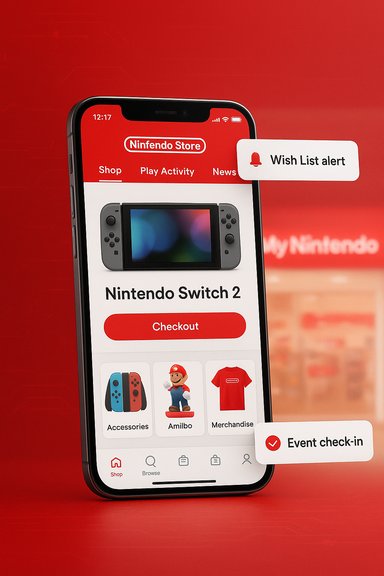
Nintendo has quietly rolled out a dedicated Nintendo Store app for iOS and Android, giving fans a native mobile hub to browse Nintendo hardware, digital and physical games, and official merchandise — and to link that activity directly to their Nintendo Account for play history, wish-list notifications, and event check-ins.
Nintendo’s mobile presence has long been a mosaic of specialized apps — from companion tools to promotional launch pieces — rather than a single unified storefront. The new Nintendo Store app is a global relaunch and rebrand of a Japan-only shopping companion that debuted in 2020, and it is now positioned as Nintendo’s official mobile gateway to My Nintendo Store content and account-linked services on iOS and Android. This move follows Nintendo’s broader 2025 strategy to expand its direct-to-consumer channels amid a strong hardware cycle (the Switch 2 launch) and a proliferation of franchise-driven services. The Store app is not a standalone eShop replacement — rather, it’s a browsing and account-management layer that funnels purchases through Nintendo’s web storefront while adding push notifications and lightweight account features.
The Nintendo Store app is a pragmatic, no-frills addition to Nintendo’s mobile ecosystem: it’s designed to push discovery and account engagement without the engineering and regulatory complexity of handling native in-app commerce. For most Nintendo enthusiasts — especially those tracking releases, sales, and account rewards — it will be a welcome convenience. For users expecting a fully native in-app shopping experience or global parity on merchandise shipping, it is a useful tool but not a complete solution.
The Nintendo Store app is available now on the Apple App Store and Google Play in regions served by the Nintendo eShop; users should update their device store settings, review app permissions, and link accounts if they want consolidated play history and wish-list alerts. For authoritative, up-to-date answers about regional availability, purchase fulfillment, or legacy NNID linking, consult Nintendo’s official support documentation and the app’s settings.
Source: Windows Report Nintendo Launches "Nintendo Store" App for iOS and Android
 Background
Nintendo’s mobile presence has long been a mosaic of specialized apps — from companion tools to promotional launch pieces — rather than a single unified storefront. The new Nintendo Store app is a global relaunch and rebrand of a Japan-only shopping companion that debuted in 2020, and it is now positioned as Nintendo’s official mobile gateway to My Nintendo Store content and account-linked services on iOS and Android. This move follows Nintendo’s broader 2025 strategy to expand its direct-to-consumer channels amid a strong hardware cycle (the Switch 2 launch) and a proliferation of franchise-driven services. The Store app is not a standalone eShop replacement — rather, it’s a browsing and account-management layer that funnels purchases through Nintendo’s web storefront while adding push notifications and lightweight account features. What the Nintendo Store app actually is
The app positions itself as a single, mobile-first hub for browsing everything Nintendo sells or highlights online. Its core functions break down into three practical areas:- Shop and browse: View Nintendo Switch 2 and Nintendo Switch hardware pages, accessories, amiibo, apparel, digital games, physical boxed games, and exclusive merchandise. Product pages open natively in the app for browsing and then direct users to Nintendo’s web storefront to complete purchases.
- Account and play information: Sign in with your Nintendo Account to view play activity for supported systems (Switch family and, with linking, legacy 3DS and Wii U data), Gold/Platinum Point balances, and purchase history. The app can show legacy play data only up to a cutoff (February 2020 for 3DS/Wii U entries).
- Notifications, events, and rewards: Opt into push notifications for Wish List price drops, store sales, game releases, and check in at official events or Nintendo stores to earn related rewards. The app also surfaces news, event details, and limited-time promotions.
How browsing and purchases work
The app emphasizes discovery and reminders rather than replacing Nintendo’s web commerce stack. When you tap an item inside the app it typically:- Displays product details and availability inside the app UI.
- Provides a link or button to “jump directly to My Nintendo Store” where payment and order completion happen in the browser.
Key features, clarified and verified
Below are the app’s most prominent features as documented in Nintendo’s support materials and confirmed by independent reporting.- Shop on My Nintendo Store — Browse systems (including Nintendo Switch 2), accessories, digital and physical games, and merchandise. Physical products are not available in every country; purchase availability varies by region.
- Play Activity — Signed-in users can review play data for their Nintendo Switch and Switch 2 consoles. For Nintendo 3DS and Wii U, play activity shows only if the user has linked a Nintendo Network ID (NNID) to their Nintendo Account and only up to February 2020 for legacy systems. Nintendo’s support page documents the linking flow and the historical cutoff.
- Wish List and Sale Notifications — Users can add products to a Wish List and enable push notifications when those items go on sale or when a game on that list releases. This is a standard retail feature but significant because it brings timely sale alerts directly to your phone.
- News, Events, and Check-ins — The app aggregates news and gives you the ability to check in at official Nintendo events and stores (Warp Pipe Pass / event check-in features are integrated), which may unlock small rewards or promotions.
- Account balances and redemption — Users can view Gold/Platinum Point balances, redeem codes or Nintendo eShop cards, and see purchase history within the app. Some account management tasks still require the Nintendo Account web portal.
Regional availability and limitations
The app is available wherever the Nintendo eShop operates, but there are important regional caveats:- Physical item purchases are currently limited in scope. In the Americas, Nintendo’s support portal lists the United States and Canada as markets where physical shopping is supported inside the app; other countries may only allow browsing with checkout redirected to region-specific partners or web flows. This means accessory or merch availability will vary by country and shipping region.
- Play activity for legacy systems (3DS/Wii U) requires linking an NNID to your Nintendo Account and only shows data prior to February 2020. If your NNID was never linked, that historical data may no longer be accessible through the app.
- App store rollout windows: While the app is being distributed globally, it may appear first in major regions such as the United States, United Kingdom, Canada, and most of Europe — with staggered availability elsewhere in line with Nintendo’s eShop footprint. Users in markets without an active eShop might not see full functionality.
Privacy, data, and account linking — what to watch for
The app’s value comes from account integration, but that raises necessary privacy and data questions:- Play history transmission: Nintendo states play history is pulled from consoles after account linking and when the console is connected to the internet (sleep mode syncs can take up to 24 hours). Users should be aware that console-initiated data syncs and account links expose a record of play activity to the Nintendo Account ecosystem.
- Notification and telemetry settings: The Nintendo Store app allows granular notification toggles (store updates, sales, game releases, check-in events). Users concerned with telemetry or app permissions should review and manage notification and app-permission settings at install and inside the app’s Settings screen.
- Checkout and payment: Because purchases are completed on Nintendo’s web storefront, standard web payment security applies; however, linking payment methods or storing billing details will follow Nintendo’s existing account payment policies rather than app-store in-app purchase models. That can be preferable for users who want centralized billing, but it means the transaction lives outside Apple’s and Google’s in-app frameworks.
- Third-party integrations: The app is not an open third-party marketplace; it funnels to Nintendo’s own web services. This reduces the surface area for risky third-party tracking but keeps all commerce and metadata under Nintendo’s operational and privacy policies. Users should consult Nintendo’s privacy statements and app permissions if they have concerns.
How the Nintendo Store app compares to previous Nintendo mobile efforts
Historically, Nintendo has released focused apps rather than a single unified storefront:- The My Nintendo app in Japan (2020) provided localized shopping and rewards features; the new Nintendo Store app is effectively a global evolution of that tool.
- Nintendo Today! and other news/companion apps focus on daily content and notifications; the Store app overlaps in the news and notification domain but adds commerce and account-integration features.
- Unlike native in-app stores that process purchases directly through platform billing (and incur app-store fees), Nintendo’s decision to redirect to the web keeps control of checkout and fulfills purchases via its established My Nintendo Store infrastructure — a conscious strategic choice consistent with many console-first publishers that want to preserve margins and fulfillment control.
Strategic implications for Nintendo and consumers
For Nintendo, the Store app brings a handful of strategic benefits and operational risks:- Benefits
- Better direct marketing reach: push notifications and wish-list alerts enable Nintendo to reach users with timely promotions and drop-in notifications.
- Increased discoverability for boxed and branded merchandise: curated product surfaces can boost accessory and merch attach rates.
- Centralized account engagement: consolidating play history, points, and event check-ins in one place encourages users to remain within Nintendo’s ecosystem.
- Risks
- Fragmented commerce experience: redirecting to the web for checkout can break the native flow and introduce friction during purchasing moments, especially on mobile where app-store native billing is usually simpler for users.
- Privacy scrutiny: account-linked play history and targeted notifications may prompt privacy-conscious users to audit what is shared; Nintendo must be transparent about data use and retention.
- Regional fulfillment complexity: offering physical items globally requires logistics, customs handling, and local customer service; restricted availability could frustrate collectors in unsupported regions.
Context: why this matters now (and how Switch 2’s momentum ties in)
The timing of the Nintendo Store app launch aligns with a period of strong Nintendo hardware momentum. Nintendo’s Switch 2 achieved rapid market penetration after its mid-2025 launch, with company reports and multiple outlets citing more than 10 million units sold in the first months of availability. Nintendo revised its full-year hardware forecast upward and reported substantial year-over-year revenue growth in its Q2 FY2026 earnings — a backdrop that makes a more polished direct retail channel sensible. Why this matters for the app: the combined dynamics of increased hardware adoption, high-profile first-party software, and a larger install base create a stronger addressable market for Nintendo merchandise, accessories, and premium boxed editions — precisely the categories the Store app highlights. For Nintendo, nudging players from discovery to purchase on mobile is a logical yield optimization when hardware demand and software attach rates are high. Caution: sales figures and forecasts are inherently time-sensitive. Reported unit numbers (e.g., “10.36 million Switch 2 units sold as of September 30, 2025”) are accurate per Nintendo’s Q2 FY2026 materials and major press coverage at the time of reporting, but forecasts and cumulative shipments evolve quarterly. Readers tracking long-term trends should consult the latest Nintendo investor communications for updated numbers.Practical advice for Windows and mobile shoppers
- If you’re primarily interested in digital purchases, the Nintendo Store app is a convenient way to follow releases, set wish-list alerts, and jump to the web checkout. For most users this will be an efficient discovery and reminder tool.
- If you collect physical editions or limited-run merchandise, verify region availability before assuming the product can be shipped to your country; the app and Nintendo Support explicitly note that physical item purchases are limited in scope. If a product is available in your region, the app will link you to the local My Nintendo Store checkout.
- For privacy-conscious users, review the app’s notification and account-permission settings. Link your NNID to your Nintendo Account only if you want legacy 3DS/Wii U play history to appear inside the mobile app.
- Consider bookmarking Nintendo’s web storefront on mobile if you prefer a full checkout experience without app-to-browser redirects; the app’s core value is discovery and reminders, not a new payment flow.
Final assessment: strengths, weaknesses, and the launch verdict
Strengths- The app consolidates discovery, account data, and retail reminders in a single mobile experience — a valuable convenience for frequent Nintendo customers.
- Push-notification Wish List alerts address a real pain point for collectors and deal-hunters.
- Account integration (play history, points, check-ins) deepens engagement and drives repeated interactions that can boost long-term customer value.
- The non-native checkout flow introduces an extra step in the buying process that may reduce conversion for impulse purchases.
- Regional fulfillment limitations for physical goods will frustrate some collectors and reduce the app’s appeal for international buyers.
- Data and privacy questions around play-history retention or telemetry remain worth clarifying for privacy-minded users. Nintendo’s support documentation covers the basics but does not disclose granular retention policies inside the app.
The Nintendo Store app is a pragmatic, no-frills addition to Nintendo’s mobile ecosystem: it’s designed to push discovery and account engagement without the engineering and regulatory complexity of handling native in-app commerce. For most Nintendo enthusiasts — especially those tracking releases, sales, and account rewards — it will be a welcome convenience. For users expecting a fully native in-app shopping experience or global parity on merchandise shipping, it is a useful tool but not a complete solution.
The Nintendo Store app is available now on the Apple App Store and Google Play in regions served by the Nintendo eShop; users should update their device store settings, review app permissions, and link accounts if they want consolidated play history and wish-list alerts. For authoritative, up-to-date answers about regional availability, purchase fulfillment, or legacy NNID linking, consult Nintendo’s official support documentation and the app’s settings.
Source: Windows Report Nintendo Launches "Nintendo Store" App for iOS and Android

