

NielsenIQ has turned a labor‑intensive warehouse of packaging photos and Excel sheets into a near‑real‑time product‑intelligence engine by automating “item coding” with Microsoft Foundry — cutting per‑item coding time by roughly 90%, coding 32,000 products in 10 hours instead of 300 hours, and using the automation as the foundation for a new global Product Insights service that scales across markets without hiring large native speaker teams.
NielsenIQ (NIQ) is a consumer‑intelligence company that sells product, retail and shopper analytics to manufacturers and retailers worldwide. Product packaging metadata — the ingredients, claims, nutrition facts, brand and other visible attributes — is one of the most important signals for NIQ’s analytics. NIQ’s product catalog now spans roughly 220 million unique product items and over nine billion product attributes, according to its regulatory filings, a dataset size that makes accurate, scalable product coding a business imperative. Historically, extracting structured data from packaging was a manual, time‑consuming process: teams photographed packages, annotated ingredients and nutrition panels, and used optical character recognition (OCR) and human review to populate the metadata database. NIQ estimates that manual item coding took about four minutes per item and required deep domain knowledge and language skills — a bottleneck for scaling to tens of thousands of SKUs across multiple countries. In 2021 NIQ acquired Label Insight — a leading product metadata company whose catalog and experience in product attribution became a strategic foundation for NIQ’s product content work. That acquisition is central to NIQ’s ability to combine decades of domain expertise with new automation.
Source: Microsoft NIQ scales product coding globally, expands reach, and speeds delivery with Foundry | Microsoft Customer Stories
 Background / Overview
NielsenIQ (NIQ) is a consumer‑intelligence company that sells product, retail and shopper analytics to manufacturers and retailers worldwide. Product packaging metadata — the ingredients, claims, nutrition facts, brand and other visible attributes — is one of the most important signals for NIQ’s analytics. NIQ’s product catalog now spans roughly 220 million unique product items and over nine billion product attributes, according to its regulatory filings, a dataset size that makes accurate, scalable product coding a business imperative. Historically, extracting structured data from packaging was a manual, time‑consuming process: teams photographed packages, annotated ingredients and nutrition panels, and used optical character recognition (OCR) and human review to populate the metadata database. NIQ estimates that manual item coding took about four minutes per item and required deep domain knowledge and language skills — a bottleneck for scaling to tens of thousands of SKUs across multiple countries. In 2021 NIQ acquired Label Insight — a leading product metadata company whose catalog and experience in product attribution became a strategic foundation for NIQ’s product content work. That acquisition is central to NIQ’s ability to combine decades of domain expertise with new automation. What NIQ built with Microsoft Foundry
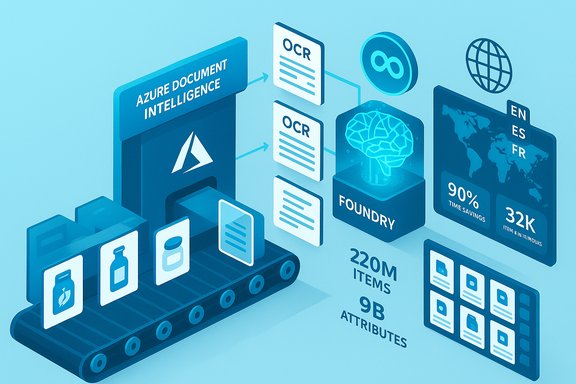
NIQ used Microsoft Foundry — specifically Azure OpenAI in Foundry Models, Azure Document Intelligence in Foundry Tools, Azure AI Search and Prompt Flow orchestration — to create Capture as a Service (CaaS), a generative‑AI‑powered pipeline that simulates NIQ’s human coding process with an ensemble of models and validation checks. The result was an MVP delivered in approximately four months and a productionized service that drastically reduced coding time and expanded market reach. Key, verifiable outcomes NIQ reports:- ~90% reduction in item coding time compared with manual coding.
- 32,000 products coded in 10 hours on a single project that previously would have required ~300 hours.
- Launch of the NIQ Product Insights (NPI) service across 25 new markets in months rather than years.
How the CaaS pipeline works — technical anatomy
NIQ’s CaaS recreates the manual coding workflow as a multi‑stage pipeline. At a high level:- Image ingestion: Packaging photos or scans are landed into a secure storage and cataloged.
- Document analysis: Azure Document Intelligence performs OCR, layout analysis and field extraction to produce structured text and positional metadata from images. This step preserves evidence links (where on the packaging a value was found).
- Interpretation and normalization: Azure OpenAI models (deployed inside Foundry) interpret extracted text, resolve ambiguous labels (e.g., “serving” vs “package”), normalize ingredient lists, map claims to NIQ taxonomies, and translate or disambiguate multilingual content when required.
- Validation and grounding: Azure AI Search and other retrieval components check the extracted/normalized values against NIQ’s existing catalog and curated knowledge bases to validate results and surface conflicts that need human review.
- Orchestration and governance: Prompt Flow orchestrates the sequence of model calls, human-in-the-loop checks, and logging for traceability; Foundry provides oversight controls, prompts registry and observability for model runs.
Why this matters: business impact and competitive advantage
Automation here is not just about reducing manual labor — it unlocks new product capabilities and commercial opportunities:- Faster product insights: By collapsing weeks of effort into hours, NIQ can deliver near‑real‑time updates to clients on product launches, reformulations, or claim changes — a competitive differentiator for retail analytics.
- Expanded market coverage: Language models and automated pipelines mean NIQ can enter markets where it lacked local coding teams, gaining global reach without long hiring cycles.
- Cost efficiency and velocity: Reduced per‑item cost improves margins and allows NIQ to offer higher‑frequency or more granular services to customers. The company attributes a >90% time savings to the approach.
- Productization: CaaS became the foundation of NPI, turning operational automation into a monetizable, platformized service that packages expertise with scale.
Critical analysis — notable strengths
- Domain + model synergy. NIQ combined decades of curated, proprietary product taxonomies (Label Insight legacy and NIQ’s Connect engine) with modern LLMs and Document AI — the result is greater accuracy than LLMs alone because the AI is grounded to authoritative product metadata.
- Rapid prototyping and iteration. The four‑month MVP demonstrates the practical payoff of using managed Foundry services: prebuilt model catalog, orchestration tools and governance primitives speed pilot‑to‑production cycles. That speed is repeatedly emphasized in Microsoft’s Foundry narratives.
- Multimodal engineering. Packaging is a multimodal problem (images + structured labels). Using Document Intelligence for layout and OCR plus LLMs for interpretation is a textbook example of combining best‑of‑breed modalities to reduce hallucination and increase precision.
- Operationalized oversight. Foundry’s observability and model‑routing features give NIQ the ability to supervise model outputs, set policies, and route edge cases to human reviewers — necessary for high‑trust data products like allergen flags.
Risks, caveats and areas that require continuous scrutiny
Automation at this scale brings meaningful risks that must be managed deliberately.- Data accuracy and error propagation. A small label error in a product (e.g., “contains tree nuts” misread) can have cascading consequences for shoppers and clients. Even with validation, automated pipelines will make mistakes; rigorous sampling, human reviews and rollback processes are essential. NIQ acknowledges this sensitivity and builds oversight into Foundry flows.
- Model hallucination and misinterpretation. LLMs can invent, conflate fields, or infer attributes that aren’t present. Grounding via search and deterministic extraction from Document Intelligence reduces but does not eliminate hallucination risk. Enterprises must monitor false positives/negatives and preserve evidence links to the original packaging.
- Language and locale coverage limits. While models handle many languages, performance can degrade in low‑resource languages, local dialects or non‑standard labeling conventions. Claims about “any market where a language model can understand the language” should be treated as aspirational and validated per region.
- Vendor and operational lock‑in. Packaging the entire stack inside a cloud vendor’s platform (Foundry + Azure services) speeds delivery but concentrates operational and contractual risk. Migration of indexes, transformation logic and provenance data should be part of vendor exit planning.
- Privacy, IP and contractual constraints. Clients and retailers may have contractual rules around product images, private labeling or IP. Additionally, any use of client data to further fine‑tune models must be governed by clear contractual terms. Foundry provides tenancy and data controls, but contracts must reflect usage rights and training constraints.
- Regulatory and compliance exposure. In some jurisdictions, product claims and labeling are regulated; automated extraction that feeds client dashboards will need audit trails and defensible provenance to support regulatory inquiries. NIQ’s use of grounding and evidence linking addresses this, but compliance is an ongoing operational burden.
A practical playbook — how enterprise teams should approach similar projects
- Inventory and prioritize: map the product categories and regions with highest business value and highest labeling risk.
- Start hybrid: pilot with a human‑in‑the‑loop configuration (AI suggests, humans confirm) to gather labeled signals and measure precision/recall.
- Ground everything: ensure each automated value includes a direct link back to the original image/text fragment extracted by Document Intelligence.
- Implement rigorous sampling and A/B validations: periodically compare automated outputs to manual gold standards and measure drift.
- Define SLOs and rollback plans: define acceptable error thresholds, testing gates, and emergency rollback playbooks for production issues.
- Model and prompt governance: version prompts, record model parameters and maintain a prompt registry to support reproducibility and audit.
- Contract and data use controls: explicitly prohibit undisclosed training on client data unless contractually agreed and enforce retention and residency requirements where needed.
- Exit and portability plan: produce exportable indexes, transformation code and documentation so the service can be migrated if required.
Economics and operational tradeoffs
Automating item coding reduces labor costs and speeds delivery, but it also shifts costs to compute, storage and ongoing model operations:- Expect ongoing inference costs for large‑scale processing and storage costs for images, vector indexes and provenance metadata.
- Engineering effort migrates from manual coding to systems engineering: build/test pipelines, red‑team for safety, and continuous monitoring.
- Procurement tradeoffs: Foundry’s integration into Azure consumption contracts can simplify billing for enterprises already on Azure, but multi‑cloud strategies may require layering or abstraction to avoid lock‑in. Foundry’s billing integration (MACC eligibility) was specifically cited as a procurement convenience in related Foundry materials.
Industry implications and competitive dynamics
NIQ’s move illustrates a broader pattern in enterprise AI for retail and consumer goods:- Data moats plus generative AI accelerate productization. Companies that combine unique, authoritative datasets with generative models can productize workflows at scale faster than purely human‑driven competitors. NIQ’s catalog scale (220M items, 9B attributes) makes the company hard to replicate while giving it high‑value signals to ground model outputs.
- Platform play for hyperscalers and SIs. Microsoft’s Foundry (and comparable offerings from other clouds) is being positioned as the production orchestration layer for multi‑model, agentic deployments. That platform framing creates a market for system integrators and accelerators that can productize vertical workflows quickly.
- New product categories emerge. Automated product‑attribute services (like NIQ’s NPI built on CaaS) can be re‑sold to brands, retailers and marketplaces — creating new recurring revenue streams around catalog enrichment, regulatory reporting and personalized search optimization.
What to watch next (and where claims need verification)
- Model behavior in low‑resource languages and local label conventions. NIQ reports expansion to multiple markets rapidly; independent validation of accuracy per region will be important. The Microsoft customer story highlights fast market rollouts but does not publish per‑market precision/recall stats — those are business‑sensitive and should be validated in customer engagements.
- Operational costs at sustained scale. One‑off throughput numbers (32,000 SKUs in 10 hours) are impressive; the ongoing cost per SKU at global run rates depends on caching, PTUs/throughput units and vendor pricing evolution. Procurement teams should request real workload billing estimates.
- Contractual promises about data usage. As customers consume NIQ’s enriched data, contracts should reflect whether outputs are used for model training or only for inference — a nuance that affects privacy, IP and competition. This detail is not fully visible in vendor case narratives and requires contractual review.
- Regulatory audits and traceability. Automated pipelines must retain provenance for regulatory or litigation inquiries. NIQ emphasizes evidence linking in its Foundry flows, but independent audits would strengthen trust for regulators and large enterprise buyers.
Conclusion
NIQ’s Capture as a Service shows how a data‑rich company can convert manual, labor‑heavy product coding into a scalable, monetizable service by combining proprietary taxonomies with contemporary multimodal AI and a managed platform like Microsoft Foundry. The result is dramatic productivity improvements — NIQ reports roughly 90% time savings and the ability to code tens of thousands of SKUs in hours — and a credible pathway to expanding global coverage without proportional hiring. At the same time, the technical and commercial promise brings real, manageable risks: accuracy and hallucination controls, language variability, compliance and traceability, vendor dependence, and ongoing operational costs. Organizations that replicate this pattern should prioritize grounding, evidence linking, human oversight, contractual clarity on data use, and an explicit portability plan. When those controls are in place, the combination of a large product metadata moat and automated, model‑driven tooling creates a durable advantage in retail and product intelligence — exactly the outcome NIQ’s team set out to achieve.Source: Microsoft NIQ scales product coding globally, expands reach, and speeds delivery with Foundry | Microsoft Customer Stories
