

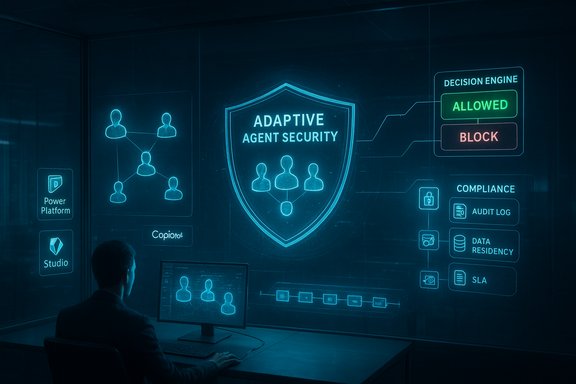
Nokod Security’s new Adaptive Agent Security promises to bring continuous, runtime protection and governance to the fast-growing world of citizen-built AI agents — addressing the class of risks that appear when no-code and low-code builders connect autonomous agents to live systems, connectors and data sources without traditional development controls.
AI agents created by citizen developers inside platforms such as Microsoft Copilot Studio, Microsoft Power Platform, ServiceNow, UiPath and Salesforce are no longer simple scripted automations. They can reason, call APIs, chain tools, persist memory and — crucially — continue to learn and adapt after deployment. That agentic behavior widens attack surfaces and breaks many assumptions that legacy application security relies on: build‑time checks, static code scans and traditional DLP appliances are no longer sufficient when an agent can change its plan at runtime and access multiple systems at machine speed.
Nokod Security’s announcement — published via a distributor and carried in industry feeds — introduces Adaptive Agent Security, a platform designed to discover, profile and control AI agents across the Agent Development Lifecycle (ADLC). The vendor positions the product as an end‑to‑end runtime enforcement layer that links agent inventory and ownership to behavioral baselining and synchronous blocking for risky tool invocations. The press materials emphasize coverage for Microsoft Copilot Studio specifically, enabling inline decisioning against Copilot agent tool calls. This is consistent with the architectural pattern Microsoft exposes for Copilot Studio: agents can call an external monitoring endpoint via an analyze-tool-execution webhook that returns an allow/block decision in real time. To set the market context, mainstream analyst firms warn that agentic automation will scale quickly and create complex governance gaps. Gartner, for example, forecast that by 2028 a significant share of GenAI interactions will invoke autonomous agents — a prediction that underpins why vendors are racing to build runtime controls and observability for agents.
However, buyers should verify a few critical items before committing:
Adopting such a control plane can materially reduce agent‑driven risk — but only if organizations treat runtime monitoring as a resilient, privacy‑aware and policy‑managed capability. The security community should insist on technical verification (latency, retention, scale) and operational readiness (policy tuning, red‑teaming, fallback policies) before moving from pilot to production enforcement. The next wave of secure agent adoption will not come from tools alone; it will require discipline, measurement and hard contractual assurances that the telemetry and verdicting that protect us do not themselves become new attack surfaces.
Source: The Manila Times Nokod Security Unveils Adaptive Agent Security for Real-Time Protection Across the Agent Development Lifecycle
 Background / Overview
AI agents created by citizen developers inside platforms such as Microsoft Copilot Studio, Microsoft Power Platform, ServiceNow, UiPath and Salesforce are no longer simple scripted automations. They can reason, call APIs, chain tools, persist memory and — crucially — continue to learn and adapt after deployment. That agentic behavior widens attack surfaces and breaks many assumptions that legacy application security relies on: build‑time checks, static code scans and traditional DLP appliances are no longer sufficient when an agent can change its plan at runtime and access multiple systems at machine speed.Nokod Security’s announcement — published via a distributor and carried in industry feeds — introduces Adaptive Agent Security, a platform designed to discover, profile and control AI agents across the Agent Development Lifecycle (ADLC). The vendor positions the product as an end‑to‑end runtime enforcement layer that links agent inventory and ownership to behavioral baselining and synchronous blocking for risky tool invocations. The press materials emphasize coverage for Microsoft Copilot Studio specifically, enabling inline decisioning against Copilot agent tool calls. This is consistent with the architectural pattern Microsoft exposes for Copilot Studio: agents can call an external monitoring endpoint via an analyze-tool-execution webhook that returns an allow/block decision in real time. To set the market context, mainstream analyst firms warn that agentic automation will scale quickly and create complex governance gaps. Gartner, for example, forecast that by 2028 a significant share of GenAI interactions will invoke autonomous agents — a prediction that underpins why vendors are racing to build runtime controls and observability for agents.
What Nokod’s Adaptive Agent Security claims to deliver
Nokod’s product announcement outlines four core runtime capabilities intended to secure agents built by no‑coders and citizen developers. The marketing summary highlights:- Agent discovery and ownership mapping — automatic inventory of agents, linking each agent to its creator/owner and surfacing which systems, connectors and data sources the agent can access.
- Behavioral profiling and baselining — continuous learning of agent activity and tool usage patterns to establish a benign profile for anomaly detection.
- Detection and blocking of risky actions — real‑time interception of high‑risk steps (unauthorized connector use, environment bridging, potential data exfiltration) and the ability to block or alter the action inline.
- Continuous enforcement of security policies across the ADLC — adaptive guardrails that travel with the agent from build to runtime and remain active as the agent evolves.
Technical verification: what is provable today
Several technical claims made in vendor announcements are verifiable against public platform documentation and industry integrations:- Microsoft Copilot Studio provides an external security webhooks API (POST /analyze-tool-execution) that sends a “plan” payload — including prompt, recent chat history, target tool and its inputs — to a configured monitoring endpoint for synchronous risk evaluation. The monitor returns a structured verdict (e.g., blockAction: true/false). This mechanism is documented by Microsoft and is the exact technical surface vendors use to provide inline enforcement.
- Analyst firms and industry press have documented the same architectural pattern: discovery/inventory plus synchronous runtime controls are being adopted by multiple vendors to secure agentic workloads. This underpins why competitors and peers (Prisma AIRS / Palo Alto, Zenity, Snyk, HUMAN, Entro and others) are announcing agent discovery, policy enforcement and runtime blocking features. Those vendor moves corroborate that Nokod’s product is part of a broader, confirmed market shift.
- The broader operational tradeoffs — telemetry residency, latency SLAs, fail‑open vs fail‑closed fallback behavior and the need for policy tuning — are well documented in platform and third‑party analyses. These are not vendor marketing points; they are practical constraints imposed by the synchronous webhook model and must be validated during pilots.
How the Copilot Studio integration works (practical mechanics)
Microsoft’s external security webhook model is instructive because it provides an explicit, supported integration path that Nokod and other vendors can use to enforce policies inline. The mechanics look like this in practice:- When an agent composes a plan with steps and tool calls, Copilot Studio packages the plan payload (user message, thought, chat history, conversationId, planId, planStepId and tool inputs) and POSTs it to the external monitoring endpoint (POST /analyze-tool-execution).
- The external monitor evaluates the payload against policies, behavioral models and contextual signals (agent identity, owner, environment, sensitivity labels) and returns a JSON verdict that indicates whether the action should be allowed or blocked.
- Copilot Studio proceeds or halts the particular step based on the verdict; the transaction is logged for audit and forensics.
Market context and competitors: where Nokod fits
The agent security space has become crowded quickly. Vendors are converging on the same basic problem statement — agents are a new class of non‑human identities or “NHIs” with unique threat models — and are offering overlapping capabilities around discovery, behavior baselining, model and memory controls, and runtime enforcement.- Palo Alto Networks’ Prisma AIRS (AIRS 2.0) and similar products emphasize posture + runtime: inventory agents, harden models and insert inline controls into agent tool invocation workflows. These solutions publicly describe using Copilot Studio’s analyze-tool-execution endpoint to mediate tool calls.
- Platform‑centric vendors and large security companies (Snyk, HUMAN, Entro, Proofpoint etc. are building adaptive trust and gatekeeper layers for agentic traffic, often focusing on web and customer‑facing surfaces or supply chain/model lineage protections. These products may emphasize actor-level trust decisions and fraud prevention in addition to data protection.
- Specialist LCNC/no‑code security vendors (including Nokod itself, which has public history in low-code/no‑code application security and has been profiled by industry analysts) are positioning to secure the citizen developer footprint across multiple platforms. Nokod’s prior product direction (inventorying no‑code apps, surfacing misconfigurations and enabling remediation) gives it relevant domain experience as it extends into agent‑centric runtime controls.
Strengths and notable positives
- Focus on citizen development risk — Nokod’s background in low‑code/no‑code security is a practical advantage because many agent risks stem from the same democratized builders who introduced LCNC app sprawl. Nokod’s platform is designed to tie findings back to creators and owners, a capability that matters for operational remediation.
- Runtime enforcement, not just alerts — moving from post‑hoc detection to inline blocking is the right architectural move for agentic threats. Vendors that can reliably intercept high‑risk steps (e.g., connector writes to payroll, mass outbound emails, or API calls that would exfiltrate critical PII) provide real prevention, not just noisy alerts. Microsoft’s webhook model makes this pattern feasible and explains the industry uptake.
- Platform breadth potential — Nokod’s stated support for multiple agent and LCNC platforms (Power Platform, UiPath, ServiceNow, Salesforce) maps to real enterprise heterogeneity; a multi‑platform approach can reduce the “shadow agent” problem where teams create agents in islands outside central visibility.
- Operational maturity signals — Nokod’s prior analyst recognition and integrations into enterprise ecosystems suggest a vendor that understands audits, compliance workflows, and developer remediation pathways — all crucial for adoption by regulated organizations.
Risks, limitations and practical caveats
No runtime enforcement solution is a silver bullet. The following are the principal, practical risks that organizations must evaluate before trusting any agent runtime monitor, Nokod included:- Telemetry exposure and data residency — the plan payload typically contains prompts, chat history and parameter values. That data can include PII, proprietary documents or regulated information. Sending live payloads to third‑party monitors requires contractual and technical guarantees (data minimization, in‑memory evaluation, no‑persistence, encryption, region residency). If the monitor stores plan payloads, that is a material compliance risk for regulated industries. These are non‑trivial legal, privacy and assurance topics and must be validated through contractual terms and independent audits.
- Latency and availability requirements — synchronous monitoring becomes part of the execution path. If the monitor is slow or unreachable, some platform preview behaviors default to allow (fail‑open) to preserve user experience — a tradeoff that can materially expand the attack surface. Customers should insist on SLA guarantees, measure p95/p99 latency under expected loads and design resilient, multi‑region monitor topologies.
- False positives and business friction — inline blocking of legitimate actions will disrupt processes. Security teams must invest in policy‑engineering workflows, staged rollouts (log‑only → block), escalation paths and exception handling to avoid breaking business continuity. The operational cost of tuning policies should not be underestimated.
- Model/map drift and adaptive adversaries — agents can be intentionally or inadvertently retrained; adversaries can craft prompt injections or obfuscation tactics that reduce monitor visibility. Robust defenses require continuous red‑teaming, model inspection and monitor‑hardened designs to detect adaptive evasion. Published research and vendor playbooks note that monitors themselves must be tested against agent‑aware attack patterns.
- Operational and governance overhead — assigning ownership, lifecycle rules, decommissioning criteria and cost accounting for thousands of agents is organizationally heavy. Runtime controls reduce risk, but they do not replace governance practices such as least‑privilege, credential rotation, and periodic agent reviews.
Practical rollout checklist — what teams should require in pilot
Organizations that pilot Adaptive Agent Security (or any runtime monitor) should treat it like mission‑critical infrastructure and validate the following checklist before production enforcement:- Inventory and classification
- Discover all agents and map owners, environments and connector scopes.
- Tag high‑risk agents (those that can write to databases, send emails, access HR/payroll).
- Pilot in logging mode
- Run the webhook in passive/logging mode first. Collect plan payloads, timing metrics and verdict distributions.
- Measure false positive/negative signals and tune policies before blocking.
- SLA and latency verification
- Load test the monitor at expected peak QPS and measure p95/p99 latency and availability.
- Validate failover behavior in the tenant (is it fail‑open or fail‑closed? and adjust fallback policies accordingly.
- Telemetry and retention controls
- Require proof that plan payloads are evaluated in memory only or that retention windows meet compliance needs.
- Prefer tenant‑hosted or VNet‑backed monitor deployments for regulated data.
- Policy engineering process
- Establish a cross‑functional runbook for policy updates, exception approvals and business continuity override flows.
- Red‑teaming and continuous validation
- Automate agent red‑teaming to surface evasions; integrate with CI/CD or agent release gates.
- Audit and evidence for compliance
- Ensure immutable audit trails with clear agent identity, owner, timestamp, payload summary and verdicts for forensic and audit use.
Compliance and governance implications
Adaptive runtime enforcement touches multiple compliance domains:- Data protection (GDPR, CCPA, sectoral privacy laws) — ensure minimal data transfer and contractual data processing agreements or keep monitors inside the corporate tenant.
- Industry regulations (finance, healthcare) — regulators will want evidence that automated agents operate under auditable guardrails and that blocking decisions are logged and explainable.
- Contractual vendor risk — third‑party monitors must prove security posture, SOC2 / ISO certifications and contractual deletion guarantees for collected telemetry.
Where Nokod’s announcement is strong — and where to verify claims
Nokod’s focus on citizen development, the emphasis on ownership mapping, and the explicit call‑out of Copilot Studio support are aligned to proven platform patterns and market demand. Their messaging reflects an important reality: agent controls must be continuous and adaptive because agents evolve after deployment.However, buyers should verify a few critical items before committing:
- Confirm the exact deployment topology Nokod will use for your tenant (in‑tenant/VNet vs vendor-hosted), and validate telemetry residency and retention guarantees as contractual terms.
- Obtain latency and availability metrics for the analyze-tool-execution decision loop under realistic load and ask for p95/p99 numbers and failover designs.
- Request independent test results or references for scale: how did Nokod perform in customers with hundreds or thousands of agents?
- Validate policy expressiveness and integration points with your existing SIEM/XDR, DLP and governance tooling.
Final assessment: value proposition vs operational cost
Adaptive Agent Security addresses a real and growing gap. The combination of agent discovery, behavioral baselining and synchronous blocking is the right technical strategy to prevent live exfiltration and stop policy‑violating actions before they execute. Microsoft’s Copilot Studio webhook model and the broader market movement validate the architecture and explain why both platform owners and third‑party vendors are investing heavily in runtime controls. That said, the solution’s ultimate value depends on three practical factors:- Data controls and deployment model: Only tenant‑centric, privacy‑preserving deployments will be acceptable for many regulated workloads.
- Operational maturity: Organizations must invest in policy engineering, resilience and red‑teaming to keep false positives manageable and the monitor reliable.
- Measurable SLAs: Runtime enforcement becomes part of the critical path; vendors must provide hard numbers and customers must validate them.
Conclusion
Adaptive Agent Security is a timely productization of a technically validated approach: discover agents, treat them as first‑class identities, baseline behavior and intervene synchronously when an agent attempts a risky action. Microsoft’s Copilot Studio webhook interface has made inline enforcement practical, and multiple vendors are racing to provide the guardrails enterprises will need as agentic automation scales. Nokod’s announcement fits squarely within this market shift and leverages its LCNC domain experience to target the citizen developer problem.Adopting such a control plane can materially reduce agent‑driven risk — but only if organizations treat runtime monitoring as a resilient, privacy‑aware and policy‑managed capability. The security community should insist on technical verification (latency, retention, scale) and operational readiness (policy tuning, red‑teaming, fallback policies) before moving from pilot to production enforcement. The next wave of secure agent adoption will not come from tools alone; it will require discipline, measurement and hard contractual assurances that the telemetry and verdicting that protect us do not themselves become new attack surfaces.
Source: The Manila Times Nokod Security Unveils Adaptive Agent Security for Real-Time Protection Across the Agent Development Lifecycle
