

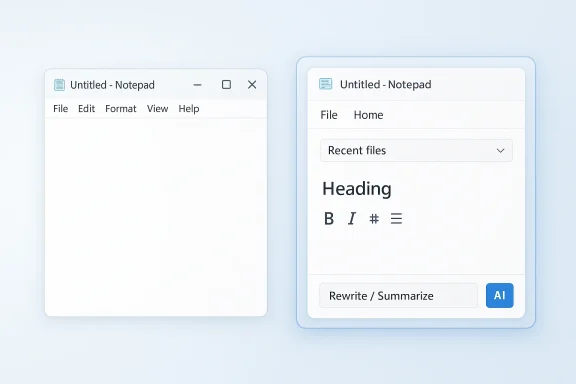
Microsoft’s Notepad is no longer just the tiny, no-nonsense text box Windows users grew up with. In Windows 11, it has quietly become a surprisingly capable editing surface with tabs, session restore, recent-file history, Markdown-style formatting, spell checking, autocorrect, and AI-assisted writing tools, while still trying to preserve the classic, fast-launch feel that made it famous. That evolution is exactly why the current conversation around “notepad-recent” matters: Microsoft is trying to modernize a legacy utility without destroying the simplicity that gives it value. The uploaded Thurrott.com material points to that broader arc, describing Notepad’s shift from a scratchpad into a more configurable workspace and, at the same time, Microsoft’s effort to keep its classic feel intact
Notepad occupies a rare place in Windows history because it was never meant to be a star. It began as a bundled utility, a simple demonstration of what a graphical desktop could do, and over time became one of the most trusted tools on the operating system. The reason users stayed loyal to it was not power but restraint: it opened instantly, did not get in the way, and was reliable in a way that more ambitious editors often were not. The Thurrott-inspired material in the uploaded file reflects that legacy by framing modern Notepad as a feature-rich but still familiar workspace, rather than a radical reinvention
That context matters because Microsoft’s recent Notepad changes are not happening in a vacuum. They are part of a larger Windows 11 strategy that has steadily pushed the desktop toward more integrated productivity features, more visible AI, and more stateful user experiences. Notepad has been pulled into that wave through tabs, session persistence, formatting, and writing assistance, but Microsoft appears to have learned that more does not automatically mean better when the app’s identity is built around speed and neutrality. The snippets in the uploaded file explicitly describe that balance: a richer Notepad that can still be stripped back close to the old experience
There is also an important practical dimension. When an app becomes the default scratchpad for notes, commands, snippets, drafts, and quick edits, users begin to rely on its behavior as much as its features. That means even small changes in recent-file handling, session restore, or visible AI controls can reshape how people work day to day. The result is that Notepad is now a case study in product philosophy, not just a text editor story. The uploaded material underscores this by treating recent-file history and the broader “classic feel” discussion as central, not incidental, elements of the app’s evolution
Recent-file behavior also makes Notepad more useful for common Windows workflows. People often reopen the same half-finished note, log, or snippet several times in a day, and recent-file access lowers friction. But it also adds a subtle layer of memory and expectation that older Notepad simply never had.
This is the central tension in the file’s coverage. The app is still recognizable, but it is now expressing a product ideology. Microsoft is effectively saying that even the most basic Windows utility should participate in the company’s broader productivity vision.
That old model was not perfect, of course. One long-standing limitation was line-ending handling. Windows users working with Unix, Linux, or classic Mac text files often encountered friction because the app was historically shaped around Windows conventions. Microsoft eventually addressed that in 2018 by improving support for different line endings, which quietly brought Notepad closer to the expectations of modern cross-platform users. That change was important not because it was flashy, but because it showed Microsoft could modernize the editor without breaking its core purpose.
The current Notepad experience grew from that sort of incremental modernization. Microsoft first added tabs, then autosave and session restoration, then Markdown-style formatting and richer editing features. Those additions transformed the app from a plain text field into something closer to a lightweight authoring surface. The uploaded text explicitly notes tabs, automatic file saving, session restore, and Markdown support as the key milestones in that transformation
At the same time, Microsoft’s broader Windows 11 direction has increasingly centered on visibility, productivity, and AI. That means Notepad is being asked to carry more than one message at once. It must remain instantly accessible, but it is also being used to demonstrate modern Windows capabilities. That dual role is why the app has become such a useful symbol in the wider debate over whether Microsoft is improving Windows or merely layering new features onto familiar surfaces.
That distinction matters because users form expectations based on app identity. If Notepad starts behaving like a workspace, then users expect recent items, tabs, persistence, and formatting. If it still looks like a scratchpad, though, they may feel the interface is becoming crowded without being told why.
That makes Notepad less of a relic and more of a strategic default. If Microsoft can keep it fast while adding just enough structure, it can fill an important gap in the Windows stack.
But convenience always comes with a cost in identity. Once an app remembers recent documents, it stops feeling purely transient. That is not automatically bad, but it does move Notepad closer to the behavior of a lightweight editor than a pure scratchpad. The uploaded source material’s title and framing around “notepad-recent” strongly reinforce that idea, even if the specific screenshot content is not detailed in the snippet itself
It also helps Notepad fit into more serious workflows. Developers, administrators, writers, and power users frequently reuse temporary text files, and a recent list reduces friction without demanding a full file-management strategy.
This is especially true for people who use Notepad for passwords, one-off codes, or other throwaway notes. A recent list may be useful, but it can also feel like a mild breach of the old “open and forget” promise.
Session restore and autosave push the app even further toward continuity. They mean Notepad is no longer just a blank page that disappears when you close it. Instead, it can bring your work back with you, which is useful if the app is being treated more like a lightweight workspace than a disposable tool. The uploaded text points to session restore and automatic saving as part of Notepad’s recent evolution, and that is a central reason the app now feels more modern
The important part is that tabs do not fundamentally alter Notepad’s job. They just make it easier to do the same job across more than one file.
Still, continuity changes expectations. Once users rely on it, they begin to assume Notepad is responsible for state, not just text. That is a more advanced role, and it naturally invites more scrutiny.
The uploaded file makes clear that Notepad’s modern identity includes formatting options, and that Microsoft wants users to be able to turn them off if they prefer the old behavior That choice is crucial. Optional formatting helps Microsoft preserve the utility’s minimalist reputation even as it expands the feature set.
It also aligns Notepad with modern workflows. Many users already draft in Markdown for notes, documentation, issue tracking, and personal knowledge bases. By supporting it natively, Microsoft makes the app more competitive without overcomplicating it.
The risk, of course, is feature creep. If formatting expands too far, Notepad could lose the very restraint that makes it useful. That is why the ability to disable these features matters so much.
But the app’s identity makes AI much more complicated here than in a mail client or document suite. Notepad has always been the place where users go when they do not want to negotiate with software. The uploaded material highlights that tension directly, describing Notepad as a test case for Microsoft’s balance between modernization and restraint, and noting the company’s effort to keep AI optional while reducing intrusive entry points
That is why Notepad is such a sensitive place for Copilot-style messaging. A visible AI affordance can change the emotional meaning of the app even if no one ever clicks it.
That distinction is one of the most important lessons in Windows 11’s current design cycle. Users do not only evaluate features; they evaluate the pressure created by the interface.
The uploaded material explicitly says Microsoft is trying to keep the classic experience intact even as Notepad becomes more configurable and capable That is the right instinct. But it is also a difficult design problem, because every new feature changes the texture of the app.
That is why Microsoft cannot treat Notepad like just another app in the bundle. It is part of the operating system’s emotional core.
That is the product challenge Microsoft faces in 2026: not whether Notepad can do more, but whether it should look like it does more all the time.
The uploaded file repeatedly frames Notepad as a useful test case for Microsoft’s broader product direction, and that is especially true in business environments where standardization matters When Notepad changes, IT managers notice, even if only because employees rely on it more than Microsoft may expect.
The biggest consumer advantage is still the same one Notepad has always had: it is already there. No install, no onboarding, no subscription barrier.
That does not mean enterprises will reject the changes. It means they will want clearer controls and a firmer understanding of what is local, what is cloud-based, and what can be disabled.
That can be good for the platform, but it also raises the bar for the rest of the market. If Microsoft can offer tabs, Markdown, and light AI in a built-in app, then third-party editors need clearer reasons to exist. The uploaded material implies exactly that dynamic by describing Notepad as a modernized native path that can stand in for simpler external editors
At the same time, this creates pressure on alternatives to differentiate more sharply. They can no longer win simply by being “Notepad, but better.” They need stronger workflows, better design, or more specialized features.
That is why this story matters far beyond one text editor. It is a small but symbolic test of how the Windows ecosystem should feel in the AI era.
There is also an opportunity for Microsoft to use Notepad as a model of restrained modernization. If the company can show that it knows when to add power and when to step back, it can rebuild trust in other parts of Windows too.
There is also a real risk of confusion. If some features are local, some are session-based, and some depend on cloud-connected AI, the mental model becomes harder to explain. That may be acceptable in a full productivity suite, but it is more problematic in a tool people once treated as invisible.
The real question is whether Microsoft treats restraint as a first-class product decision. That means not just adding capabilities, but deciding where not to surface them, which is often harder. In a platform built on familiar utilities, the difference between helpful and cluttered can be a single toolbar button.
Source: Thurrott.com notepad-recent - Thurrott.com
 Overview
Notepad occupies a rare place in Windows history because it was never meant to be a star. It began as a bundled utility, a simple demonstration of what a graphical desktop could do, and over time became one of the most trusted tools on the operating system. The reason users stayed loyal to it was not power but restraint: it opened instantly, did not get in the way, and was reliable in a way that more ambitious editors often were not. The Thurrott-inspired material in the uploaded file reflects that legacy by framing modern Notepad as a feature-rich but still familiar workspace, rather than a radical reinventionThat context matters because Microsoft’s recent Notepad changes are not happening in a vacuum. They are part of a larger Windows 11 strategy that has steadily pushed the desktop toward more integrated productivity features, more visible AI, and more stateful user experiences. Notepad has been pulled into that wave through tabs, session persistence, formatting, and writing assistance, but Microsoft appears to have learned that more does not automatically mean better when the app’s identity is built around speed and neutrality. The snippets in the uploaded file explicitly describe that balance: a richer Notepad that can still be stripped back close to the old experience
There is also an important practical dimension. When an app becomes the default scratchpad for notes, commands, snippets, drafts, and quick edits, users begin to rely on its behavior as much as its features. That means even small changes in recent-file handling, session restore, or visible AI controls can reshape how people work day to day. The result is that Notepad is now a case study in product philosophy, not just a text editor story. The uploaded material underscores this by treating recent-file history and the broader “classic feel” discussion as central, not incidental, elements of the app’s evolution
Why “recent” matters
The word recent is doing a lot of work here. A recent-files surface is not just a convenience feature; it changes the mental model of the app from temporary scratchpad to persistent workspace. That is a major shift for a tool historically associated with ephemeral, one-and-done text entry. Microsoft’s move toward that kind of statefulness is one reason Notepad’s update cycle has attracted so much attention in 2025 and 2026.Recent-file behavior also makes Notepad more useful for common Windows workflows. People often reopen the same half-finished note, log, or snippet several times in a day, and recent-file access lowers friction. But it also adds a subtle layer of memory and expectation that older Notepad simply never had.
A utility that now has opinions
The classic Notepad had very few opinions about how you worked. You typed, saved, and moved on. The modern version has a much clearer view of what a “good” note-taking experience should look like: tabs for multiple documents, session restore so you do not lose context, and formatting tools for people who want structure without graduating to a full word processor. That is useful, but it is no longer neutral.This is the central tension in the file’s coverage. The app is still recognizable, but it is now expressing a product ideology. Microsoft is effectively saying that even the most basic Windows utility should participate in the company’s broader productivity vision.
Background
For decades, Notepad was one of the most stable parts of Windows, and that stability became part of its identity. Users trusted it because it did very little, which made it excellent at doing exactly that little thing. The app’s launch speed, tiny footprint, and lack of clutter made it indispensable for quick tasks, from editing configuration files to jotting down a phone number. The uploaded material echoes that history by describing Notepad as a trusted, nearly invisible place to think, which is exactly what many users have always wanted from itThat old model was not perfect, of course. One long-standing limitation was line-ending handling. Windows users working with Unix, Linux, or classic Mac text files often encountered friction because the app was historically shaped around Windows conventions. Microsoft eventually addressed that in 2018 by improving support for different line endings, which quietly brought Notepad closer to the expectations of modern cross-platform users. That change was important not because it was flashy, but because it showed Microsoft could modernize the editor without breaking its core purpose.
The current Notepad experience grew from that sort of incremental modernization. Microsoft first added tabs, then autosave and session restoration, then Markdown-style formatting and richer editing features. Those additions transformed the app from a plain text field into something closer to a lightweight authoring surface. The uploaded text explicitly notes tabs, automatic file saving, session restore, and Markdown support as the key milestones in that transformation
At the same time, Microsoft’s broader Windows 11 direction has increasingly centered on visibility, productivity, and AI. That means Notepad is being asked to carry more than one message at once. It must remain instantly accessible, but it is also being used to demonstrate modern Windows capabilities. That dual role is why the app has become such a useful symbol in the wider debate over whether Microsoft is improving Windows or merely layering new features onto familiar surfaces.
From scratchpad to workspace
The shift from scratchpad to workspace is not merely semantic. A scratchpad is temporary, disposable, and intentionally simple. A workspace implies memory, state, and a workflow that can survive beyond a single session. Notepad’s recent evolution makes it much more of the latter, whether Microsoft says that explicitly or not.That distinction matters because users form expectations based on app identity. If Notepad starts behaving like a workspace, then users expect recent items, tabs, persistence, and formatting. If it still looks like a scratchpad, though, they may feel the interface is becoming crowded without being told why.
The WordPad gap
One reason Microsoft has room to evolve Notepad is that Windows has been losing other lightweight local-authoring options over time. That leaves Notepad in a stronger position than it used to have. In practical terms, Microsoft may now see it as the easiest native place to give users more than raw plain text without forcing them into a heavier Office-style path.That makes Notepad less of a relic and more of a strategic default. If Microsoft can keep it fast while adding just enough structure, it can fill an important gap in the Windows stack.
The Recent-File Experience
The recent-file layer is one of the biggest clues that Notepad is changing category. A list of recently opened files turns the app from a throwaway utility into something that remembers what you are doing. That is convenient for real work, especially when people revisit the same notes repeatedly through the day. It also makes the app feel more intentional and less ephemeral.But convenience always comes with a cost in identity. Once an app remembers recent documents, it stops feeling purely transient. That is not automatically bad, but it does move Notepad closer to the behavior of a lightweight editor than a pure scratchpad. The uploaded source material’s title and framing around “notepad-recent” strongly reinforce that idea, even if the specific screenshot content is not detailed in the snippet itself
Recent items as workflow glue
Recent-file history is a classic productivity feature because it removes small but repeated annoyances. Users no longer need to browse a directory tree or remember exactly where they saved a note. Instead, they can jump back into ongoing work with a single click. In a world where people keep dozens of tiny documents alive at once, that matters.It also helps Notepad fit into more serious workflows. Developers, administrators, writers, and power users frequently reuse temporary text files, and a recent list reduces friction without demanding a full file-management strategy.
The downside of memory
The downside is subtle but real. The more Notepad remembers, the more it behaves like a living workspace that carries context from session to session. That can be helpful, but it can also create privacy or expectation concerns for users who still think of it as a clean slate.This is especially true for people who use Notepad for passwords, one-off codes, or other throwaway notes. A recent list may be useful, but it can also feel like a mild breach of the old “open and forget” promise.
Tabs, Session Restore, and Continuity
Tabs were one of the most visible modern additions to Notepad, and they immediately changed how the app felt. Multiple documents can now live in one window, which reduces clutter and makes the editor more practical for users who juggle related text files. That sounds modest, but in daily use it is a major usability gain.Session restore and autosave push the app even further toward continuity. They mean Notepad is no longer just a blank page that disappears when you close it. Instead, it can bring your work back with you, which is useful if the app is being treated more like a lightweight workspace than a disposable tool. The uploaded text points to session restore and automatic saving as part of Notepad’s recent evolution, and that is a central reason the app now feels more modern
Why tabs changed the experience
Tabs make Notepad feel less like a single-purpose editor and more like a small document manager. Users can switch between multiple notes without spawning a desktop full of windows, and that lowers friction for quick multitasking. For a utility that traditionally competed on simplicity, this is a very careful kind of complexity.The important part is that tabs do not fundamentally alter Notepad’s job. They just make it easier to do the same job across more than one file.
Continuity without bloat
Session restore is powerful because it preserves momentum. If you closed a note by accident or simply shut down for the day, Notepad can help you pick up where you left off. That is especially valuable in a hybrid work environment where people use the same machine for many small tasks.Still, continuity changes expectations. Once users rely on it, they begin to assume Notepad is responsible for state, not just text. That is a more advanced role, and it naturally invites more scrutiny.
- Tabs improve multitasking without forcing a heavier interface.
- Session restore makes the app feel persistent rather than disposable.
- Autosave reduces accidental data loss.
- Recent history helps with repeated short-form work.
- Stateful behavior changes the privacy and trust conversation.
Markdown and Lightweight Formatting
One of the clearest signs that Microsoft wants Notepad to remain relevant is the addition of Markdown-style formatting. This is a smart move because it gives users structure without forcing them into classic rich-text bloat. Bold, italics, headings, lists, and links are enough to make notes more readable while still keeping the editing model compact.The uploaded file makes clear that Notepad’s modern identity includes formatting options, and that Microsoft wants users to be able to turn them off if they prefer the old behavior That choice is crucial. Optional formatting helps Microsoft preserve the utility’s minimalist reputation even as it expands the feature set.
Why Markdown is the right compromise
Markdown is a good fit for Notepad because it is both human-friendly and machine-friendly. It lets users mark up text quickly without learning a complex document model, and it remains close enough to plain text that the files are still portable and easy to inspect. That fits Windows users who need just a little structure, not a whole publishing system.It also aligns Notepad with modern workflows. Many users already draft in Markdown for notes, documentation, issue tracking, and personal knowledge bases. By supporting it natively, Microsoft makes the app more competitive without overcomplicating it.
Formatting as a philosophical signal
Formatting support is also a signal about what Microsoft thinks Notepad should be. It suggests the company no longer sees the app merely as a fallback utility, but as a legitimate surface for writing. That is a meaningful change in product philosophy.The risk, of course, is feature creep. If formatting expands too far, Notepad could lose the very restraint that makes it useful. That is why the ability to disable these features matters so much.
- Markdown support modernizes the app without turning it into Word.
- Bold and italics help with structure and readability.
- Lists and headings make small documents more useful.
- Optional controls preserve the classic feel.
- Plain text compatibility remains a core advantage.
AI in Notepad
The most controversial part of Notepad’s transformation is AI. Microsoft has introduced writing assistance concepts such as rewrite and summarize, and those features make sense on paper. They can be helpful for drafting, polishing, and quick transformation of rough text into something more usable. For students and office workers, that can be a genuine convenience.But the app’s identity makes AI much more complicated here than in a mail client or document suite. Notepad has always been the place where users go when they do not want to negotiate with software. The uploaded material highlights that tension directly, describing Notepad as a test case for Microsoft’s balance between modernization and restraint, and noting the company’s effort to keep AI optional while reducing intrusive entry points
Helpful in theory, intrusive in practice
AI features become harder to defend in a utility when the work itself is simple. If a user is editing a password, a command, a quick reminder, or a code snippet, they probably do not want an assistant trying to interpret or reshape the content. In those moments, AI is not an enhancement; it is a distraction.That is why Notepad is such a sensitive place for Copilot-style messaging. A visible AI affordance can change the emotional meaning of the app even if no one ever clicks it.
Optional is not invisible
Microsoft appears to understand that users want choice. The ability to turn off features is good, but optional does not equal invisible. The mere presence of AI buttons or prompts can still make an app feel heavier and more promotional than before.That distinction is one of the most important lessons in Windows 11’s current design cycle. Users do not only evaluate features; they evaluate the pressure created by the interface.
- Rewrite is useful for some drafting workflows.
- Summarize is useful for longer notes, not every note.
- Code snippets and secrets are poor candidates for AI interference.
- Visibility matters almost as much as capability.
- Trust is fragile in a minimalist app.
The “Classic Feel” Problem
The phrase classic feel is more than marketing fluff. It is Microsoft acknowledging that people do not just use Notepad for its functions; they use it for its personality. That personality is rooted in speed, simplicity, and the absence of drama. Any change that makes the app feel slow, crowded, or overly eager risks undermining that trust.The uploaded material explicitly says Microsoft is trying to keep the classic experience intact even as Notepad becomes more configurable and capable That is the right instinct. But it is also a difficult design problem, because every new feature changes the texture of the app.
Simplicity as a feature
For many Windows users, simplicity is not a fallback. It is the feature. The reason Notepad is still loved is that it gets out of the way. Its modern additions only work if they preserve that sense of immediacy.That is why Microsoft cannot treat Notepad like just another app in the bundle. It is part of the operating system’s emotional core.
When improvement becomes dilution
There is a point at which feature accumulation stops feeling like progress and starts feeling like dilution. Notepad is close to that boundary. Tabs, autosave, Markdown, and maybe even AI can all be justified individually. But together, they need careful restraint or they begin to blur the app’s identity.That is the product challenge Microsoft faces in 2026: not whether Notepad can do more, but whether it should look like it does more all the time.
- Speed is part of the brand.
- Minimalism remains the app’s strongest asset.
- Visibility of controls can feel like clutter.
- User trust depends on restraint.
- Feature layering must be deliberate, not reflexive.
Enterprise and Consumer Impact
Notepad’s evolution affects consumers and enterprises differently, which is one reason the current changes matter so much. For consumers, the appeal is obvious: a familiar app that now handles more note-taking, more formatting, and more session continuity. For enterprises, the story is more nuanced, because any AI or stateful feature raises policy, privacy, and support questions.The uploaded file repeatedly frames Notepad as a useful test case for Microsoft’s broader product direction, and that is especially true in business environments where standardization matters When Notepad changes, IT managers notice, even if only because employees rely on it more than Microsoft may expect.
Consumer benefits
Consumers benefit most from convenience. Tabs make day-to-day note handling simpler, formatting makes casual writing more readable, and recent-file behavior makes it easier to stay organized. These are the kinds of changes that quietly improve the Windows experience without forcing users to learn a new app.The biggest consumer advantage is still the same one Notepad has always had: it is already there. No install, no onboarding, no subscription barrier.
Enterprise caution
Enterprises, by contrast, care about predictability. If Notepad begins to save session state, expose AI options, or surface cloud-connected features, then administrators have to think more carefully about policy and behavior. Even if the features are optional, they still become part of the support surface.That does not mean enterprises will reject the changes. It means they will want clearer controls and a firmer understanding of what is local, what is cloud-based, and what can be disabled.
Competition and the Wider Market
Notepad’s transformation also has competitive implications, even if they are subtle. Microsoft is not only competing with third-party text editors; it is also competing with the idea that the Windows shell should remain spartan. By making Notepad more capable, Microsoft reduces the need for many casual users to adopt separate lightweight tools.That can be good for the platform, but it also raises the bar for the rest of the market. If Microsoft can offer tabs, Markdown, and light AI in a built-in app, then third-party editors need clearer reasons to exist. The uploaded material implies exactly that dynamic by describing Notepad as a modernized native path that can stand in for simpler external editors
A better inbox utility
The easiest way to read this strategy is that Microsoft wants Windows to have a better default answer for quick text work. If users can accomplish enough inside Notepad, they may not need to hunt for a separate editor for basic tasks. That is a classic platform strategy: improve the default until it becomes hard to justify replacing it.At the same time, this creates pressure on alternatives to differentiate more sharply. They can no longer win simply by being “Notepad, but better.” They need stronger workflows, better design, or more specialized features.
The AI UX benchmark
Notepad also matters because it helps establish the right UX threshold for AI in local desktop tools. If Microsoft gets the balance right here, it strengthens its argument that AI can be useful without being intrusive. If it gets it wrong, it reinforces the opposite belief: that AI belongs in heavier apps, not everyday utilities.That is why this story matters far beyond one text editor. It is a small but symbolic test of how the Windows ecosystem should feel in the AI era.
Strengths and Opportunities
Microsoft’s approach to Notepad has several real strengths. The best part of the strategy is that it does not force users into a single model of work. People who want the classic editor can still get very close to it, while users who want a modern note surface can benefit from tabs, formatting, and optional assistance. That flexibility is a real competitive advantage for Windows.There is also an opportunity for Microsoft to use Notepad as a model of restrained modernization. If the company can show that it knows when to add power and when to step back, it can rebuild trust in other parts of Windows too.
- Low-friction adoption because Notepad is already built in.
- Better productivity from tabs, restore, and recent-file access.
- Markdown support meets modern text-work expectations.
- Optional AI gives users a choice without forcing a workflow.
- Classic mode behavior preserves goodwill with longtime users.
- Enterprise relevance grows when the app becomes more capable but still manageable.
- Platform credibility improves when Microsoft shows restraint instead of bloat.
Risks and Concerns
The biggest risk is that Microsoft may overestimate how much change a “simple” utility can absorb before it loses its identity. Even when features are optional, their presence can make the app feel heavier, more promotional, and less trustworthy. That is especially true for users who open Notepad expecting a clean slate.There is also a real risk of confusion. If some features are local, some are session-based, and some depend on cloud-connected AI, the mental model becomes harder to explain. That may be acceptable in a full productivity suite, but it is more problematic in a tool people once treated as invisible.
- Feature creep could erode the classic Notepad identity.
- AI visibility may feel intrusive even when optional.
- Privacy expectations are higher in a local scratchpad.
- Stateful behavior can surprise users who expect ephemerality.
- Support complexity grows when more behaviors need explanation.
- Interface clutter can reduce the app’s emotional simplicity.
- User backlash is possible if Microsoft pushes too far, too fast.
Looking Ahead
The next phase of Notepad will likely be defined less by headline-grabbing features than by how carefully Microsoft manages the ones already on the table. If the company keeps trimming unnecessary friction and keeps offering a true minimalist path, the app could become one of Windows 11’s best examples of thoughtful evolution. If it instead keeps layering in visible AI and stateful features without restraint, the backlash will likely keep growing.The real question is whether Microsoft treats restraint as a first-class product decision. That means not just adding capabilities, but deciding where not to surface them, which is often harder. In a platform built on familiar utilities, the difference between helpful and cluttered can be a single toolbar button.
- Watch for more granular controls over formatting and AI.
- Watch for broader recent-file integration across Windows utilities.
- Watch for enterprise policy options that clarify what can be disabled.
- Watch for further UI simplification if Microsoft continues its restraint phase.
- Watch for community reaction whenever Notepad’s identity appears to shift again.
Source: Thurrott.com notepad-recent - Thurrott.com
