

Intel’s next‑generation desktop chips may be preparing one of the biggest shifts in on‑device AI since NPUs first arrived on client silicon: recent leaks claim the Core Ultra 400 “Nova Lake‑S” family will ship with an NPU6 block rated near 74 TOPS, a figure that would not only eclipse Intel’s current desktop NPUs by a large margin but would also comfortably clear Microsoft’s Copilot+ threshold. Those numbers, if true, would reshape conversations about what “AI PCs” mean for desktop users — but they come with important caveats. This feature examines the rumor, what TOPS actually measures, how Nova Lake would compare to Intel’s recent generations and AMD’s Ryzen AI roadmap, what Copilot+ certification requires in practice, and the practical limits that make NPUs less magical than marketing sometimes suggests.
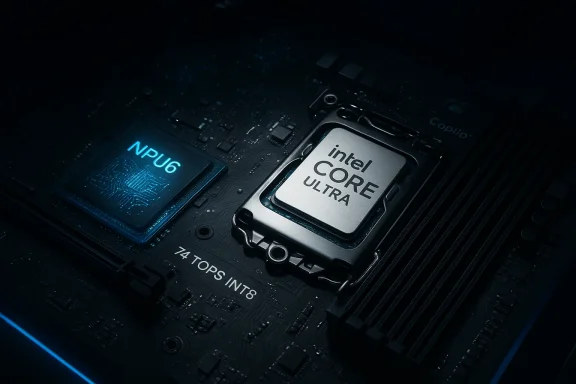
Intel has publicly confirmed that the Core Ultra 400 (Nova Lake) desktop family is scheduled to arrive by the end of 2026, positioning it as the company’s next major client‑CPU push. At the center of the current discussion is a leak from an independent hardware tipster that claims Nova Lake‑S will use a sixth‑generation neural processing unit (NPU6) with a target throughput around 74 TOPS (INT8). Multiple industry outlets and regional sites have circulated the leak and the supporting driver/kernel artifacts. At the same time, AMD’s refreshed Ryzen AI roadmap (the so‑called Ryzen AI 400 / “Gorgon Point” APUs) is being positioned to bring Copilot+‑capable NPUs to desktop AM5 platforms first, with reported NPU figures in the ~50–60 TOPS range for some SKUs. These developments are accelerating a migration of meaningful, hardware‑assisted AI capability from mobile‑first silicon to mainstream desktop platforms.
Yet the headline number is not the whole story. TOPS is a rough, vendor‑friendly metric; real advantage depends on the software stack, model quantization strategies, memory subsystems, and sustained power delivery. Buyers should treat early TOPS figures as directional, not definitive, and prioritize systems that demonstrate end‑to‑end support: drivers, OS integration, and sustained workload performance.
In short: the Core Ultra 400 rumor is exciting and could rewrite expectations for desktop AI capability — but the difference between marketing‑friendly TOPS numbers and day‑to‑day user experience is often larger than vendors acknowledge. Expect a flood of Copilot+ marketing in the next 12–18 months, and plan purchases on measured benchmarks and feature‑deliveries rather than on peak TOPS alone.
Source: Overclocking.com Core Ultra 400: an NPU offering 74 TOPS in the field of AI! - Overclocking.com EN
 Background / overview
Intel has publicly confirmed that the Core Ultra 400 (Nova Lake) desktop family is scheduled to arrive by the end of 2026, positioning it as the company’s next major client‑CPU push. At the center of the current discussion is a leak from an independent hardware tipster that claims Nova Lake‑S will use a sixth‑generation neural processing unit (NPU6) with a target throughput around 74 TOPS (INT8). Multiple industry outlets and regional sites have circulated the leak and the supporting driver/kernel artifacts. At the same time, AMD’s refreshed Ryzen AI roadmap (the so‑called Ryzen AI 400 / “Gorgon Point” APUs) is being positioned to bring Copilot+‑capable NPUs to desktop AM5 platforms first, with reported NPU figures in the ~50–60 TOPS range for some SKUs. These developments are accelerating a migration of meaningful, hardware‑assisted AI capability from mobile‑first silicon to mainstream desktop platforms.What exactly is being claimed — and where the leak comes from
The heart of the rumor
- The claim: Nova Lake‑S will include an NPU6 block with roughly 74 TOPS of INT8 throughput.
- The provenance: the number traces back to public postings by hardware leakers and to grassroots collections of driver/kernel artifacts and leaked product tables that have circulated on social platforms and hardware forums. The leaker most frequently cited is known by an X handle that has broken several architectural details in the past; the slides and kernel references behind the claim have been shared and reposted by multiple secondary outlets.
- Associated claims: the leak pairs the NPU uplift with other Nova Lake expectations — substantially higher core counts and a new socket (LGA1954), very high DDR5 speed support, and a late‑2026 launch window.
Why the claim is credible — at least in lineage
- Intel’s NPU roadmap has been public enough in driver and developer materials to show multiple NPU architectures (NPU3, NPU4, NPU5, etc.) evolving across generations, so a next‑step NPU6 is plausible.
- Past leaks from the same sources have correctly identified driver strings and configuration blocks for previous Intel platforms, lending some operational credibility.
- Several independent hardware outlets have reported the same figures after parsing the same leaked material, which raises the probability that the documents have a real provenance.
Why the claim remains a rumor
- There is no official Intel specification sheet that lists a 74 TOPS figure for Nova Lake‑S.
- As is common with pre‑launch artifacts, the numbers may represent internal engineering goals, theoretical maximums, or per‑die aggregate figures that will not necessarily match shipping SKUs (which may be binned at lower TOPS or disabled tiles).
- NPUs are easy to advertise by quoting “up to” numbers; real‑world performance depends on frequency, power, thermal headroom, drivers, and workload mix.
Understanding TOPS and why raw TOPS don’t tell the whole story
What TOPS measures
TOPS (Tera Operations Per Second) quantifies how many simple arithmetic operations (usually multiply‑accumulate primitives used in neural network inference) a hardware block can execute each second. Vendors often publish INT8 TOPS because many inference pipelines use 8‑bit integer quantization to trade model accuracy for hardware efficiency.Why TOPS can be misleading by itself
- TOPS is a theoretical peak for a particular datatype (e.g., INT8). It doesn’t directly translate to latency or throughput for real models or tasks, which depend on memory bandwidth, on‑chip cache, model quantization quality (INT8 vs INT4 vs FP16), and the software stack’s ability to map models efficiently to the hardware.
- Different vendors measure TOPS differently (sustained vs burst, aggregate across tiles vs per‑tile), so apples‑to‑apples comparisons are tricky without detailed disclosure.
- A high TOPS NPU can be starved by slow system memory, poor driver support, or missing kernel/OS/runtime integration, so overall system gains may be lower than the headline number implies.
What matters beyond TOPS
- Quantization support: Does the NPU efficiently support INT8, INT4, and other compressed formats that modern LLMs use in trimmed forms?
- On‑chip memory and bandwidth: Can the NPU feed data at the rate its compute units need?
- Software ecosystem: Framework support, optimized runtimes, and drivers translate silicon potential into user‑visible improvements.
- Thermal and power envelope: Sustained inference workloads often run longer than microbursts; endurance matters.
Nova Lake’s alleged 74 TOPS in context — how it compares to recent Intel chips
Recent NPU evolution at Intel
- Meteor Lake introduced Intel’s first integrated client NPU block at modest TOPS (single‑digit, mobile‑targeted numbers).
- Arrow Lake/Arrow Lake Refresh desktop parts used NPU variants with around ~13 TOPS in many desktop SKUs, which is sufficient for some low‑latency on‑device tasks but falls short of Microsoft’s Copilot+ bar.
- Lunar Lake (mobile variants) and Panther Lake (planned mobile refreshes) were reported to use NPU4/NPU5 designs with higher TOPS — tens of TOPS in some mobile parts.
The step‑change to 74 TOPS
- A 74 TOPS NPU6 would represent a multi‑fold increase over the 13 TOPS desktop NPU that Intel shipped in earlier desktop families.
- If implemented across a tiled design (multiple NPU tiles combined), that throughput could enable larger local models at reasonable latencies and could make a wide set of Copilot+ features practical on desktop silicon without external accelerators.
Caveats on integration and SKU differentiation
- Intel traditionally differentiates SKUs aggressively; top‑end chips may carry the full NPU block while mainstream SKUs might ship with reduced NPU resources.
- Even if Nova Lake‑S has a 74 TOPS part at the very top end, many consumer desktop SKUs could have lower TOPS, leaving a fragmentation of Copilot+‑capable parts.
AMD’s Ryzen AI 400 (Gorgon Point) — a competing angle
What AMD is claiming and positioning
- AMD’s mobile Ryzen AI 400 APU family (codenamed Gorgon Point) is a refresh of the Zen 5 APU line and has been publicly shown in AMD slides. AMD has indicated desktop AM5 APUs are planned, and multiple outlets report ~50–60 TOPS figures for some Ryzen AI 400 variants.
- Unlike Intel’s rumored Nova Lake‑S schedule, AMD’s roadmap suggests desktop Copilot+ APUs could arrive earlier in some regions, giving AMD the opportunity to be first to ship Copilot‑certified desktop parts.
Why AMD’s approach matters
- AMD’s XDNA‑based NPUs integrated in their APUs have been optimized for inference and multimedia offload; delivering 50–60 TOPS would clear Microsoft’s Copilot+ 40 TOPS floor and allow OEMs to offer Copilot+ desktops based on AM5.
- AMD’s advantage would be especially visible for systems that want a single‑chip, socketed solution (APU) that can provide both GPU and NPU capability without a discrete accelerator.
Microsoft Copilot+ certification: the 40 TOPS bar and what it enables
The certification baseline
- Microsoft’s Copilot+ program defines a hardware envelope that aims to guarantee a set of on‑device AI experiences. One of the prominent hardware thresholds is an NPU capable of at least 40 TOPS, paired with minimum memory and storage targets (e.g., 16 GB RAM, 256 GB SSD in earlier statements).
- The practical effect: Copilot+‑certified devices can enable features like Windows Recall, on‑device image generation, enhanced live captions, low‑latency editing helpers, and other OS‑level integrations that expect responsive local inference.
Why 40 TOPS is a meaningful threshold
- The 40 TOPS floor is not arbitrary; it reflects a pragmatic balance between what modern, quantized models need to run decently on consumer hardware and what SOC manufacturers can deliver within laptop thermal and battery budgets.
- Hitting that threshold unlocks a consistent experience across OEM builds — which matters for Microsoft’s marketing and OEM guidelines.
Important nuance: certification ≠ complete capability
- Devices that meet 40 TOPS can run Copilot+ features, but the quality and scope of those features still depend on memory, storage speed, software integration, and ongoing driver updates.
- Conversely, exceeding 40 TOPS does not automatically translate into better user experience unless the OS and app stack take advantage of the additional headroom.
Real‑world usefulness: local models, cloud models, and where NPUs actually help
When NPU silicon matters
- NPUs excel when users want local inference — running quantized LLMs for conversation, search, note recall, or creative tasks without sending data to cloud servers.
- Use cases:
- Instant, private recall of locally stored documents and context (privacy advantage).
- Low‑latency on‑device assistants, offline transcription, and quick local image edits.
- Edge services in enterprise environments where data sovereignty limits cloud usage.
When NPUs don’t move the needle
- If the user is primarily accessing large cloud models (ChatGPT, Grok, or high‑capacity hosted LLMs), the presence of an NPU in the local CPU matters very little; those models run on remote servers and the NPU is idle.
- Heavy model training and large‑model inference (multi‑billion‑parameter models at latency budgets) still runs best on discrete accelerators (desktop GPUs) or server clusters.
The practical developer and OS challenge
- For NPUs to deliver value, software must route appropriate workloads to them and provide model packaging/quantization tools.
- Microsoft’s AI Runtime and vendor drivers matter a lot; without stable drivers and runtime hooks, even a 74 TOPS block can be underutilized.
Strengths and opportunities of a 74 TOPS desktop NPU
- Enables larger on‑device models: a 74 TOPS NPU could run more capable quantized LLMs locally, expanding what “offline Copilot” looks like on desktops.
- Privacy and latency benefits: desktop users in regulated industries or privacy‑sensitive workflows would gain offline assistive features without cloud dependency.
- OEM differentiation: motherboard and system builders can market desktop Copilot+ PCs as high‑value productivity machines.
- Ecosystem nudge: a significant NPU uplift would accelerate third‑party optimization for on‑device workflows and model compilers targeting client silicon.
Risks, limitations, and should‑buy considerations
Risks and unknowns
- Unverified headline numbers: 74 TOPS originates from leaked documents and driver strings; it may be an engineering target, per‑tile aggregate, or maximum burst number, not a guaranteed SKU spec.
- Software and driver immaturity: without polished runtimes, real‑world gains will lag silicon capability. Early NPU launches frequently suffer driver teething issues.
- Power and thermals: sustaining high TOPS for long inference runs increases platform power draw and heat, which matters on mainstream desktop chassis and will affect cooling design and acoustic profiles.
- Fragmentation: if only flagship Nova Lake SKUs carry the full NPU6 block, the desktop market will be split between Copilot‑capable and non‑capable models, confusing buyers.
- Marketing vs reality: TOPS makes for compelling PR, but users should evaluate what features they care about (Recall, fast local editing, offline assistants) rather than raw TOPS alone.
Practical buyer guidance
- If you rely on cloud LLMs for most AI tasks, a high‑TOPS NPU is low priority.
- If you value on‑device privacy, low latency, or want to experiment with local models, favor systems with clear Copilot+ certification or explicit vendor TOPS disclosures (and verify that OEMs provide driver support).
- Watch for sustained performance numbers in reviews, not just peak TOPS; thermal throttling can mute the advantage in real tasks.
- Consider the platform shift costs: new socket (LGA1954), faster DDR5 memory tiers, and higher motherboard premiums may be part of Nova Lake adoption.
What this means for the wider PC landscape
- If Nova Lake‑S ships with a substantive NPU uplift, the line between laptops and desktops for on‑device AI will begin to blur: desktops will no longer be an afterthought for client NPUs.
- AMD’s possible first‑to‑desktop Copilot+ APUs (Ryzen AI 400/Gorgon Point) could force Intel to accelerate shipping Copilot‑ready desktop SKUs or risk losing the OEM Copilot+ slot in the short term.
- For enterprise customers and OEMs, a standard threshold (40 TOPS and associated platform requirements) provides a useful baseline for procurement — but the real differentiator will be long‑tail support and managed OS integration.
Final analysis: why the leak matters — and why cautious skepticism is essential
A reported 74 TOPS NPU in Intel’s Nova Lake‑S family would be a meaningful technical milestone for client silicon. It could enable significantly broader local inference use and make Copilot+‑level features genuinely practical on desktop PC platforms. The leak’s circulation across multiple outlets means the claim deserves attention, and Intel’s broader roadmap (Nova Lake slated for late 2026) provides a plausible window for such an architectural upgrade.Yet the headline number is not the whole story. TOPS is a rough, vendor‑friendly metric; real advantage depends on the software stack, model quantization strategies, memory subsystems, and sustained power delivery. Buyers should treat early TOPS figures as directional, not definitive, and prioritize systems that demonstrate end‑to‑end support: drivers, OS integration, and sustained workload performance.
In short: the Core Ultra 400 rumor is exciting and could rewrite expectations for desktop AI capability — but the difference between marketing‑friendly TOPS numbers and day‑to‑day user experience is often larger than vendors acknowledge. Expect a flood of Copilot+ marketing in the next 12–18 months, and plan purchases on measured benchmarks and feature‑deliveries rather than on peak TOPS alone.
Source: Overclocking.com Core Ultra 400: an NPU offering 74 TOPS in the field of AI! - Overclocking.com EN
