

StatCounter’s November snapshot showed a fight that almost mattered: Windows 10 inched forward but did not topple Windows 7, narrowing the gap to roughly one percentage point — a shift that is meaningful for commentators but, on closer inspection, little more than a snapshot in an imperfect measurement system.
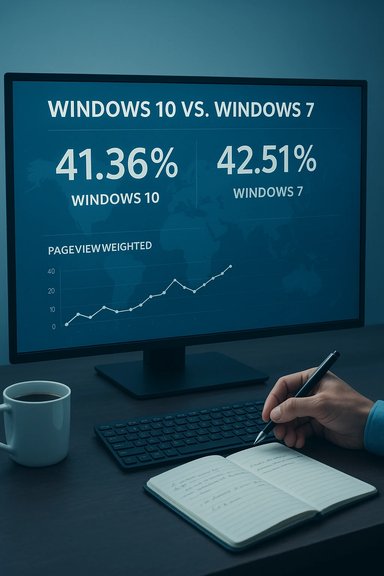
StatCounter’s monthly “Desktop Windows Version Market Share Worldwide” figures have long been a focal point for coverage of the Windows upgrade race. In October 2017 StatCounter recorded Windows 10 at 40.95% and Windows 7 at 42.67%; the November figures showed Windows 10 at 41.36% and Windows 7 at 42.51%, narrowing the gap to 1.15 percentage points but falling short of an overtaking. Those numbers — and the way they moved month-to-month — motivated headlines and a wave of analysis at the time. Two facts are important to lock down before we dig in further: first, what StatCounter measures; and second, why a small monthly swing can be amplified in headlines. StatCounter reports pageview-weighted usage (the operating systems that generate site visits in its panel), not a census of installed devices. That methodological choice makes StatCounter especially useful for trend signals, but also vulnerable to short-term sampling noise and site-mix effects.
Conclusion
The November 2017 StatCounter figures were a small but legitimate piece of the Windows adoption story: they signaled progress for Windows 10 but not a decisive overtaking. The episode is a useful case study in measurement literacy — how differing metrics, seasonal traffic and sampling choices can produce dramatic headlines from tiny movements. For IT professionals and publishers alike, the takeaway remains consistent: use trackers for signals, but verify operational realities with direct telemetry before committing budgets or rewriting compatibility roadmaps.
Source: BetaNews StatCounter: Windows 10 fails to overtake Windows 7, but edges slightly closer
 Background / Overview
StatCounter’s monthly “Desktop Windows Version Market Share Worldwide” figures have long been a focal point for coverage of the Windows upgrade race. In October 2017 StatCounter recorded Windows 10 at 40.95% and Windows 7 at 42.67%; the November figures showed Windows 10 at 41.36% and Windows 7 at 42.51%, narrowing the gap to 1.15 percentage points but falling short of an overtaking. Those numbers — and the way they moved month-to-month — motivated headlines and a wave of analysis at the time. Two facts are important to lock down before we dig in further: first, what StatCounter measures; and second, why a small monthly swing can be amplified in headlines. StatCounter reports pageview-weighted usage (the operating systems that generate site visits in its panel), not a census of installed devices. That methodological choice makes StatCounter especially useful for trend signals, but also vulnerable to short-term sampling noise and site-mix effects.Why the November stall mattered — and why it didn’t
The headline: momentum stalled
Between October and November 2017 the apparent momentum that had pushed Windows 10 up by 1.65 percentage points in October slowed dramatically: growth dropped to just 0.41 points in November while Windows 7 barely retreated. For anyone watching the “race” the simple narrative was obvious — Windows 10 was gaining, but not rapidly enough to flip the leaderboard before year-end. BetaNews ran that concise account and the raw numbers that underpinned it.The counterpoint: small changes, big headlines
A monthly change of 0.41 percentage points in a global pageview-weighted sample translates to millions of pageviews but not necessarily to millions of devices changing OS. There are several reasons a one-month pause or slowdown can occur without signaling a reversal of the broader trend:- Sampling variance: StatCounter’s panel is a sample of websites and pageviews; different site mixes (holiday shopping traffic, news cycles, or bot traffic) can tilt short-term results.
- Regional swings: StatCounter’s worldwide figure aggregates regions where the Windows 10 upgrade pace differed markedly; a slowdown in one large region can offset gains elsewhere.
- Behavioral factors: Weekend vs weekday browsing patterns, corporate vs consumer web activity, and holiday season traffic all change the composition of pageviews and can distort month-to-month comparisons.
The data and the timeline: what really happened
October and November 2017 (the BetaNews snapshot)
- October 2017: Windows 10 — 40.95%; Windows 7 — 42.67%. StatCounter suggested the gap was closing quickly.
- November 2017: Windows 10 — 41.36% (gain of 0.41 points); Windows 7 — 42.51% (drop of 0.16 points). The gap narrowed to 1.15 points, but Windows 10 did not overtake Windows 7 that month.
January 2018: the “flip”
Several months later, StatCounter’s publicly posted figures showed Windows 10 edging ahead of Windows 7 on the pageview measure — a milestone widely reported as the moment Windows 10 “overtook” Windows 7 on StatCounter’s dataset. Coverage at the time (and retrospective summaries) reproduced the January 2018 figures: Windows 10 ~42.78%, Windows 7 ~41.86%. Those numbers confirmed the longer-term trend that had been visible behind November’s wobble.Understanding StatCounter’s measurement and its limits
What StatCounter measures
- Pageviews: StatCounter’s global numbers are derived from the OS reported by browsers visiting the tracked sites. It weights by pageviews rather than devices or unique visitors. This amplifies the activity of heavy web users and high-traffic sites.
- Global panel: The dataset is a patchwork of sites and geographies; changes in the composition of visits (for example, more traffic from a region where Windows 7 remained common) can move the headline share without underlying device counts changing materially.
Where StatCounter’s strengths lie
- Timely signals: Pageview-weighted trackers can surface changes in what users actively use online more quickly than shipment or licensing data.
- Publicly accessible dashboards: The ability to slice by region and day makes StatCounter useful for journalists and analysts trying to read short-term shifts.
- Comparative value: When used alongside other trackers (NetMarketShare, Net Applications, vendor telemetry), StatCounter helps build a more complete picture.
And its weaknesses
- Not an installed-base census: Pageviews do not map one-to-one to devices; heavier browsing devices (new laptops, gaming rigs) can skew the sample.
- Susceptible to short-term noise: Traffic spikes, bots, and campaign-driven site visits can temporarily distort percentages.
- Panel composition changes: Natural churn in the sites that feed StatCounter makes month-to-month apples-to-apples comparison harder than it appears.
Why Windows 10 adoption behaved the way it did (2016–2018 context)
Enterprise inertia and corporate procurement
Large corporate fleets migrate slowly. For many businesses, upgrades involve compatibility testing, image builds, driver validation, and procurement cycles. Even when consumer upgrades proceed quickly because of free upgrade offers, enterprise migrations can lag by quarters or years — and that lag shows up in both installed-base and pageview statistics in different ways.Hardware eligibility and refresh cycles
In 2017 many older machines remained perfectly serviceable on Windows 7 and were not upgradeable to the latest Windows 10 feature releases without hardware changes. Even where upgrades were technically possible, organizations often budgeted hardware refresh programs on multi-year cycles, slowing mass adoption.Microsoft’s upgrade policy and messaging
Microsoft’s free upgrade window (2015–2016) and ongoing feature updates nudged adoption. But the nature of Windows as a platform — entrenched applications, custom drivers, and large-scale deployments — limited the pace of forced conversion. The November 2017 wobble reflected that mix of consumer momentum and corporate caution.How journalists and IT teams should read trackers like StatCounter
Practical reading checklist
- Check the metric — Is this pageviews, unique visitors, or device share? Each tells a different story.
- Compare multiple trackers — StatCounter, Net Applications (NetMarketShare), Steam hardware surveys, vendor telemetry and OEM shipment reports often diverge; triangulate rather than treat one figure as gospel.
- Look for trendlines — Smooth month-to-month noise with rolling averages or polynomial trendlines before declaring a major shift.
- Regional breakdown — One region can dominate a global change; examine geographies to understand drivers.
- Ask the operational question — For IT teams: does the shift change your compatibility matrix, patching posture, or refresh schedule? If not, minor monthly swings are mostly noise.
The strengths and risks of treating “the race” as decisive
Strengths: useful narrative, meaningful inflection points
- Narrative clarity: A head-to-head framing (Windows 7 vs Windows 10) simplifies a complex market into a story readers can grasp.
- Operational importance: When a new OS crosses a usage threshold, developers, ISVs and enterprise teams can use that signal to prioritize testing and support.
- Public accountability: Trackers create pressure for vendors to produce clearer migration paths and lifecycle timelines.
Risks: oversimplification and policy missteps
- False urgency: Treating a single monthly cross as definitive can push organizations into premature migrations or ill-planned upgrades.
- Misplaced confidence: Relying solely on pageview-weighted statistics can understate the continuing presence of older, mission-critical systems.
- Security blind spots: If coverage focuses on percentage leadership rather than absolute counts of unpatched devices, organizations may underestimate residual risk from legacy OS installs.
What the November numbers taught IT pros and decision makers
- Don’t base migration budgets on a single month’s change. A single StatCounter uptick does not equate to tens of millions of devices being upgraded.
- Use telemetry where it matters. Enterprises should rely on endpoint management telemetry (SCCM, Intune, MDM, AD inventories) and vendor-supplied diagnostics for precise counts of upgradeable systems.
- Plan for heterogeneity. The installed base is not monolithic: some devices are upgrade-ready, some require hardware refresh, and others operate in locked-down environments where migration is complex.
Closing analysis: measurement, media and the reality behind the numbers
StatCounter’s November 2017 snapshot — Windows 10 growing to 41.36% while Windows 7 remained at 42.51% — was an accurate reflection of one carefully defined measure: pageview-weighted desktop OS usage in StatCounter’s panel. Reporting those figures was correct; treating them as a definitive cross-over would have been a mistake. The broader trend that followed (Windows 10 overtaking Windows 7 on StatCounter’s measure in early 2018) validated that adoption was moving in Microsoft’s direction, but it also reinforced the core lesson: metrics differ by design and purpose, and good coverage must explain those differences rather than simply amplify a percentage.- The BetaNews readout captured the month’s figures and their immediate implications.
- Follow-up coverage and StatCounter’s own dashboards showed the longer-term cross-over in January 2018, highlighting how short-term stalls can reverse with continued momentum.
- Measurement nuance matters: pageview-weighted trackers are fast and public, but they are not a substitute for device inventories and enterprise telemetry when operational decisions are being made.
Conclusion
The November 2017 StatCounter figures were a small but legitimate piece of the Windows adoption story: they signaled progress for Windows 10 but not a decisive overtaking. The episode is a useful case study in measurement literacy — how differing metrics, seasonal traffic and sampling choices can produce dramatic headlines from tiny movements. For IT professionals and publishers alike, the takeaway remains consistent: use trackers for signals, but verify operational realities with direct telemetry before committing budgets or rewriting compatibility roadmaps.
Source: BetaNews StatCounter: Windows 10 fails to overtake Windows 7, but edges slightly closer
