

NSF’s life‑sciences auditors cut months of manual work into weeks after partnering with Microsoft to build an Azure AI‑driven auditing agent — a proof‑of‑concept delivered in 12 weeks through Microsoft’s Cloud Accelerate Factory that NSF says halves audit turnaround time and frees scientists to focus on regulatory strategy rather than paperwork.
For more than eight decades NSF International has audited and certified products and processes that affect public health — from water treatment systems and food safety to pharmaceuticals and medical devices — and its life‑sciences arm runs intensive, highly regulated reviews that can involve tens of thousands of documents per audit. NSF’s stated objective was pragmatic: reduce manual, repetitive effort and the risk of human error so audits complete faster without sacrificing regulatory rigor. The organization experimented internally with agentic AI approaches, then engaged Microsoft’s Cloud Accelerate Factory — a no‑cost deployment assistance program — to assemble an Azure‑native toolset and deliver a working proof‑of‑concept within a measured sprint.
Model Context Protocol (MCP) adoption has also accelerated as an interoperability standard to safely enable agents to find and consume enterprise data — an important architectural trend for regulated workloads that need predictable access controls. Recent reporting and implementation guides show MCP being integrated across major model platforms and public cloud tooling.
Source: Microsoft NSF enables life-saving treatments to get to patients faster with Azure AI | Microsoft Customer Stories
 Background
For more than eight decades NSF International has audited and certified products and processes that affect public health — from water treatment systems and food safety to pharmaceuticals and medical devices — and its life‑sciences arm runs intensive, highly regulated reviews that can involve tens of thousands of documents per audit. NSF’s stated objective was pragmatic: reduce manual, repetitive effort and the risk of human error so audits complete faster without sacrificing regulatory rigor. The organization experimented internally with agentic AI approaches, then engaged Microsoft’s Cloud Accelerate Factory — a no‑cost deployment assistance program — to assemble an Azure‑native toolset and deliver a working proof‑of‑concept within a measured sprint. Overview of the NSF–Microsoft project
What was delivered
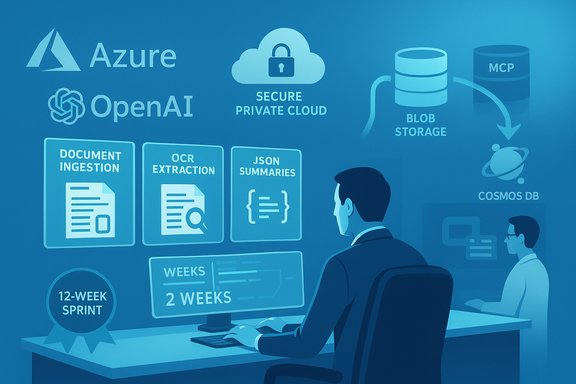
- A proof‑of‑concept agentic auditing tool built on Azure that automates document ingestion, extraction, classification, version tracking and draft summary generation for regulatory audits.
- The pipeline uses Azure Blob Storage for structured data storage, Azure AI Document Intelligence (formerly Form Recognizer) for extraction, Azure OpenAI models for synthesis, and Model Context Protocol (MCP) servers to control how LLMs interface with internal tools and data. Versioning and metadata are handled via Azure Cosmos DB and orchestration uses Azure SDKs and role‑based access through Microsoft Entra ID.
- NSF reports that the tool reduced average audit time from four‑to‑six weeks to roughly two weeks for the cases described in the customer story. The organization further describes the summaries as requiring only cosmetic edits and says the system materially reduces human error in repetitive review tasks.
How it was built so quickly
Microsoft’s Cloud Accelerate Factory supplies hands‑on, no‑cost delivery resources and proven deployment patterns to accelerate Azure projects; NSF credits that program with compressing a year’s planned engineering effort into a 12‑week proof‑of‑concept. Microsoft has positioned the Factory specifically to move customers from pilot to production faster by handling repeatable deployment work alongside partners.Technical anatomy — the pipeline explained
Ingestion and indexing
Documents and structured inputs are landed in Azure Blob Storage and indexed. For life‑science audits, the collection commonly includes protocols, batch records, certificates, lab reports and regulatory correspondence — often thousands of disparate PDFs, images and Office files. The system must normalize formats, track versions, and preserve chain‑of‑custody metadata for regulatory defensibility. NSF’s implementation routes that structured data through Blob Storage into downstream analysis.Extraction and normalization
Microsoft’s Azure AI Document Intelligence provides OCR, layout analysis and prebuilt domain extractors (and supports custom trained models) to pull named entities, tables and key fields from complex documents. Document Intelligence returns structured JSON that downstream components can consume for validation and RAG (retrieval‑augmented generation) workflows. That service also publishes guidance and transparency notes explaining accuracy metrics (word‑level accuracy, precision/recall tradeoffs) that are useful when designing a regulated pipeline.Orchestration and safe tool access
NSF’s architecture uses MCP (Model Context Protocol) servers to regulate how LLMs interact with tools and data, providing a lightweight bridge so the language models can discover, query and act on enterprise data without uncontrolled access. Microsoft’s Azure MCP Server implementations and sample code demonstrate how MCP allows clients (LLMs or agentic clients) to list tools, query schema and execute allowed actions — important for a security‑conscious audit workflow.Reasoning, summarization and versioning
Raw text extracted by Document Intelligence is handed to Azure OpenAI models that produce draft summaries and syntheses across documents. Version control and provenance tracking use Azure Cosmos DB, while role‑based permissions are enforced through Microsoft Entra ID and Azure RBAC so only authorized reviewers can edit, approve or publish final audit reports. NSF maintains the workflow inside a private Microsoft 365 tenant and isolates data paths with private links, minimizing external exposure.What’s novel — and why it matters
- Speed at scale: compressing manual audit throughput materially reduces a bottleneck in bringing regulated therapeutics and devices to market. NSF frames the downstream impact in human terms: faster, rigorous audits mean patients access treatments sooner.
- Human‑in‑the‑loop augmentation: the implementation deliberately keeps experts in control for strategy and verification while delegating repetitive verification, extraction and initial synthesis to the AI pipeline. This hybrid approach reflects current best practice for regulated domains.
- Repeatability and reusability: by packaging the solution as an agentic template built atop MCP and Azure services, NSF anticipates replicating and tailoring the pattern across other audit domains — medical devices, supplements, water safety and more.
Scrutinizing the claims: what is provable and what needs caution
The “12‑week” and “no‑cost” elements
- Microsoft’s Cloud Accelerate Factory is a legitimate program that offers zero‑cost deployment assistance for supported Azure workloads; documentation and partner pages describe the program and its strategic aim to accelerate customer projects. That context supports NSF’s timeline claim and the “no‑cost” framing for Microsoft‑delivered time and expertise (eligibility rules and regional availability apply).
The productivity numbers
- NSF reports a move from an average audit window of four‑to‑six weeks to approximately two weeks using this tool. That specific improvement is reported in Microsoft’s customer story and represents NSF’s field observation for the workloads described; it is not, however, an industry‑wide guarantee. Outcomes will vary by document quality, regulatory complexity and the degree of custom model training required.
- The article’s stronger qualitative claim — that the system “delivers 100% truth value” and only requires cosmetic edits — should be treated as an internal NSF assessment rather than an independently validated benchmark. No public tool can universally promise absolute truth across all document types and jurisdictions. Azure Document Intelligence and other extraction technologies publish precision/recall metrics and known limitations; real deployments must validate extraction accuracy at the entity and field level for the specific forms and languages in scope.
Model limitations and hallucination risk
- LLMs can produce fluent summaries but also make unsupported assertions — the well‑documented “hallucination” risk. Relying on model outputs for regulatory or clinical conclusions without robust verification introduces risk. NSF’s design explicitly uses human reviewers to validate conclusions; that remains a best‑practice mitigation. Azure Document Intelligence documentation and community threads also call out edge cases and known limitations in complex layout or language scenarios.
Compliance and PHI concerns
- NSF handles proprietary and sensitive medical data; Microsoft’s customer story stresses private tenancy, private connections and role‑based permissions as mitigations. Azure supports HIPAA‑eligible services and provides BAAs for covered customers, but caveats exist: Azure services become HIPAA‑eligible only under appropriate contractual arrangements (BAA) and configuration, and some modalities (for example, image or audio processing in certain AI services) have historically been outside BAA coverage unless explicitly included. Organizations must determine whether any particular Azure AI service or preview feature is within the compliance scope required for their PHI use case.
Security, governance and regulatory best practice
Controls NSF and others applied
- Identity and access: Microsoft Entra ID and Azure RBAC to restrict access and enforce least privilege across storage, MCP servers and model endpoints.
- Network isolation: private tenant architectures and private links to avoid public egress for sensitive data.
- BAA and compliance posture: running HIPAA‑eligible services under a signed BAA and leveraging Azure Compliance Manager and audit reports to demonstrate controls for regulators.
- Tool gating: MCP servers expose explicit tool interfaces, allowing teams to limit what an agent can do (read‑only vs. read/write, tool whitelists), which reduces blast radius from misbehaving agents.
Recommended hardened practices before production rollout
- Establish a formal governance board that includes compliance, legal, clinical and security stakeholders.
- Sign or verify a Microsoft BAA and map each service used to the compliance scope required by your regulators.
- Run multi‑scenario accuracy testing (precision/recall) on Document Intelligence models using representative samples and measure the impact of OCR errors on downstream reasoning.
- Enforce strict audit trails: immutable logs for data inputs, model invocations, prompts, outputs, and human approvals.
- Use data minimization and de‑identification where feasible; encrypt data at rest and in transit, and consider customer‑managed keys for additional control.
- Design human‑in‑the‑loop checkpoints where AI outputs that affect regulatory findings require explicit reviewer signoff.
Broader industry context — why Azure for life sciences?
Microsoft’s strategy for health and life sciences centers on cloud scale, security, and an expanding set of AI services tailored to document understanding, machine learning and agentic workflows. The Cloud Accelerate Factory program aims to compress deployment time for customers at no direct cost for Microsoft’s hands‑on delivery resources, which reduces the time to value for clients. Cases such as Thomson Reuters’ Azure migration and other Azure life‑sciences engagements show similar patterns: a joint Microsoft‑partner delivery model can accelerate complex projects. Community and industry commentary — including forum threads and analyst notes — highlight two consistent expectations: AI will materially speed research and compliance workflows, and organizations must invest heavily in governance and verification to capture those gains safely. Those external conversations, visible in industry discussion archives, align with NSF’s approach of pairing AI automation with expert review.Model Context Protocol (MCP) adoption has also accelerated as an interoperability standard to safely enable agents to find and consume enterprise data — an important architectural trend for regulated workloads that need predictable access controls. Recent reporting and implementation guides show MCP being integrated across major model platforms and public cloud tooling.
Risks beyond technology — business and reputational considerations
- Vendor dependency: building an agentic audit stack tightly around Azure services makes migration or multi‑cloud strategies more expensive. Organizations must evaluate lock‑in tradeoffs versus speed‑to‑value.
- Regulatory scrutiny and auditability: regulators will expect full provenance for decisions affecting safety claims. Any deployment must make model reasoning auditable and defensible.
- Human trust and change management: adoption depends on convincing skeptical subject‑matter experts that the system’s outputs are reliable; NSF’s account candidly describes stakeholder skepticism that had to be overcome.
- Public perception: life‑sciences work intersects with patient safety. Any AI‑driven mistakes — even if rare — can generate outsized reputational damage.
Practical guidance for other regulators, labs and auditing organizations
- Prototype with representative workloads and treat the POC as an evidence‑gathering exercise: measure extraction accuracy, false‑positive rates and end‑to‑end latency against regulatory timelines.
- Use Cloud Accelerate Factory or equivalent vendor acceleration programs to compress initial delivery time, but require knowledge transfer and upskilling so internal teams can operate and adapt the solution. NSF specifically noted upskilling as a benefit of the Microsoft delivery.
- Make governance non‑optional: require signed BAAs, run compliance manager frameworks, and publish internal SOPs describing how AI outputs are reviewed and retained for inspection.
- Build with safety primitives: role‑limited MCP tools, immutable audit logs, reviewer approval gates, and pre‑registered model prompts and instruction templates to limit drift.
Final assessment — promise anchored to precaution
NSF’s story is a clear case study in how cloud AI can accelerate time‑consuming, compliance‑heavy tasks in regulated industries when deployed thoughtfully: it demonstrates meaningful operational gains, a defensible security model, and pragmatic human‑in‑the‑loop controls. The compressed timeline — a 12‑week proof‑of‑concept delivered with Microsoft’s Cloud Accelerate Factory — and the reported halving of audit time are credible outcomes for a scoped pilot and reflect a broader industry shift toward agentic tooling in life sciences and regulatory workflows. At the same time, several claims in the customer narrative warrant sober scrutiny: a blanket “100% truth” statement for LLM‑generated summaries is extraordinary and should be treated as an operational claim specific to that deployment and dataset rather than a universal guarantee. Organizations that follow NSF’s path must validate extraction accuracy on their own corpora, ensure BAA and regional compliance where PHI is involved, and bake auditability and human approvals into every workflow. The NSF case is instructive for IT leaders and compliance officers: with proper governance, cloud AI can be a force multiplier for public‑health work. The gains are real, but the margin for error in life sciences is zero — so fast deployment must be paired with equally fast and rigorous controls.Quick checklist for organizations considering a similar project
- Run a focused POC on a single audit type and dataset; measure entity‑level accuracy and the reviewer time saved.
- Sign a BAA and verify each Azure service used is in‑scope for HIPAA/HITRUST requirements.
- Deploy MCP servers with conservative tool permissions and explicit read/write rules.
- Implement immutable logging and human sign‑off gates for every AI output that affects regulatory conclusions.
- Upskill auditors and reviewers so the organization can maintain and replicate the solution without excessive vendor dependence.
Source: Microsoft NSF enables life-saving treatments to get to patients faster with Azure AI | Microsoft Customer Stories
