

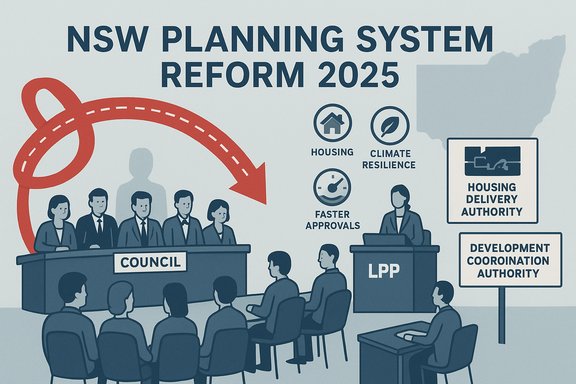
The NSW Parliament’s Planning System Reforms Bill 2025 passed with sweeping changes that will reconfigure who actually decides development applications (DAs) across the state — moving day‑to‑day DA decision‑making away from elected councillors and toward Local Planning Panels (LPPs) and delegated council officers, while embedding new state‑level bodies such as the Housing Delivery Authority and a Development Coordination Authority. This shift has prompted alarm in regional councils — notably Goulburn Mulwaree Council, whose mayor described the reforms as a “clear erosion” of local government powers — and triggered a broader debate about democratic accountability, probity safeguards, and whether the promised acceleration of housing supply justifies reducing elected officials’ direct role in development decisions.
The Planning System Reforms Bill 2025 is presented by the NSW Government as the most significant overhaul of the Environmental Planning and Assessment framework in decades. The reforms are framed around three stated objectives: speed up approvals to deliver more housing, reduce red tape and duplication, and modernise statutory instruments to prioritise housing delivery and climate resilience. In pursuit of those aims the Bill introduces new decision pathways, expands complying development and a “targeted assessment pathway,” establishes state‑level authorities for coordination and housing delivery, and restructures the role and composition of planning panels. That combination of reforms has led to two parallel narratives. The Government frames the changes as a pragmatic, technical fix to a slow, complex system that has dragged down supply and affordability. Local councils and some legal and environmental advocates see a step change: a restructuring that will transfer practical DA decision powers away from elected councillors — in some cases entirely — and create new routes by which significant projects can be accelerated with fewer local political touchpoints. Both positions are grounded in facts in the Bill and in the accompanying explanatory materials, but the translation from legislation to on‑the‑ground practice is where the conflict has intensified.
The legislative text clearly permits councils’ consent authority functions to be exercised by Local Planning Panels or delegated officers, and it excludes councillors from panel membership — facts that explain why regional mayors and LGNSW have sounded the alarm. At the same time, the Government’s framing — emphasising strategic planning roles for councillors and probity advice from ICAC‑linked engagements — is not without factual basis, although the absence of a formal ICAC review of the final Bill weakens that part of the integrity narrative. The real test will be implementation: how the Minister and Department define which DAs go to LPPs, what procedural and reporting rules govern the new pathways, how councils are resourced to administer panels, and whether statutory criteria limit ministerial discretion for targeted pathways. If those implementation details are transparent, constrained and subject to independent audit, the reforms could deliver faster outcomes while preserving community trust. If not, the shift risks producing faster decisions but weaker democratic legitimacy and higher integrity risks. The balance between speed and accountability will determine whether the Bill is remembered as a pragmatic fix or as a structural diminution of local democratic oversight.
Source: psnews.com.au Mayor fears councils will no longer have any role in development under new reforms | PS News
 Background
The Planning System Reforms Bill 2025 is presented by the NSW Government as the most significant overhaul of the Environmental Planning and Assessment framework in decades. The reforms are framed around three stated objectives: speed up approvals to deliver more housing, reduce red tape and duplication, and modernise statutory instruments to prioritise housing delivery and climate resilience. In pursuit of those aims the Bill introduces new decision pathways, expands complying development and a “targeted assessment pathway,” establishes state‑level authorities for coordination and housing delivery, and restructures the role and composition of planning panels. That combination of reforms has led to two parallel narratives. The Government frames the changes as a pragmatic, technical fix to a slow, complex system that has dragged down supply and affordability. Local councils and some legal and environmental advocates see a step change: a restructuring that will transfer practical DA decision powers away from elected councillors — in some cases entirely — and create new routes by which significant projects can be accelerated with fewer local political touchpoints. Both positions are grounded in facts in the Bill and in the accompanying explanatory materials, but the translation from legislation to on‑the‑ground practice is where the conflict has intensified. What the reforms change — a practical summary
Local Planning Panels and consent authority roles
- Local Planning Panels (LPPs) are formal bodies a council may constitute to exercise functions of the council as consent authority. The Act’s Division establishing LPPs specifies that a panel may be the body exercising council functions as consent authority instead of councillors, and that panels are to be constituted and appointed under rules set out in the Act. The law makes clear that LPPs are not subject to council direction or control in their substantive decision‑making, and councillors are expressly ineligible to be panel members.
- The legislation already provides that the functions of a council as consent authority — including determining DAs — can be exercised by an LPP or by council officers to whom the council delegates those functions. In practice, that means many applications that would historically have been decided by councillors in public council meetings can be determined by panels or by staff exercising delegated authority. The Minister may also give directions to councils on which DAs must be determined by an LPP.
- The membership rules in the Act require LPPs to be composed of an approved independent person (chair), two approved independent persons, and a local community representative who is not a councillor or mayor. The Act also makes property developers and real estate agents ineligible to serve as panellists; planning consultants remain eligible. These composition rules underline the separation the Bill enshrines between elected councillors and the panels that can make consent decisions.
Regional panels, Housing Delivery Authority and other pathways
- Regional planning panels — a state‑level mechanism that previously handled many large or region‑significant matters — are set to be removed in a staged process under the reforms, with local panels and council staff taking over many of those functions. The Bill also legislates the Housing Delivery Authority (HDA) and a Development Coordination Authority (DCA) to streamline major and multi‑agency projects. A new Targeted Assessment Pathway is introduced to allow faster assessment where prior strategic planning or consultation has already occurred.
- The reforms also change the Act’s objects — updating the statutory purposes to include housing delivery and climate resilience and to embed proportionality in assessment. The Bill restructures consultation instruments (moving to a state‑wide Community Participation Plan), adjusts modification and review mechanisms, and introduces timeframes and delegation changes designed to accelerate decision times.
The local government reaction: Goulburn Mulwaree and beyond
Goulburn Mulwaree Council’s mayor, Nina Dillon, used a mayoral minute to call on the NSW Government to “pull back” from the LPP provisions, arguing the reforms enable provisions that would leave elected councillors with no role in considering development assessments and would vest DA decision powers solely in LPPs. Councillors at the meeting warned that removing councillors from DA decisions risks eroding the community’s voice and trust in local government. The Council moved to seek engagement with state MPs and other sector bodies to oppose parts of the reforms. The peak body Local Government NSW (LGNSW) has publicly raised similar concerns. LGNSW’s statements and media releases repeatedly emphasise that elected representatives must be retained on planning panels and call for a measured, consultative implementation process. LGNSW warns that removing councillor roles from determinations could harm the “social licence” for reform if communities feel their elected representatives are cut out of locally significant decisions. Regional councils’ concerns are not isolated: inner‑city councils and mayors have also expressed strong objections on democratic and environmental grounds, while some legal advocates and environmental groups have warned the reforms weaken protections or concentrate discretion in ways that could reduce transparency. The political landscape is mixed: the Government argues the changes implement probity recommendations and streamline approvals, while critics note that the practical consequence is less direct elected oversight of individual development decisions.Government defence and the ICAC claim
The Planning Minister, Paul Scully, has pushed back on assertions that councils would be “cut out” entirely. The Minister’s messaging emphasises that elected members will continue to set strategic planning direction — through Local Environmental Plans (LEPs), Development Control Plans (DCPs), strategic plans and policy settings — and that those documents set the boundaries for development proposals. He has also cited “corruption protection recommendations” from the Independent Commission Against Corruption (ICAC) as a rationale for creating panels of independent members. The Minister has argued that most DA processes are already handled by council officers under delegation, and that panels and staff determinations are simply formalising those arrangements with independent oversight. That ICAC link is central to the Government’s probity narrative, but the watchdog’s role is not straightforward. ICAC’s Chief Commissioner, John Hatzistergos, told MPs and critics that while ICAC officers met with Departmental staff in 2024–25 and provided probity advice on aspects such as separation of assessment and decision‑making, lobbying controls and managing conflicts, ICAC was not asked to formally review the final Bill or to give a formal public endorsement of the legislation. That distinction — between informal advice to departmental officers and formal review of primary legislation — is an important one politically and legally, and it has been seized on by critics as evidence the Government’s invocation of ICAC is overstated. Where ministers say “reflecting ICAC recommendations,” ICAC correspondence suggests there was high‑level engagement on probity matters but not necessarily a formal ICAC approval or sign‑off for the legislative package as enacted. That nuance matters for transparency and for public confidence in the claim that the reforms are primarily anti‑corruption measures rather than structural changes to decision‑making roles.Legal and integrity risks — what independent experts are warning about
Legal, planning and environmental advocates have flagged several risks that merit careful scrutiny:- Broad ministerial discretion and unconstrained pathways. The new “targeted assessment pathway” is criticised for lacking clear statutory limits on the types of projects that can be declared eligible. Without hard criteria, critics say that pathway risks being used beyond low‑risk projects — potentially enabling projects to bypass fuller assessment. Legal advocates argue that this creates corruption or misuse risk if the mechanism is not tightly defined and transparent.
- Reduction in public accountability for DA decisions. When elected councillors do not sit at the table to determine DAs, the most direct line of accountability between voters and development outcomes is weakened. Panels and staff are professionalised, but they are also less visible to the electorate and less subject to direct democratic sanction. Councils and community advocates see this as a diminution of public voice.
- Risk that speed comes at the cost of environmental and amenity safeguards. Several critics point to changes that narrow the scope of what consent authorities must consider — for example, by focusing on “significant” impacts rather than a broader set of impacts — and warn that environmental or amenity concerns may be deprioritised amid a push for faster approvals. That concern is heightened where major projects can be steered to state‑level authorities.
- Probity safeguards vs. perception of probity. The Government’s claim that reform reflects ICAC recommendations is partially supported by earlier probity advice provided during departmental meetings, but the lack of a formal ICAC review of the final Bill opens the door to scepticism. Where public trust is already fragile, informal probity engagement is not equivalent to a transparent, independent endorsement of legislative detail.
Practical implications for councils, communities and developers
For councils
- Councils will retain strategic planning instruments (LEPs, DCPs, strategies) that shape the envelope for approvals, but their role in individual consent determinations may reduce significantly where LPPs or delegated officers act as consent authorities.
- Councils are required to provide staff and facilities for LPPs, monitor LPP performance and report annually to the Planning Secretary — a resourcing and administrative burden that shifts costs and day‑to‑day responsibilities to local government even while removing councillors from determinations.
- Councils should expect transitional complexity as regional panels are phased out and new panels are constituted; this will require policy, staffing, internal delegations and procedural changes to comply with the new statutory framework.
For communities
- Community access to decision‑makers will change. Where DAs are decided by panels or officers rather than full council meetings, opportunities for public deputations to elected representatives will diminish. That shift can be offset only if panels have transparent hearings, accessible reporting and clear avenues for representations — elements critics say must be enshrined in the roll‑out.
For developers
- For development proponents the reforms bring potential speed, predictability and new pathways (HDA, DCA, Targeted Assessment), but also a more technicalised and less politically negotiated approvals environment. Developers who manage compliance with new thresholds and pre‑consultation requirements may benefit, while those relying on bespoke rezoning deals may find the planning landscape less malleable.
Strengths of the reforms
- Potential to reduce time to decision: By consolidating pathways, increasing delegation to professional officers and panels, and creating state authorities to coordinate multi‑agency approvals, the reforms genuinely aim to cut duplication and timeframes that have long plagued large projects. That could help unlock housing supply if implementation matches intent.
- Professionalisation of decision‑making: Panels composed of credentialed experts and independent chairs can reduce ad‑hoc political trade‑offs in DA decisions and improve consistency across similar development types, particularly where councils have small resourcing bases.
- Focus on outcomes: Embedding housing delivery and climate resilience in the objects of the Act creates a statutory direction that aligns planning law with policy priorities. Properly enforced, that could deliver measurable outcomes for housing and resilience planning.
Key risks and weaknesses
- Democratic accountability is diluted. Removing elected councillors from substantive DA decisions breaks the direct electoral link between voters and development outcomes, increasing the risk that decisions will be perceived as remote and technocratic. This risk is particularly acute in regional communities where local councillors are often the primary conduit for community concerns.
- Unclear constraints in new pathways can invite misuse. Where the legislation allows broad ministerial discretion (for example, in declaring developments eligible for targeted assessment), the absence of clearly defined statutory criteria raises the spectre of arbitrary uses or politically driven exemptions unless tightly controlled. Critics describe this as an integrity and anti‑corruption gap unless reporting and limits are introduced.
- Perception matters for probity. Even where the Government can point to ICAC advice on certain issues, the lack of formal ICAC sign‑off of the final Bill leaves room for legitimate public scepticism. Public faith in decision‑making institutions depends as much on transparent process as it does on technical safeguards.
- Implementation and resourcing are unresolved. Councils will be required to host and resource panels and to adapt procedures; yet the costs, timelines and training required for a smooth roll‑out are not fully settled publicly. Poorly managed implementation could offset any speed gains and increase friction.
What’s verifiable and where caution is needed
- Verifiable: The Act’s text and existing EP&A provisions demonstrate that LPPs can exercise council consent authority functions and that councillors are ineligible to be panellists; the legislation sets out panel membership, reporting obligations and delegation options. Those statutory facts are clear.
- Requires caution: Claims that every council will be entirely removed from all DA matters are an overgeneralisation. Councils retain strategic planning powers (LEPs, DCPs) and the statute permits councils to delegate functions to officers and to constitute or not constitute panels in some circumstances. The exact mix of LPP vs staff vs council determinations will vary by council, by ministerial directions and by staged implementation. Statements that councillors will have “no role” should therefore be read as referring to decision‑making for many classes of DAs rather than an absolute removal of all local government input. The difference is important in legal and political terms.
- The ICAC link: It is correct that ICAC provided probity advice in departmental meetings. It is also verifiable that ICAC did not conduct a formal review of the final Bill or issue a public legal endorsement of the enacted reforms. Using ICAC as a shorthand for formal anti‑corruption approval is therefore misleading; the government’s statements must be read in context.
What councils and communities can — and should — do next
- Lobby for detailed implementation rules and transparent reporting: Councils should press for explicit criteria in regulations or Ministerial directions that limit the scope of the Targeted Assessment Pathway and require public reporting on all uses of fast‑track powers. Clear thresholds and regular, searchable registers of decisions will reduce misuse risk.
- Seek local representation in panel design and oversight: While the Act excludes councillors as panellists, councils should negotiate procedural rights: the ability to provide written briefs, appear as a party in panel hearings, nominate community representatives, and receive timely reporting. LGNSW’s push for formal implementation panels with local input is a constructive avenue.
- Contractual and resourcing readiness: Councils must prepare staff capacity, IT systems, and governance arrangements to support panels, process determinations and manage post‑approval compliance. The reforms increase administrative burdens even where they reduce councillor workloads.
- Demand independent probity oversight and audit: If ICAC will not perform a formal Bill review, councils and community groups should press for independent audits and parliamentary oversight mechanisms (reporting obligations, required public disclosures, parliamentary scrutiny committees) to restore confidence.
Conclusion
The Planning System Reforms Bill 2025 is consequential and complex: it offers a credible pathway to faster, more professionalised approvals that could help address housing supply constraints, but it also shifts the locus of many DA decisions away from elected councillors and toward panels and officers. That structural change raises legitimate concerns about democratic accountability, transparency and the practical checks needed to prevent discretionary misuse.The legislative text clearly permits councils’ consent authority functions to be exercised by Local Planning Panels or delegated officers, and it excludes councillors from panel membership — facts that explain why regional mayors and LGNSW have sounded the alarm. At the same time, the Government’s framing — emphasising strategic planning roles for councillors and probity advice from ICAC‑linked engagements — is not without factual basis, although the absence of a formal ICAC review of the final Bill weakens that part of the integrity narrative. The real test will be implementation: how the Minister and Department define which DAs go to LPPs, what procedural and reporting rules govern the new pathways, how councils are resourced to administer panels, and whether statutory criteria limit ministerial discretion for targeted pathways. If those implementation details are transparent, constrained and subject to independent audit, the reforms could deliver faster outcomes while preserving community trust. If not, the shift risks producing faster decisions but weaker democratic legitimacy and higher integrity risks. The balance between speed and accountability will determine whether the Bill is remembered as a pragmatic fix or as a structural diminution of local democratic oversight.
Source: psnews.com.au Mayor fears councils will no longer have any role in development under new reforms | PS News