
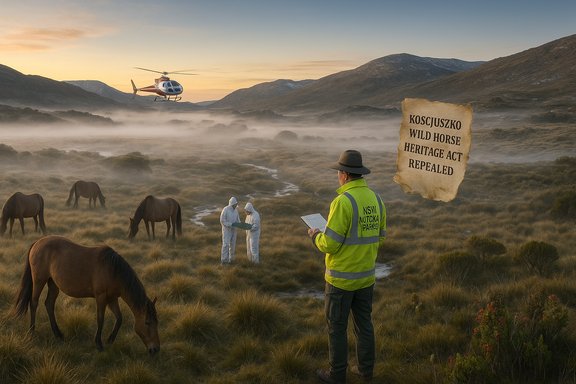
Just before midnight on Thursday, 27 November 2025, the New South Wales Parliament delivered a decisive shift in land and wildlife policy: the Kosciuszko Wild Horse Heritage Repeal Bill — introduced by independent Wagga Wagga MP Dr Joe McGirr — passed the Upper House and will become law, removing the statutory heritage protection afforded to wild horses (commonly called brumbies) in Kosciuszko National Park and restoring full discretion to park managers to treat feral horses as an invasive pest. The vote in the Legislative Council was emphatic, reported as 19–7, and drew cross-party support from Labor, the Greens, most Liberals and several independents; opposition came from a mix of Nationals MPs and a small group of dissenters concerned about animal welfare and cultural heritage. The repeal ends the 2018 “Brumby Bill” framework and sets a statutory transition toward science-led management of fragile alpine ecosystems, water catchments and threatened species — while also reopening politically charged disputes over culling methods, Indigenous heritage, and the ethics of lethal control.
Background / Overview
The Kosciuszko Wild Horse Heritage Act (the 2018 “Brumby Bill”) explicitly recognised the heritage value of sustaining a population of wild horses within designated parts of Kosciuszko National Park and created a legal obligation for a management plan that included maintaining a target population. The 2018 law was widely contested from the moment it passed: conservation scientists, national parks advocates and international biodiversity groups argued it protected an invasive species at the expense of native plants, wetlands and several threatened native animals unique to the Australian Alps.Dr Joe McGirr’s Kosciuszko Wild Horse Heritage Repeal Bill 2025 rescinds that legal protection. The repeal removes the statutory requirement to retain a fixed number of horses in the park, dismantles the applicable advisory body created under the 2018 Act, and restores the capacity of the NSW National Parks and Wildlife Service to manage wild horses under normal pest-animal rules. The legislative outcome preserves a transition period and the existing management arrangements for a limited time, while paving the way for a new management plan and an expanded toolbox for park managers — including methods previously restricted by policy.
How MPs voted and the political contours
The numbers and the split
- The Upper House vote was reported as 19 in favour and 7 against, a margin that reflects broad crossbench and cross-party agreement to repeal the 2018 law.
- Support came from Labor, the Greens, Legalise Cannabis and most Liberal MPs; the Nationals caucus largely opposed the repeal.
- Notable vocal opponents included Nationals MPs Wes Fang, Nicole Overall and Sarah Mitchell. The Liberal MP Rachel Merton broke from many of her party colleagues and voted against, citing animal welfare and cultural concerns; two former One Nation MPs turned independents, Rod Roberts and Tania Mihailuk, were among the dissenters; the Animal Justice Party’s Emma Hurst also opposed the repeal.
Key public statements that framed the debate
- Dr Joe McGirr: “The Wild Horse Heritage Act put symbolism ahead of science and ideology ahead of evidence — and our most fragile alpine landscapes paid the price.” His central claim was that the 2018 law had hamstrung managers and left threatened species and delicate wetlands exposed to ongoing damage.
- Liberal MP Rachel Merton (the single Liberal dissenter): She said crossing the floor was not a decision taken lightly, but framed her “no” vote as opposition to “much more of the cruel mass aerial killing of our brumbies” and a defence of cultural heritage.
- Justin Clancy (Liberal MP for Albury): He framed support for repeal as a legacy decision: “Protecting it now means future generations will inherit a park defined by healthy rivers, thriving wildlife and resilient high country.”
- Greens and environment advocates emphasised the relief felt for species like the broad-toothed rat and the southern corroboree frog, which are constrained to alpine habitats and described as being threatened by habitat degradation.
What the repeal actually changes — the legal and operational effects
Immediate legal consequences
- The statutory protection of wild horses under the 2018 Act is repealed. That means the specific requirement embedded in law to maintain a legislated number or area for horses no longer exists.
- The existing Kosciuszko Wild Horse Heritage Management Plan and the advisory panel established under the 2018 law are to be wound down and replaced by a management framework that treats horses as invasive animals within national parks.
Transition timeline
- The change is not overnight abolition of all horses; the legislation includes a transition window, during which existing plan provisions may still apply while authorities draft and implement a new management plan. The transition window runs to a specified date in 2027, giving managers a defined period to shift operations and meet statutory responsibilities.
Practical effects for park management
- Park rangers regain the ability to deploy the full suite of feral-animal management techniques available elsewhere in NSW national parks. That includes:
- Aerial shooting (previously contentious and limited under the heritage framework),
- Ground shooting and mustering,
- Passive trapping and rehoming where practicable,
- Later-stage trials of reproductive control once populations are reduced to manageable levels.
- The legislative change also aims to clarify that the protection of native species, wetlands and drinking-water catchments will be the guiding priority for management decisions in Kosciuszko.
The science and the conservation case
Damage to alpine ecosystems
- Independent reviews and state environment authorities that have studied Kosciuszko document consistent impacts from feral horses including:
- trampling and structural damage to alpine sphagnum bogs and fens (wetland systems that are slow to recover),
- soil erosion and sedimentation that degrade water quality in headwater streams,
- spread of invasive plant species via seed dispersal on horses’ coats,
- competition and habitat loss for specialised fauna that live only in the alpine zone.
Threatened species at stake
- Several threatened species and ecological communities have been identified as being adversely affected in areas where horses are active. Prominent examples named by conservation scientists include:
- the broad-toothed rat,
- the southern corroboree frog,
- small and localized plant communities tied to alpine wetlands.
- Scientific bodies have flagged that, in the absence of meaningful population control, feral horses present an ongoing extinction risk for species with extremely narrow ecological niches in the Alps.
The role of aerial shooting in ecological recovery
- Managers and some conservation scientists argue that aerial shooting (delivered under strict operational protocols) is the only practicable method to rapidly reduce very large and widely dispersed populations in remote, rugged terrain.
- Aerial culling is controversial for ethical reasons, but technical assessments commissioned by government and observed pilot programs (including veterinary and animal-welfare auditing) have concluded that, when conducted to best-practice standards, aerial shooting can be faster and — in some welfare measures — less protracted than capture, transport and slaughter over long distances.
- The state’s approach is to pair lethal control at scale with later trials of fertility control and expanded rehoming where appropriate, moving to an integrated, adaptive strategy once populations are reduced.
Animal welfare, cultural values and the public controversy
Welfare concerns and the critics’ perspective
- Opponents of lethal control, especially aerial shooting, characterise the method as cruel, arguing that:
- aerial culling can appear brutal and irreversible to the public,
- mistakes or non-compliance with protocols could cause avoidable suffering,
- leaving carcasses in situ (a standard practice in large-scale pest control) is distressing to some visitors and communities.
- Animal welfare groups and some MPs pushed for alternatives and insisted the government should exhaust non-lethal options such as mustering, rehoming and fertility control before lethal means are used at scale.
Cultural and heritage claims
- Supporters of brumbies invoke an Australian pastoral and pioneering heritage: the brumby as a cultural emblem in poetry, film and local identity.
- Some rural communities and horse advocates argued the 2018 Act acknowledged that cultural connection and provided a mechanism for stewardship that did not rely solely on lethal control.
Indigenous perspectives
- Many Indigenous custodians and Indigenous-led advocacy groups voiced a different interpretative lens: for some, protecting fragile country and endemic species is a form of caring for Country, and allowing invasive animals to damage water, bogs and cultural sites is an affront to that responsibility.
- Indigenous representatives who supported repeal framed it as restoring balance to Country and prioritising ecological values that sustain cultural practice.
Implementation challenges and practical risks
Reducing legal protection is only the first step. The operational and political hurdles ahead are significant.- Logistics and capacity: Large-scale removal in remote alpine terrain requires helicopters, trained markspeople, strict operational SOPs, carcass management plans and co‑ordination with animal‑welfare auditors. NSW National Parks will need resources, contracts and oversight to deliver this safely and transparently.
- Carcass management: Standard practice for remote feral‑animal control is to leave most carcasses in situ. Managers argue decomposition and scavenging reintroduces nutrients to the ecosystem, but this practice raises visitor-safety and aesthetic concerns near high-use areas. A robust carcass management and community engagement plan is essential.
- Animal welfare auditing and transparency: To maintain public confidence, managers must adhere to strict veterinary oversight, independent auditing and timely reporting. Any deviation risks reputational damage and potential legal challenges.
- Long-term funding: Short-term population reduction is only the first phase; maintaining lower populations will require ongoing monitoring, rapid-response removal and, where feasible, fertility control. Securing consistent funding over years — not just the electoral cycle — will be crucial.
- Social licence and community fracture: The debate has deeply divided regional communities, recreational users, horse supporters, conservationists and some political actors. Without effective communication and local engagement, the policy risks fuelling ongoing protest, legal challenges and erosion of trust in government.
- Verifiability of population figures: Estimates of the total feral horse population in Kosciuszko have varied widely in public discourse. Some advocacy groups and earlier media reports cited figures in the thousands to tens of thousands; these numbers are sensitive to survey methods, seasonal movements and detection biases. Any specific population claim should be treated cautiously until confirmed by robust, recent systematic surveys.
Alternatives, mitigation and long-term strategy
A lasting outcome for Kosciuszko must link lethal control with a comprehensive, science-backed maintenance strategy.- Immediate reduction:
- Deploy best-practice removal techniques to reduce numbers to an ecologically sustainable level as quickly as feasible.
- Stabilisation:
- Use targeted fertility control trials in isolated populations where feasible to reduce reproduction rates.
- Increase trapping and rehoming capacity where there is demand and suitability.
- Long-term maintenance:
- Establish ongoing monitoring and early-detection teams to remove breaches rapidly and prevent re-expansion.
- Invest in habitat restoration of bogs and wetlands to accelerate recovery and re‑establish resilience.
- Community and cultural programs:
- Develop collaborative programs with Indigenous groups for ongoing land care that align traditional knowledge and modern conservation science.
- Create pathways for rural stakeholders and horse advocates to participate in non-lethal rehoming and stewardship initiatives.
- Transparency and independent review:
- Commit to independent veterinary audits, public reporting of operations, and a transparent complaints and redress process.
The political fallout and legal flashpoints
- The repeal closes one chapter in a long-running political saga that began in earnest with the 2018 Act. Still, political contestation is likely to continue — especially in rural electorates and within conservative party ranks where brumby support is stronger.
- Past inquiries raised constitutional questions about the interaction between state-level wildlife protections and federal environmental laws; those legal arguments could re-emerge if parties or interest groups pursue judicial review of particular control activities or implementation choices.
- Election cycles will test the durability of the new approach: long-term funding and program continuity depend on political will across successive governments.
What to watch next — practical milestones and timelines
- 2026–mid‑2027: Transition period to implement repeal provisions while existing plan elements are wound down. Expect operational planning, procurement and early-stage removal operations.
- New management plan: The state will publish and consult on a revised Kosciuszko management plan that treats wild horses as an invasive species and sets population objectives and permitted control methods.
- Monitoring reports and welfare audits: Independent veterinary and RSPCA auditing during preliminary operations will be an early indicator of compliance and a test of the government’s commitment to welfare standards.
- Restoration outcomes: Ecological monitoring will begin showing recovery trajectories in trampled bogs, stream health and species indicators within years; full peatland and community recovery will take decades.
- Community engagement: Expect ongoing local consultation processes, compensation or adaptation funds for affected tourism operators, and programs for humane rehoming where possible.
Strengths and benefits — a measured assessment
- The repeal places science and species protection at the centre of decision-making and gives park managers the operational flexibility to protect ecological values that are globally rare.
- It can halt ongoing, cumulative degradation of alpine wetlands and headwaters that supply downstream communities and ecosystems.
- The move removes a legal anomaly — a statute that uniquely prioritized an invasive animal — restoring policy coherence for national-park pest management.
- If accompanied by stringent welfare oversight and rigorous transparency, the change could deliver faster ecological recovery with a lower total number of suffering animals than protracted, piecemeal removal.
Risks and unresolved questions
- Ethical and welfare concerns around aerial shooting remain potent and politically mobilising. Even with best-practice protocols, the optics and moral weight of helicopter-based lethal control will continue to generate public outcry.
- Population science uncertainty: The exact number of feral horses and how populations will respond to different control mixes is uncertain. Misestimation risks under- or over-shooting population targets.
- Operational failures (logistics, contractor performance, poor carcass handling) could create local ecological, sanitary and reputational problems.
- Social fracture: Without meaningful avenues for cultural recognition and local participation, the policy will deepen rural-urban divides and could produce sustained protest that impedes operations.
Conclusion
The repeal of the Kosciuszko Wild Horse Heritage Act represents a consequential recalibration of how New South Wales balances cultural attachment with ecological stewardship in one of Australia’s most iconic alpine landscapes. It is a victory for conservation science and for those who argued that legal protection for an invasive species was undermining the survival of fragile wetlands and range‑restricted fauna. That said, the political decision is the opening act of a long, technically complex and emotionally charged implementation phase.Success will hinge on more than legislation. It will depend on rigorous, transparent operations; consistent funding; independent animal welfare oversight; meaningful Indigenous and local engagement; and a long-term commitment to restoring and monitoring the park’s unique ecosystems. If those conditions are met, the repeal offers a pathway to measurable ecological recovery and stronger protection for species that exist nowhere else. If they are not, the state risks renewed social conflict and ecological missteps that could undo the promise of this pivot toward evidence-led management.
Cautionary note: several figures quoted in public debate — particularly total feral-horse population estimates reported at various times — vary considerably between sources and depend heavily on survey methods. Any future operational plan should begin with a rigorous, repeatable population assessment so that targets, methods and welfare safeguards are based on the clearest possible baseline.
Source: psnews.com.au McGirr bill to allow more wild horse culling set to become law - here's how MPs voted | PS News