

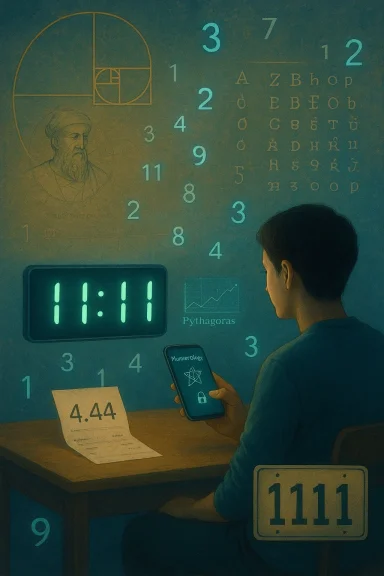
Stop scrolling for a second — numerology is not a trend, it’s a cultural practice with ancient roots that many people now encounter through apps, viral posts, and the familiar tingle of seeing 11:11 on a clock.
Background: what the Yardbarker piece said — and what it really means
The Yardbarker excerpt the community circulated opens with a hook most of us have felt: a glance at a clock that reads 11:11, a receipt totaling $4.44, or a license plate with repeating digits — those small pattern hits that feel like messages. The piece leans into a striking claim: numerology is an “ancient study that blends the magic of the occult with the precision of physics” and traces a direct line to Pythagoras, the ancient Greek known best for geometry, as the origin point.That summary captures popular numerology’s storytelling: numbers as patterns, patterns as meaning. But it also compresses history and science into a memorable headline. The truth is more layered. Numerology as practiced today is an eclectic mix of traditions — Pythagorean numerology, Chaldean systems, Jewish gematria, and modern interpretations such as “angel numbers” — and its claims about physics or objective causal power are metaphoric, not scientific. Where the Yardbarker piece is persuasive is in the emotional resonance: repeated numbers act as hooks for curiosity and meaning-making. Where it’s weak is in implying scientific backing for mystical claims without distinguishing metaphor from measurable evidence.
Overview: a short primer on numerology systems
Numerology, in the modern sense, is the practice of assigning numerical values to letters, names, and dates and interpreting the resulting numbers as indicators of personality traits, life themes, and timing. The practice you’ll encounter online or in popular magazines generally falls into a few families:- Pythagorean (Western) numerology: Assigns numbers 1–9 to letters of the Latin alphabet in a simple linear mapping. Widely used for “Life Path,” “Expression,” and “Soul Urge” numbers.
- Chaldean numerology: Older in provenance (named after ancient Chaldea), uses a different letter-to-number mapping and treats certain numbers as more mystical; less commonly taught in mainstream blogs.
- Gematria / Isopsephy: Jewish (gematria) and Greek (isopsephy) traditions that assign numeric values to words for scriptural interpretation; historically significant but distinct in method and purpose from pop numerology.
- Angel numbers / Repeating sequences: A modern, pop-psychology layer on top of numerology that reads repeated digital sequences (111, 444, 11:11) as “messages” or signs.
How to calculate the Life Path number — step-by-step (practical guide)
The most common entry point for beginners is the Life Path number, calculated from your full date of birth. This is a computation you can do with pencil and paper; many online calculators do it for you, but doing it yourself helps you understand the logic and catch mistakes.- Write your birth date in numeric form (MM/DD/YYYY or DD/MM/YYYY depending on your habit).
- Reduce the month, day, and year separately to single digits by adding digits together.
- Sum the three reduced values and reduce again to a single digit — unless you encounter a Master Number (11, 22, 33) along the way; those are handled specially (see below).
- Birthdate: July 29, 1987 → 07 / 29 / 1987
- Month: 0 + 7 = 7
- Day: 2 + 9 = 11 → Master Number — keep as 11 for now
- Year: 1 + 9 + 8 + 7 = 25 → 2 + 5 = 7
- Sum: 7 + 11 + 7 = 25 → 2 + 5 = 7 → Life Path = 7
(Alternative schools may reduce differently; if you reduce the day 29 to 2+9=11 then later compress 11 to 1+1 = 2, you’ll get a different final layer. Be consistent about the method you choose.)
- The usual final range is 1–9, with special recognition for 11, 22, and 33 as Master Numbers. Some systems also acknowledge 44 and beyond, but those are rarer.
- Life Path is one of several core numbers; others include Expression (Destiny), Soul Urge (Heart’s Desire), and Personality — each calculated from your full name or variations of it.
Master Numbers: what they are and how to read them
Master Numbers (commonly 11, 22, and 33) are two-digit numbers that numerologists treat as intensified versions of their root digits:- 11 → resembles an amplified 2: intuition, sensitivity, spiritual messaging.
- 22 → resembles an amplified 4: large-scale building, practicality combined with vision (sometimes called the “master builder”).
- 33 → resembles an amplified 6: compassionate teacher, healer.
What “angel numbers” like 11:11 and 444 actually are
The Yardbarker piece leans into the pop phenomenon of angel numbers — repetitious digital patterns many people feel are meaningful. Modern culture has attached emotional weight to these patterns for several reasons:- They’re easy to spot and remember (11:11 on a clock is visually salient).
- They’re short, repetitive, and pattern-friendly, so they stick in memory.
- Social sharing and celebrity references have amplified them into cultural shorthand.
- 111 / 11:11 — manifestation, alignment, a “wake-up” call.
- 222 — balance, partnership, alignment in relationships.
- 333 — spiritual support.
- 444 — protection, foundations, reassurance.
A concise history: where numerology really comes from
The idea that numbers carry deeper significance is ancient and cross-cultural:- Near Eastern and Mediterranean traditions practiced forms of gematria and isopsephy, assigning numeric values to words for sacred interpretation.
- The Greek philosopher-mathematician Pythagoras (6th century BCE) and his school associated numbers with musical harmony and metaphysical principles; later writers attributed mystical number philosophies to that circle, blending mathematics with metaphysics.
- Chaldean systems (named for an ancient region) and later medieval European adaptations added further mappings and methods.
Why numerology feels convincing: the psychology behind the magic
If numbers can be read for meaning, why do so many people feel certain sequences are “messages”? Cognitive science offers a few clean explanations:- Pattern recognition and apophenia: Humans are wired to detect patterns; sometimes we see meaningful connections in random data.
- Confirmation bias: Once you expect a pattern to mean something, you selectively remember hits (the times 11:11 meant something) and forget misses (the hundreds of times it didn’t).
- Frequency illusion (Baader–Meinhof effect): After noticing a pattern once, you suddenly “see it everywhere,” which reinforces belief.
- Meaning-making and narrative: Numerology offers tidy narratives about identity and destiny; humans prefer stories that organize life’s chaos.
Strengths and uses: why numerology has enduring appeal
- Personal reflection tool: Numerology can function like journaling prompts or a structured way to consider values and patterns.
- Language for life transitions: People use numbers to anchor decisions, declare intentions, or create ritual around important dates.
- Cultural resonance: Repeating-number motifs are an accessible spiritual language in a secular world — quick, portable, and shareable.
- Community and commerce: Numerology fuels podcasts, apps, guides, and communities that help people feel seen and connected.
Risks and critiques — practical and ethical concerns
- Claims of scientific backing are misleading. Phrases like “numbers are the vibrational building blocks of reality” are metaphorical, not measurable scientific claims. Numerology lacks reproducible predictive power in the way physical sciences demand.
- Over-reliance can be harmful. Making major life decisions (medical, financial, legal) solely on numerological advice risks real harm.
- Commercial exploitation. Many apps and paid readings upsell premium content, subscription “personal readings,” or access to “expert” interpretations with no standardized qualifications.
- Data privacy concerns. Numerology services often require birthdates and full names — personally identifiable information (PII) that can be cross-referenced with other datasets. Free or “fun” calculators may collect and monetize this data.
- Encourages confirmation bias. Heavy engagement can reinforce selective memory and reduce reliance on evidence-based judgment.
Numerology in the digital age: apps, privacy, and monetization
Numerology’s modern life is digitally native. That brings convenience — instant calculators, automated charts, and community forums — but also real IT concerns:- Data collection: Many free numerology sites collect your full name and birth date. That information is often used to target ads or build marketing profiles.
- Authentication risk: Birthdate plus full name are classic identity-verification items used by banks or recovery flows. Sharing them widely increases the surface area for social-engineering attacks.
- App permissions: Mobile numerology apps with excessive permission requests (contacts, camera, storage) should be avoided unless the feature set clearly needs them.
- Subscription traps: Some services lure users with a “free reading” that escalates into recurring charges hidden in small-print subscriptions.
- Treat numerology apps like any other digital product that wants your PII.
- Use knock-off or disposable information only if you don’t want your real data stored.
- Prefer reputable platforms with clear privacy policies and the ability to export or delete your data.
A practical reading checklist: how to approach a numerology reading responsibly
- Start skeptical, stay curious. Use numerology to ask questions, not to hand over decisions.
- Keep personal data minimal. If you try an online calculator, avoid entering unnecessary sensitive details.
- Compare multiple interpretations. Different systems (Pythagorean vs Chaldean) will sometimes give divergent outputs.
- Document predictions. If you expect numerology to “predict,” write down the prediction and the date; revisit later to evaluate accuracy.
- Watch for monetization pressure. If a reader or app pushes paid “deeper insights” aggressively, step back.
Sample quick-read cheat sheet: what commonly assigned numbers mean (overview)
- 1 — initiation, leadership, independence.
- 2 — partnership, diplomacy, sensitivity.
- 3 — creativity, communication, sociability.
- 4 — structure, practicality, discipline.
- 5 — freedom, change, adventure.
- 6 — responsibility, home, nurture.
- 7 — reflection, study, spiritual inquiry.
- 8 — abundance, authority, business.
- 9 — completion, compassion, service.
- 11 / 22 / 33 — master energies: intensified versions of 2, 4, and 6 respectively, often framed as higher potential paired with higher pressure.
Critical perspective: what numerology can teach a WindowsForum readership
As an IT-oriented community, this audience should evaluate numerology on two fronts: epistemic value (does it reliably tell you truths about the world?) and functional utility (does it help you make better choices or feel better?).- Epistemically, numerology does not meet scientific standards of reproducible, falsifiable prediction. Treat it as interpretive, not causal.
- Functionally, numerology is a low-cost, culturally resonant framework for introspection. If it helps you plan, reflect, and act in ways that align with your values, it has pragmatic worth.
How to experiment with numerology safely — a 30-day test protocol
- Pick one system (Pythagorean is simplest).
- Calculate your Life Path and one other number (Expression or Birthday).
- Journal daily for 30 days, noting any decisions you make with explicit mention of numerology influence.
- Track outcomes and emotional effects — separate objective results from subjective feelings.
- At day 30, evaluate: did the practice cause measurable improvements, or did it primarily shift your internal narrative?
Final verdict: numerology as an interpretive tool, not an oracle
Numerology is a durable cultural language for making sense of life, and for many people it provides comfort, structure, and creative metaphor. The Yardbarker-style phrasing — “the universe is sending you a text message” — captures that emotional intuition vividly, but it should not be conflated with empirical claims about the physical world.If you approach numerology as a reflective practice — a set of metaphors, symbols, and rituals that help you notice patterns in your life — it can be useful and surprisingly practical. If you treat it as a substitute for evidence-based decision-making, or hand over sensitive personal data to a flashy app without reading the privacy policy, the risks are real.
Use numerology to spark questions, not to answer them definitively. Protect your personal data. Keep a journal. And remember that the power of numbers, in daily life, is often the power of the stories we tell about them.
Quick reference: what to do next
- To calculate your Life Path: reduce birth month, day, year separately; add and reduce; watch for 11/22/33.
- To test numerology’s value: run a 30-day experiment and track outcomes.
- To protect yourself: minimize PII shared with apps, audit permissions, and avoid recurring-payment traps.
Source: Yardbarker Beginners Complete Guide to Numerology
