

The AI application boom that dominated headlines in 2024–2025 shows no signs of slowing, and the emerging consensus among investors and IT strategists is simple: Nvidia and Microsoft are the most balanced, durable plays on the new AI stack — one supplying the compute engine and the other owning the platform and distribution layer that turns compute into recurring revenue.
The generative-AI-driven shift from experiment to production has accelerated enterprise demand for both high-performance accelerators and cloud AI services. Industry forecasts cited in recent market commentary expect continued rapid expansion: the AI market is projected to grow at a high compound annual growth rate over the coming decade, a driving force for both infrastructure and application spend.
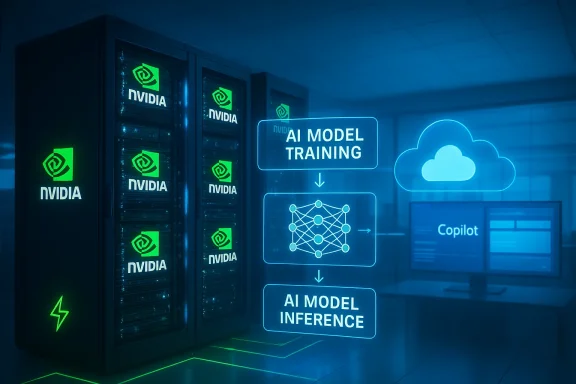
Nvidia and Microsoft represent two complementary exposures to that growth. Nvidia is the dominant supplier of discrete GPUs — the “picks and shovels” for AI model training and inference — while Microsoft is pairing hyperscale cloud infrastructure with product-integrated generative AI (Copilot and related offerings) to monetize AI through seats, subscriptions, and metered inference. This feature unpacks the thesis behind that view, verifies the major technical and financial anchors in the public narrative, and offers a critical analysis for IT leaders and investors navigating 2026.
For Windows users, IT leaders, and investors, the practical takeaway is to treat Nvidia as the premier hardware vendor whose performance and supply dynamics you must follow closely, and to treat Microsoft as the dominant platform and distribution partner that can convert AI into measurable productivity gains across enterprises. Hedged, scenario-based planning and a focus on governance, ROI measurement, and sustainability will be the best ways to capture the upside of this AI boom while managing the attendant risks.
Source: The Motley Fool The AI Application Boom: Why Microsoft and Nvidia Will Win Big This Year | The Motley Fool
 Background
The generative-AI-driven shift from experiment to production has accelerated enterprise demand for both high-performance accelerators and cloud AI services. Industry forecasts cited in recent market commentary expect continued rapid expansion: the AI market is projected to grow at a high compound annual growth rate over the coming decade, a driving force for both infrastructure and application spend.Nvidia and Microsoft represent two complementary exposures to that growth. Nvidia is the dominant supplier of discrete GPUs — the “picks and shovels” for AI model training and inference — while Microsoft is pairing hyperscale cloud infrastructure with product-integrated generative AI (Copilot and related offerings) to monetize AI through seats, subscriptions, and metered inference. This feature unpacks the thesis behind that view, verifies the major technical and financial anchors in the public narrative, and offers a critical analysis for IT leaders and investors navigating 2026.
Overview: two different layers of the AI stack
- Nvidia = infrastructure and accelerators: selling the raw compute that training and fine-tuning large models require, along with a software layer (CUDA) that locks developers into its ecosystem.
- Microsoft = platform and distribution: turning model access into enterprise-grade products and recurring revenue through Azure, Microsoft 365, and Copilot integrations that embed AI into the everyday workflows of organizations.
Why Nvidia still sells the best AI picks and shovels
GPUs vs. CPUs: the technical edge
GPUs are architected for massively parallel computation, making them far better suited than general-purpose CPUs for the matrix-heavy operations at the core of modern neural networks. That architectural advantage is the reason hyperscalers and leading AI labs prioritized GPUs for both training and many inference workloads. Nvidia’s GPUs — particularly its data-center-focused product lines — are purpose-built for those parallel workloads and for high-memory bandwidth needed by large models.Market position and ecosystem
Nvidia now accounts for the overwhelming majority of discrete GPUs used in machine learning contexts. That concentration of supply, combined with the company’s proprietary software stack (CUDA) and a broad set of developer tools and libraries, creates a strong network effect: software and models optimized for CUDA run best on Nvidia silicon, which reinforces hardware demand. Analysts and market observers have repeatedly highlighted this “stickiness” as a structural moat.Product cadence and architectural leadership
Nvidia’s product roadmap has repeatedly introduced denser and more power-efficient architectures — examples commonly cited include Turing, Ampere, Hopper, and Blackwell generations — each delivering tangible performance-per-watt and throughput improvements for AI workloads. This regular cadence matters because AI practitioners constantly chase better training throughput and lower cost-per-token inference. The company’s success in migrating a large share of its business from gaming to data-center GPUs underscores the pivot from consumer graphics to enterprise AI infrastructure.Financial momentum and valuation anchors
Recent coverage points to exceptionally high growth expectations for Nvidia: analysts had been modeling very high revenue and EPS CAGRs in the mid-2020s — figures in the Motley Fool summary cited multi-year revenue CAGRs in the high double digits for the fiscal 2025–2028 window. That growth, coupled with elevated valuation multiples, reflects a market pricing in persistent supply constraints and structural demand for AI accelerators. Investors need to reconcile those multiples with execution risk and capital intensity, but the core thesis — Nvidia sells the tools necessary for modern AI — is simple and powerful.Why Microsoft’s cloud and AI investments are paying off
Copilot as the product-first monetization engine
Microsoft’s strategy is built on converting a massive installed base of productivity-seat customers into AI revenue generators. Copilot is not just a feature; it’s a monetization architecture: seat-based licensing for knowledge workers, domain-specific agents, and integration across Microsoft 365 and Windows that increases Azure consumption as Copilot calls hosted models. That combination turns AI into a recurring revenue stream rather than a one-off services contract. Company-level disclosures and market reporting have emphasized an expanding Copilot footprint and Azure AI monetization as immediate drivers of revenue.Azure: infrastructure, hosting, and managed models
Azure has evolved from raw infrastructure into a managed AI substrate: model hosting (Azure OpenAI Service), lifecycle tooling, governance and compliance features for enterprises, and verticalized offerings for regulated industries. Microsoft’s pitch to enterprises centers on the ability to run models securely, log and filter content, and keep data under corporate control — features that matter to CIOs in finance, healthcare, and government. Those capabilities make Azure a natural place for companies to deploy inference workloads and pay for metered usage.Strategic investment in OpenAI and model access
Microsoft’s early and sustained investment in OpenAI delivered both a strategic partnership and preferential access to leading foundation models. That relationship enables Microsoft to embed state-of-the-art generative AI into its products while also offering enterprises managed access through Azure. This dual advantage — product integration plus cloud monetization — is central to the argument that Microsoft will capture application-layer value as AI scales.Custom silicon and performance-per-dollar
Microsoft has also invested in developing custom AI chips — names like Maia and Cobalt appear in industry reporting — aimed at improving Azure’s inference economics. While Microsoft will remain a buyer of Nvidia accelerators for many use cases, proprietary chips can reduce per-inference costs over time and strengthen margins for Azure-hosted AI services. This chip development is a strategic hedge and a pathway to reduce vendor concentration risk.Financial framing: what the market is pricing
Recent market summaries quoted headline valuation metrics to make the point that both companies are expensive but justifiable under an AI growth scenario. Nvidia has been discussed at multiples reflecting aggressive growth expectations, while Microsoft’s valuation sits at a premium that assumes steady Azure monetization and expanding Copilot seat economics. Both stocks are characterized as “best-in-breed” plays: Nvidia for its growth and hardware leadership, Microsoft for its diversified, recurring-revenue business that embeds AI across software and cloud.Strengths: what each company does best
Nvidia’s strengths
- Hardware leadership: top-to-bottom GPU portfolio optimized for AI training and inference.
- Software ecosystem (CUDA): extensive developer tools that make migration costs high for customers.
- Scale in data centers: the company is the default supplier for hyperscalers and AI cloud providers.
Microsoft’s strengths
- Distribution and seat economics: Microsoft monetizes AI directly through Office, Teams, Windows, and Dynamics as well as through Azure metering.
- Enterprise trust and compliance: Azure’s focus on security, regional compliance, and managed services matters for regulated workloads.
- Ecosystem integration: Microsoft can turn incremental AI features into stickier, higher-value customer relationships across an enormous installed base.
Risks and headwinds: why dominance is not guaranteed
No company is immune to the structural risks that accompany a fast-moving technology wave. For both Nvidia and Microsoft, the AI boom brings unique operational, regulatory, and competitive threats.For Nvidia
- Supply and geopolitical constraints: concentration of advanced semiconductor manufacturing and export controls create both opportunity and regulatory risk; governments may restrict access to leading-edge accelerators.
- Competition: AMD, Intel, bespoke accelerator startups, and major cloud providers developing in-house accelerators could erode Nvidia’s share over time. Expect aggressive product development cycles from competitors.
- Cyclicality of capex: enterprise GPU purchasing can be lumpy; a macro slowdown in capex could quickly impact revenue.
For Microsoft
- Cloud competition: AWS and Google Cloud are intensifying AI-specific offerings; customers may multi-cloud or favor other providers for specialized workloads.
- Regulatory and ethical scrutiny: reliance on generative models raises concerns about bias, misinformation, and privacy — risks that can slow enterprise adoption or force costly compliance work.
- Monetization execution: turning AI features into sustained, seat-based revenue requires convincing customers to pay more for productivity gains — there is execution risk in pricing, positioning, and measurement of ROI.
The environmental and social calculus
AI compute is energy-intensive. Large model training and the inference loads of real-time copilots materially increase data-center power demands. Both companies will face pressure to demonstrate meaningful reductions in energy intensity and transparency in carbon accounting. For Microsoft, some gains come through broader cloud efficiency and renewable procurement; for Nvidia, device-level power efficiency and an expanding product mix with better performance-per-watt are the leverage points. Ignoring sustainability will invite regulatory scrutiny and reputational costs.What to watch in 2026: bellwethers for the thesis
- GPU supply and utilization — Are hyperscalers still capacity-constrained? Broad data-center utilization and supply-chain stability will determine Nvidia’s near-term revenue trajectory.
- Copilot seat adoption and pricing — Measure the speed and stickiness of Copilot conversions inside Microsoft 365 customers; this is the clearest direct monetization signal.
- Azure AI run-rate and inference economics — Watch whether Azure’s incremental margins improve as Microsoft deploys custom chips and as inference becomes a larger percentage of cloud revenue.
- Competitive silicon announcements — New accelerators from AMD, Intel, Amazon, or bespoke vendors could meaningfully shift the landscape. Track performance-per-dollar announcements relative to Nvidia.
- Regulatory action — Export controls, antitrust inquiries, or new data-protection laws could materially affect operations or customer trust for both hardware suppliers and cloud platforms.
Practical guidance for IT leaders and Windows-centric organizations
- Plan hybrid GPU procurement: balance on-premises accelerators for sensitive workloads with cloud-bursting on Azure or other clouds. Procurement timing matters: early reservations can protect against supply tightness.
- Instrument ROI for Copilot and AI features: before licensing large seat volumes, pilot Copilot integrations with clear KPIs (time saved, error reduction, process automation) so that licensing decisions are data-driven.
- Governance-first deployments: adopt model governance standards, logging, and content-filtering practices to meet compliance and protect data privacy. Enterprises that bake governance into deployment accelerate procurement approvals.
- Invest in sustainability and efficiency: identify energy-efficiency gains at the workload level (scheduling, quantization, model distillation) to reduce both cost and carbon footprint.
Critical assessment: strengths, blind spots, and valuation caution
The core narrative that Nvidia and Microsoft will “win big” in an AI application boom is persuasive because it maps to structural realities: AI needs compute and enterprise-grade distribution. However, there are three important caveats:- Concentration risk: both the compute supply chain and cloud distribution are concentrated among a few players. That concentration invites regulatory attention and makes the ecosystem brittle to geopolitical shocks. Short-term headlines often understate this fragility.
- Execution and pricing risk: for Microsoft, turning Copilot into sustained margin expansion depends on convincing large enterprises to accept new pricing models and seat add-ons. For Nvidia, the challenge is sustaining architectural leadership and volume economics as competitors and hyperscalers innovate.
- Valuation and time horizons: market multiples for AI leaders embed high growth expectations. That’s fine if growth materializes; it’s painful if AI monetization falters, supply normalizes, or macro conditions tighten. Investors and IT procurement teams alike should stress-test scenarios where growth slows or competition intensifies.
Bottom line
Nvidia and Microsoft occupy complementary and defensible positions in the AI ecosystem: one provides the raw horsepower and developer ecosystem; the other converts that horsepower into products, seats, and recurring cloud revenue. Both will benefit meaningfully if the AI application wave continues to scale in 2026 and beyond. Yet durable success will depend as much on execution — managing supply chains, pricing strategy, product adoption, and regulatory exposures — as on technical leadership.For Windows users, IT leaders, and investors, the practical takeaway is to treat Nvidia as the premier hardware vendor whose performance and supply dynamics you must follow closely, and to treat Microsoft as the dominant platform and distribution partner that can convert AI into measurable productivity gains across enterprises. Hedged, scenario-based planning and a focus on governance, ROI measurement, and sustainability will be the best ways to capture the upside of this AI boom while managing the attendant risks.
Source: The Motley Fool The AI Application Boom: Why Microsoft and Nvidia Will Win Big This Year | The Motley Fool
