

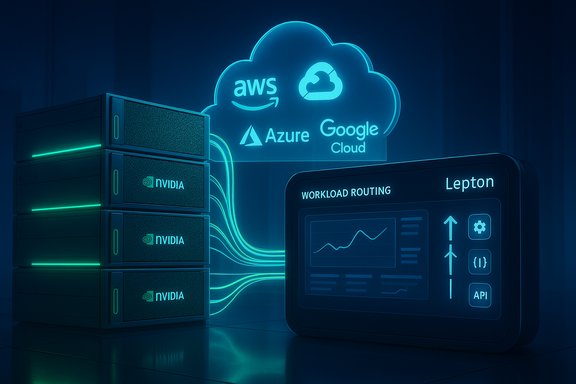
NVIDIA’s retreat from a customer-facing DGX Cloud business marks one of the more consequential strategic pivots in the AI infrastructure market this year, driven by a mix of high launch pricing, operational complexity across multiple hyperscalers, and the political reality of selling services that directly compete with the companies that buy the bulk of NVIDIA’s chips.
Background / Overview
DGX Cloud was introduced as NVIDIA’s answer to the surge in demand for GPU-backed AI compute: a managed, NVIDIA-native environment bundling DGX hardware, software, and a “white‑glove” operations layer intended to make model training simpler and faster than using commodity cloud instances. The offering was built on top of existing cloud infrastructure — racks of H100 and A100 GPUs leased from major providers, configured to NVIDIA’s specifications, and offered as an integrated service to enterprise AI teams. Early pitch materials and public launches emphasized performance parity with the best in-class cloud setups while promising a more optimized stack for large-model workloads. That promise hit three hard headwinds in practice. First, the listing price for a DGX Cloud instance at launch — widely reported as roughly $36,999 per month for an 8‑GPU H100 “DGX” instance — positioned DGX Cloud as a premium alternative to hyperscaler instances. Second, the cloud market itself matured rapidly: hyperscalers aggressively cut GPU prices and expanded capacity as supply normalized, eroding the scarcity premium DGX initially relied on. Third, operating an overlay service across multiple hyperscaler data centers introduced unexpected operational and support complexity that undermined the plug‑and‑play narrative. Several industry reports now say NVIDIA has de‑emphasized DGX Cloud as a customer product and redirected most of that capacity for internal research and chip development.How DGX Cloud was supposed to work
- DGX Cloud packaged NVIDIA‑branded servers (DGX racks) and the company’s AI software into a managed service.
- At launch, the architecture relied on leasing rack space and hardware from multiple cloud partners, then applying NVIDIA’s own configuration, software stack, and managed services.
- The objective was to give enterprises access to optimized training environments without the integration and maintenance burden of assembling and tuning GPU clusters in-house.
Why DGX Cloud struggled: pricing, partners, and operational complexity
1) Pricing vs. hyperscaler economics
At launch, DGX Cloud’s sticker price put it in the “premium, white‑glove” tier. Charging roughly $36,999 per month for an H100‑based instance made sense when H100 supply was constrained and hyperscaler prices were far higher. But that dynamic changed quickly in 2025 as hyperscalers slashed GPU instance costs — AWS alone cut prices for H100, H200, and A100 instances by up to 44–45% in a single round of reductions. Those price cuts compressed the arbitrage DGX Cloud hoped to capture and made buying directly from a hyperscaler materially cheaper for most customers. The economics challenge is straightforward: when a hyperscaler drops on‑demand prices for an 8×H100 VM to the mid‑single‑dollars per GPU‑hour range, a multi‑thousand‑dollar monthly premium for the same underlying silicon (even with NVIDIA’s optimizations) becomes a far harder sell. Some niche customers with extreme optimization needs might still prefer a managed DGX stack, but most teams prioritize cost or flexibility — and those preferences tilt toward the big cloud vendors.2) Running “across clouds” created support and troubleshooting friction
Reports from informed sources say DGX Cloud was run across different hyperscaler data centers — Oracle initially hosted some early DGX Cloud capacity, while Microsoft, Google and other providers were also involved in hosting arrangements. That multi‑provider approach created a logistical nightmare for troubleshooting: a fix or low‑level tuning that worked in one provider’s environment didn’t necessarily translate to another’s, and coordinating hardware, firmware, and networking fixes across multiple hosting partners slowed down responses and complicated SLAs. In short, the “one stack to rule them all” promise came undone by the reality that each hyperscaler operates unique infrastructure and processes. That kind of cross‑stack operational burden matters when customers are running multi‑million‑dollar training jobs and need predictable, fast responses. Hyperscalers have built deep operational machinery and ticketing disciplines for that scale. Operating a separate managed service that sits on top of them multiplies the places failures can occur and complicates escalation paths.3) Hyperscaler politics: selling to the people who buy your chips
Perhaps the most delicate aspect was political. NVIDIA’s biggest customers for GPUs are the hyperscalers themselves — the same companies it would be competing with if DGX Cloud became a credible, revenue‑generating public cloud product. Multiple reports suggest NVIDIA’s leadership grew wary of alienating those customers and jeopardizing the company’s prime position as a chip supplier. In other words, price and operational friction mattered, but so did the strategic risk of antagonizing the companies that control most of the GPU purchasing power. That calculus appears to have weighed heavily on the decision to pull back on customer‑facing DGX Cloud ambitions.The pivot: DGX Cloud to Lepton and internal use
Faced with commercial headwinds, NVIDIA appears to have shifted course in two ways.First, the company has redirected much of the DGX Cloud capacity to support internal R&D — training internal models, speeding chip design verification, and serving the compute hunger of NVIDIA’s research teams. That reduces the commercial pressure on the product while still extracting value from the infrastructure investment. Several reports say NVIDIA now classifies much of DGX Cloud as internal compute rather than a primary customer revenue stream. NVIDIA has publicly pushed back against characterizations that it has “abandoned” DGX Cloud, stressing that customers and internal teams both still use the service, but the messaging has clearly shifted. Second, NVIDIA has leaned into a new model — a GPU marketplace and orchestration layer called Lepton. Unlike DGX Cloud, which effectively subleased NVIDIA‑configured racks as a full managed service, Lepton is designed as a router/marketplace: an orchestration layer that connects customers to GPU capacity across an ecosystem of partners (including hyperscalers and specialist “neocloud” GPU providers). Lepton’s promise is to give developers a single control plane for finding and routing work to the best available GPUs without NVIDIA having to act as the landlord of the compute. This model preserves NVIDIA’s position as the software and stack owner while avoiding direct competition with its biggest infrastructure customers.
Financial and contract realities: renting back GPUs and long‑term commitments
NVIDIA’s cloud strategy involved large, long‑dated commitments to rent back server capacity from providers. Public filings and reporting indicate multibillion‑dollar commitments to lease servers over several years — numbers that were significant enough to affect investor and partner conversations. Those contracts give NVIDIA large pools of GPUs to use for internal work or to route through a marketplace, but they also represent a financial obligation that must be reconciled with slower‑than‑expected customer uptake. Transforming that leased capacity into a profitable third‑party cloud business proved much harder than anticipated.What DGX Cloud’s troubles mean for customers and the market
For enterprise AI teams
- Short term: customers benefit from hyperscalers’ price competition. More on‑demand H100/A100 capacity at lower cost means AI training and experimentation budgets stretch farther.
- Medium term: the availability of integrated, managed NVIDIA‑grade stacks is mixed. Organizations with extreme performance and low‑latency requirements still value deep hardware + software integration, but many will rely on hyperscalers or specialized GPU providers for cost and scale.
- Long term: orchestration layers like Lepton could simplify multi‑cloud GPU orchestration — but that depends on adoption and whether hyperscalers accept being aggregated rather than directly selling to end customers.
For hyperscalers (AWS, Azure, GCP)
- The hyperscalers win economically in the near term: price cuts increased supply and collapsed the premium for intermediary services.
- They also face the strategic choice of continuing to invest in proprietary silicon (Trainium, Inferentia, etc. to reduce dependence on NVIDIA — a trend already visible across the industry. That strategy gives them more pricing power and control over the stack.
For NVIDIA
- Retaining close relationships with hyperscalers is vital; pushing too hard into cloud retail risks weakening those supplier slots.
- Operating a marketplace and orchestrator preserves influence over workload routing and software dependencies without carrying the full cost and risk of running a public cloud. Lepton lets NVIDIA monetize orchestration, software, and sticky developer tooling rather than competing on raw infrastructure economics.
Strengths of NVIDIA’s approach — what worked and why it mattered
- Technical competence and vertical integration: NVIDIA’s stack — from GPUs to libraries to optimization tooling — remains unmatched in its breadth and integration. That gives the company a durable competitive advantage in performance‑sensitive workloads.
- Strategic flexibility: Pivoting DGX Cloud to serve internal research preserves value from leased capacity and helps NVIDIA iterate on chips and models faster than many competitors can.
- Marketplace leverage: Moving to a Lepton‑style marketplace means NVIDIA can still influence where workload demand lands, controlling a valuable layer of the stack without direct ownership of all compute. This is a capital‑efficient way to maintain influence.
Risks and unresolved questions
- Operational opacity and vendor lock: Routing customers through a marketplace that sits between hyperscalers and end users could create new lock‑in dynamics. Organizations will need clarity on SLAs, data locality, and security guarantees when Lepton or similar orchestration layers route workloads across multiple providers.
- Antitrust and competitive scrutiny: NVIDIA already draws regulatory attention because of its dominant GPU position. Expanding control across software and orchestration layers — even without owning all the compute — raises questions about market power and fair access that regulators may scrutinize more closely.
- Dependence on hyperscalers’ cooperation: The marketplace model depends on hyperscalers participating and being comfortable with their capacity being routed and marketed through a third party. If major cloud platforms restrict or favor their own channels, NVIDIA’s ability to deliver a consistent marketplace experience could be hamstrung.
- Customer confidence in ‘NVIDIA‑managed’ clouds: Customers who need predictable pricing and support may still prefer direct hyperscaler contracts. If NVIDIA cannot make the marketplace deliver equivalent support and economics, commercial traction will remain limited.
Practical takeaways for WindowsForum readers: what to watch and what it means for your AI projects
- If your team needs large‑scale H100 training capacity, shop the hyperscalers first: aggressive price cuts mean hyperscaler instances are now far more cost‑competitive than a year ago. Consider long‑term savings via savings plans/reservations where appropriate.
- For latency‑sensitive or extremely tuned stacks, evaluate managed offerings that guarantee a tight hardware + software integration. But insist on clear SLAs and run a short pilot to validate support pathways across different hosting environments.
- Watch NVIDIA’s Lepton and similar marketplaces closely. These services could reduce friction for multi‑cloud orchestration, but verify the actual availability of providers, pricing transparency, and the ease of routing workloads back to your chosen vendor.
- Plan for vendor diversification. Given the rapid evolution of pricing and the growing number of specialist GPU providers, architecting for portability across providers pays off — especially for training pipelines that are expensive or long‑running.
A measured verdict
NVIDIA’s decision to stop trying to be a traditional public cloud operator — and instead act as a marketplace and stack owner while using much of the DGX pool internally — makes strategic sense in the current market. It aligns with two enduring truths about modern compute markets: hyperscalers command scale and pricing power, and owning the developer stack (APIs, libraries, optimizers, and marketplaces) often yields more durable influence than owning commoditized hardware.That said, the DGX Cloud episode also exposes how quickly advantages can evaporate when supply normalizes and hyperscalers use price as a lever. NVIDIA’s early premium positioning exposed it to market corrections that were faster and deeper than many expected, and the company paid a steep coordination cost trying to operate “across clouds.” The pivot reduces immediate commercial risk but leaves open sensitive governance questions about how GPU demand will be orchestrated and who will control the end‑user experience.
Ultimately, customers should welcome the outcome that lowers prices and expands choices. For enterprises and developers, the short‑term winners are those who act pragmatically: lock in capacity where it’s cheapest and most reliable, validate vendor support with small pilots, and keep architectural flexibility so workloads can be moved as pricing and supply evolve.
NVIDIA has not walked away from cloud tooling — it has recalibrated. The next phase will be defined by how well Lepton, hyperscalers, and specialist GPU providers interoperate, and whether the market favors an orchestration‑first model or continues to consolidate around the hyperscalers’ vertically integrated offerings. The stakes are high: whoever controls the most efficient, predictable path to GPU compute will hold outsized influence over the future of model development and deployment.
Source: Times Now NVIDIA Is Not Going To Compete With Google, Amazon, And Microsoft In This Field, All Details Here
